
ASUS, also known as ASUSTek, is a Taiwanese company that makes a wide range of displays. They have gaming monitors with different panel types, resolutions, and refresh rates to models with accurate colors meant for content creators. Their monitors are available in various sizes, too, including large, ultrawide, and portable monitors, so you can find the best size for your needs. They make some of the best high-end gaming monitors on the market, and they're usually loaded with features, though at a cost premium.
We've bought and tested over 50 ASUS monitors, and below are our recommendations for the best monitors you can get from ASUS, including the best ASUS gaming monitors. For other options, you can also see all our reviews of ASUS products.
Updates
- 03/26/2026ASUS ROG Strix Pulsar XG27AQNGV reviewed
- 03/17/2026ASUS ROG Swift OLED PG27AQWP-W reviewed
- 03/09/2026ASUS ROG Strix OLED XG27AQWMG reviewed
- 11/27/2025ASUS ProArt Display 6K PA32QCV reviewed
- 10/30/2025ASUS ROG Strix OLED XG32UCWMG reviewed
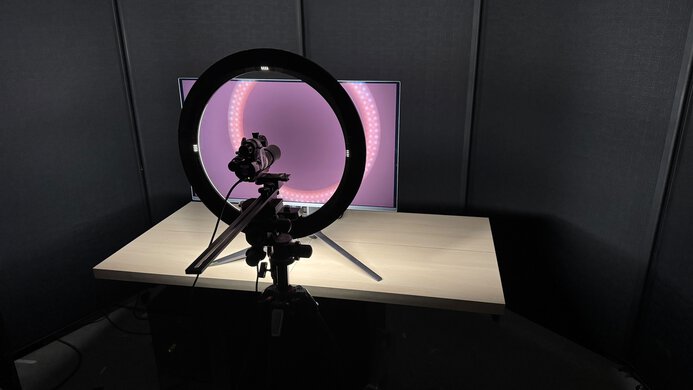
We buy and test more than 30 monitors each year, all of which we purchase ourselves, without cherry-picked units or samples. We put a lot into each unbiased, straight-to-the-point review, and there's a whole process from purchasing to publishing, involving multiple teams and people. We do more than just use the monitor for a week; we use specialized, custom tools to measure various aspects and deliver objective, data-driven results. We also consider multiple factors before making any recommendations, including the monitor's cost, its performance compared to the competition, and whether it's easy to find.
-
Best ASUS Monitor
 PC GamingConsole GamingOfficeEditingBrightnessResponse TimeHDR PictureSDR PictureColor AccuracySize27"Panel TypeOLEDSub-TypeQD-OLEDMax Refresh Rate240 HzSee all our test resultsNative Resolution3840 x 2160
The best ASUS monitor we've tested is the ASUS ROG Swift OLED PG27UCDM. It's a high-end 4k, 240Hz display that offers premium picture quality and gaming performance. This is because its QD-OLED panel has a near-instantaneous response time for sharp motion, and it even supports both DisplayPort and HDMI 2.1 bandwidth. This means it takes full advantage of a variety of devices, and it supports all common types of VRR, too. Plus, it's incredible for HDR gaming as it displays deep blacks in dark rooms with bright highlights and vivid colors.
It isn't the only QD-OLED from ASUS, though, as you can also get the larger ASUS ROG Swift OLED PG32UCDM. It performs similarly with most of the same features, but because the 27-inch PG27UCDM has higher pixel density, text and images look sharper. Its 240Hz refresh rate is good enough for most gamers, too, but if you want an even higher refresh rate, you can also check out the ASUS ROG Strix OLED XG32UCWMG. It's a 4k, 240Hz model that has a feature to switch to a 1080p resolution and 480Hz refresh rate for a smoother feel. It also maintains lower black levels in bright rooms than the PG27UCDM, but its colors aren't as vivid, and it lacks DisplayPort 2.1 bandwidth.
-
Best Upper Mid-Range ASUS Monitor
PC GamingConsole GamingOfficeEditingBrightnessResponse TimeHDR PictureSDR PictureColor AccuracySize27"Panel TypeOLEDSub-TypeQD-OLEDMax Refresh Rate360 HzSee all our test resultsNative Resolution2560 x 1440If the ASUS ROG Swift OLED PG27UCDM is too expensive, and you don't need its high 4k resolution, you can find the ASUS ROG Strix OLED XG27ACDNG for cheaper. It's different from the higher-end PG27UCDM in a few ways, as it has a lower 1440p resolution, so images aren't as detailed and sharp. However, the main advantage of getting this over the PG27UCDM is that it has a higher 360Hz refresh rate, which is great for competitive gaming, and it provides a smoother and more responsive feel.
While it doesn't have DisplayPort 2.1 bandwidth like the PG27UCDM, it at least has HDMI 2.1 bandwidth, which is great if you have an HDMI 2.1 graphics card or a gaming console. It supports any signal from a PS5 or Xbox Series X|S, but has to downscale 4k signals. Besides that, it's similar to the PG27UCDM as it's another QD-OLED with sharp motion, deep blacks in dark rooms, and a wide range of vivid colors. It also comes with a USB hub that includes a KVM switch and 90W of power delivery, which is ideal if you want to connect your gaming PC and a laptop to the monitor.
-
Best Mid-Range ASUS Monitor
PC GamingConsole GamingOfficeEditingBrightnessResponse TimeHDR PictureSDR PictureColor AccuracySize27"Panel TypeOLEDSub-TypeWOLEDMax Refresh Rate280 HzSee all our test resultsNative Resolution2560 x 1440Should you still think that the ASUS ROG Strix OLED XG27ACDNG is out of your price range or that you won't take advantage of its high refresh rate, then look into the ASUS ROG Strix OLED XG27AQWMG. You can often find it for less than the XG27ACDNG, but it's a step down in perks and performance. It has a lower 280Hz refresh rate, and while it's still good enough for most gamers, this is the trade-off for getting something cheaper. Though it still offers what you'd expect in an OLED gaming monitor, with sharp motion at any refresh rate.
In terms of picture quality, it displays the same deep blacks against bright highlights in dark rooms as the XG27ACDNG, but colors aren't as vivid. On the plus side, it gets bright enough to fight glare in well-lit rooms and make highlights pop thanks to its Tandem OLED panel. There are a few other differences versus the higher-end XG27ACDNG, though, as it lacks a USB-C port to quickly connect a laptop, but on the plus side, it supports the same HDMI 2.1 bandwidth for consoles and graphics cards.
-
Best Budget ASUS Monitor
PC GamingConsole GamingOfficeEditingBrightnessResponse TimeHDR PictureSDR PictureColor AccuracySize27"Panel TypeLCDSub-TypeIPSMax Refresh Rate180 HzSee all our test resultsNative Resolution2560 x 1440If you're looking for the best ASUS gaming monitor on a budget, they have a few good options you can choose from. One of those is the ASUS ROG Strix XG27ACS, which is a basic entry-level 1440p gaming monitor that's a good choice if you're building your first gaming setup. It doesn't have an OLED panel like the ASUS ROG Strix OLED XG27AQWMG. The picture quality is much worse, as blacks look gray, but that's what you have to expect for a low-cost display. It also has a lower 180Hz refresh rate, so gaming doesn't feel as smooth, but this refresh rate is still good enough for most gamers.
What makes it a great choice in this price category is that it has a consistently fast response time at any refresh rate and supports all common VRR formats. It even has a backlight strobing feature to reduce persistence blur, and you can use it at the same time as VRR across a wide refresh rate range, which is a nice touch for a budget-friendly monitor.
-
Best ASUS Work Monitor
PC GamingConsole GamingOfficeEditingBrightnessResponse TimeHDR PictureSDR PictureColor AccuracySize27"Panel TypeLCDSub-TypeIPSMax Refresh Rate60 HzSee all our test resultsNative Resolution3840 x 2160If you want an ASUS monitor for work, they have some great productivity options in their ProArt lineup, like the ASUS ProArt Display PA279CRV. It's specifically designed for content creation and has various picture modes for different color spaces, from sRGB to Rec. 2020. It has fantastic accuracy before calibration, and it displays a wide range of colors, too. Its 4k resolution ensures text is very sharp and your videos and photos look detailed. You can also check out the 5k ASUS ProArt Display PA27JCV and the ASUS ProArt Display 6K PA32QCV if you want higher-resolution options, but they cost more.
The PA279CRV offers good value because it also has additional features to help keep you productive. This includes a large USB hub you can use to connect various devices, and a USB-C port with DisplayPort Alt Mode with 90W of power delivery, which is ideal if you want to connect your laptop. If you don't need a high-end monitor, there are other budget-friendly models in the ProArt lineup, like the ASUS ProArt Display PA278CV, which has some useful features like a USB-C port and 65W of power delivery, but it has a lower 1440p resolution.













Compared To Other Brands
-
Fantastic gaming performance.
Many of ASUS's monitors focus on gaming, particularly their ROG and TUF Gaming lineups. These generally offer fantastic gaming performance with smooth motion handling. Some even have useful perks, like DisplayPort 2.1 and Dolby Vision.
-
Productivity features.
Some high-end options have added work-friendly perks like KVM switches and high power delivery over USB-C. Most of their productivity models have these features, too.
-
Options with high refresh rates.
ASUS has a good amount of options with high refresh rates, ideal for competitive gaming. Some high-end OLED displays even have dual-mode features that boost the refresh rate with a lower resolution, so they're versatile for different types of gamers.
-
Limited Mini LED options.
While other brands are releasing monitors with Mini LED backlighting, ASUS has only a few options with Mini LED backlighting, like the ROG Swift PG32UQX and the PG32UQXE.
-
Tend to be costly.
Their high-end options, like those from the ROG Swift lineup, tend to be more costly than the competition.
ASUS vs Dell
Dell and ASUS make a wide range of monitors, including high-end gaming monitors and monitors for work or content creation, so you can find a monitor that fits most needs with either company. That said, Dell tends to offer more work-oriented displays, especially at a lower cost. On the other hand, ASUS has more options with high refresh rates for competitive gamers.
ASUS vs Samsung
Samsung and ASUS are competing brands that both offer a range of gaming and productivity monitors. ASUS' high-end gaming monitors have added productivity features, like KVM switches. Some Samsung models offer other types of extra features, like integrated smart TV apps. While they both make OLEDs, Samsung also has more Mini LED gaming monitors, which are great options if you want enhanced HDR performance without getting an OLED.
ASUS is one of the most well-known monitor manufacturers, offering a wide range of options, from budget models to feature-rich gaming options. They offer a good selection for competitive gamers with high refresh rates, including models with dual modes. They also have work-focused monitors, and some of their high-end options have productivity features like KVM switches and high-power delivery over USB-C. While they make some fantastic gaming displays and usually offer the best performance in the market, a few of their monitors cost more than the competition.
Lineup
ASUS makes a lot of monitors, and they generally fall into the following lineups:
- Republic Of Gamers (ROG): This is ASUS's premium gaming lineup aimed at gamers who want the best experience, including high refresh rates and extra features. Within this lineup, there are premium ROG Swift and lower-end ROG Strix models.
- TUF Gaming: These monitors are more budget-friendly alternatives to ROG monitors, but you can still find them with various refresh rates and resolutions.
- ProArt: This lineup includes a variety of monitors aimed at content creators. It includes basic 1440p work monitors and even high-end OLED displays.
ASUS also has a few other smaller lineups, like the Eye Care, Touch, ZenScreen, and Business lineups. Like other brands, ASUS's naming scheme can be complex, but the model code generally includes info about the lineup, size, and resolution. Regardless, if you're looking at an ASUS monitor, it's best to read the full specs to know its features, refresh rate, and resolution.
2026 Models
ASUS announced new models set to be released in 2026, including new top-of-the-line models. This includes the ASUS ROG Swift OLED PG32UCDM Gen 3, which is another 4k, 240Hz QD-OLED that's different from previous-generation models because it uses the new BlackShield Film layer that's advertised to lower black levels in bright rooms. Other newly announced models are advertised as having new RGB Stripe OLED technology, which is meant to improve text clarity compared to other OLEDs. These new models include the PG27UCWM, which is a 27-inch, 4k, 240Hz WOLED, and the PG34WCDN and the XG34WCDMS, which are both ultrawide QD-OLEDs.
If you want us to buy and test these new models, you can vote for them, and if they're popular enough, we'll buy and test them.
Recent Updates
Apr 16, 2026:
We replaced the ASUS ROG Strix OLED XG27AQDMG with the newer ASUS ROG Strix OLED XG27AQWMG as the 'Best Mid-Range ASUS Monitor.'
Jan 20, 2026:
We added mentions of newer models throughout, including a new section regarding ASUS's 2026 lineup.
Apr 23, 2025:
We replaced the ASUS ROG Swift OLED PG32UCDP with the ASUS ROG Swift OLED PG27UCDM to better represent the current market.
Feb 19, 2025:
We added the ASUS ROG Strix OLED XG27ACDNG as the 'Best Upper Mid-Range Monitor' and removed the ASUS ROG Swift OLED PG34WCDM as the 'Best Ultrawide Monitor' to be better representative of ASUS' lineup. We introduced a new format to the article and updated the text to reflect these changes.
Jan 22, 2025:
We replaced the ASUS ROG Swift OLED PG32UCDM with the ASUS ROG Swift OLED PG32UCDP as it's a higher-end model.
Conclusion
ASUS makes a wide range of monitors, and their biggest strength is their gaming models. Many have high refresh rates for competitive gaming and sharp motion handling. Some of their high-end gaming models even include productivity-focused features, but they have more dedicated work monitors in their ProArt lineup. While they make some of the best gaming displays, their models cost more than the competition, so their improved performance comes at a price premium.