
If you're looking for a new TV to pair with your console or gaming PC, there are certain features to look for. Modern consoles such as the Series X|S, PS5, and Switch 2 all offer up to 120 fps gaming, so you'll want a TV that offers a 120Hz refresh rate or even higher if you're using a gaming PC. A high refresh rate also goes hand-in-hand with VRR, which can come in the form of G-SYNC, FreeSync, or HDMI Forum VRR, and allows a TV to dynamically adjust its refresh rate to match the game's frame rate to help eliminate screen-tearing. If you want the clearest motion possible, a TV with a fast response time is very important. For gaming to feel snappy and responsive, you'll also want a television that offers low input lag. These are the main performance-related aspects to consider, but a TV's picture quality is also crucial for an immersive gaming experience.
Through our rigorous testing procedure, we can determine which TVs simultaneously provide excellent performance and image quality, depending on your budget. This article takes a wide approach to gaming, considering all aspects without a specific console or type of game in mind. If you're looking for the best TVs for a specific console, check out our picks for the best PS5 TVs, the best TVs for Xbox Series X, or the best TVs for the Switch 2. If you're looking for an even bigger screen than a TV can give you, check out our picks for the best projectors for gaming. You can also vote on which TVs you want us to buy and test. To learn about all of the newest models on the market, visit our 2026 TV lineup page.

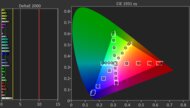
We buy and test dozens of TVs yearly, taking an objective, data-driven approach to deliver results you can trust. Our testing process is complex, with hundreds of individual tests that take over a week to complete. Most of our tests use specially designed test patterns that mimic real content, but we also use the same sources you have at home to ensure our results match the real-world experience. We use two main tools for our testing: a Colorimetry Research CR-100 colorimeter and a CR-250 spectroradiometer.
-
Best Gaming TV
 Mixed UsageHome TheaterBright RoomSportsGamingBrightnessBlack LevelColorMotion HandlingGame Mode ResponsivenessProcessing (In Development)Resolution:4kNative Refresh Rate:165HzScreen Finish:MattePanel Type:OLEDSub-Type:QD-OLEDDolby Vision:NoSee all our test resultsSizes:55" 65" 77" 83"
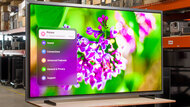
If you want the best of the best with almost no compromises, the best gaming TV we've tested overall, and the best OLED TV for gaming that we've tested is the Samsung S95H OLED. This QD-OLED offers incredibly bright and vibrant colors in combination with inky blacks, so your games look incredibly punchy. Furthermore, HDR games look fantastic since bright areas really pop out, leading to an immersive experience. Blacks can look a bit gray when you're gaming in a very bright room, but the TV's matte screen coating essentially eliminates reflections, so you have no problem viewing the action on your screen.
The TV is also equipped with pretty much every gaming feature you can ask for. It has four HDMI 2.1 ports that support up to 4k @ 165Hz, and it supports FreeSync, G-SYNC, and HDMI Forum VRR, so it offers a nearly tear-free gaming experience regardless of the console or PC you play on. Motion is crystal clear, and input lag is kept to a minimum, so gaming feels very responsive. The only minor downside is that it doesn't support Dolby Vision for Xbox gamers, but since the vast majority of Xbox games don't natively support Dolby Vision and you really don't need it on a TV this good, it's not a big deal at all.
-
Best Upper Mid-Range Gaming TV
Mixed UsageHome TheaterBright RoomSportsGamingBrightnessBlack LevelColorMotion HandlingGame Mode ResponsivenessProcessing (In Development)Resolution:4kNative Refresh Rate:165HzScreen Finish:GlossyPanel Type:OLEDSub-Type:WOLEDDolby Vision:YesSee all our test resultsSizes:42" 48" 55" 65"If you want an OLED but a flagship model like the Samsung S95H OLED is out of your price range, you can go with the LG C6 OLED 2026 and still get an amazing gaming TV. Colors aren't quite as vivid as they are on the Samsung, but they still look impressively vibrant, and you still get the same inky blacks, so games still look punchy. Some bright areas in HDR games don't pop out as much as they do on the Samsung, but they certainly don't look dim, so HDR games look great. Reflections are more of an issue on this model, especially if you have light sources facing the screen, but the TV's reflection handling and brightness are good enough for moderately lit spaces. An advantage this TV has over the Samsung is that blacks stay much deeper in a bright room, so you're not forced to sacrifice much image quality when you flip your lights on.
Even better is that the TV offers the same features as the more expensive Samsung, so you still get four HDMI 2.1 ports capable of up to 4k @ 165Hz. All three commonly used VRR formats are also supported, so screen tearing is a thing of the past, no matter what console or PC you own. Motion is crystal clear and input lag is very low, so gaming just feels snappy on this TV, whether you're playing a single-player RPG or a competitive PVP game. It even supports Dolby Vision for Xbox gamers who want to play in that HDR format. The C6 is available in sizes ranging from 42 to 65 inches. If you get the 77 or 83-inch model, you're actually getting the LG C6H OLED, which offers the same features but has more vivid colors and is noticeably brighter.
-
Best Lower Mid-Range Gaming TV
Mixed UsageHome TheaterBright RoomSportsGamingBrightnessBlack LevelColorMotion HandlingGame Mode ResponsivenessProcessing (In Development)Resolution:4kNative Refresh Rate:165HzScreen Finish:MattePanel Type:LCDSub-Type:VADolby Vision:YesSee all our test resultsSizes:55" 65" 75" 85" 100"If you want something cheaper than the LG C6 OLED 2026 and don't need the perfect blacks, check out the Hisense U7SG. You can still play games in a completely black room, but you'll see some haloing around bright details on a dark background. It also has a slower response time than the two OLEDs, so there's more motion blur in fast games. It's not too bad, though, and as long as you're not playing competitive esports, you probably won't have any issues with the level of motion blur. If you mainly play casual games or even faster action RPGs, you might not even notice it.
As far as gaming features go, it's even better than the top two picks. It has the same great connectivity, with four HDMI 2.1 ports that let you take full advantage of the latest consoles. Like the C6, it offers a fast 165Hz refresh rate for PC gamers, and it has VRR support to reduce tearing from any console that supports it. Unlike the C6, you can increase the refresh rate up to an impressive 330Hz by decreasing the resolution down to 1080p. It's a great choice for PC gamers looking for the smoothest motion possible who don't necessarily need the sharpest image.
-
Best Budget Gaming TV
Mixed UsageHome TheaterBright RoomSportsGamingBrightnessBlack LevelColorMotion HandlingGame Mode ResponsivenessProcessing (In Development)Resolution:4kNative Refresh Rate:144HzScreen Finish:GlossyPanel Type:LCDSub-Type:VADolby Vision:YesSee all our test resultsSizes:55" 65" 75" 85" 98"If the Hisense U7SG is a bit out of your price range, you don't lose a ton by going with the TCL QM6K instead. Blacks aren't as deep as they are on the Hisense, but its local dimming feature is still good enough for bold blacks in dark rooms and brighter spaces. Colors appear slightly muted compared to the U7SG, but they remain vibrant enough to please most gamers. The TV has good enough brightness to help overcome glare from indirect sources, such as overhead lights. Unfortunately, the TV's HDR is a bit too dim for bright areas to truly pop, so HDR games appear somewhat flat and underwhelming.
Fortunately, the TV's gaming performance is nearly on par with that of the more expensive Hisense. The amount of motion blur is essentially the same, input lag is low, and it supports VRR to reduce screen tearing. It supports 4k @ 144Hz and 1080p @ 288Hz for PC gaming, but unlike the top three picks, only two of its HDMI inputs support HDMI 2.1 bandwidth. If you just have one or two recent consoles, this isn't an issue, but it's not quite as versatile overall.
-
Best Cheap Gaming TV
Mixed UsageHome TheaterBright RoomSportsGamingBrightnessBlack LevelColorMotion HandlingGame Mode ResponsivenessProcessing (In Development)Resolution:4kNative Refresh Rate:60HzScreen Finish:GlossyPanel Type:LCDSub-Type:VADolby Vision:YesSee all our test resultsSizes:43" 50" 55" 65" 75" 85" 100"If you don't have a lot of money to spend and just need something that gets the job done, the Hisense QD6QF is a decent choice. In terms of picture quality, the TV is unremarkable. This is the only LED TV on our list that doesn't have local dimming, so blacks appear grayish, resulting in an image that looks somewhat flat. The TV can't display very bright colors or very dark ones, but since it still displays a wide range of colors, games don't look too muted. Unfortunately, it's too dim in HDR for bright areas to truly stand out, so HDR gaming is lackluster. The TV is just bright enough to use in a room with a few overhead lights on, and you may not be distracted by reflections, but visibility is an issue in bright rooms.
You won't find many modern gaming features on this model, but it still supports VRR to reduce screen tearing. The TV offers a 1440p @ 120Hz mode for those who prefer frames over resolution, but input lag is unusually high when you do that, so most people are best off sticking to 4k @ 60Hz for the most responsive experience. Fast motion is noticeably blurry, but it's not too bad for a cheap model, and motion blur isn't an issue in slower games. If you're an Xbox gamer, this model supports Dolby Vision, allowing you to play games in this HDR format. It's definitely not one of the best televisions you can buy, but it outperforms other cheap models and is a decent option for more casual gamers.



Notable Mentions
-
LG G6 OLED:
The LG G6 OLED shares many of the same features as the Samsung S95H OLED, like a 165Hz refresh rate.
It has very impressive colors, but it still doesn't match the level of vividness you get from the Samsung. The LG also doesn't do as good a job at reducing the intensity of reflections, making the Samsung the slightly better gaming TV overall.
See our review -
LG B6 OLED 2026:
The LG B6 OLED 2026 is a great alternative to the LG C6 OLED 2026. It offers a very similar gaming experience overall, but it's not quite as bright, so games aren't as vibrant. It's worth considering if you can find it at a great price, but it's usually so close in price to the C6 that most people are better off getting that model instead.
See our review -
Vizio Mini LED Quantum 4K:
The Walmart-exclusive Vizio Mini LED Quantum 4K is a cheap option that competes with the Hisense QD6QF. The Vizio has the edge in image quality, as it's brighter, delivers deeper blacks, and is a bit more colorful. However, the Hisense offers better gaming performance, since fast motion is clearer on it.
See our review
Recent Updates
Oct 01, 2026:
We removed the TCL QM7K and replaced it with the Hisense U7SG, as it's better than the QM7K and more widely available. We also removed the LG B5 OLED entirely, as it's outdated, and the new LG B6 OLED 2026 is too similar to the LG C6 OLED 2026.
Jul 29, 2026:
We added the Vizio Mini LED Quantum 4K to the Notable Mentions section to offer another option for those looking for a cheap TV.
Jun 11, 2026:
We replaced the Samsung S95F OLED with the Samsung S95H OLED as our top pick since the former is no longer available. We also replaced the Samsung S90F OLED with the LG C6 OLED 2026 in the 'Best Upper Mid-Range Gaming TV' category because the LG is the better option. Additionally, we refreshed the picks in the Notable Mentions section to better reflect the current market.
Mar 17, 2026:
We rewrote the introduction and revised the text throughout the article for clarity.
Dec 16, 2025:
We confirmed the accuracy and availability of our picks.
All Reviews
Our recommendations are based on what we think is the best 4k TV for gaming, depending on your budget and needs. They are adapted to be valid for most people in each price range. The rating is based on our review, factoring in price and feedback from our visitors. If you would prefer to make your own decision, here is a list of our TV reviews from the past few years. Be careful not to get too caught up in the details. Most TVs are good enough to please most people, and some of the things we fault TVs for are often not noticeable unless you really look for them.


