
Whether you're looking at a TV, monitor, or even your phone, resolution is one of the first metrics you'll see listed. But what is the resolution? In the context of a display, it's the number of pixels that the display can show at once. A higher resolution display allows you to see more fine details in your favorite games or content, assuming you're close enough to actually see the difference. While resolution isn't the only aspect of picture quality, it's important, and most people can easily notice and appreciate the difference between a high-resolution TV and a low-resolution one, especially when sitting up close.
It's a physical attribute of the display itself, so every display, whether it's a TV, monitor, your smart watch, or even the infotainment screen in your car, has exactly one native resolution. A display's resolution on its own doesn't matter all that much, but when you combine it with the size of the display and how close you are to it, it's a strong indicator of how clear the image will be. In this article, we'll break down the common resolutions you'll find in the TV market and talk about how they impact your viewing experience. You can also read about the resolution and size of monitors.
What Is The Resolution?
A TV's resolution is defined by the number of horizontal and vertical pixels. The vast majority of TVs available on the market in 2026 have a 4k resolution, but what does 4k mean on a TV? For 1080p TVs and lower, the resolution refers to the number of vertical pixels, while 4k and 8k TVs mean they have nearly 4,000 and 8,000 horizontal pixels, respectively. You can see the differences between each resolution and its marketing name below.
| Name | Other Names | Horizontal Pixels | Vertical Pixels | Total Pixels | TV Availability In 2026 | Common Media |
|---|---|---|---|---|---|---|
| 480p | Standard | 720 | 480 | 345,600 | None |
|
| 720p | HD HD Ready |
1280 | 720 | 869,760 | Very rare |
|
| 1080p | Full HD FHD |
1920 | 1080 | 2 million+ | Rare |
|
| 4k | 2160p Ultra HD UHD |
3840 | 2160 | 8 million+ | Very common |
|
| 8k | 4320p 8k UHD |
7680 | 4320 | 33 million+ | Uncommon |
|
There are still a few smaller TVs available in 20-32 inch sizes that have a 720p or 1080p resolution, but these are increasingly rare. Manufacturers have started offering those sizes with 4k resolution instead, and many monitors are available with high-resolution screens and built-in smart features, blurring the market for those sizes.
On the other end of the resolution spectrum, 8k TVs have been around for a few years, but in 2026, they're mostly abandoned by manufacturers (for now). 8k TVs will likely make a comeback in a few years, as content and scaling technology improve, but for now, they're mostly not worth buying.
Common Media Resolutions
While the resolution of your display is very important, the resolution of the media matters, too. Unlike TVs, which are almost all 4k these days, media is available in a wide range of resolutions depending on the source and age of the content. Most streaming content is either 1080p or 4k, depending on the specific package you choose, but the content itself will often be some variation of those main formats, depending on the age of the content and the aspect ratio the director chose.
The good news is, you usually don't have to worry about the specific resolution of the content you're watching. While the resolution impacts the quality of the image you see on your screen, your TV handles the conversion process automatically. It'll scale the content to fit the area of the screen, through a process called upscaling.
Why TV Resolution Matters
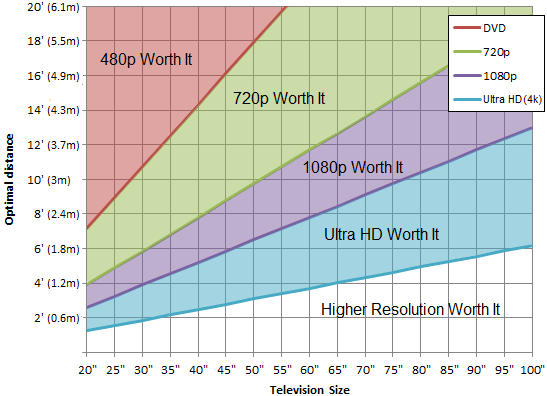
You might be wondering if TV resolution even matters. Since most modern TVs have a 4k resolution, you don't really have a choice but to get a 4k TV. Size and viewing distance have a factor in whether it's worth getting a high-resolution TV. As you can see in the TV resolution chart above, a higher-resolution TV is only worth it if you sit close or if you have a large screen. Someone with perfect vision can't tell the difference between a 65-inch 1080p and a 4k TV when sitting 10 feet away; only at 8 feet and closer, you start to notice the finer details on a 4k TV. The same can be said about an 8k vs 4k TV: you only start to notice the true difference on a 65-inch model if you sit within 4 feet of it, which is very close to the screen.
However, as mentioned before, 4k TVs are the most common on the market, so you don't really have an option if you need to buy a new TV. There are a few 8k TVs available, but as you can see above, unless you're sitting really close to the screen, they're usually not worth buying. Learn more about the difference between 4k and 8k.
Conclusion
A TV's resolution defines how many pixels there are. For the most part, a higher resolution is better, but it doesn't mean a higher-resolution TV is better than a lower-resolution one; it just means you can see more detail. If you watch TV from a far distance, you may not notice the difference between a 1080p and 4k TV, or a 4k and 8k TV, but those differences are easier to see if you sit up close. If you're buying a new TV in 2021, chances are that you'll be getting a 4k model, but unless you watch native 4k content from streaming platforms or Ultra HD Blu-ray players, you're likely watching lower resolution content, as the majority of sources are still 1080p and lower.