
Samsung releases a fair share of new models every year, so if you find yourself searching the internet for the best Samsung televisions, you might become overwhelmed by the number of options. Samsung releases many different TVs every year, including everything from budget LED models to high-end OLEDs. Generally speaking, their budget models tend to be a bit overpriced and don't offer the best performance for the price, but Samsung releases several mid-range and high-end options that perform excellently. Their best TVs tend to be either QLEDs or OLEDs, and choosing between the two technologies really depends on your viewing environment and use case.
We buy and test dozens of TVs each year, and we've reviewed over 145 Samsung TVs, so we can help narrow down your options to find the best Samsung television for your needs and budget. Below are our recommendations for the best Samsung televisions. You can also vote on which Samsung TVs you want us to buy and test.
Updates
- 02/12/2026Samsung QN70F reviewed
- 01/21/2026Samsung U7900F reviewed
- 11/25/2025Samsung 100QN80F reviewed
- 10/31/2025Samsung Q8F 2025 reviewed
- 09/24/2025Samsung DU8000 updated

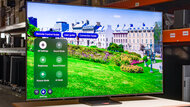
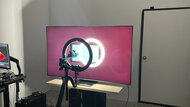
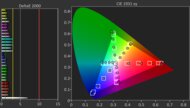
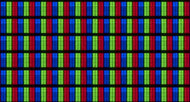
We buy and test dozens of TVs yearly, taking an objective, data-driven approach to deliver results you can trust. Our testing process is complex, with hundreds of individual tests that take over a week to complete. Most of our tests use specially designed test patterns that mimic real content, but we also use the same sources you have at home to ensure our results match the real-world experience. We use two main tools for our testing: a Colorimetry Research CR-100 colorimeter and a CR-250 spectroradiometer.
-
Best Samsung TV
 Mixed UsageHome TheaterBright RoomSportsGamingBrightnessBlack LevelColorMotion HandlingGame Mode ResponsivenessProcessing (In Development)Resolution:4kNative Refresh Rate:165HzScreen Finish:MattePanel Type:OLEDSub-Type:QD-OLEDDolby Vision:NoSee all our test resultsSizes:55" 65" 77" 83"
The Samsung S95F OLED is the best Samsung TV. Like any OLED, you get unrivaled black levels, so blacks are deep and inky in a dark room. Since it uses a QD-OLED panel, you also get incredibly bright and vibrant colors that can't be matched by traditional WOLED displays. A lot of OLED models don't fare well in bright rooms, but this TV is the only OLED on the market that features a matte screen coating. Reflections are almost invisible on this TV, so overhead lights and even direct light sources facing the screen are a non-factor. Combined with its amazing peak brightness, visibility isn't an issue at all on this TV. Another positive is that it has a very wide viewing angle, so it's great for group settings. It comes with Samsung's unique Slim One Connect Box, which gives you quick access to the inputs when the TV is wall-mounted and offers versatility for your setup.
The TV is also equipped with a plethora of modern gaming features like four HDMI 2.1 ports, 4k @ 165Hz, and VRR, making it a great option for pairing with modern consoles and gaming PCs. It also has nearly instant pixel transitions, so motion is crisp and clear. In addition to that, it has exceptionally low input lag for a responsive feel. Home theater enthusiasts may be put off by Samsung's lack of Dolby Vision and DTS audio passthrough, but if you can live without those features, the S95F is one of the best TVs on the market.
-
Best Upper Mid-Range Samsung TV
Mixed UsageHome TheaterBright RoomSportsGamingBrightnessBlack LevelColorMotion HandlingGame Mode ResponsivenessProcessing (In Development)Resolution:4kNative Refresh Rate:144HzScreen Finish:GlossyPanel Type:OLEDSub-Type:QD-OLEDDolby Vision:NoSee all our test resultsSizes:42" 48" 55" 65" 77" 83"What if you don't need the matte coating, the One Connect box, or 165Hz, and want to spend less? That's where the Samsung S90F OLED comes in, which is the best Samsung TV in the upper mid-range category. Being a QD-OLED, you still get the same inky blacks and similarly vibrant colors as its older sibling. You also get impressive HDR brightness, so HDR content is impactful. Unfortunately, the TV isn't nearly as bright in SDR as the S95F, and it's not nearly as good with reflection handling due to its glossy coating, so there are some visibility issues in bright rooms. Still, you can watch TV and not be distracted by glare in moderately lit rooms. You also get the same wide viewing angle as the more expensive model, making it great for large seating arrangements.
Despite not offering 165Hz support, you can still game in up to 4k @ 144Hz with VRR on any of its four HDMI 2.1 ports. The TV has the same nearly instant pixel transitions and low input lag, so you get a sharp and smooth gaming experience. Like any Samsung TV, it doesn't support Dolby Vision or DTS audio passthrough, but it still offers HDR10+. If you're considering this TV, just keep in mind that only some sizes have a QD-OLED panel, and even that varies by region.
-
Best Mid-Range Samsung TV
Mixed UsageHome TheaterBright RoomSportsGamingBrightnessBlack LevelColorMotion HandlingGame Mode ResponsivenessProcessing (In Development)Resolution:4kNative Refresh Rate:120HzScreen Finish:GlossyPanel Type:OLEDSub-Type:QD-OLEDDolby Vision:NoSee all our test resultsSizes:55" 65" 77" 83"If you want an OLED, but the two picks above are out of your price range, consider the Samsung S85F OLED. It's not as bright as the Samsung S90F OLED, and it caps out at 4k @ 120Hz, but outside of that, the two TVs are remarkably similar. You still get the inky blacks, vivid colors, wide viewing angle, and the nearly instant response times QD-OLEDs are known for. Even though the TV isn't as bright as its more expensive siblings, you can still watch SDR content in a room with a few lights on and not be distracted by reflections. There's a larger disparity in HDR brightness compared to the other two Samsung OLEDs, so highlights in dark scenes and entirely well-lit scenes don't pop out as much, but you still get a decently impactful HDR experience.
Some PC gamers might feel like they're missing out by not having a 144Hz refresh rate, but the TV still offers four HDMI 2.1 ports capable of 4k @ 120Hz with VRR, so the TV is fully compatible with the features offered by modern consoles. Unfortunately, like the S90F, there's a catch. In North America, only the 55-inch and 65-inch models use a QD-OLED panel, whereas the larger options utilize a normal WOLED panel. The rest of the world gets a WOLED panel throughout all size options. You can determine what type of panel it has by looking at the model code.
-
Best Lower Mid-Range Samsung TV
Mixed UsageHome TheaterBright RoomSportsGamingBrightnessBlack LevelColorMotion HandlingGame Mode ResponsivenessProcessing (In Development)Resolution:4kNative Refresh Rate:144HzScreen Finish:GlossyPanel Type:LCDSub-Type:VADolby Vision:NoSee all our test resultsSizes:55" 65" 75" 85" 100"If you want a Samsung TV, but the QD-OLEDs above are too expensive, the Samsung QN80F is the best lower mid-range Samsung TV. It's a lot brighter than the Samsung S85F OLED in SDR, so it overcomes more glare in a well-lit room. Although the Samsung has local dimming to help deepen blacks, you don't get anything close to the inky blacks you get from OLEDs, and there's haloing around highlights. It has about the same HDR brightness as the S85F, but since its contrast ratio is much lower and it doesn't display as wide a range of colors, HDR content doesn't look as good on it. The TV's viewing angle is pretty narrow, so it's not as good for wide seating arrangements as the OLEDs above.
Fortunately, it has HDMI 2.1 bandwidth, up to 4k @ 144Hz, and VRR, so it pairs excellently with modern gaming consoles. The TV's input lag is low on this model, but pixel response times are a lot slower than they are on OLEDs, so fast motion is a bit blurry. Like almost any Samsung model, it supports HDR10+, which helps HDR content look as good as it can on this model.
-
Best Budget Samsung TV
Mixed UsageHome TheaterBright RoomSportsGamingBrightnessBlack LevelColorMotion HandlingGame Mode ResponsivenessProcessing (In Development)Resolution:4kNative Refresh Rate:60HzScreen Finish:GlossyPanel Type:LCDSub-Type:VADolby Vision:NoSee all our test resultsSizes:43" 50" 55" 65" 75" 85" 98"The Samsung Q7F 2025 is the best budget Samsung TV available. Samsung doesn't release many budget models anymore, and the ones they do release tend to have mediocre image quality. That's the case here, as the Q7F doesn't have local dimming to help deepen blacks, which leads to dark scenes looking washed out. The TV is also too dim to handle much glare at all in a room with the lights on, so it's best suited for a dimly lit environment. Its lack of brightness also means that HDR content looks underwhelming, since highlights don't stand out like they should. Colors are also more muted on this TV, and the image lacks vibrancy. Like the Samsung QN80F, it has a narrow viewing angle, so it's best viewed from directly in front of the screen.
Unfortunately, this is a 60Hz TV that's pretty bare-bones in terms of gaming features. It doesn't have VRR to reduce screen tearing, and motion is blurry due to its slow pixel response times. However, 4k @ 60Hz gaming has decently low input lag, so at least gaming feels responsive. You still get HDR10+, which makes HDR content look a bit better, but that format doesn't save this TV from looking underwhelming. If you really want a budget Samsung TV, it's not the worst choice, but most people are better off shopping for a budget model from brands like TCL and Hisense.






Compared To Other Brands
-
Well-rounded.Samsung's high-end models are some of the best TVs we've tested. They don't excel in just one category; they're well-rounded and offer great performance for various uses.
-
Perform well in dark and bright environments.Their QLED TVs, especially those with VA panels, have high contrast and get bright, so they're good for dark and bright rooms.
-
Great gaming features.Samsung is a leader in gaming features, and even their mid-range models have variable refresh rate (VRR) and ALLM support.
-
Uniformity issues.Samsung models typically don't have the best gray uniformity and have some dirty screen effect, which could get distracting during sports or PC use.
-
TVs can be costly, and may not offer good value.Samsung's high-end TVs can get costly, so while they provide the best performance, they may not have the best value compared to other brands. There are often cheaper TVs that you can get with no compromises.
-
Few budget models.Although Samsung used to offer a wide range of budget models, in recent years, they've really scaled down their budget lineup. Their budget models typically aren't worth buying when you can get better picture quality and performance from companies like Hisense and TCL.
-
No Dolby Vision or DTS audio support.Although Samsung has their own dynamic HDR format in HDR10+, none of their TVs support the more widely used Dolby Vision format. They also don't include support for advanced DTS audio formats, which are prevalent in physical media.
Samsung vs Sony
Samsung TVs usually have more gaming features than Sony TVs, in particular, lower input lag and official 4k @ 144Hz on some models, and Samsung also has a bigger TV lineup. In comparison, Sony TVs are usually built a bit better, with mostly metal construction. They also tend to have better image processing and color accuracy, so they're better for home entertainment setups, especially as Sony typically supports Dolby Vision HDR and advanced DTS audio formats.
Samsung vs LG
Samsung TVs generally have better picture quality than the average LG LED-backlit TV. Samsung TVs usually get a fair bit brighter and have better contrast, while LG TVs generally have much wider viewing angles and better smart features. While LG was one of the first companies to offer OLED displays and has a few popular models to choose from, Samsung has caught up with their OLED offerings. They offer OLEDs that use the same WOLED panel found in LG's OLEDs, but they also offer QD-OLEDs, which produce brighter and more vibrant colors. LG OLEDs tend to have a bit more features than Samsung's, like support for Dolby Vision HDR. LG also has slightly better image processing than competing Samsung models. Learn more about the differences between Samsung and LG TVs.
Samsung vs Hisense
Hisense TVs have better value than Samsung TVs, as their TVs tend to be a fraction of the price for equal, and sometimes even better, performance. However, Hisense doesn't have any TVs to compete with Samsung's OLEDs, and their TVs tend to have bugs and quirks that Samsung's products don't have. Plus, Hisense TVs tend to have a narrow viewing angle, so they're not as well-suited for wide seating arrangements.
Samsung vs TCL
TCL TVs are a better value than Samsung TVs, as they offer comparable or better performance for a fraction of the price. Like with Hisense, TCL has no models to compete with Samsung's OLEDs. Learn more about TCL vs. Samsung TVs.
Samsung TVs provide performance suitable for most buyers, but they can also be costly compared to some competing brands. They generally perform very well and are among the best TVs on the market, especially if you want gaming features. However, competition is increasing, and Samsung LED TVs don't provide as much value as they previously did. On the other hand, their OLED TVs are some of the best on the market and compete with high-end LG OLED models.
2026 Samsung Lineup
Samsung announced some of its upcoming 2026 lineup at CES in early January 2026, but there aren't many details known about their full 2026 lineup at the time of publication of this article. We expect most of their lineup to be very similar to last year, with minor upgrades and improvements. Below is a table with all of Samsung's announced models for 2026. If you want to see a more detailed write-up about what to expect from them this year, and see how their lineup compares to the competition, check out our 2026 TV lineup page. We'll update the table below with more information as it becomes available.
| Model | Sizes | Panel Type | Advertised Zones | Refresh Rate | Notes |
|---|---|---|---|---|---|
| S99H | 48", 55", 65", 77", 83" | QD-OLED | N/A | 165Hz | 83" - WOLED, includes Wireless One Connect |
| S95H | 48", 55", 65", 77", 83" | QD-OLED | N/A | 165Hz | 83" - WOLED, Wireless One Connect available separately |
| S90H | 42", 48", 55", 65", 77", 83" | WOLED | N/A | 165Hz | |
| S85H | 48", 55", 65", 77", 83" | WOLED | N/A | 120Hz | |
| MR95H | 65", 75", 85", 130" | RGB LED | Unknown | Unknown | |
| MR90H | Unknown | RGB LED | Unknown | Unknown | |
| MR85H | Unknown | RGB LED | Unknown | Unknown | |
| QN80H | Unknown | LED | Unknown | Unknown | |
| QN70H | Unknown | LED | Unknown | Unknown |
Samsung's lineup largely falls into three lineups: their Crystal UHD TVs, QLED, and OLED. The Crystal UHD lineup is their entry-level series, featuring basic picture processing with no advanced features like local dimming, limited colors, and relatively low peak brightness. Their QLED lineup covers most of their mid and high-end TVs, and their OLED lineup consists of a few different OLED models with varying performance, covering a range of budgets. Read more about the differences between their Crystal UHD and QLED lineups.
Product Naming
Samsung's lineup covers everything from budget to high-end models. As a rule of thumb, the higher the number, the better it is, although sometimes the improvements aren't worth it. Samsung releases four main TV lineups, and they use a consistent naming scheme for the top three, making it very easy to understand what you're buying by looking at the model number.
Samsung uses the prefix 'Q' to denote its mid-range QLED models, and the last letter of each model also indicates the model year. They introduced the Mini LED lineup in 2021, denoted by the 'QN' prefix in the model name, such as the Samsung QN90D. Their entry-level models follow a slightly different naming structure in 2025, with a single 'Q' used to identify their lower-end options. For example, the Q7F is a normal LED model without features like local dimming.
Smart Features

Samsung uses their own smart OS, known as Tizen, across all of their TVs. It offers many smart features that make finding content to watch fast and easy. Tizen allows you to easily find popular apps, cast content from your phone, play content from a USB stick, and use your voice to control the TV. If you own other Samsung smart devices, Tizen integrates with Samsung's SmartThings ecosystem, allowing you to control your other devices through the TV. On top of that, Samsung's Gaming Hub allows you to play games directly on your TV using the included remote or a dedicated gaming controller.
You can read more detailed information on Samsung's Tizen OS and see how it stacks up against the competition.
Recent Updates
Mar 23, 2026:
We updated the Introduction, Smart Features, and Samsung Lineup sections.
Nov 19, 2025:
Replaced the Samsung Q80D with the Samsung QN80F in the 'Best Lower Mid-Range Samsung TV' category, and replaced the Samsung Q60D with the Samsung Q7F in the 'Best Budget Samsung TV' category.
Jun 27, 2025:
We replaced the Samsung S95D, S90D, and QN85D with the Samsung S95F, S90F, and S85F, respectively. We also updated the 2025 Samsung Lineup section and refreshed text throughout the article.
Jan 14, 2025:
Rewrote the Samsung Lineup section to include information on their 2025 models.
Oct 17, 2024:
Replaced the Samsung Q80C QLED with the Samsung Q80D QLED in the 'Best Lower Mid-Range Samsung TV' category. We also refreshed some text throughout for clarity.
Conclusion
Samsung, in general, makes very good TVs. Their budget options are a bit overpriced and don't perform as well as similarly priced models from some other brands, but their higher-end TVs are some of the best on the market. Their range has increased in price over the years, but most people will still find a TV that suits their needs. They're usually quite versatile and fit most uses. If you want more detailed information on their models, you can find a list of our recent Samsung TV reviews below. Also, keep in mind that our scores aren't comparable across different test benches, so most of the older Samsung TVs in the list below score higher than they would today.