
Portable air conditioners fill a much-needed role within the A/C market. They're a practical choice for anyone who needs a flexible, easy-to-move cooling solution who isn't able to have a more efficient permanent wall-mounted or window-based setup, and they're generally simple to install and store between seasons. The best portable air conditioners feature efficient dual-hose designs and quieter inverter-controlled compressors, while delivering quick, consistent cooling performance and added convenience features like programmable timers or app control. It's also important to pick a unit that's sized appropriately: an oversized A/C cools too fast to properly remove humidity, which can make a room feel clammy rather than cool and dry.
We've bought more than 20 air conditioners, subjected them all to the same rigorous testing methodology, and based our recommendations on that data, along with additional factors like price and availability. That said, if you'd rather do the work yourself, we've included a buyer's guide to help identify some of the main things to look out for when shopping for a new A/C.
If you're looking for an alternative and have the space and ability to install one, it's worth checking out our recommendations for the best window air conditioners, as they tend to be more efficient overall and can cool spaces more quickly and consistently than portable units. Alternatively, if you want a broader overview of the A/C market, see our recommendations for the best air conditioners, the best small room air conditioners, and the best air conditioners for bedrooms.

Behind all of our air conditioner recommendations are our product reviews. We buy our own air conditioners directly from major retailers and have our team rigorously test them in our lab. The result? Robust data on features you care about, like cooling capacity and inside noise, which you can then compare across the over 20 models we've tested.
If this sounds cool to you, you'll definitely want to read more in our About Us.
-
Best Portable Air Conditioner
 TypeDual-Hose Portable A/CLarge Room8.0Combined Efficiency7.7Oversizing Tolerance8.1Advertised Coverage600 ft² (56 m²)Advertised Capacity (DOE)12,000 BTU/hrSee all our test resultsCompressor TechnologyInverter
The best portable air conditioner we've tested is the Whynter NEX ARC-1230WN. This high-end unit has enough cooling power to handle even large open-concept living spaces all by itself. Despite that output, it runs impressively quietly, so it won't be overly intrusive in shared spaces or in rooms where you'd prefer peace and quiet, like a bedroom or nursery. It also packs in everything you could want from a portable A/C. It has built-in Wi-Fi, so you can control it or check the temperature at home remotely through a smartphone app. It also works with Google Home and Amazon Alexa so that you can adjust the temperature or fan speed with a voice command. On top of that, there's a dedicated dehumidification-only mode for humid days when you don't necessarily need cooling. Its two-in-one hose design is more compact than most dual-hose models, so it's easier to move between rooms since there's less need to wrestle with its hoses.
That being said, you still can't get around its size: it's a genuinely bulky appliance, so if floor space is tight, that's worth keeping in mind. That aside, it doesn't suffer from the same over-cooling issue that plagues cheaper A/Cs with fixed-speed compressors. The Whynter's inverter compressor can run at a lower speed instead of cycling on and off when maintaining your desired temperature, which gives it enough time to properly dehumidify the air as it cools. The result is a room that feels comfortably cool and dry rather than cold and clammy. If you're dealing with a large, humid space and want a portable unit that can actually keep up, the Whynter is about as good as it gets.
-
Best Upper Mid-Range Portable Air Conditioner
TypeDual-Hose Portable A/CLarge Room8.3Efficiency7.5Stability9.5Advertised Coverage550 ft² (51 m²)Advertised Capacity (DOE)10,000 BTU/hrSee all our test resultsCompressor TechnologyInverterIf you have a smaller space and don't need the sheer cooling capacity of the Whynter NEX ARC-1230WN, the Midea Duo MAP12S1TBL is a slightly more affordable option with a similar feature set. It has a slightly lower overall capacity, so it won't cool spaces as quickly as the more potent Whynter. For smaller apartments or medium-sized living spaces, though, it's more than capable and unlikely to leave you wanting more. That aside, the two units are actually nearly identical under the hood: they share the same digital interface, and Whynter's companion app is effectively a reskinned version of Midea's smartphone app. It also shares the same space-saving two-in-one hose design.
The Midea also has an inverter compressor, which allows for relatively efficient operation with minimal swings in temperature or humidity while maintaining your desired setpoint, which is particularly useful in humid climates where keeping moisture levels stable matters as much as the temperature itself. It's also quiet enough to leave running in the background while you're watching TV or trying to sleep.
-
Best Mid-Range Portable Air Conditioner
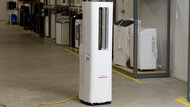
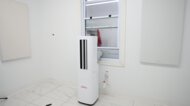
TypeDual-Hose Portable A/CLarge Room7.6Efficiency7.3Stability7.7Advertised Coverage350 ft² (33 m²)Advertised Capacity (DOE)8,000 BTU/hrSee all our test resultsCompressor TechnologyInverterThe Hisense Tower HIAP0825TWD is worth a look if you're shopping at a mid-range price point and want something that takes up a little less space, and don't mind a slight step down in terms of performance. Compared to the pricier Midea Duo MAP12S1TBL, its cooling capacity is a little lower, so it'll take longer to bring an equivalently sized space to the same temperature. That said, the Hisense's performance is still sufficient for most offices and smaller apartments. Its tower-like design gives it a more compact footprint than other, more conventionally shaped A/Cs, though it's still worth noting that this is a very tall unit, at a little over four feet in height.
Its inverter-controlled compressor runs quietly too, especially at lower fan speeds, and it won't be a nuisance even in home offices and bedrooms. Unfortunately, availability from most retailers is also highly region-specific.
-
Best Budget Portable Air Conditioner
TypeSingle-Hose Portable A/CLarge Room5.2Efficiency4.3Stability7.8Advertised Coverage215 ft² (20 m²)Advertised Capacity (DOE)4,000 BTU/hrSee all our test resultsCompressor TechnologyNon-InverterIf you're on a tight budget and only need to cool a small space, the SereneLife SLPAC8 could be right for you. With a tested capacity of under 3,000 BTU/hr, it's best suited for a tighter dorm room or home office than larger areas, and it'll take much longer to cool a comparably sized room than the more powerful Hisense Tower HIAP0825TWD. On the upside, for a unit this basic, it's a welcome surprise how feature-rich it is: there's a remote control so you can adjust settings without getting up, a dedicated dehumidification mode for humid days when you don't necessarily need full cooling, and a digital thermostat for precise temperature control, though there's no Wi-Fi connectivity or associated companion app.
The main drawback of this unit is its noise: compared to the Hisense, which is whisper-quiet at lower fan speed settings, the SereneLife can become a genuine nuisance in areas where you'd prefer some peace and quiet, like a bedroom or nursery. It occasionally produces brief bursts of noise exceeding 78 dBA, which is roughly on par with a vacuum cleaner and loud enough to interrupt a conversation or pull your attention away from what you're watching. Its single-hose design also forces it to work harder than more powerful dual-hose units like the Hisense, which takes a toll on efficiency. That being said, if noise isn't a dealbreaker for you and you just need something basic to cool a small space on a budget, it gets the job done.








Notable Mentions
-
LG DUAL Inverter LP1419IVSM:
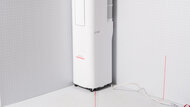
The LG DUAL Inverter LP1419IVSM is a high-end portable A/C unit designed for medium- to large-sized spaces. It features a somewhat unique dual inverter compressor cooling system. Unfortunately, this unit is hamstrung by its single-hose design, which results in higher energy consumption than the Whynter NEX ARC-1230WN.
See our review -
Whynter NEX ARC-1030WN:
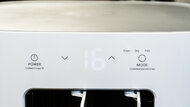
The Whynter NEX ARC-1030WN is a portable A/C with an advertised 10,000 BTU/hr cooling capacity. It's mechanically identical to the Midea Duo MAP12S1TBL, as Whynter is a Midea subsidiary, and delivers near-identical performance as a result. If one unit is a good fit for your circumstances, pick whichever is cheaper in your region.
See our review
Recent Updates
Sep 16, 2026:
We've updated the text of this article to reflect the new performance data collected during version 1.1 of our air conditioner test bench. We've also ensured all our main picks are still available and represent the best fit for user needs.
Aug 13, 2026:
We've made slight adjustments to the text of this article to better outline the strengths and weaknesses of portable units as a whole and to ensure all our main picks are still available.
Jun 23, 2026:
We've replaced the LG LP0721WSR with the Hisense Tower HIAP0825TWD as the 'Best Mid-Range Portable Air Conditioner' pick due to the latter's superior overall performance. We've also added the Whynter NEX ARC-1030WN to the Notable Mentions section and a Buyer's Guide to help you determine what to look out for when buying a new portable A/C.
Apr 30, 2026:
We ensured all main picks remain available and improved text clarity by providing better context for user needs and features.
Mar 31, 2026:
Recategorized the Midea Duo MAP12S1TBL as the 'Best Upper Mid-Range Portable Air Conditioner' pick, and added the LG LP0721WSR as the 'Best Mid-Range Portable Air Conditioner'. Removed the Hisense HAP0824TWD from the Notable Mentions due to current availability.
What To Consider When Choosing A Portable A/C
There are a few main factors to consider when shopping for a new portable A/C unit. Here are some of the key considerations to take into account:
Dual-Hose VS. Single-Hose Designs
Portable A/Cs typically come in one of two flavors, which are meant to cater to different sections of the market.
-
Single-Hose Portable Units
- Generally found on cheaper, lower-end units.
- Inefficient overall design:
- Single-hose models intake indoor air to cool the hot compressor, generating negative air pressure and dragging warm air from outside, which forces the unit to offset that additional load.
- Take up less room than dual-hose units, especially when not in use.
-
Dual-Hose Portable Units
- Typically found on mid-range and higher-end models.
- Far more efficient than single-hose units, as they have a separate intake hose to draw in outdoor air to cool the compressor. As a result, warm outdoor air isn't being sucked into the cooled space.
- Take up a lot of room, though some newer models feature two-in-one hoses to minimize bulk.
Compressor TYpe
-
Inverter Compressors
- Generally found on more expensive models.
- Run consistently at whatever speed is required to match the required load.
- Introduces a higher number of potential failure points.
-
Fixed-Speed Compressors
- Depending on the unit's capacity, they can have trouble maintaining consistent temperature and humidity levels since this style of compressor cycles on and off once the setpoint is reached.
- More common on cheaper models.
- Lack of an inverter control board reduces potential failure points.
Capacity
Depending on the size of the room you're trying to cool, you'll want to aim for a certain level of capacity, so you don't overpay for an oversized model or purchase an underpowered model that can't keep up with the required demand.
-
5,000 BTU/hr
- Generally suitable for rooms up to 150 ft² (13.9 m²)
-
8,000 BTU/hr
- Generally suitable for rooms up to 350 ft² (32.5 m²)
-
10,000 BTU/hr and higher
- Generally suitable for rooms up to and larger than 450 ft² (41.8 m²)
Properly sizing an A/C is especially important for A/Cs with a fixed-speed compressor. Since units of this type need to cycle on and off to maintain the setpoint, an oversized unit will do so too slowly, so temperature and humidity levels rise before dropping once the compressor kicks back on. As a result, conditions in your room won't feel especially consistent. This issue doesn't affect A/Cs with inverter compressors nearly as much, as they can lower their compressor speed to match the required load, so you can buy a unit with more capacity than needed. That said, there is a line in the sand here: a 15,000 BTU/hr inverter unit used in a small space and forced to operate constantly at its lowest operating range simply won't be as efficient as a 5,000 BTU/hr inverter unit that's a better match for the space.
Noise
Here are a couple of examples of different noise levels that cover the vast majority of household A/Cs, and what they can generally be compared to:
- ≥ 60 dBA
- The threshold most people would have for an A/C to be considered "noisy". Examples of things that produce a similar level of noise are typing on an office keyboard or nearby conversation at a normal volume.
- 50 dBA
- Within the general range of quiet conversation or moderate to strong rainfall.
- 40 dBA and below
- What people typically consider "quiet." Generally, the range of most household appliances, like a refrigerator or dishwasher.
Inverter compressors tend to produce a high-pitched chattering sound when entering a cooling cycle, which is a relatively infrequent but sometimes distracting sound. Conversely, fixed-speed compressors regularly cycle on and off to maintain your desired temperature, resulting in a more frequent, but potentially less noisy, sound overall. Since portable A/Cs have their compressors inside the room being cooled, this operating noise can be more distracting than it is for an equivalent window-mounted A/C.
All Reviews
Our recommendations above are some of the best portable A/Cs for most people. We factor in the price, feedback from our visitors, and availability.
That said, there's no single best option that'll suit everybody; your needs will depend on your budget, the size of the space you're trying to cool, your tolerance for operating noise, and whether you like having a device with convenience features like Wi-Fi connectivity. If you'd like to choose for yourself, here's the list of all our portable A/C reviews.