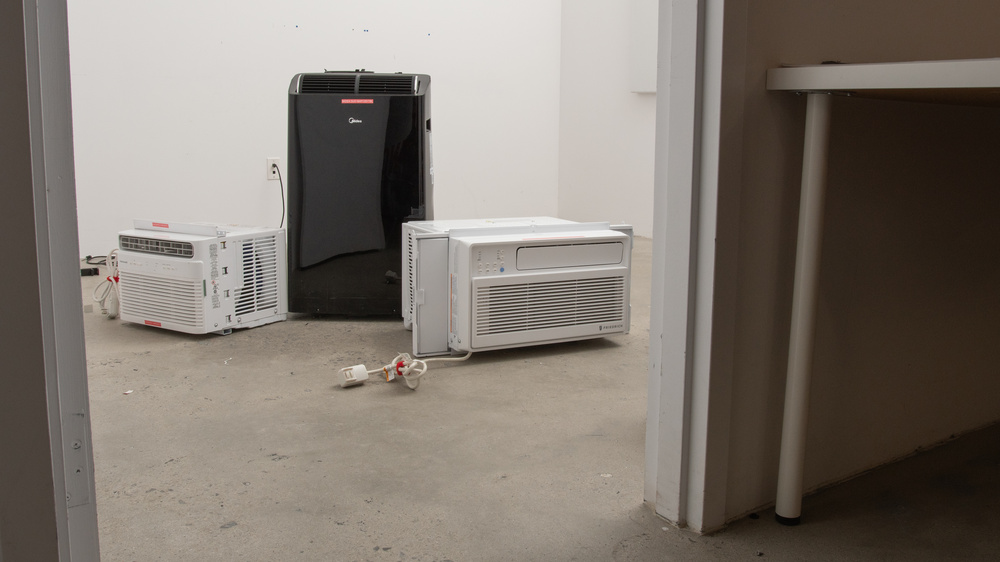
Shopping for an air conditioner for a small room, like a home office, bedroom, nursery, or even a dorm room, presents unique challenges. You need a unit that can cool the space effectively without being excessively powerful, noisy, or difficult to fit into the room.
We've bought and tested over 20 air conditioners, and below are our recommendations for the best options for small rooms. Using our lab testing and scoring, here's a quick guide to what matters most:
- Capacity: Look for a capacity of around 5,000 BTU/hr for rooms up to 150 ft², and 8,000 BTU/hr for up to 350 ft². Inverter models are more expensive, but are also more efficient since they can adjust their output as cooling demands change.
- Size: Window units keep your floor clear but can block some natural light and are more of a hassle to install, while portable models preserve more of your window but take up valuable floor space.
- Noise: Noise can be especially noticeable in a small room where you're working, dining, or otherwise spending time close to the A/C. Inverter compressors can produce a high-pitched chatter, while fixed-speed models cycle on and off more frequently.
For a more detailed breakdown of capacity, compressor types, A/C designs, and noise, see our buying guide below. If you're shopping for alternatives, see our recommendations for the best bedroom air conditioners, the best window air conditioners, and the best air conditioners.

Behind all of our air conditioner recommendations are our product reviews. We buy our own air conditioners directly from major retailers and have our team rigorously test them in our lab. The result? Robust data on features you care about, like cooling capacity and inside noise, which you can then compare across the over 20 models we've tested.
If this sounds cool to you, you'll definitely want to read more in our About Us.
-
Best Air Conditioner For Small Rooms
 TypeDual-Hose Portable A/CCompressor TechnologyInverterBedroom/Small Room8.0Efficiency7.5Advertised Capacity (DOE)10,000 BTU/hrTested Capacity6,691 BTU/hr (1,962 W)Advertised Coverage550 ft² (51 m²)Compressor On @ Max Setting60.0dBASee all our test resultsCompressor On @ Min. Setting50.4dBA
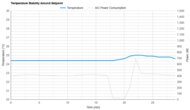
The Midea Duo MAP12S1TBL is the best air conditioner for small rooms we've tested. It has enough cooling power to quickly bring down the temperature in spaces like offices, dens, dorms, and gaming rooms, while its inverter compressor gives it the flexibility to ease off once the room gets close to your target temperature. Rather than cycling on and off, it holds a steadier temperature and humidity level, so the room never feels overcooled or clammy. On lower fan speeds, it's quiet enough to keep running while you work or rest nearby, and it's fully compatible with its smartphone app, so you can set your ideal temperature before you get home and walk into a comfortably cool room. Its window kit also takes up much less of the opening than a full window-mounted A/C, so you keep more natural light and a clearer view, which can matter in a smaller room that may already have fewer windows to begin with. Its portable design also makes it easier to use in rooms where installing a full window-mounted A/C simply isn't practical.
There are a few drawbacks worth considering, especially if your room is tight on usable floor space. The Midea itself is fairly bulky, so it may be hard to fit beside a larger desk, dresser, or other furniture. It can also get quite noisy at its highest fan speed, and its inverter compressor produces a high-pitched chatter that some people find distracting.
-
Best Upper Mid-Range Air Conditioner For Small Rooms
TypeWindow A/CCompressor TechnologyInverterBedroom/Small Room8.6Efficiency8.2Advertised Capacity (DOE)8,000 BTU/hrTested Capacity5,081 BTU/hr (1,490 W)Advertised Coverage350 ft² (33 m²)Compressor On @ Max Setting52.8dBASee all our test resultsCompressor On @ Min. Setting43.9dBAIf you can install a window unit and don't mind something that's a little slower to cool a room, consider the Friedrich Chill Premier Inverter CCV08A10A. While it offers less capacity than our top pick, the portable Midea Duo MAP12S1TBL, its window-mounted design makes it more power-efficient and keeps it from taking up valuable real estate in tighter spaces. Like the Midea, it also features an inverter compressor, which allows it to keep undersized areas consistently cool and dry, rather than clammy and damp, by running steadily at a speed that matches the required cooling load. It's impressively power-efficient for cooling your room and maintaining your desired temperature, and it stays fairly quiet from inside your home.
While this unit is a great performer in smaller spaces, it's physically rather large and heavy. It weighs over 50 lbs, which can make it a hassle to install and uninstall every summer, especially if you live alone. Its size can also make it awkward to store during the off-season, particularly if your storage space is just as limited as the room you're using it in. It also takes up a substantial portion of your window, blocking more of your view and natural light than the Midea. While operating noise is minimal within your living space, its compressor, which hangs outside your window, produces a high-pitched chatter when entering a cooling cycle, which can still be a disturbance for nearby neighbors if you live in an apartment.
-
Best Mid-Range Air Conditioner for Small Rooms
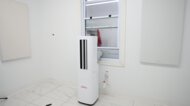
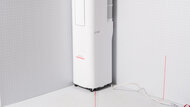
TypeDual-Hose Portable A/CCompressor TechnologyInverterBedroom/Small Room7.3Efficiency7.3Advertised Capacity (DOE)8,000 BTU/hrTested Capacity4,514 BTU/hr (1,324 W)Advertised Coverage350 ft² (33 m²)Compressor On @ Max Setting55.7dBASee all our test resultsCompressor On @ Min. Setting52.6dBANot every small room has space to spare, and the Hisense Tower HIAP0825TWD is built for the ones that don't. Its narrow, tower-style design leaves far more of the floor open than the Midea Duo MAP12S1TBL, so it tucks in nicely beside a desk, dining table, or dresser instead of eating into what little room you have. Only the window kit needs to sit in the opening, too, so you keep more daylight and a clearer view than you would with the Friedrich Chill Premier Inverter CCV08A10A. The compact build doesn't come at the cost of cooling power. It lags only slightly behind the Friedrich in this respect, and handles smaller offices, bedrooms, and dens without breaking a sweat. The inverter compressor keeps the room steady instead of swinging between blasts of cold air and long lulls. It's quiet enough to work beside in an office or run while you're hosting in a dining nook, and it also comes with app control, a remote, and a dedicated dehumidification mode.
That said, it isn't quite as efficient as the window-mounted Friedrich when it comes to maintaining your desired temperature, so its operating costs are higher. Its space-saving footprint comes at the expense of height, too. The Tower is also unusually tall, which can make it more awkward to store during the off-season if you don't have high clearance storage areas. Unfortunately, it's also worth noting that availability from most retailers is also highly region-specific.
-
Best Budget Air Conditioner For Small Rooms
TypeWindow A/CCompressor TechnologyNon-InverterBedroom/Small Room7.6Efficiency7.8Advertised Capacity (DOE)5,000 BTU/hrTested Capacity3,504 BTU/hr (1,028 W)Advertised Coverage150 ft² (14 m²)Compressor On @ Max Setting58.7dBASee all our test resultsCompressor On @ Min. Setting55.4dBAIf you want to spend less on an air conditioner for a smaller room and are in a situation that permits a window unit, check out the Frigidaire FHWC054TE1. Its cooling output is still enough to keep smaller spaces like offices and dorms consistently cool, though it'll be slower to cool an equivalently sized room than the Hisense Tower HIAP0825TWD. Despite using a fixed-speed compressor as opposed to a more efficient inverter-controlled component, it still cycles fast enough to keep the temperature and ambient humidity levels fairly steady. The sound of its compressor cycling on and off can also be distracting, though it isn't overly loud.
Extra features are few but welcome: if you live near a busy intersection or suffer from serious allergies, you can mount a MERV-14 filter to the unit to trap allergens before they're blown into your room. It also has an easy-to-set digital thermostat and a remote control, and it's easier to install if you live alone, as it's smaller and nearly 20 lbs lighter than more powerful window units like the
Friedrich Chill Premier Inverter CCV08A10A. As a window unit, it does take up part of the opening and can cut down on some natural light, but it leaves your floor completely clear, which can be especially useful in a makeshift home office where a desk and other furniture already take up most of the available space.








Notable Mentions
-
Midea U-Shaped MAW12V1QWT:
The Midea U-Shaped MAW12V1QWT is a high-end window A/C with an inverter compressor that can cool a room faster than the Friedrich Chill Premier Inverter CCV08A10A, thanks to its higher cooling capacity. However, it's also louder and will have a bigger impact on your monthly utility bill. Its unique U-shaped body allows you to open a window while it's in place.
See our review -
Midea MAW12HV1CWT:
The Midea MAW12HV1CWT is a high-end window A/C with an inverter compressor. It's mechanically similar to the Midea U-Shaped MAW12V1QWT but has a more conventionally shaped body. Compared to the Friedrich Chill Premier Inverter CCV08A10A, it can cool a small room faster, but it also consumes more power and makes more noise.
See our review -
Whynter NEX ARC-1230WN:
The Whynter NEX ARC-1230WN is a high-end dual-hose portable A/C. It's a rebranded, slightly modified variant of the Midea Duo MAP12S1TBL, but with a higher 12,000 BTU/hr capacity. While it cools slightly faster, it's also even bulkier and slightly noisier.
See our review -
Whynter NEX ARC-1030WN:
The Whynter NEX ARC-1030WN is a portable A/C with an advertised 10,000 BTU/hr cooling capacity. It's a re-branded version of the Midea Duo MAP12S1TBL and delivers near-identical performance. If either unit fits your needs, pick whichever is cheaper in your region.
See our review -
Frigidaire FFRA051WAE:
The Frigidaire FFRA051WAE offers similar cooling performance to the Frigidaire FHWC054TE1 and is also well-suited to small rooms. However, it has a more basic thermostat, no remote, and less stable humidity control.
See our review
Recent Updates
Sep 16, 2026:
We've replaced the LG LP0721WSR with the Frigidaire FHWC054TE1 as the 'Best Budget Air Conditioner For Small Rooms' pick due to current product pricing.
Aug 13, 2026:
We restructured the article and added the Hisense Tower HIAP0825TWD and LG LP0721WSR as new picks. We also refreshed the intro with a mini buyer's guide and added the Frigidaire FFRA051WAE to the Notable Mentions.
Jun 22, 2026:
We've ensured that all main picks remain available and continue to be the best fit for user needs. We've also added the Hisense Tower HIAP0825TWD and Whynter NEX ARC-1030WN to our Notable Mentions, and removed the Toshiba RAC-WK0512CMRU from the same section due to limited current availability.
What To Consider When Choosing A Small Room A/C
There are a few main factors to consider when shopping for a new A/C unit for a small room. Here are some of the key considerations to take into account:
Oversizing Tolerance
There are two main factors that determine whether an A/C can operate effectively in a small room: compressor type and capacity.
Compressor Type
-
Inverter Compressors
- A design aspect more common with higher-end A/Cs.
- Can run consistently at a lower speed instead of cycling on and off to maintain your desired temperature.
- This results in greater flexibility and allows the A/C to run efficiently in areas where it would otherwise be oversized, as the unit can cool as quickly as it dehumidifies, keeping rooms comfortably cool instead of clammy.
- Introduces a higher number of potential failure points.
-
Fixed-Speed Compressors
- Relatively inefficient and can result in inconsistent temperature and humidity levels since this style of compressor cycles on and off to maintain your desired temperature.
- Typically found on cheaper units.
- Lack of an inverter control board reduces potential failure points.
Capacity
If you do go for an air conditioner with a fixed-speed compressor, you'll want to pay close attention to its overall capacity. This is because fixed-speed compressors operate as their name suggests: they either run at full speed or not at all. If you purchase an A/C with too much capacity for a given space, it will cool a room faster than it can dehumidify it, rendering the space cold and clammy. Below is a quick outline of the cooling capacity you should aim for, depending on the size of the room you're trying to cool.
-
2,500 BTU/hr
- Generally suitable for rooms up to 60 ft² (5.6 m²)
-
5,000 BTU/hr
- Generally suitable for rooms up to 150 ft² (13.9 m²)
-
8,000 BTU/hr
- Generally suitable for rooms up to 350 ft² (32.5 m²)
Units with fixed-speed compressors cycle their compressors to maintain the temperature. Higher capacity models reach the target temperature in smaller rooms quickly and cycle off for relatively prolonged periods, which causes inconsistencies in temperature and humidity. This is why A/Cs with inverter compressors are generally preferable for small rooms, as they can run at whatever speed is required. That said, there is a point of diminishing efficiency here: a 15,000 BTU/hr inverter unit used in a small space and forced to operate constantly at its lowest operating band isn't as efficient as a 5,000 BTU/hr inverter unit that runs in a medium-speed band.
A/C Design
We buy and test both window-mounted and portable units, which each have their own strengths and weaknesses:
-
Portable Units
- They're relatively easy to install or move around, with most units rolling on caster wheels.
- They have a large overall footprint, especially dual hose models.
- The compressor is located inside the room being cooled, which decreases overall efficiency since this waste heat needs to be offset.
- Single-hose models intake indoor air to cool the compressor, generating negative air pressure and resulting in a further loss of efficiency
- Dual-hose models feature a separate intake that uses outdoor air to cool the compressor, mitigating this efficiency loss.
-
Window Units
- Installing or removing these units is difficult, especially for larger, heavier high-capacity units.
- Furthermore, they vary drastically in size, with higher capacity units only fitting in bigger windows.
- Some apartments forbid their installation.
- They take up less room than portable units, making them a more space-efficient option for smaller rooms.
- They're more efficient than portable units, since the hot compressor is located outside the space being cooled.
- Installing or removing these units is difficult, especially for larger, heavier high-capacity units.
Noise
A small room A/C should be discreet too: loud, distracting operating noise can be effectively amplified by the confines of a small room. Here are a couple of examples of different noise levels that cover the vast majority of household A/Cs, and what they can generally be compared to:
- ≥ 60 dBA
- Generally, the threshold most people would consider to be "noisy" or "distracting" for a household appliance. Examples include conversation spoken at a normal volume or typing on an office keyboard.
- 50 dBA
- Within the general range of quiet conversation or moderate to strong rainfall.
- 40 dBA and below
- The threshold for what is considered "quiet" for most people.
A/C design and compressor type also factor in how discrete an appliance of this type will be. With portable A/Cs, the compressor is inside the space you're trying to cool, and you're more likely to hear them while you're working in an office or trying to get some sleep in your bedroom. Conversely, window A/C compressors are located outside your home, isolating you from most of their noise.
Inverter compressors emit a high-pitched chattering sound when entering a cooling cycle, which is a relatively infrequent but sometimes distracting sound. Conversely, fixed-speed compressors regularly cycle on and off to maintain your desired temperature, resulting in a more frequent, but potentially less noisy, sound overall.
All Reviews
The recommendations above are among the best air conditioners for small rooms for most people. We factor in price, visitor feedback, and availability.
That said, there's no single best option that'll suit everybody; your needs will depend on your budget, the exact size of the space you're trying to cool, your tolerance for operating noise, and whether you like having a device with convenience features like Wi-Fi connectivity. If you'd like to choose for yourself, here's the list of all our A/C reviews.