Find The Best
Air Conditioner
For Your Needs

 Support our independence and get unlimited access to our test results, tools to compare products, and website features.  Join now

Notice: We've updated our Air Conditioner test bench to version 1.1! We've changed our performance testing methodology to reduce its susceptibility to environmental factors. You can read about these changes in our Test Bench 1.1 Changelog.

Top Air Conditioner Picks

View all 
Best Portable Air Conditioners

Portable air conditioners fill a much-needed role within the A/C market. They're a practical choice for anyone who needs a flexible, easy-to-move cooling solution who isn't able to have a more efficient permanent wall-mounted or window-based setup, and they're generally simple to install and store between seasons. The best portable air conditioners feature efficient dual-hose designs and quieter inverter-controlled compressors, while delivering quick, consistent cooling performance and added convenience features like programmable timers or app control. It's also important to pick a unit that's sized appropriately: an oversized A/C cools too fast to properly remove humidity, which can make a room feel clammy rather than cool and dry.

We've bought more than 20 air conditioners and subjected them all to the same rigorous testing methodology, and based our recommendations on that data, along with additional factors like price and availability. That said, if you'd rather do the work yourself, we've included a buyer's guide to help identify some of the main things to look out for when shopping for a new A/C.

If you're looking for an alternative and have the space and ability to install one, it's worth checking out our recommendations for the best window air conditioners, as they tend to be more efficient overall and can cool spaces more quickly and consistently than portable units. Alternatively, if you want a broader overview of the A/C market, see our recommendations for the best air conditioners, the best small room air conditioners, and the best air conditioners for bedrooms.

Newsletter

What's New in Home

View all 
Air Conditioner Test Bench 1.1
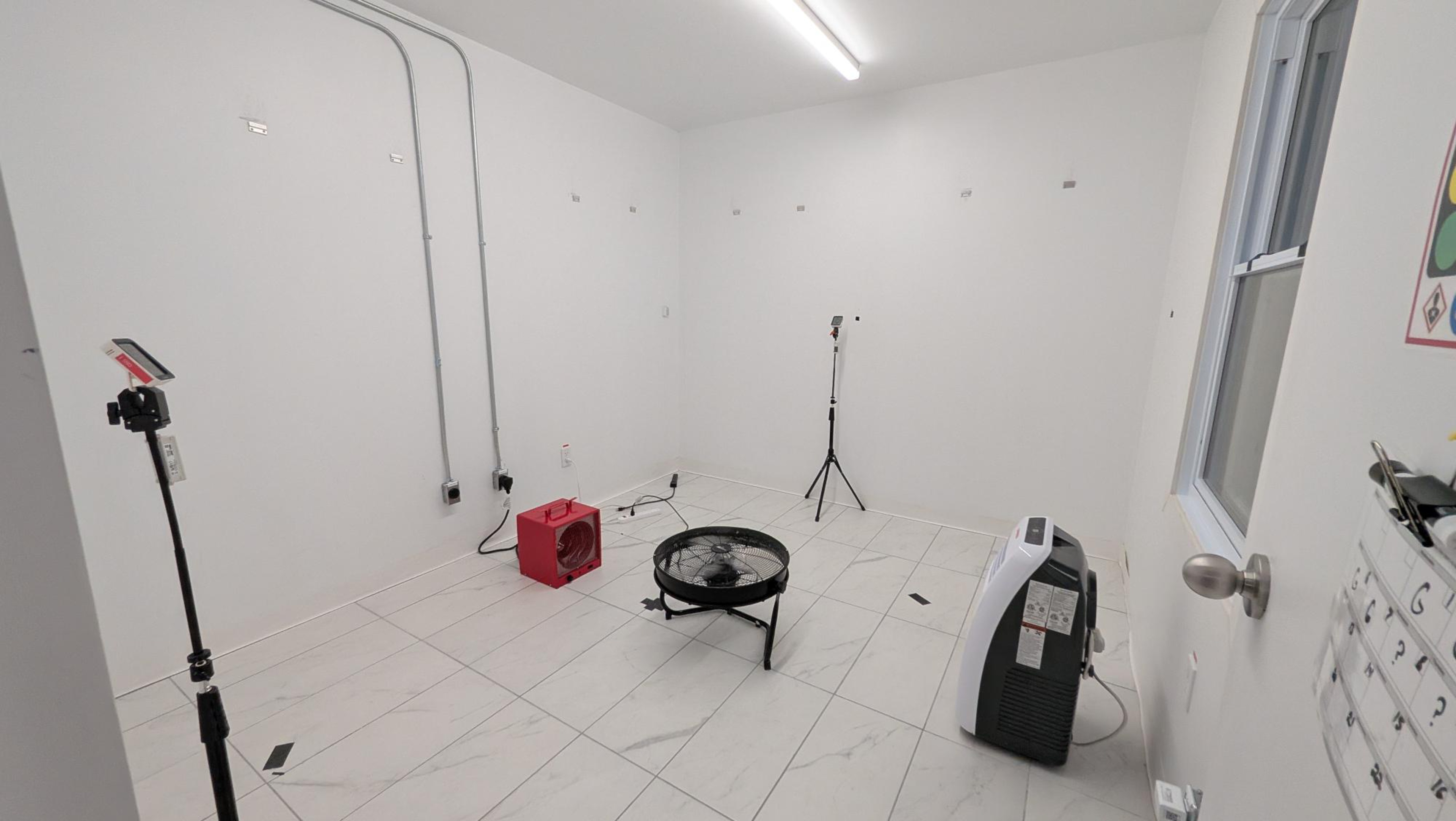
Version 1.1 of our air conditioner testing methodology updates how we measure and score air conditioner capacity, as well as secondary performance metrics like efficiency and stability, to provide more consistent data that's more applicable to real-world circumstances.What's Changed?New Performance Usage BoxesCapacityEfficiencyStabilitySizeUpdated Testing MethodologyCapacityEfficiency When CoolingEfficiency When Maintaining TemperatureTemperature StabilityHumidity StabilityWhy Are We Making These Changes?Our previous testing methodology produced performance data that varied drastically depending on ambient environmental conditions, with the previous methodology tracking performance as the tested A/C brought the temperature down to an established setpoint.Our cold room used for version 1.0 of our testing methodology. Notice the smaller 500W space heater near the center of the room.Our cold room used for version 1.1 of our testing methodology. Notice the larger 5600W space heater near the center of the room.Our new methodology aims to rectify that by testing performance in a room-agnostic fashion, allowing us to test new A/C units at any time, regardless of temperature and humidity levels. This was done by tracking unit performance in an environment where humidity and temperature are held stable, rather than being brought down to a setpoint by the A/C itself. This difference in philosophy is reflected most clearly in the results of our 'Capacity' test:A graph illustrating cooling capacity for the Black+Decker BPACT12HWT in version 1.0 of our test bench. Observe how performance is tracked as the ambient temperature inside the testing room is brought down to a setpoint.A graph illustrating cooling capacity for the Black+Decker BPACT12HWT in version 1.1 of our test bench. Observe how the temperature is held at the desired setpoint at the start of the test.This new methodology ensures that the results aren't being skewed by differing ambient conditions and allows our testers to produce consistent, repeatable results that more closely align with other independent sources across a spectrum of ambient conditions. This also pays dividends when measuring unit efficiency, particularly in the case of lower-capacity models:A graph illustrating maintenance efficiency for the Frigidaire FHWC054TE1 in version 1.0 of our test bench. The graph illustrates very rapid compressor cycling, which isn't necessarily indicative of real-world performance.A graph illustrating maintenance efficiency for the Frigidaire FHWC054TE1 in version 1.1 of our test bench. The graph illustrates much slower compressor cycling, more representative of how the unit performs in a real-world context.Let Us Know What You ThinkIf you just have suggestions to improve our A/C reviews, we encourage you to leave a comment on any page or email us at feedback@rtings.com. We wouldn't be able to do what we do without the support of users like you!
0