
Window air conditioners are great for cooling apartments, dorm rooms, or even rooms in a house. While they require dedicated mounting solutions and don't suit as many living spaces as portable A/C units, their design offers some significant advantages. Since the hottest and noisiest components are outside of the space you're cooling, they generally operate and cool much more efficiently. This configuration helps keep your utility bills low and your living environment comfortable.
Of course, not all window A/Cs are built the same, so you'll want to look for a few key characteristics when shopping. The best window air conditioners use inverter compressors that modulate their output based on load requirements and offer ample capacity, making them versatile appliances that can cool large or small rooms. Noise is a big consideration, too, as no one wants a loud unit drowning out their TV or making it impossible to sleep. Other nice-to-haves include remote control, whether via a remote or an application, and smart home integration.
We've tested over 20 air conditioners, and below are our recommendations for the best window air conditioners based on performance, pricing, and general availability. If you'd rather do the work yourself, we've included a buyer's guide to help identify some of the main things to look out for when shopping for a new A/C. If you're short on window space and need a portable unit, check out our recommendations for the best portable air conditioners. Alternatively, if you need an air conditioner for your bedroom, see our recommendations for the best air conditioners for bedrooms.

Behind all of our air conditioner recommendations are our product reviews. We buy our own air conditioners directly from major retailers and have our team rigorously test them in our lab. The result? Robust data on features you care about, like cooling capacity and inside noise, which you can then compare across the over 20 models we've tested.
If this sounds cool to you, you'll definitely want to read more in our About Us.
-
Best Window Air Conditioner
 Large Room8.7Bedroom/Small Room8.3Stability8.9Efficiency8.5Advertised Coverage550 ft² (51 m²)Tested Capacity8,766 BTU/hr (2,571 W)Compressor On @ Max Setting57.9dBASee all our test resultsCompressor On @ Min. Setting41.7dBA
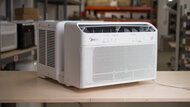
The Midea U-Shaped MAW12V1QWT is the best window air conditioner we've tested, especially for those seeking class-leading performance, quiet running, and a dense feature set. This high-end model can easily cool larger spaces such as open-concept apartments or spacious living rooms. It runs quietly and incredibly efficiently thanks to its inverter compressor, which adjusts its speed gradually depending on the required load instead of constantly turning on and off; this lowers energy consumption, minimizes swings in temperature, and keeps operation generally quiet. At its lowest fan speed, it's quiet enough to fall into the background of most households. It also supports remote operation through its companion app, along with Amazon Alexa and Google Assistant integration, so you can adjust settings from your phone or with voice commands instead of walking over to the unit.
The MAW12V1QWT's U-shaped design is also a standout feature, as it lets you partially open your window while the unit is installed, helping bring in fresh air and reducing the blocked-in feeling that most window A/Cs create. That said, installation is more involved than with most standard window units due to that unique design, and its bulky, heavy design can make setup more cumbersome, particularly if you're installing it on your own or in a tight window space.
-
Best Mid-Range Window Air Conditioner
Large Room7.5Bedroom/Small Room5.9Stability5.2Efficiency7.9Advertised Coverage700 ft² (65 m²)Tested Capacity9,667 BTU/hr (2,835 W)Compressor On @ Max Setting63.7dBASee all our test resultsCompressor On @ Min. Setting59.0dBAIf you're okay losing the quiet operation and overall versatility of an A/C with an inverter compressor to save some money, the Hisense AW1422CW1W is worth considering. It's a high-capacity unit, but it doesn't have the U-shaped design of the Midea U-Shaped MAW12V1QWT, so you can't open the window while it's installed, and it only has a fixed-speed compressor. This means that once it reaches your set temperature, the compressor shuts off for longer periods, leading to noticeable swings in both temperature and humidity before kicking back on. In practice, this can leave the air in smaller rooms feeling cold and clammy instead of cool and dry, so it's far from the best option for compact apartments and the like. It's also less efficient overall, consuming roughly 40% more energy to keep an equivalently sized room at the same temperature, so you'll definitely notice a hit to your utility bill in warm months. Even at its lowest fan speed, it's quite noisy and disruptive when set up near a TV or in a bedroom.
It also includes convenient features like Wi-Fi connectivity, app control, and voice assistant support, so you can adjust settings without needing to be right next to the unit. It's worth noting that this unit can be hard to find at some retailers, often at a considerable discount; if you can't find it, check out the Hisense AW1222CW1W. We haven't tested its performance, but it has only a slightly lower advertised capacity of 12,000 BTU/hr and should perform similarly overall.
-
Best Budget Window Air Conditioner
Large Room7.1Bedroom/Small Room7.6Stability7.3Efficiency7.8Advertised Coverage150 ft² (14 m²)Tested Capacity3,504 BTU/hr (1,028 W)Compressor On @ Max Setting58.7dBASee all our test resultsCompressor On @ Min. Setting55.4dBAThe Frigidaire FHWC054TE1 is the best window A/C we've tested at a budget price point. While the Hisense AW1422CW1W and Midea U-Shaped MAW12V1QWT are geared toward cooling large spaces, this model is a great option if you only need an A/C for a smaller office or bedroom, offering simple, reliable cooling without driving up your energy bill. Its power draw is comparatively low in real-world use, and its compressor cycles quickly enough in appropriately sized spaces to maintain a steady temperature and humidity level without noticeable swings. It's also easy to use overall, with a remote control for convenient adjustments and a dehumidification-only setting for added flexibility. It's a few decibels quieter than the Hisense, and just about quiet enough to keep you from waking overnight if you have it set up in a bedroom. That said, the pricier Midea U-Shaped MAW12V1QWT, with its inverter-controlled compressor, is the unit you want if quiet operation is your main priority.
Like the AW1422CW1W, it doesn't use an inverter compressor, so it's less efficient over time and can't maintain conditions as smoothly as inverter-based models. Its cooling output is also on the lower end, and as a result, it won't be able to cool bigger spaces within a reasonable span of time. As far as usability goes, its white-on-white digital display can be difficult to read under direct sunlight. Still, it's a straightforward, cost-effective option that will get the easily get the job done if you're cooling a smaller space.







Notable Mentions
-
Frigidaire FFRA051WAE:
The Frigidaire FFRA051WAE is a basic window A/C unit like the Frigidaire FHWC054TE1, which works well for small spaces, has a low power draw, and is compact. However, it's noisier, lacks additional features, and does a worse job of maintaining ambient humidity levels.
See our review -
Friedrich Chill Premier Inverter CCV08A10A:
The Friedrich Chill Premier Inverter CCV08A10A is a high-end window air conditioner with an advertised output of 8,000 BTU/hr. It runs slightly more quietly than the Midea U-Shaped MAW12V1QWT, but it takes up the same amount of room while cooling slightly slower.
See our review -
Midea MAW12HV1CWT:
The Midea MAW12HV1CWT is a mechanical twin to the Midea U-Shaped MAW12V1QWT, but with a more conventional design that doesn't allow you to open your window while it's installed. If that isn't a major dealbreaker for you, it's worth a look, particularly if you can find it at a lower price, but know that current availability is quite limited.
See our review
Recent Updates
Sep 16, 2026:
We've updated the text of this article to reflect the new performance data collected during version 1.1 of our air conditioner test bench. We've also ensured all our main picks are still available and represent the best fit for user needs.
Aug 13, 2026:
We've added a buyer's guide to this article to help facilitate your search for a new window A/C. We've also ensured all our main picks still represent the best fit for user needs.
Jul 13, 2026:
We've ensured all our main picks still represent the best fit for user needs. We've also added the Friedrich Chill Premier Inverter CCV08A10A and Midea MAW12HV1CWT to the Notable Mentions section of the article.
May 29, 2026:
We've ensured all main picks are available and represent the best option for user needs. We've also made slight changes to the text of this article to explain the real-world impact of the designs and performance of our picks.
Apr 29, 2026:
We replaced the GE AHEF06BC with the Hisense AW1422CW1W due to product availability, and added the Frigidaire FFRA051WAE to the Notable Mentions. We also made edits for clarity throughout.
What To Consider When Buying A Window A/C
There are a few main considerations you need to make before buying a new window A/C. Here are a few to take into account.
Compressor TYpe
You'll find one of two compressor designs within household A/Cs, each with their own set of trade-offs.
-
Inverter Compressors
- Can run consistently at a lower speed to maintain a desired temperature.
- This allows them to run in smaller spaces more efficiently, as the compressor doesn't need to cycle on and off to maintain the setpoint.
- Generally, more complex and more expensive.
- Introduces a higher number of potential failure points.
- Can run consistently at a lower speed to maintain a desired temperature.
-
Fixed-Speed Compressors
- Consume a relatively large amount of power and can lead to inconsistent ambient conditions since they cycle on and off to maintain your desired temperature.
- Cheaper to implement, and thus more common on entry-level models.
- Lack of an inverter control board reduces potential failure points.
Capacity
Below is a quick outline of the cooling capacity you should aim for, depending on the size of the room you're trying to cool.
-
5,000 BTU/hr
- Generally suitable for rooms up to 150 ft² (13.9 m²)
-
8,000 BTU/hr
- Generally suitable for rooms up to 350 ft² (32.5 m²)
-
10,000 BTU/hr and higher
- Generally suitable for rooms up to and larger than 450 ft² (41.8 m²)
Properly sizing an A/C is a big concern if you're looking at an A/C with a fixed-speed compressor. With an oversized unit, the compressor cycling can be slow and inconsistent. This allows for the ambient temperature and humidity of a room to rise, so conditions in your room may fluctuate between cool and dry and cold and clammy. This isn't as pressing for units with inverter compressors, since they can lower their compressor speed to match the required load. That said, there is a point of diminishing efficiency here: a 15,000 BTU/hr inverter unit used in a small space and forced to operate constantly at its lowest operating range simply won't be as efficient as a 5,000 BTU/hr inverter unit that's a better match for the space.
Noise
Here are a couple of examples of different noise levels that cover the vast majority of household A/Cs, and what they can generally be compared to:
- ≥ 60 dBA
- Generally, the threshold most people would consider to be "noisy" or "distracting" for a household appliance. Examples include conversation spoken at a normal volume or typing on an office keyboard.
- 50 dBA
- Within the general range of quiet conversation or moderate to strong rainfall.
- 40 dBA and below
- The threshold for what is considered "quiet" for most people.
Inverter compressors tend to produce a high-pitched chattering sound when entering a cooling cycle, which is a relatively infrequent but sometimes distracting sound. Conversely, fixed-speed compressors regularly cycle on and off to maintain your desired temperature, resulting in a more frequent, but potentially less noisy, sound overall. With window units in particular, since the compressor is located outside the room being cooled, operating noise isn't as big a concern as it is with an equivalent portable unit.
All Reviews
Our recommendations above are some of the best window air conditioners for most people. We factor in the price, feedback from our visitors, and availability.
That said, there's no single best option that'll suit everybody; your needs will depend on your budget, the size of the space you're trying to cool, your tolerance for operating noise, and whether you like having a device with convenience features like Wi-Fi connectivity. If you'd like to choose for yourself, here's the list of all our window A/C reviews.