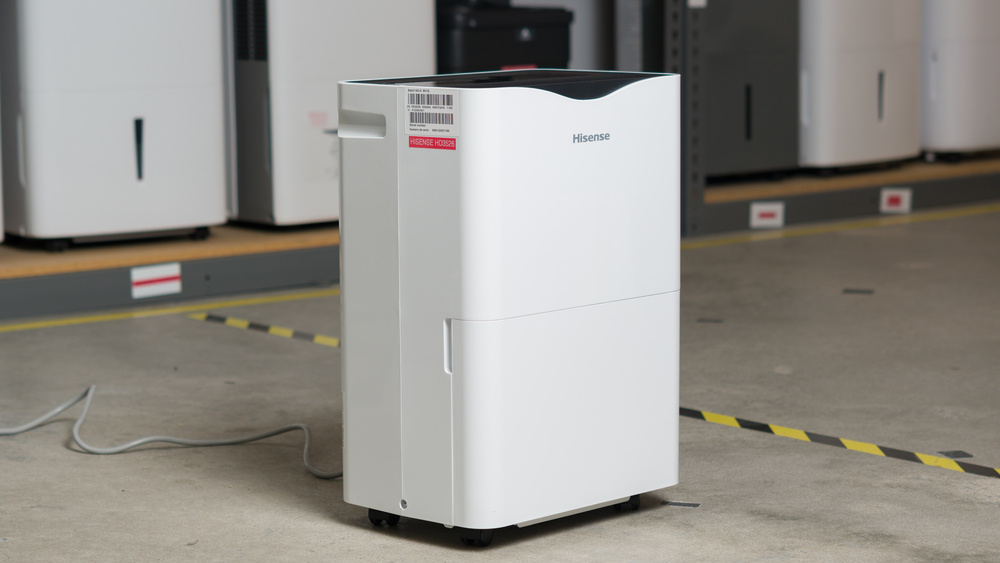
The Hisense HD3526 is a 35-pint dehumidifier intended for use in medium-sized spaces. It features a front-emptying water tank with a 1.3 gal (5.0 L) capacity, along with a hose port for continuous drainage; however, there's no pump for drainage into an elevated basin. Beyond that, there's an integrated humidistat for automatic humidity regulation, a digital display, and Wi-Fi connectivity so that you can operate the device and change settings while you're away from home. It's also advertised as being capable of operating in temperatures as low as 38 °F (3.3 °C).
Our Verdict
The Hisense HD3526 is a decent fit for use in a basement, as long as it's a small one. Its capacity is a little too limited to handle especially big open-concept basements, though it should be able to tackle smaller partial dens. You can connect a hose to its drain port for continuous usage, though you'll need to rely on gravity drainage into a floor drain, as there's no pump to have it drain into an elevated basin or sink. Its max fan speed setting provides a high enough airflow to promote air movement in most basements, though it's also quite noisy in this configuration. Like many other modern dehumidifiers, there's on-board Wi-Fi so that you can change settings or set operating schedules with your smartphone, saving you the trouble of having to trek up and down your stairs.
Overall dehumidification efficiency is good.
Capable of generating relatively high maximum airflow.
Features a drainage port for continuous operation.
Struggles in especially large rooms.
No pump for drainage into an elevated basin.
The Hisense HD3526 performs satisfactorily in bathrooms. It's a reasonably compact unit that has a high enough dehumidification capacity to quickly handle moisture problems in all but the biggest of bathrooms. Unfortunately, while you can connect a hose to have it drain continuously, you won't be able to do so into a sink or a high-walled tub, as this unit lacks an integrated pump. It also produces quite a lot of noise and heat and could make smaller bathrooms feel hot and stuffy.
Capacity is well-suited to medium-sized spaces.
Compact design.
Features a drainage port for continuous operation.
Noisy operation across its fan speed range.
Produces a lot of heat while running.
Minimum airflow is still quite high and could be disruptive in smaller rooms.
No pump for drainage into an elevated basin.
The Hisense HD3526 is a decent option for large rooms, but this isn't really what it's designed for. Its capacity is well-suited to medium-sized spaces like living rooms, but it's likely to struggle in especially large open-concept areas, even if its max fan speed setting generates relatively high air movement. It runs quite efficiently, but is unfortunately somewhat loud and is likely to be a significant distraction if you set it up near a TV or speaker.
Compact design.
Overall dehumidification efficiency is good.
Capable of generating relatively high maximum airflow.
Struggles in especially large rooms.
Noisy operation across its fan speed range.
The Hisense HD3526 is an okay option for use in bedrooms. Its compact size makes it easy to set up in smaller or more cluttered bedrooms, and it runs pretty efficiently, so it shouldn't have too much of an impact on your utility bill even if you frequently run it overnight. That said, it can also make smaller bedrooms feel uncomfortably hot. It also makes a lot of noise and produces a high degree of air movement even at its lowest fan speed setting, and if you're a sensitive sleeper, you might have trouble getting some rest if you leave it to run nearby.
Capacity is well-suited to medium-sized spaces.
Compact design.
Overall dehumidification efficiency is good.
Noisy operation across its fan speed range.
Produces a lot of heat while running.
Minimum airflow is still quite high and could be disruptive in smaller rooms.
The Hisense HD3526's dehumidification capacity is satisfactory. It can easily handle smaller spaces like bedrooms or home offices, or medium-sized areas like living rooms or small partial basements. That said, it'll struggle in especially large basements or open-concept spaces that are dealing with a serious moisture problem.
Capacity is well-suited to medium-sized spaces.
Struggles in especially large rooms.
The Hisense HD3526 is a somewhat noisy appliance. At its highest fan speed, it's likely to be a distraction if you set it up near you in a normally quiet area like a home office or bedroom. It also remains louder than many of its peers at lower fan speeds.
Noisy operation across its fan speed range.
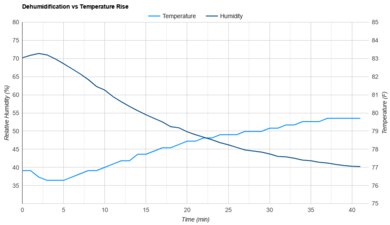
The Hisense HD3526 has a pretty noticeable impact on the temperature of the room it's dehumidifying. It releases quite a bit of heat during sustained operation and raises the temperature in smaller rooms by a noticeable degree.
Produces a lot of heat while running.
Performance Usages
Check Price
Differences Between Sizes And Variants
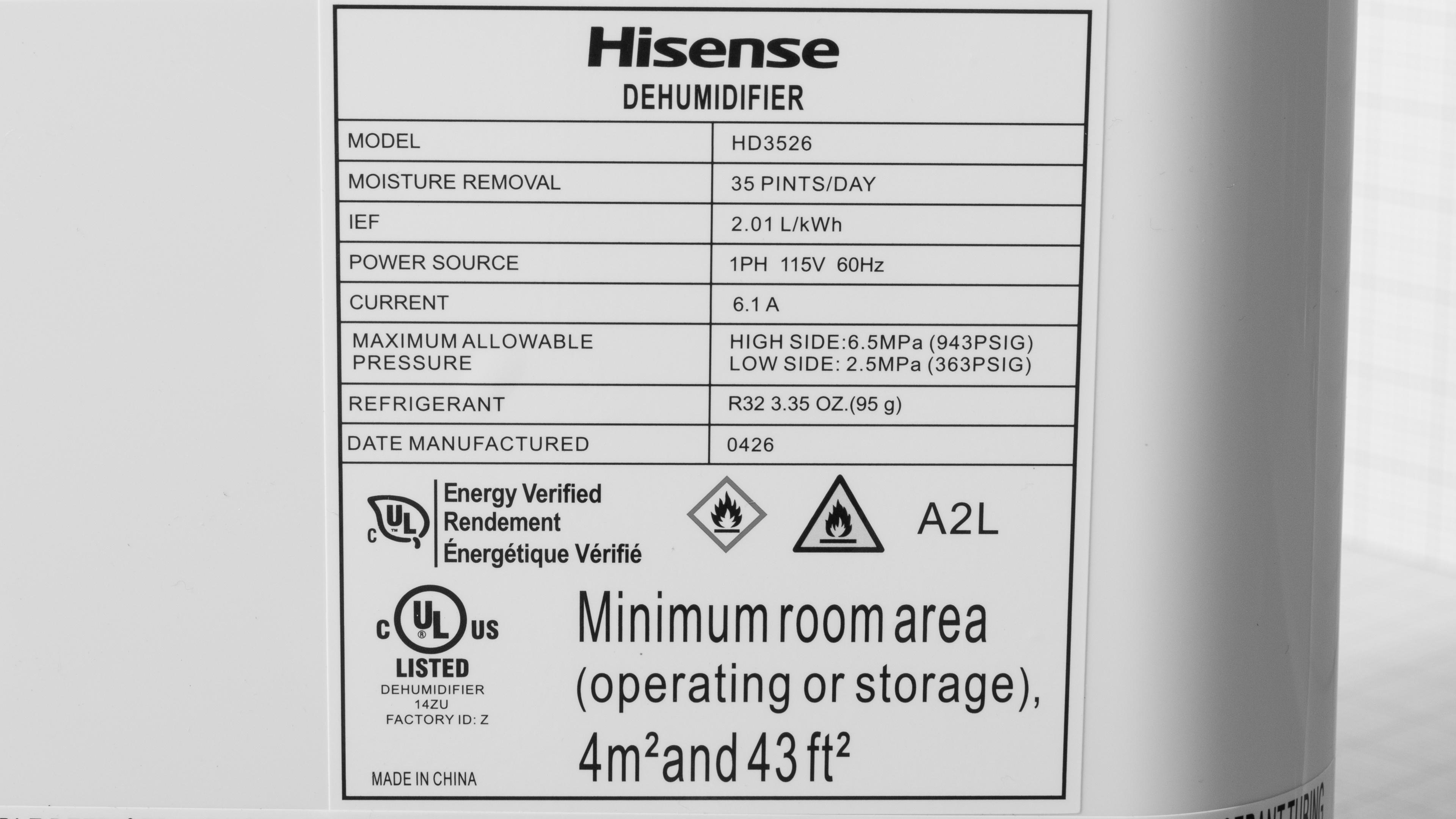
The Hisense HD3526 is only available in a single color variant: 'White.' For those interested, here's the product label for the unit we bought and tested.
Let us know in the comments below if you come across another variant of this dehumidifier so that we can update our review.
Popular Dehumidifier Comparisons
The Hisense HD3526 is a compact mid-range 35-pint dehumidifier. It has a more compact design than many other alternatives like the Frigidaire FFAD3533W1, making it easy to set up in smaller rooms, but it delivers otherwise unremarkable performance within its class. Compared to the admittedly larger Midea MAD35PS1QGR, the Hisense has a lower dehumidification capacity, and it runs louder and slightly less efficiently. Unlike the Levoit Smart Dehumidifier, it also lacks a drain pump, so it can't drain continuously into any elevated basins like a high-walled bathtub or a sink.
If you're interested in alternatives, check out our overall recommendations for the best dehumidifiers. If you're dealing with moisture problems in your bedroom, see our picks for the best dehumidifiers for bedrooms. If you want something compact, see what we recommend as the best small dehumidifiers.
The Hisense HD3526 is a better 35-pint dehumidifier than the Frigidaire FFAD3533W1. The Hisense is considerably more compact, runs slightly quieter, and provides a slightly higher dehumidification capacity. That said, the Frigidaire is fractionally more efficient and produces less heat with sustained operation.
The GE ADHL35LA and Hisense HD3526 are pretty evenly matched 35-pint dehumidifiers. The Hisense has a slightly larger water tank that won't need to be emptied as often, though neither unit has a drain pump. It also runs quieter than the GE at its max fan speed. Meanwhile, the GE runs slightly more efficiently and has a lower minimum airflow for less disruptive operation in smaller spaces.
Test Results
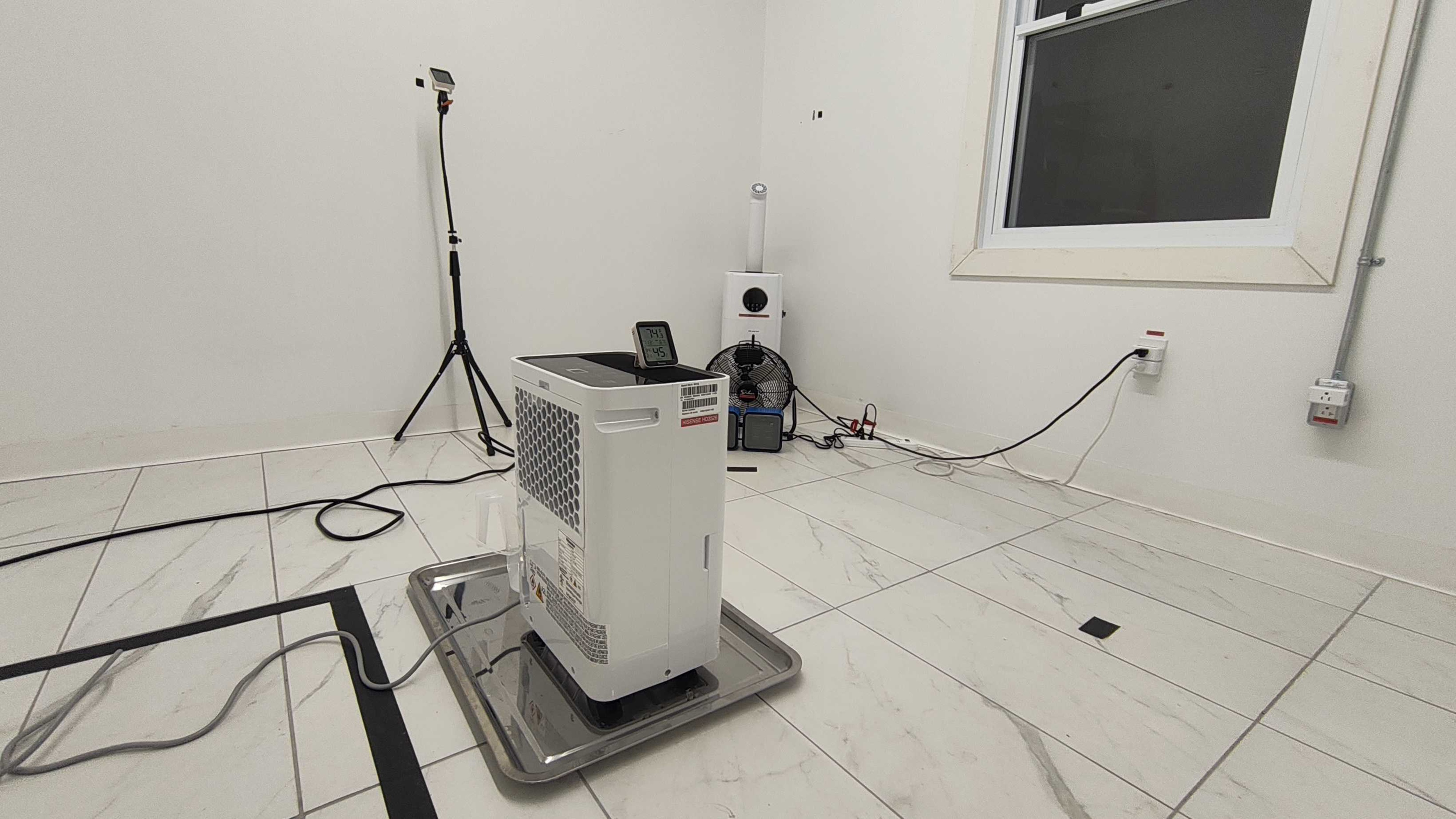
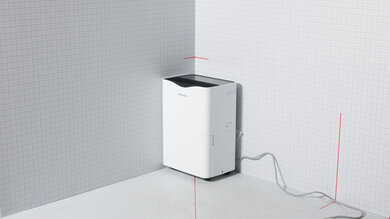
This is a very compact dehumidifier. It has a considerably narrower, slimmer, and shorter design than many other 35-pint models, making it a good fit for smaller rooms.
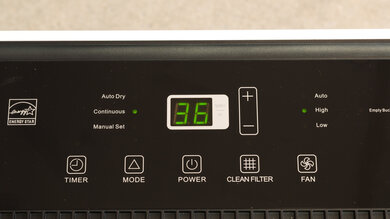
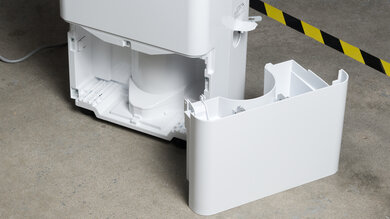
This dehumidifier has a decent array of drainage options. The front-facing water tank is simple to pull out and remove, but has a somewhat limited capacity; as a result, you'll likely need to empty it often. There is a port so that you can connect a hose and have the unit drain continuously, but there's no pump, so you're restricted to floor drains.
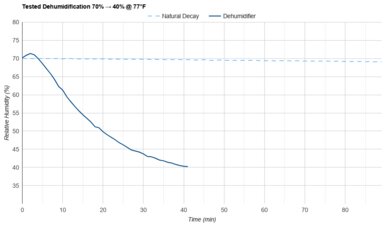
This unit provides decent dehumidification capacity. Its performance is well-suited to spaces like large bedrooms and bathrooms, medium-sized living areas, or even small partial basements.
This unit provides good dehumidification efficiency. It shouldn't have too big an impact on your utility bill in more humid months, though it's worth noting that some alternatives, like the Levoit Smart Dehumidifier, have a notably lower power draw while providing similar performance.
This is a pretty noisy dehumidifier. Operating noise across its fan speed range is quite high, and it could prove to be disruptive if you have it set up nearby in a room where you'd normally expect peace and quiet, like a bedroom or home office.
This unit has a decently wide airflow range. Its max airflow is relatively impressive, allowing it to generate air movement in larger spaces, though it falls short of 50-pint units in this respect. On the other hand, its minimum fan speed setting is somewhat on the higher end of the scale, which could make it feel a little disruptive if placed nearby. An overly high minimum airflow can also slightly impede performance in cooler, more humid areas, as it doesn't give sufficient time to cool its evaporator coils.