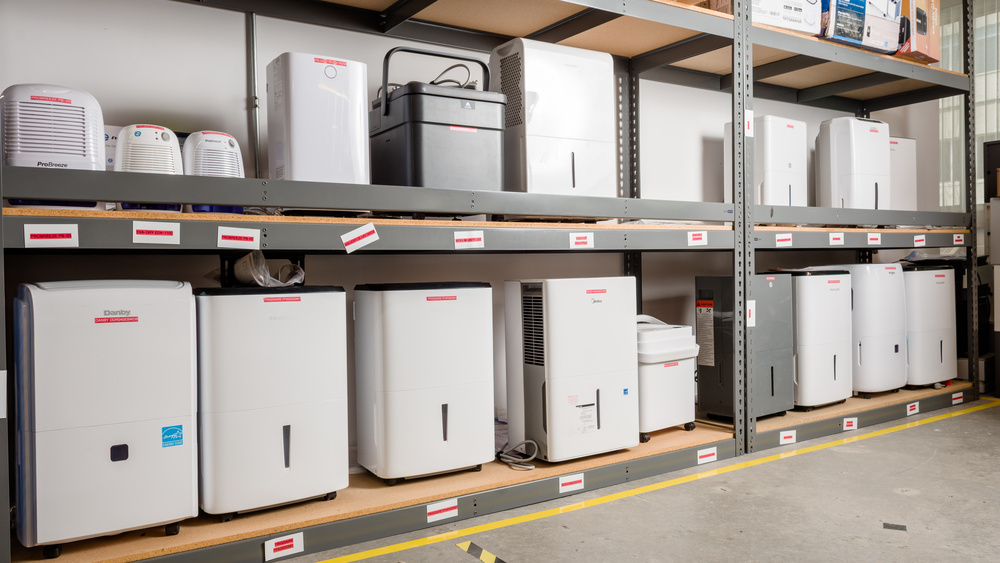
If you're tired of rooms in your home feeling clammy and damp, it might be worth investing in a portable dehumidifier. While these devices are only a partial band-aid solution for more serious water infiltration problems, the best dehumidifiers will efficiently remove humidity in a wide variety of spaces.
We've tested over 20 dehumidifiers, and below are our recommendations for the best dehumidifiers we've tested based on their performance, price, and feature sets. Using our lab testing and scoring, here's a quick guide to what matters most:
- Capacity: Fifty-pint units are intended for especially large basements and open-concept living areas, typically in the realm of 1,200 ft². Thirty-five-pint models are good for 600–800 ft², depending on the level of humidity you mean to clear out. Twenty-pint models and below are suitable for areas 400 ft² or smaller, like bedrooms and bathrooms.
- Airflow: A wider range of airflow speeds makes a unit more versatile. A high maximum fan speed generates air movement in larger rooms, while a low minimum speed will be quieter for smaller spaces.
- Drainage: Most models on the market feature drain ports for continuous operation, but for a hands-off experience, look for drain pumps to drain out into an elevated receptacle.
If you're interested in a more in-depth look at these factors and why they matter, see our full buyer's guide below. Also, check out our recommendations for the best dehumidifiers for basements and the best dehumidifiers for bedrooms. Or if you're concerned about your home's air quality, check out our recommendations for the best air purifiers.
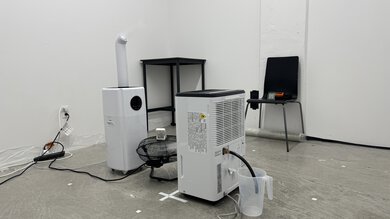
If you don't know where to start, deciding between dehumidifiers can put a damper on your day. Luckily, we've streamlined the process, buying and testing 20 dehumidifiers from major retailers; no cherry-picked models. Our lab team then measures airflow, capacity, and more to ensure you have the data you need to make a buying decision. If you're still between models, you can compare them directly, side by side.
For more information, you can visit our About Us page.
-
Best Dehumidifier
 Basement8.4Bathroom7.6Large Room7.8Bedroom5.8Noise5.0Capacity8.5Drain PumpYesSee all our test resultsAppNo
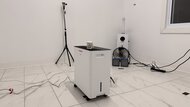
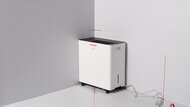
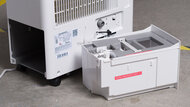
The best dehumidifier that we've tested is the GE APYR50LC. This high-capacity 50-pint model is intended for big spaces, and its powerful fan generates enough air movement to circulate air effectively in open-concept living areas. Despite its high capacity, it's relatively energy-efficient, which is great if you plan on leaving it running for long periods. There's also a drain spout and a built-in pump, so you can set it up for continuous drainage instead of having to regularly empty the water tank, which is especially convenient in high-moisture environments like basements or larger bathrooms. Operation is pretty hands-off overall, thanks to its integrated moisture sensor, which allows it to adjust its fan speed based on real-time humidity levels.
Unfortunately, the downsides are fairly obvious: this unit is big and bulky and produces a lot of heat, so you should make sure you need a dehumidifier with this level of capacity before placing it in a high-traffic area or a room that already tends to trap heat. It also lacks app connectivity and a remote control, so you'll need to walk over to the unit whenever you want to adjust its settings.
-
Best Upper Mid-Range Dehumidifier
Basement7.6Bathroom6.7Large Room7.4Bedroom7.0Noise6.6Capacity7.2Drain PumpNoSee all our test resultsAppYesThe Midea MAD35S1QWT is our recommendation for medium-sized rooms and is a good choice for anyone looking for a quieter operation. It has a smaller 35-pint capacity than the GE APYR50LC, so it isn't quite as efficient for use in large rooms. However, it has its fair share of advantages, including app connectivity, so you can check humidity levels and adjust settings remotely. It has a unique collapsible design, which makes it easier to stow away when not in use. You can set it up normally with the compressor sitting atop its bucket, detach the compressor entirely and have it drain into a sink, or connect a hose to the drain port for continuous drainage into a sink or tub; just know there's no built-in drain pump, so it can't pump water upward into an elevated drain. However, it has a similar footprint to the GE when fully deployed. As mentioned earlier, it's also quieter than the more potent GE, and it emits less heat, so it'll be less of a nuisance in smaller spaces.
Unfortunately, its compressor unit is rather heavy, so it'll require some muscle to take it out of its water bucket. Its fan also provides less airflow than the GE, reaching 189 cubic feet per minute (CFM) at its highest speed and 155 CFM at its lowest. This means it circulates less room air through the unit and has a narrower range of airflow to work with, so it can't adapt as seamlessly to varying ambient humidity conditions. This model is sometimes unavailable from major online marketplaces, but if you don't see it elsewhere, Home Depot reliably has it in stock.
-
Best Mid-Range Dehumidifier
Basement8.5Bathroom7.7Large Room7.8Bedroom6.4Noise5.6Capacity8.5Drain PumpYesSee all our test resultsAppYesThe Costco-exclusive Midea MAD50PS1AWT-C is a solid option if you want performance closer to the GE APYR50LC without sacrificing modern convenience features that make the unit easier to live with day to day. Like the GE, it has a high 50-pint capacity that's well suited to large, damp spaces, along with a built-in drain pump for continuous drainage into an elevated sink or drain. If you'd rather empty the tank yourself, its side-mounted bucket slides in and out smoothly and has a raised lip that makes it easier to carry with less risk of spilling. It also offers Wi-Fi connectivity, allowing you to monitor humidity levels and adjust settings remotely via its companion app. Compared to the Midea MAD35S1QWT, it removes moisture much more quickly and is better suited to larger or consistently damp spaces, though it doesn't have the MAD35's collapsible design for easier storage.
That said, it's a loud dehumidifier that's likely to be distracting if you're spending time in the same room while it's running. It also produces a noticeable amount of heat, making it better suited to basements and larger living spaces where you can distance yourself from the unit than in smaller rooms. While its shorter, shallower design makes it easier to place than the GE, it's still a full-size unit that takes up a fair amount of floor space.
-
Best Budget Dehumidifier
Basement6.9Bathroom7.3Large Room7.0Bedroom7.7Noise7.9Capacity6.1Drain PumpNoSee all our test resultsAppNoBudget-conscious shoppers looking to dehumidify small spaces like a bedroom or home office should check out the Waykar PD160B. This model has a pretty modest 8.5-pint capacity, meaning it's best for small and medium-sized rooms. That said, it's also a lot smaller than either the GE APYR50LC or the Midea units, so it's easier to find space for it in smaller rooms. It also generates very little heat or noise, making it a better fit for spaces where you'll be spending a lot of time, like a bedroom or home office. You can set your desired humidity level and let the unit automatically adjust its fan speed based on current conditions, reducing the need to constantly fiddle with the settings.
Unfortunately, it can be a bit of a bear to interact with due to its dim display with poor viewing angles, making it almost impossible to see unless you're looking straight at it from above. It also lacks app connectivity, so you can't monitor humidity levels or adjust settings remotely. This model doesn't have a built-in pump to drain water upward into an elevated receptacle; instead, you can connect a hose for continuous drainage into a lower drain, so you don't have to regularly empty the water tank.
-
Best Cheap Dehumidifier
Basement3.6Bathroom5.8Large Room4.5Bedroom7.1Noise8.0Capacity2.5Drain PumpNoSee all our test resultsAppNoIf you only need a cheap dehumidifier to deal with a small space like a closet or crawl space, consider the ProBreeze PB-03. Given its compact stature, it isn't a replacement for a full-size machine and will struggle to clear away moisture in even modestly sized rooms. However, at just over 2 lbs, it weighs roughly 5% of what the GE APYR50LC does and occupies approximately one-tenth as much space. As a result, you can set it on a dresser or shelf in a closet and leave it to run without it taking up much usable space. It also operates very quietly and emits very little heat, so it won't make smaller spaces feel stuffy.
The ProBreeze has a very small 0.4-gal (1.5 L) water tank, but since its dehumidification rate is so low, it takes quite a while to fill up, and you won't have to empty it often. It draws only 37W of power, so it uses very little electricity while running, but its poor capacity means it isn't an energy-efficient option relative to how much moisture it actually removes. It also lacks app connectivity, so you can't monitor or control it remotely, though that can be expected given this model's small size and basic feature set. If you're having trouble finding this model, check out Home Depot's website.






Notable Mentions
-
Frigidaire FFAD5033W1:
The Frigidaire FFAD5033W1 is a 50-pint dehumidifier with similar capacity and lower operating noise than the GE APYR50LC, but it also lacks an integrated pump for more convenient drainage options.
See our review
Recent Updates
Aug 25, 2026:
We ensured all picks remain available and continue to be our top recommendations.
Jul 30, 2026:
We added the Midea MAD50PS1AWT-C as the new mid-range pick, moved the Midea MAD35S1QWT to upper mid-range, and refreshed the article accordingly.
Jul 17, 2026:
We've confirmed that all picks are still available and made minor text updates to add more context for users and better clarify how performance figures are presented.
Jun 08, 2026:
We've ensured all the main picks are available and still represent the best option for user needs. We've also added the Frigidaire FFAD5033W1 to the Notable Mentions section and removed the Whirlpool WHAD50PCW due to current availability.
May 08, 2026:
We've added a buyer's guide section to this article to help users make a more informed choice when considering a dehumidifier. We've also updated the text in our picks to better convey product details.
What To Consider When Choosing A Dehumidifier
There are a few main factors to consider when shopping for a new dehumidifier. Here are some of the key considerations to take into account.
Dehumidification Capacity
While these guidelines aren't set in stone, you can have a good idea of whether a dehumidifier is the right fit for your needs based on its approximate capacity:
-
50-pint
- Assuming a starting relative humidity level of approximately 60%, these units are suitable for areas up to 1,200 ft² (111.5 m²).
-
35-pint
- Assuming a starting relative humidity level of approximately 60%, these units are suitable for areas up to 800 ft² (74.3 m²).
-
20-pint
- Assuming a starting relative humidity level of approximately 60%, these units are suitable for areas up to 400 ft² (37.1 m²).
-
10-pint and below
- Assuming a starting relative humidity level of approximately 60%, these units are suitable for areas up to 300 ft² (27.9 m²) and smaller.
It's important to note that a higher starting relative humidity level within the same-sized room will require a higher-capacity humidifier. Buying too small a humidifier for your space will keep the room from reaching your desired humidity level. However, buying too big a unit should also be avoided: the heat output of a dehumidifier scales pretty predictably with its capacity, and an oversized unit will make smaller rooms feel hot and stuffy.
Airflow/Fan Speed
The larger the difference in fan speed between a unit's max and lowest settings, the better. A high maximum airflow, exceeding 160 cubic feet per minute (CFM), is enough to generate air movement in larger rooms, while a low minimum airflow of under 120 CFM or so keeps things quiet, which is useful in bedrooms where the unit may be placed nearby.
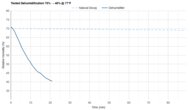
However, it's worth noting that there's a point of diminishing returns for maximum airflow. As we discovered in our investigative R&D article, too high a maximum airflow for a given humidifier's capacity can actually have a negative impact on dehumidification performance. Slowing air movement gives the air more contact time with a dehumidifier's condenser coils, increasing the rate at which water vapor in the air is condensed and boosting dehumidification efficiency.
Drainage/Water Tank Capacity
Water tank capacity generally scales with the advertised capacity of a dehumidifier. For instance, 50-pint models typically feature 1.6 gal (6.0 L) to 2.4 gal (9.0 L) tanks, 35-pint models generally have 0.79 gal (3.0 L) to 1.1 gal (4.0 L) tanks, and 10-pint and under models usually have 0.7 gal (2.5 L) or smaller tanks. The main thing to remember is that the larger the tank, the more of a hassle it can be to empty when filled. Water weighs in at 2.2 lbs (1 kg) per liter, so something like the Midea MAD20S1QWT, with its enormous 12.0 L tank, can be a bit of a bear to empty out regularly.
Of course, if you have an especially humid room, it's probably worth considering setting a unit up for continuous drainage. As stated earlier, most full-size units on the market feature drain ports, which allow them to pour out any accumulated moisture from a hose into a floor drain or shower. That said, if you plan on running the unit in a finished area where that isn't an option, you should consider something with a drain pump, which allows the unit to drain any accumulated water into an elevated basin or sink.
All Reviews
Our recommendations above are some of the best dehumidifiers for homes for most people. We factor in the price, feedback from our visitors, and availability.
That said, there is no single best dehumidifier for home use that will suit everybody; your needs will depend on your budget, the size of your living space, your tolerance for operating noise, and whether you like having a device with convenience features like Wi-Fi connectivity or a drain pump. If you'd like to choose for yourself, here's the list of all our dehumidifier reviews.