
If you struggle with allergies or asthma, a vacuum with a HEPA filter can make a real difference, trapping allergens rather than reintroducing them into the air as you clean. We've tested more than 110 vacuum cleaners, and below are our recommendations for the best vacuums for allergies based on our test results. Here are the most important things to look for:
- Filtration System: A HEPA filter traps 99.97% of airborne particles as small as 0.3 microns, including dust, pollen, and pet dander, but the filter is only part of the picture. The vacuum also needs to be well-sealed so air can't bypass it and recirculate allergens, and many brands achieve this with proprietary multi-step systems rather than a traditional HEPA filter.
- Particle Filtration: This score reflects how well a vacuum actually seals in allergens during use, accounting for both the filter quality and the overall build. Look for a score of 8.0 or higher.
- Air Quality During Emptying: Even a vacuum with a great filtration system can release a cloud of dust when you empty the bin or swap the bag. Look for a score of 8.0 or higher here. Bagged vacuums with self-sealing dirtbags tend to score best on this, since the bag itself contains the debris when you remove it.
- Cleaning Performance: A good filtration system only helps if the vacuum can actually remove allergens from surfaces where they accumulate. Dust and pet dander that work deep into carpet fibers and upholstery can still act as irritants if your vacuum can't reach them.
- Recurring Costs: Many of the best vacuum cleaners for allergies are bagged, so you'll need to weigh whether you want to deal with continually purchasing new bags.
If you want a closer look at some of those factors, check out the buyer's guide at the bottom of this article. For more recommendations, see our lists of the best vacuums, the best vacuums for allergies, and the best vacuums for pet hair. Alternatively, if you're dealing with allergens settling throughout your home, check out our recommendations for the best HEPA filter air purifiers.
-
Best HEPA Vacuum
 Vacuum TypeCanisterBaglessNoParticle Filtration9.9Air Quality During Emptying9.5Air Quality9.8House8.7See all our test resultsSmall Apartment8.6
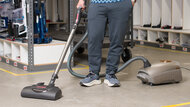
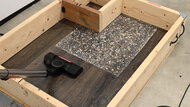
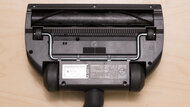
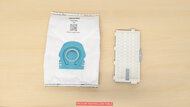
The Miele Guard L1 Electro is the best HEPA vacuum we've tested if keeping your indoor air as clean as possible is your top priority. Its filtration system captures nearly all airborne particles while you're using it, and because it uses bags, you won't reintroduce dust into the room when it's time to empty it. It's a solid choice for pet owners because it excels at picking up pet hair on both floors and furniture, and the included electrobrush provides effective agitation on carpets. The major caveat is that its bare-floor performance is inadequate because the floorhead tends to scatter larger debris rather than suction it up. Carpet pickup is also just okay, so you may need extra passes to thoroughly clean your space. It's also a heavier canister at nearly 22 lbs total, which makes carrying it between floors more of a chore.
Recurring costs are high because you'll need to replace the bags and HEPA filters regularly, though this is true of any vacuum with top-notch air quality control. On the plus side, build quality feels great, with a sturdy metal-and-plastic construction and a well-balanced canister body that's easy to maneuver around furniture. It also runs quietly, so you can vacuum without it being too disruptive. It's important to note that not all L1 variants come with a HEPA filter. To find the Electro variant, you might need to purchase it from a specialty vacuum retailer.
-
Best Budget HEPA Vacuum
Vacuum TypeUpright/HandheldBaglessNoParticle Filtration9.9Air Quality During Emptying8.0Air Quality9.3House8.6See all our test resultsSmall Apartment8.6The Kenmore Intuition Bagged is the best HEPA vacuum at a budget price point. Its HEPA filter captures nearly all fine particles during cleaning, and its self-sealing dirtbags keep dust locked away when you swap them out, so you're not releasing allergens back into your home at the time of disposal. The price cut shows up in a few areas. It falls behind the Miele Guard L1 Electro in pet hair pickup, and it's a heavier, bulkier upright that's somewhat tricky to maneuver and doesn't glide as smoothly.
There's also no floorhead height adjustment, which means it can snag on thicker rugs. Build quality feels mediocre, with some fragile-feeling internal components. You'll also have ongoing costs for replacement dirtbags. Luckily, you can remove the dirtbag from its housing with the press of a latch, so you won't get your hands dirty when taking it out. You can also pick up and carry its canister body separately from its upright portion, making it easier to clean tight spots.
-
Best Cheap HEPA Vacuum
Vacuum TypeStick/HandheldBaglessYesParticle Filtration9.1Air Quality During Emptying4.0Air Quality7.6House6.7See all our test resultsSmall Apartment7.6If HEPA filtration at the lowest possible cost is your priority and you can accept weaker cleaning performance across the board, the Wyze Cordless Vacuum S is our top cheap pick. Its HEPA filter does an excellent job capturing fine particles during cleaning, which is impressive at this price point. The compromises at this price are significant, though. It's bagless, so emptying the dustbin sends dust back into the air, largely offsetting the HEPA filtration benefit unless you empty it outdoors. The tiny dustbin also means you'll have to empty it more often. Bare floor performance is disappointing, and carpet pickup is only mediocre. Pet hair performance is decent, but it falls well behind every other pick here.
That said, it's also one of the lightest vacuums we've tested at just under five pounds, making it effortless to pick up and carry around. It runs quietly, too, so it's a good choice if you're sensitive to noise. The battery is swappable, which means you can buy a spare and swap it in if you run out of charge mid-clean, and there are few recurring costs since the filter is washable and only needs occasional replacement. Unfortunately, there's no wall mount or docking station, and the only included attachment is a crevice tool.
-
Best Cordless HEPA Vacuum
Vacuum TypeStick/HandheldBaglessYesParticle Filtration9.9Air Quality During Emptying4.0Air Quality8.1House7.4See all our test resultsSmall Apartment8.7If you want the convenience of a cordless model without sacrificing filtration quality during cleaning, the Dyson V15 Detect is our top choice. It's worth noting that this vacuum doesn't actually ship with a HEPA-certified filter, but its sealed filtration system still delivers outstanding particle capture right out of the box. If you want the added peace of mind that comes with a certified HEPA filter, Dyson sells one separately. That said, its whole-machine sealed filtration system captures practically all fine particles during cleaning, performing on par with HEPA-certified vacuums. Where it falls short is dust containment when you're emptying it. Because it's bagless, opening the dirt compartment releases a visible cloud of dust back into the air, which largely undermines the filtration benefits. The dirt compartment is also small, meaning you'll empty it often. If you're able to empty it outside, though, it's still worth a look.
That said, it offers better overall cleaning performance than our top pick, the Miele Guard L1 Electro, picking up debris well on both hard floors and carpets. Pet hair pickup is exceptional, so it's worth a look if you have shedding pets. Build quality feels mediocre, with thin plastic construction and flimsy-feeling floorhead wheels. As a plus, the wall-mounted docking station keeps it stored neatly and charged, and there are no recurring filter or bag costs.


Notable Mentions
-
Dyson Ball Animal 3 Extra:
If you'd rather avoid ongoing bag and filter costs, the Dyson Ball Animal 3 Extra is an upright alternative to the Miele Guard L1 Electro. That said, it's bagless, so it releases a cloud of dust when you empty it.
See our review -
Shark PowerPro Flex Reveal Plus:
For a cordless model that's cheaper than the Dyson V15 Detect, the Shark PowerPro Flex Reveal Plus is a good alternative. Cleaning performance is weaker across the board, though, and, like the Dyson, the bagless design will reintroduce allergens into your air.
See our review -
Shark Stratos Cordless IZ862H:
The Shark Stratos Cordless IZ862H is a cordless option to consider if you're looking for something more affordable than the Dyson V15 Detect. It's also bagless, so it shares the same core downside, and it doesn't lift pet hair from carpets as effectively.
See our review -
Dyson Gen5detect:
The Dyson Gen5detect is the successor to the Dyson V15 Detect. It features a HEPA-rated filtration system and the same built-in particle sensor as its predecessor. However, it's far more expensive than the V15 and shares a common downside: it lacks the Samsung Bespoke AI Jet Ultra's self-emptying capability.
See our review
Recent Updates
Sep 22, 2026:
We added a new category for the 'Best Cordless HEPA Vacuum' and moved the Dyson Ball Animal 3 Extra to the Notable Mentions section. We removed the Samsung Bespoke AI Jet Ultra because it's not currently available.
Jul 06, 2026:
We've added a buyer's guide to this article to help simplify your search for a new HEPA vacuum. We've also made sure all our main picks are still available.
Apr 02, 2026:
We overhauled this article based on our air quality tests from Test Bench 1.4. For our top pick, we added the Miele Guard L1. We swapped out the Miele Classic C1 for the Dyson V15 in the upper mid-range category. We removed the discontinued Airsign HEPA Vacuum in the mid-range category and added the Dyson Ball Animal 3 Extra. We added the Wyze Cordless Vacuum S as our best cheap pick. We also added the Shark PowerPro Flex Reveal Plus and Samsung Bespoke AI Jet Ultra as Notable Mentions.
Nov 21, 2025:
We replaced the discontinued Samsung Bespoke Jet with the Samsung Bespoke AI Jet Ultra. We checked all recommendations for availability and accuracy.
Apr 17, 2025:
We've replaced the Miele Complete C3 Brilliant with the SEBO Airbelt D4 Premium as the 'Best HEPA Vacuum' as the former is unavailable. We also made minor edits to the text for clarity.
What To Consider When Choosing A HEPA Vacuum
There are a couple of key factors you should consider when looking at our reviews before purchasing a HEPA vacuum:
air quality
If you or someone else in your household has allergies, you'll want to factor air quality into your buying decision. We measure air quality using two separate tests:
Particle Filtration
This test measures how well the vacuum traps fine particles during cleaning. Many premium cordless vacuums use HEPA-rated filters within a sealed system, which keeps dust from leaking back into the air as you clean. Look for a Particle Filtration score of 8.0 or higher, especially if anyone in your home suffers from allergies.
air quality during emptying
This test measures how much dust escapes when you empty the dirtbag or dustbin. The biggest contributing factor in a vacuum performing well here is whether it's bagged or bagless.
- Bagged vacuums collect dust inside a sealed bag that you swap out when it's full and are a better option for locking in allergens. Higher-end models can feature cloth bags that act as an additional filter, in combination with existing pre-motor and exhaust filters.
- Bagless vacuums collect dust in a reusable bin you empty into the trash. While this means that you don't have to worry about replacing bags, emptying the bin releases a cloud of fine dust, even on models with otherwise excellent filtration. If anyone in your home has allergies, it's best to empty the bin outdoors. If you're dead-set on a bagless unit due to the lower costs of ownership, but still suffer from allergies, consider a higher-end unit, as premium options tend to feature sophisticated filtration systems that are almost as effective as bagged systems in locking in fine particles (though that doesn't necessarily tell the whole story).
For a more in-depth comparison, read our article on bagged vs. bagless air quality.
Filter types
There is a wide variety of differing filtration standards espoused by vacuum manufacturers, with some claims being contradictory or even outright misleading. To cut down on some of the chaff, here are the most common filter types you'll run into when shopping for a vacuum.
-
True HEPA
- True HEPA filter systems are rated to capture at least 99.97% of particles at 0.3 microns in size, a standard set by the U.S. Department of Energy.
-
S-Class
- A filter standard only found on SEBO vacuums. This standard is marginally less stringent than true HEPA filtration, with an advertised claim of being able to trap 99.9% of particles at 0.3 microns.
- In real-world terms, this difference won't be too noticeable unless you have extremely serious allergies.
- A filter standard only found on SEBO vacuums. This standard is marginally less stringent than true HEPA filtration, with an advertised claim of being able to trap 99.9% of particles at 0.3 microns.
-
"HEPA-type"/"HEPA-style"
- An unregulated standard, typically only used for marketing purposes. HEPA-type filters aren't certified to capture allergens to any specific degree.
All Reviews
Our recommendations above are what we think are currently the best HEPA vacuums for most people. We factor in the price, feedback from our visitors, and availability.
If you would like to do the work of choosing yourself, here's the list of all our reviews of vacuums equipped with an allergen-trapping HEPA filter and a video of their air quality performance test. Be careful not to get too caught up in the details. While no vacuum is perfect for every use, most are good enough to please almost everyone, and the differences are often not noticeable unless you really look for them.


