- 85.0%Produce Moisture Retention
- 15.0%Fridge Compartment Humidity Level
A fridge does more than keep your food cool; it also regulates humidity, a key component in keeping produce crisp and fresh. Delicate foodstuffs like celery, lettuce, and spinach have a high water content and will lose this moisture over time, causing them to soften and wilt. Our Produce Preservation test evaluates how well a fridge can keep delicate greens crisp and snappy by measuring their moisture loss.
Generally speaking, there are three main factors that influence the level of humidity both inside the produce drawers and inside the main fridge cabinet itself. These are:
- The quality of the produce bin seals
- The distribution of humid air through the fridge cabinet and the automatically controlled bin vents
- Evaporator configuration (dual evaporator systems are able to keep higher humidity levels in the refrigerator compartment)
This article explains how fridge design can influence produce preservation performance, how our tests are conducted, and the science behind outlier results.
Test results
When It Matters
This test matters when you want the produce in your fridge to last longer and stay in better condition. Maintaining a high-humidity environment for produce storage marks the difference between having to toss out food once a week and keeping it around for more than twice that span, minimizing food waste and saving you money.
Our Tests
The specifics in this test are measured using a set of InkBird sensors, placed in appropriate sections of the fridge to record humidity. In order to actually observe the impact of humidity on produce, we load the refrigerator's crisper drawer with approximately 500 g of celery stalks, chosen for their high water content and propensity to visibly brown and wilt as they lose moisture.
Produce Moisture Retention
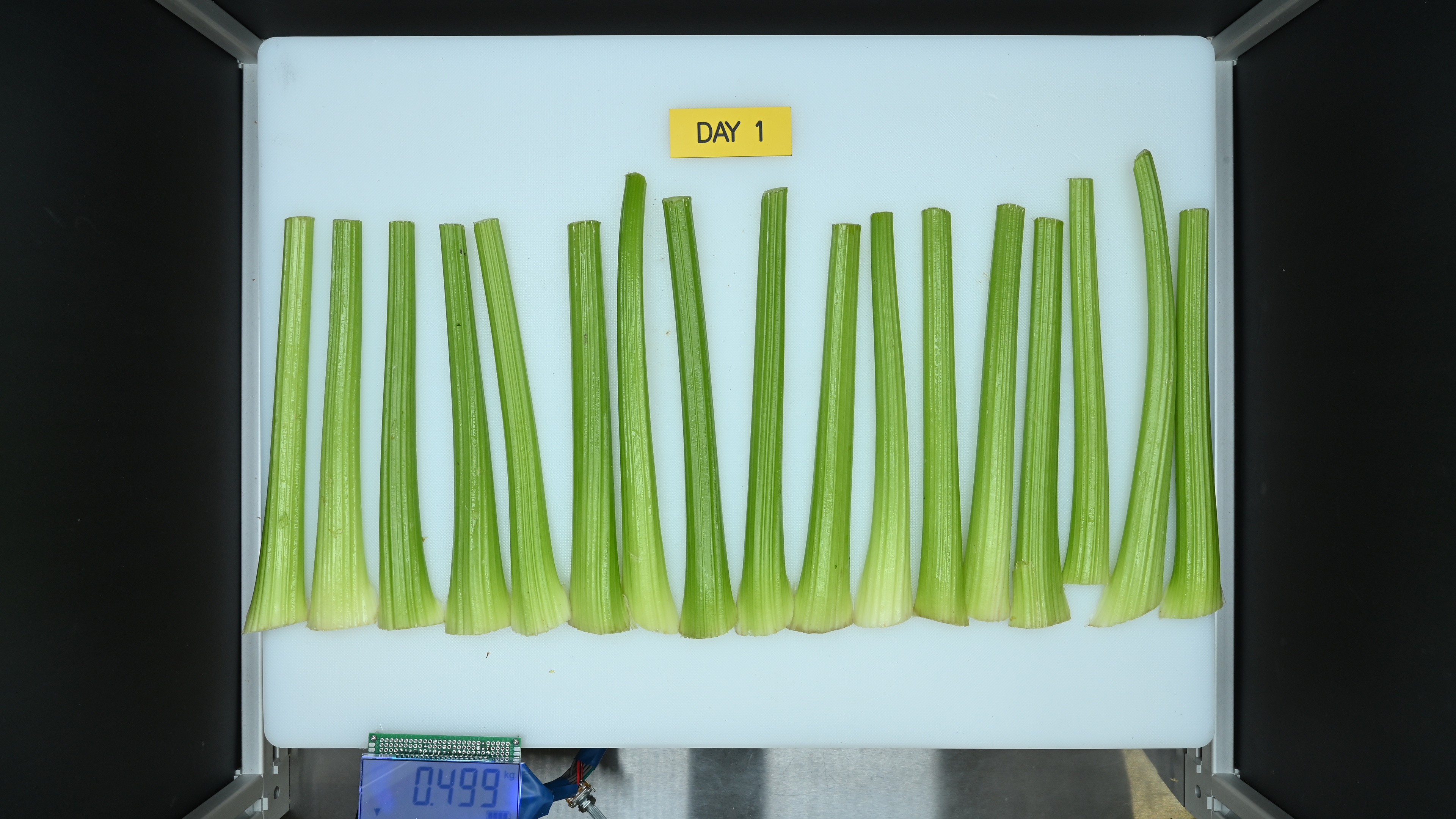
Produce moisture retention is the measure of the remaining moisture left inside our sample of celery stalks. The celery is weighed just before it's loaded into the section of the fridge most-suited for produce storage, traditionally that being the produce drawer. From there, the fridge is closed, and the InkBird sensors are left to log humidity data for the following four days. Once that time has expired, the celery stalks are removed from the produce drawers and weighed again. That difference is used to calculate the remaining moisture left inside the stalks.
 |
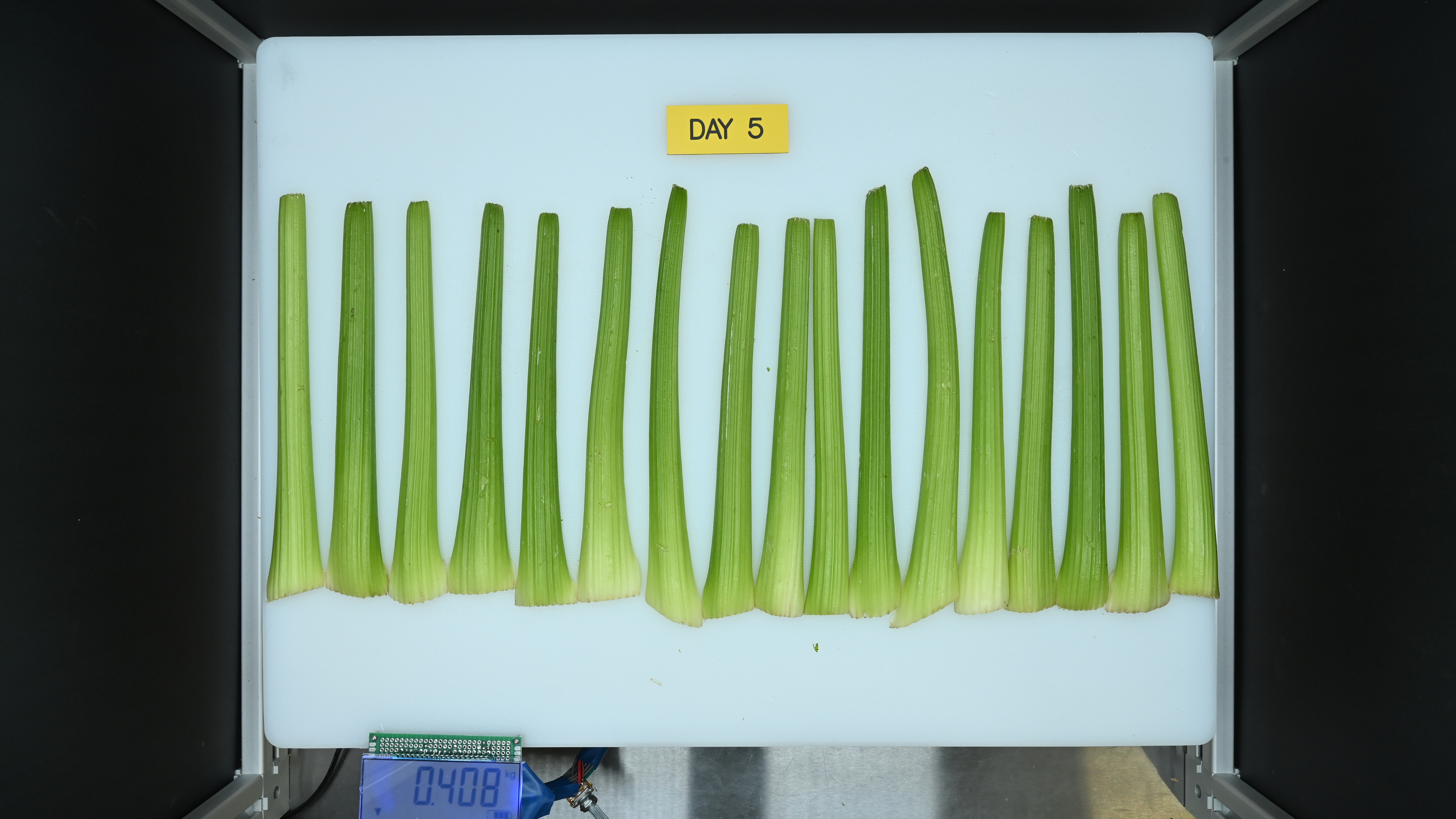 |
A comparison between celery stalks left inside the Samsung RS27T5200SR for four days. The stalks at the end of the observation period have visibly shrunken near their tips, a clear indicator of moisture loss.
Simply put, the higher the relative humidity level of a produce drawer or main fridge cabinet, the more moisture produce will generally retain over time.
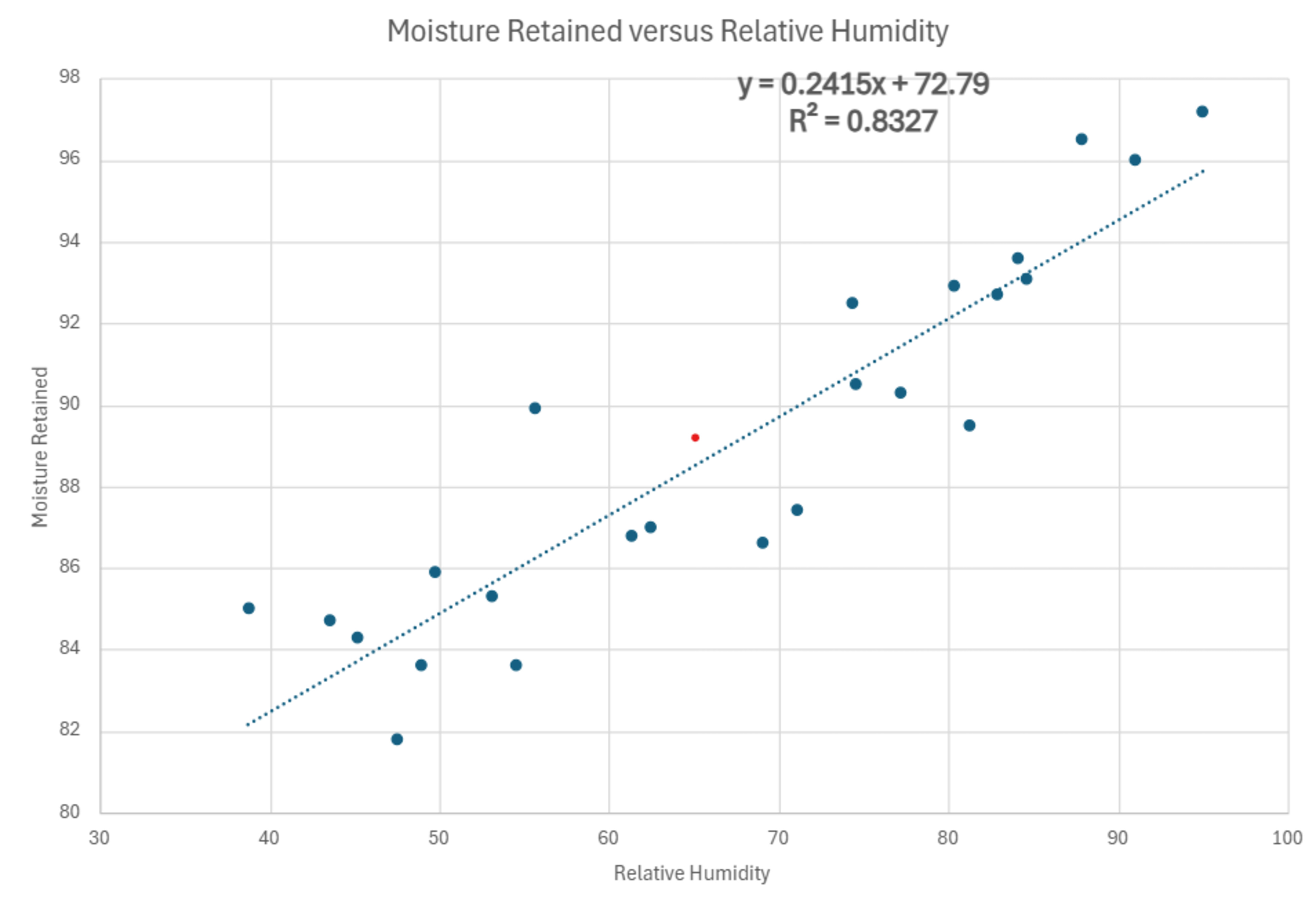
That said, this relationship begins to weaken as the relative humidity climbs past a certain threshold. The following graph traces the relationship between Vapor Pressure Deficit (VPD) and relative humidity. VPD is a metric used to quantify the difference between the current amount of moisture in the air and the air's maximum potential for holding moisture. When the VPD is at its highest, relative humidity is at its lowest, and the surrounding air is at its driest. As such, if you were to place produce with a high water content (like celery) within this space, this moisture will evaporate readily into the surrounding environment.
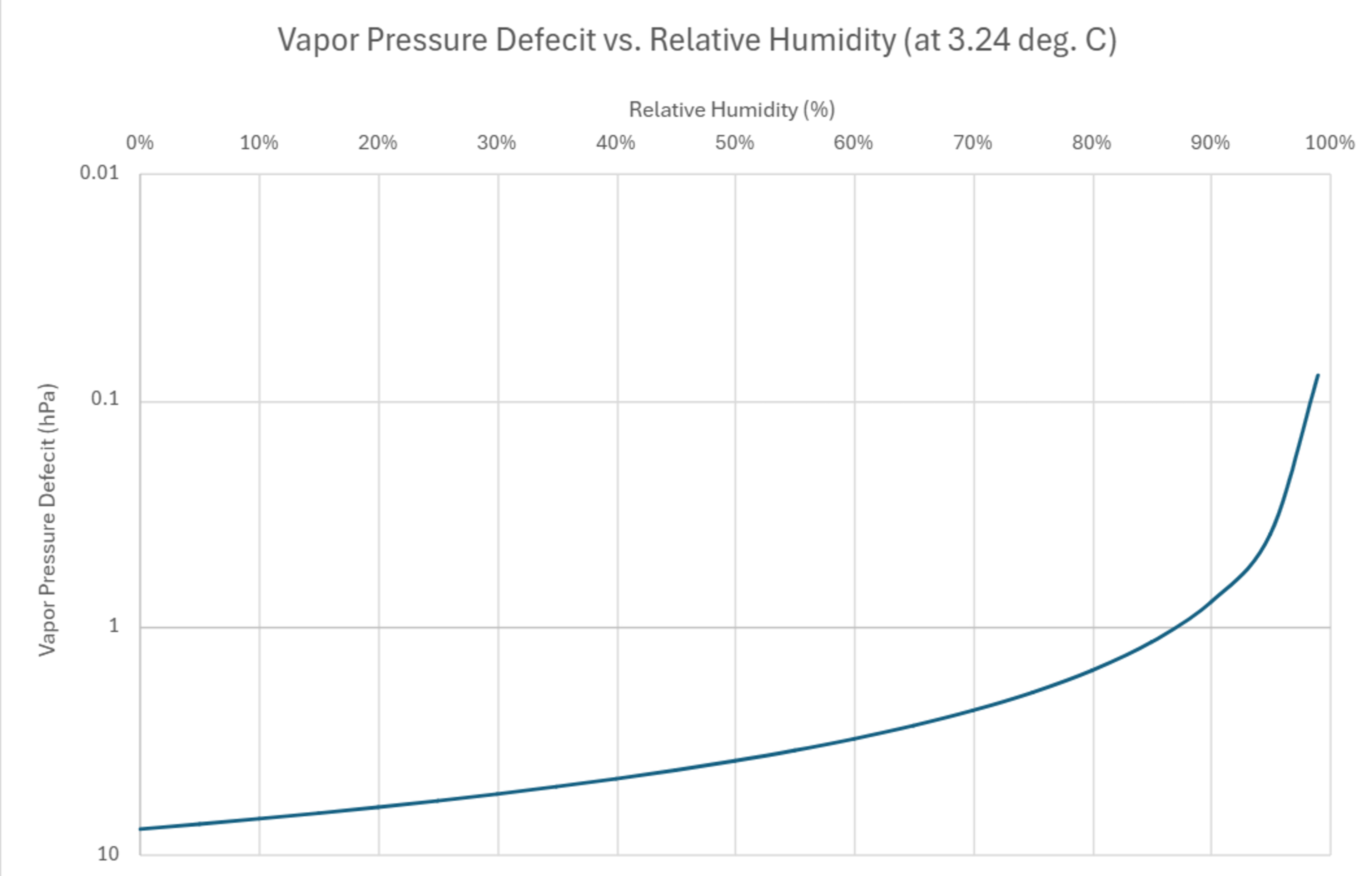
As relative humidity climbs past 80% or so, VPD decreases sharply as the air is brought closer to its saturation point, and produce doesn't transpire moisture nearly as quickly. This phenomenon explains why there's very little difference in performance in this respect near the top end of our results. For instance, consider the difference between the Bosch 500 Series B36FD52SNS and the Bosch 800 Series B36CT80SNS.
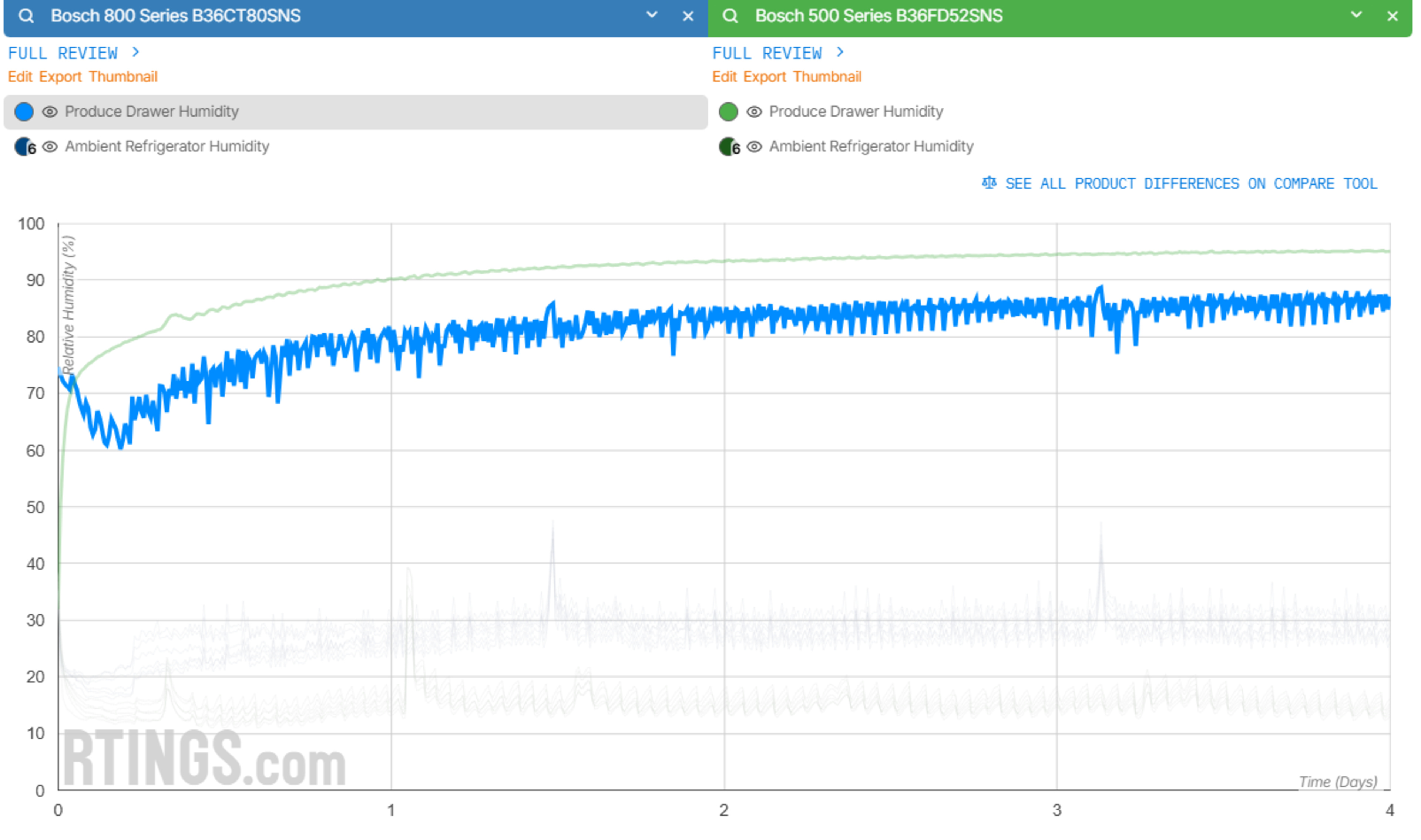
The 500 Series can maintain a higher produce drawer humidity level of 93.7% while the Bosch 800 Series B36CT80SNS keeps the same space at 83.8% relative humidity. Despite this approximately 10% difference, both units achieve near-identical produce moisture retention levels, with the former keeping produce at 97.2% moisture retention at the end of the testing period and the latter keeping it at 97.4%. At this level of surrounding humidity, variance in moisture retention comes down to the produce itself: we source our celery from grocery stores, not identically sized and cultivated specimens from labs, and as a result, we can't expect perfect replicability from these samples.
Produce Drawer Humidity Level
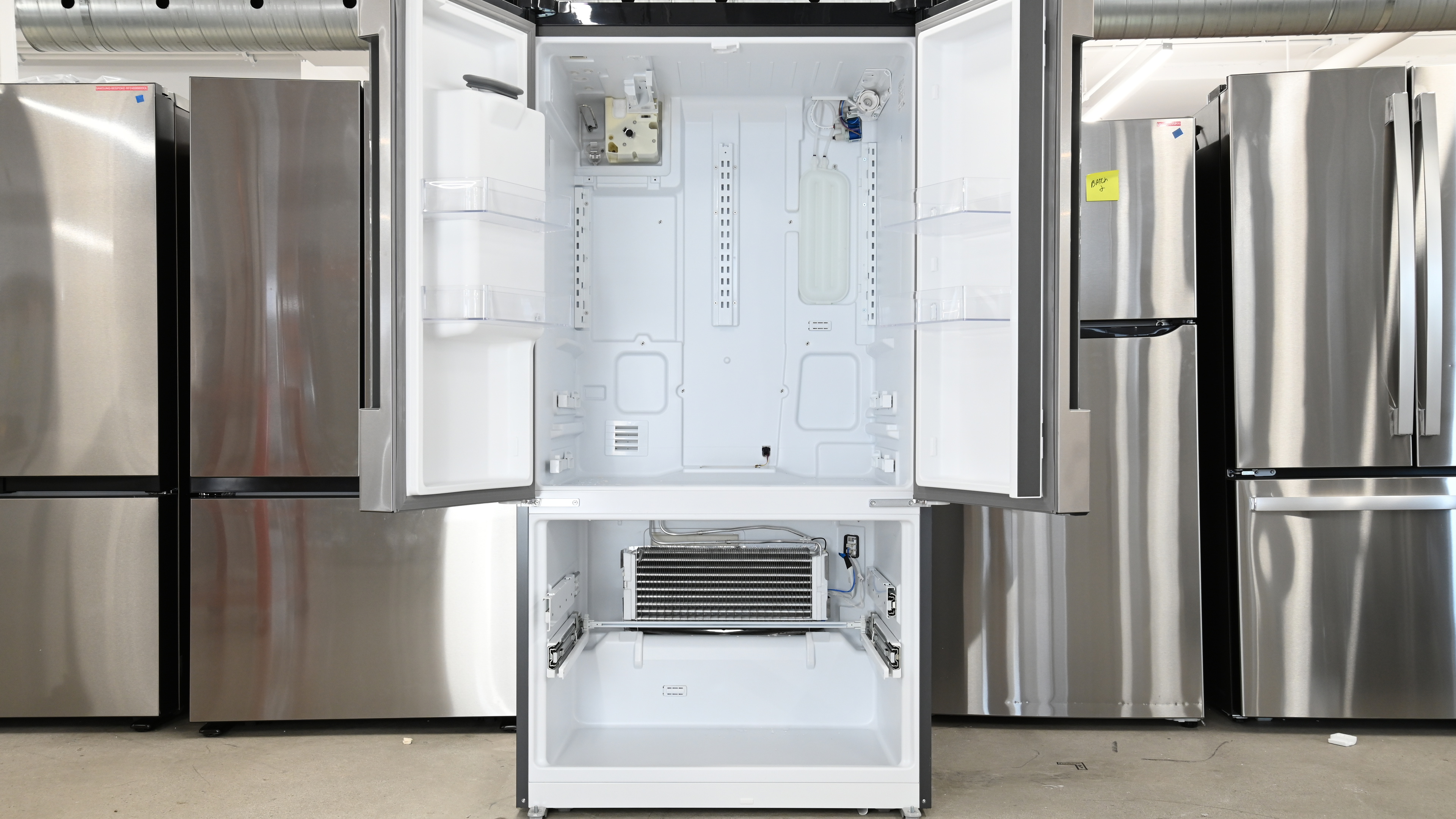
The Produce Drawer Humidity Level section of the test measures the relative humidity of the produce drawer over time. It's also the aspect where the quality of the produce drawer's seals is most important. Below is a comparison of the produce drawer humidity level between the Bosch 500 Series B36FD52SNS and the Bosch 100 Series B36FD10ENS. Mechanically speaking, these refrigerators are extremely similar in design. They use the same Embraco VESC11 compressor and the same single-evaporator configuration, and have effectively identical vent layouts for distributing cool air.
 |
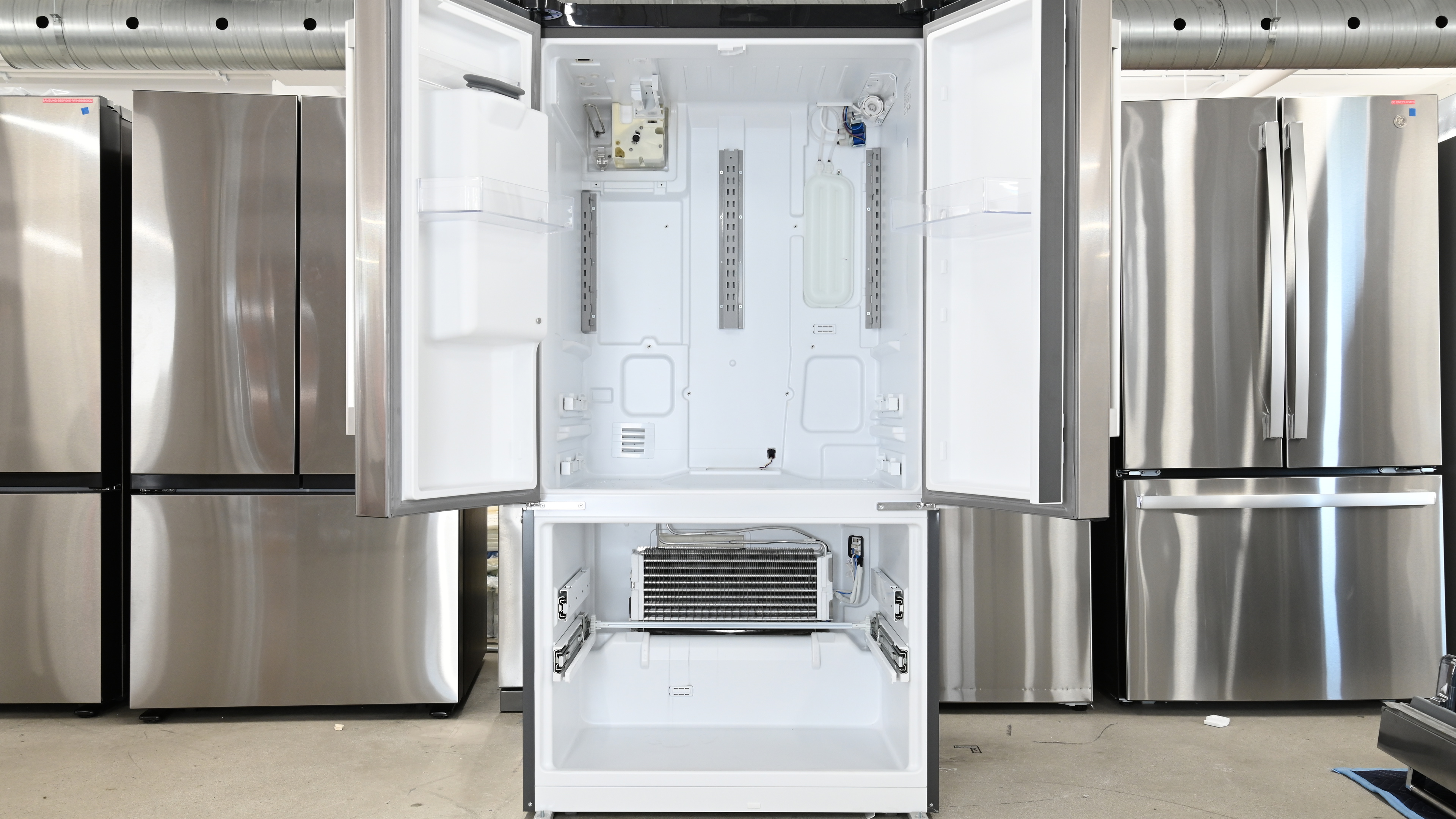 |
That said, because the 500 has an additional slider that allows you to lower a lid to effectively seal the produce drawer completely, it preserves humidity more effectively than the somewhat loosely fitting drawer of the 100 Series.
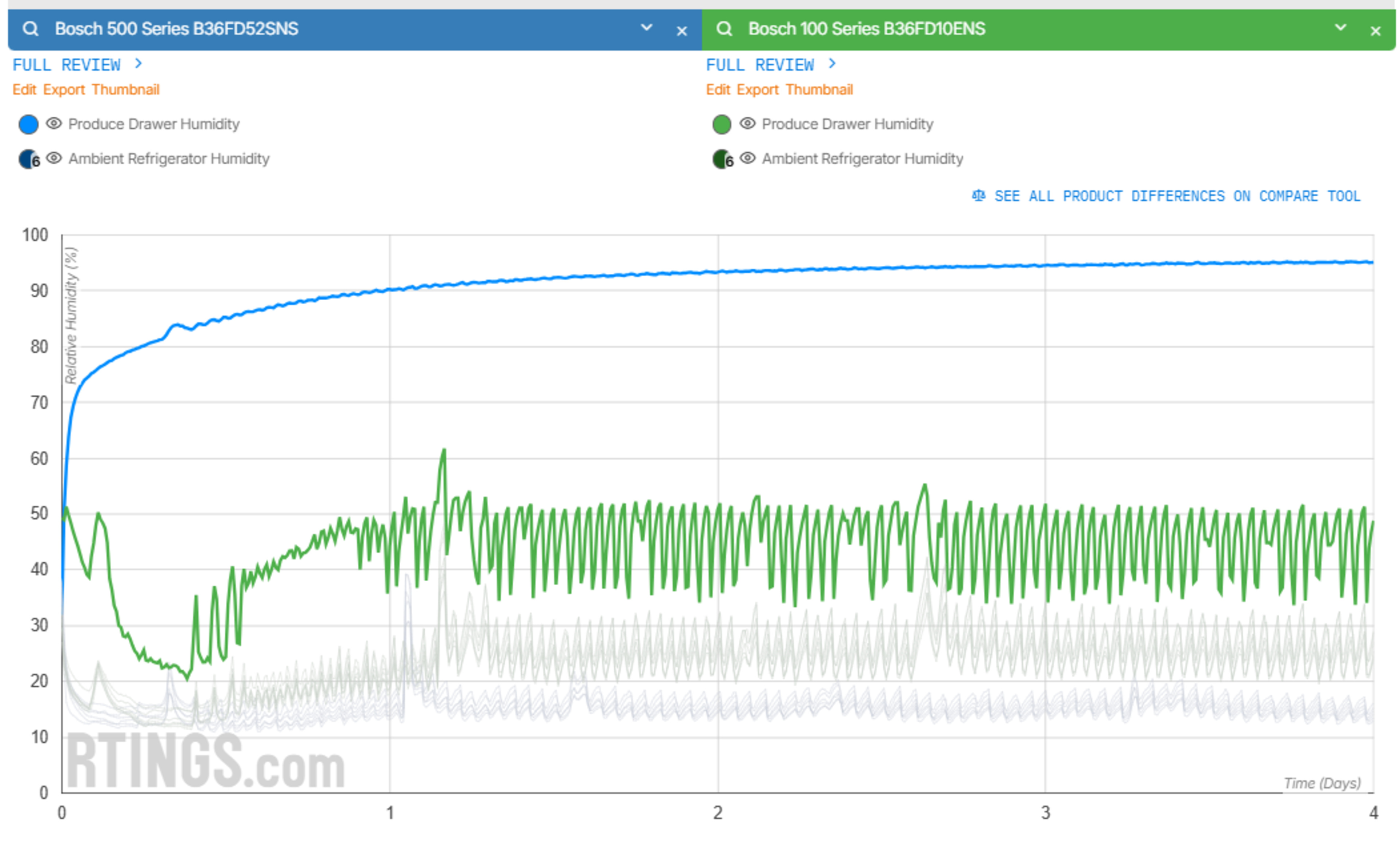
It's important to note that the bulk of the moisture in the air comes directly from the produce stored inside. As the celery stalks lose their moisture, it evaporates into the surrounding environment. Inside the relatively small volume of the crisper drawer, this drastically increases the relative humidity of the environment. However, as moisture escapes from the crisper drawer moisture from the produce drawer, it's diluted by the much larger volume of the main refrigerator cabinet, which leads us on to the next test section.
Fridge Compartment Humidity Level
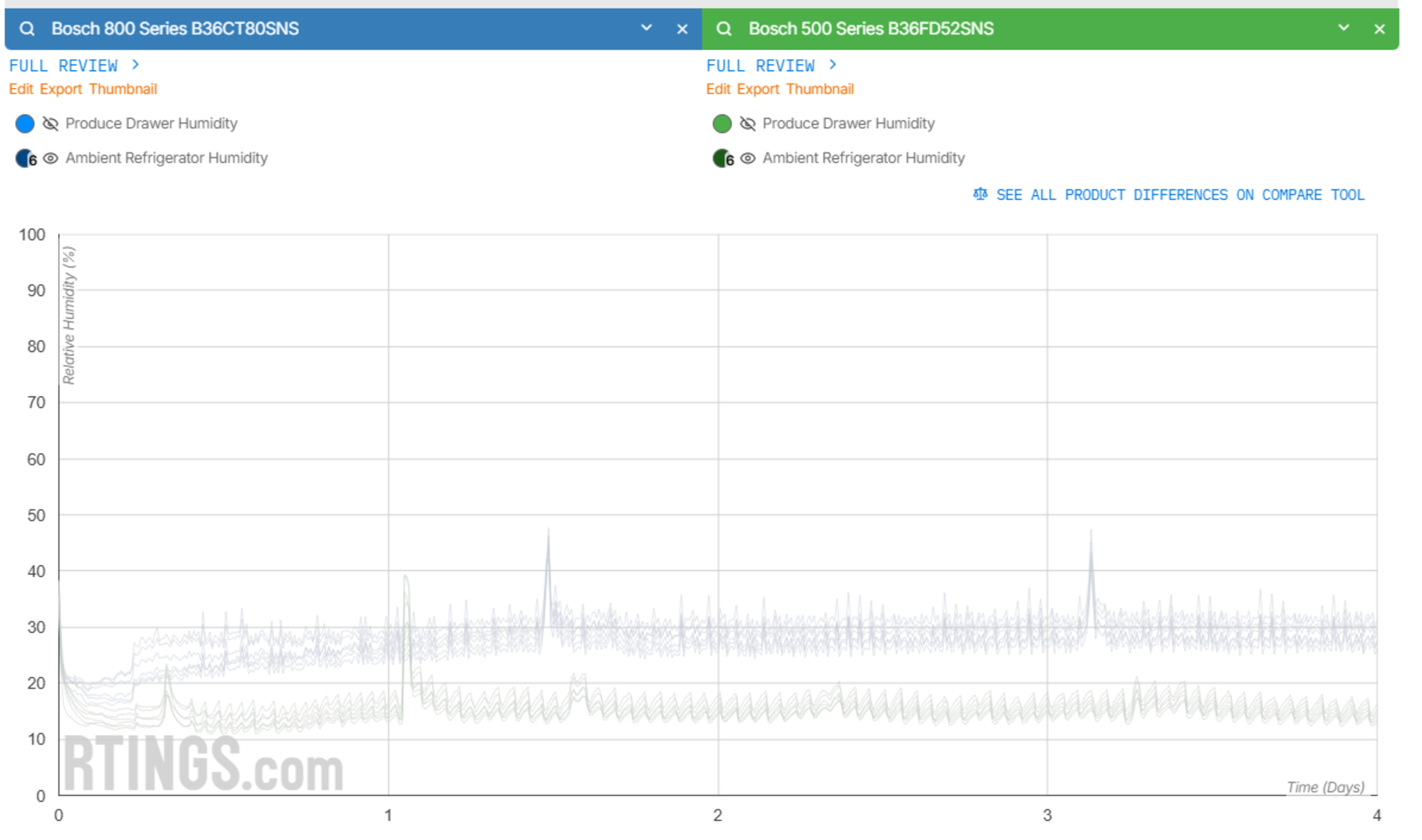
The Fridge Compartment Humidity Level section of the test measures the level of humidity inside the main fridge cabinet over time and is where the evaporator configuration of a given fridge is most important. Many budget and mid-range refrigerators use single evaporators, where cool air from an in-freezer evaporator travels into the fridge compartment and back again. Usually, these configurations are set up to minimize humidity, as this prevents frost from building up within the freezer. The flip side of this arrangement is that it can cause produce stored inside the main fridge cabinet to dry out, as discussed earlier. The main on-paper advantage of a dual-evaporator unit is that each compartment can have different humidity levels: low moisture content in the freezer to inhibit frost buildup, and high moisture content in the fridge to extend the lifespan of produce, even when it's stored outside the crisper drawer.
While the aforementioned Bosch 500 Series is an outlier in terms of produce drawer humidity level, the disadvantage of its single-evaporator design is very noticeable when examining the level of humidity inside its main fridge compartment when compared to the dual-evaporator Bosch 800 Series B36CT80SNS. As a result, delicate greens (like celery stalks) won't last as long when stored outside the crisper drawer.
Conclusion
To summarize, produce preservation is based largely on a fridge's capacity to prevent moisture from evaporating from delicate foodstuffs with a high moisture content. While this is mostly influenced by the placement of said produce within a refrigerator, manufacturers can improve performance in this regard with design choices like well-sealing crisper drawers or more drastic measures like separate evaporators for fridge and freezer compartments.