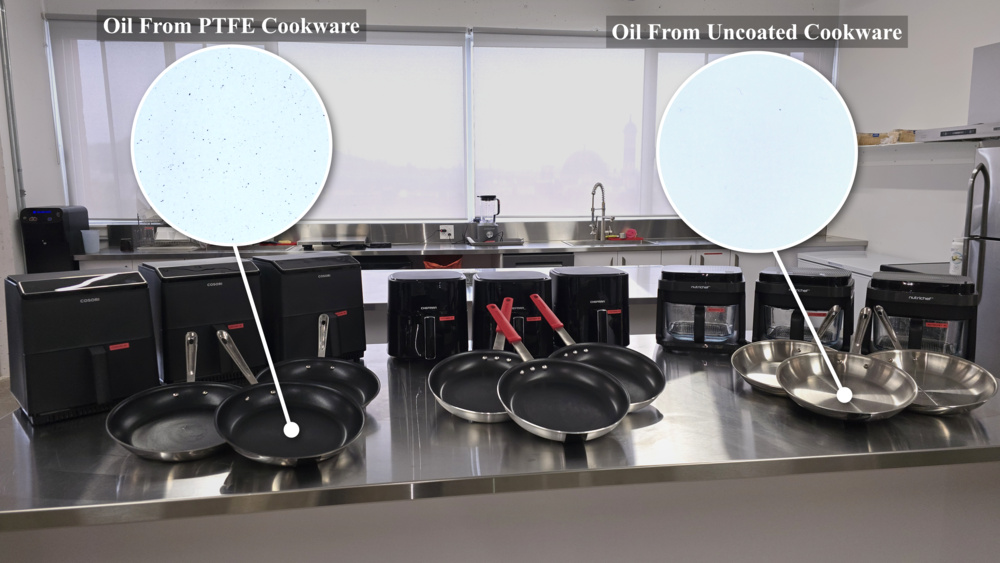
- Advice about nonstick cookware tells you that they are safe to use as long as the coating isn't scratched, peeling, or visibly damaged
- Our testing found that even brand new PTFE cookware can shed particles into food and that price is also not a reliable indicator of how much coating may be released.
- Consumers wanting to to minimize exposure to PTFE coating particles should treat nonstick cookware as a specialized tool rather than a default choice.
Most advice about nonstick cookware follows a simple rule: as long as the coating isn't scratched, peeling, or visibly damaged, it's considered safe to use. Consumers are often told to avoid overheating nonstick pans, avoid metal utensils, and replace cookware once the coating begins to wear out.
We wanted to test that advice. Can particles from a PTFE nonstick coating enter cooking oil during normal use, even before obvious damage appears?
To find out, we purchased new PTFE-coated skillets and air fryer baskets, stirred avocado oil in them using a plastic spoon, and filtered the oil to look for particles released from the cookware. We also tested uncoated cookware and oil-only controls to help account for background contamination from the oil, utensils, filtration process, and environment.
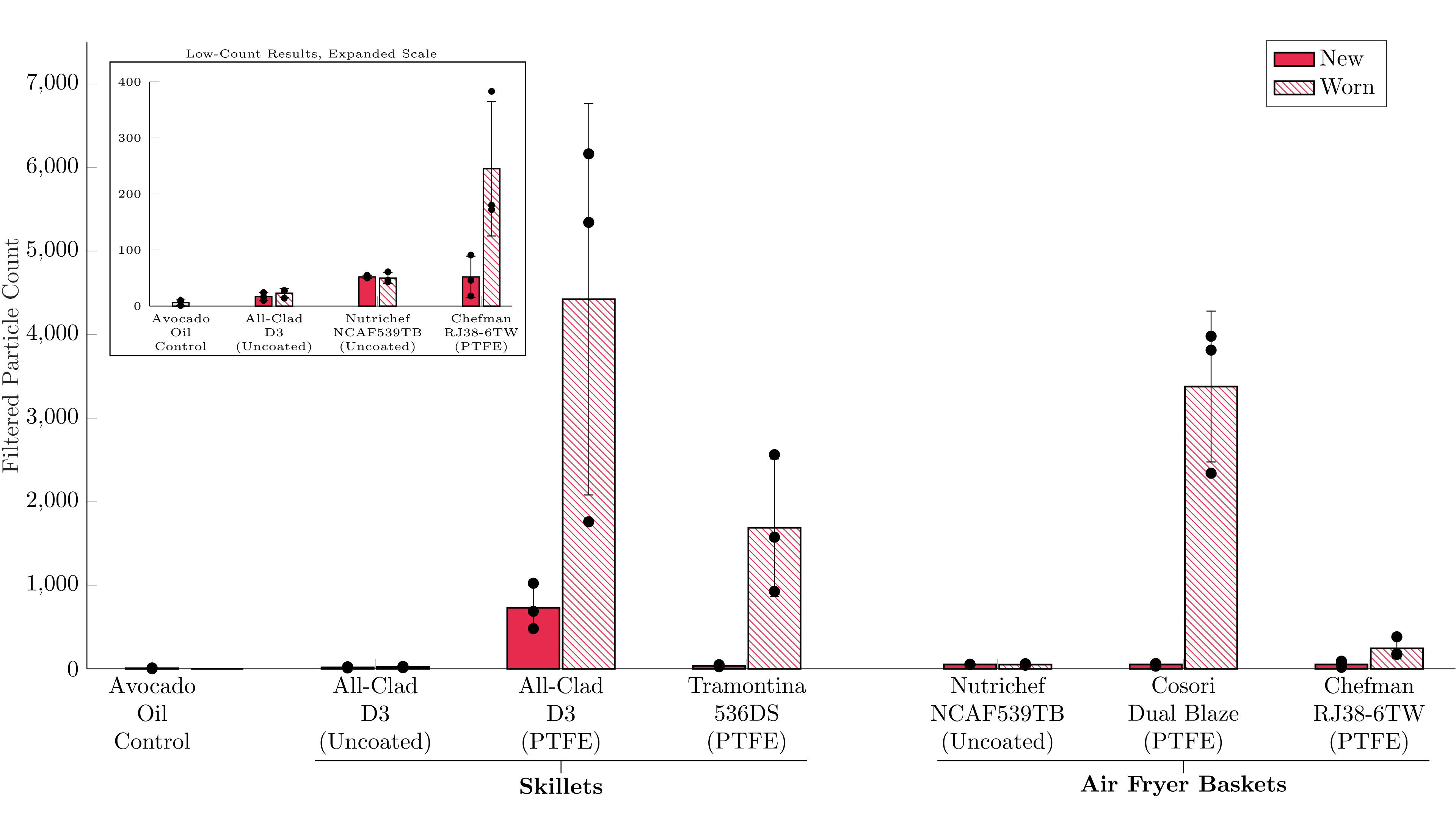
We found that some PTFE-coated cookware released substantially more filter-visible particles than the controls, even when brand new. After a standardized wear procedure, every PTFE-coated product we tested released more particles than it had in its new condition. Surprisingly, the largest increases occurred in two of the highest-priced PTFE-coated products we evaluated.
This study measured particle shedding, not health effects. We did not investigate whether ingesting these particles is harmful. However, our findings suggest that PTFE coatings may begin shedding material before visible damage appears, and that particle release can increase substantially as the coating wears.
How We Tested
We tested six cookware products across two categories: skillets and air fryer baskets. Within each category, we compared an uncoated control with lower-cost and higher-cost PTFE-coated products. Each product was tested in triplicate, for a total of 18 individual pieces of cookware.
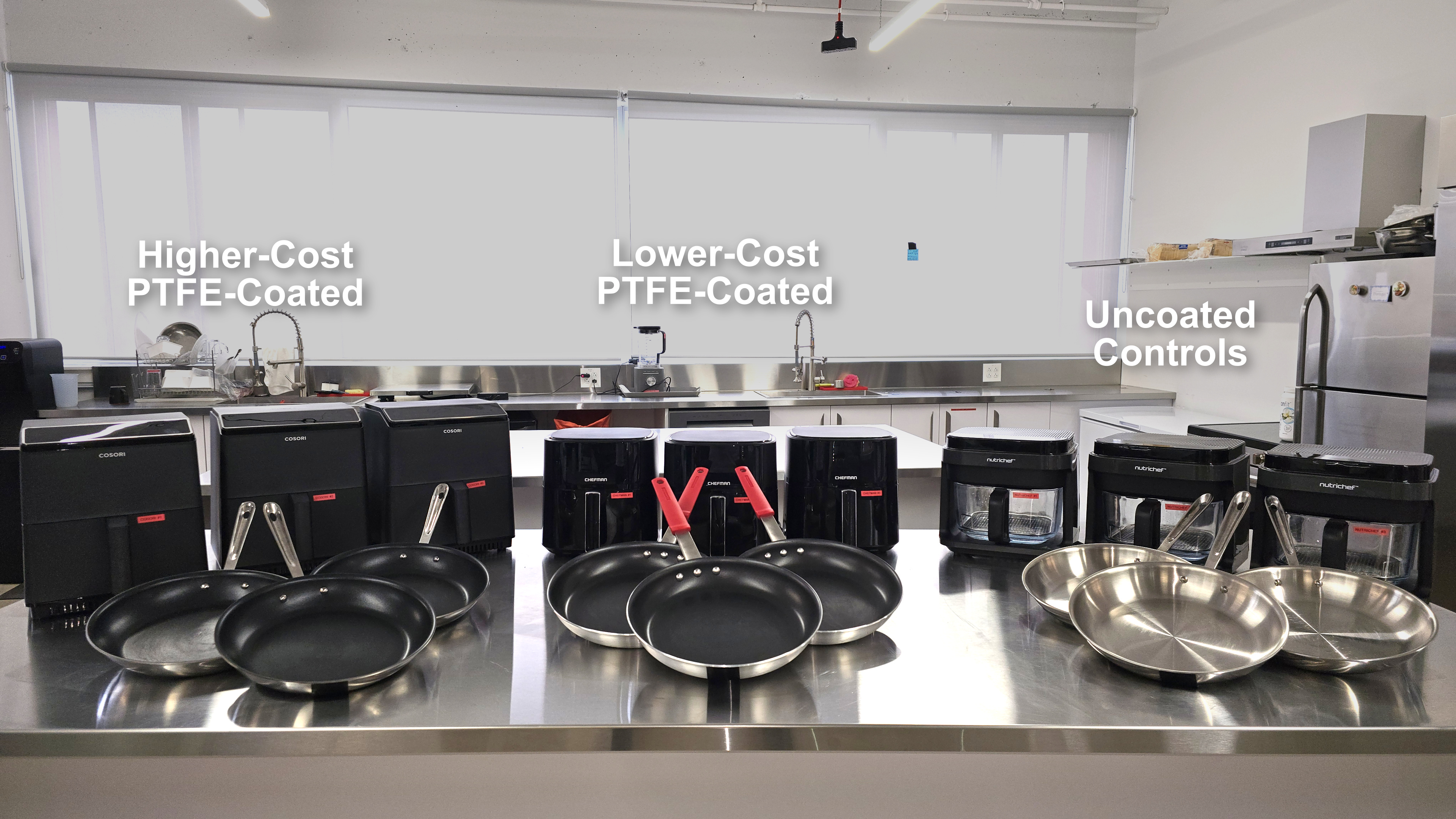
We stirred avocado oil in each item using a plastic spoon, filtered the oil through a 5 µm membrane, and photographed any recovered particles. Because the particles were identified visually rather than chemically, the results should be interpreted as filter-visible particle counts recovered under our test conditions. We also tested oil blanks and uncoated cookware controls to help account for background contamination. Each product was tested both when new and again after a standardized wear procedure.
New PTFE-Coated Cookware Can Shed Particles Before Visible Wear
We began by testing the cookware in its new condition. Before testing, each item was washed and rinsed three times to remove loose residue from manufacturing, packaging, and shipping.
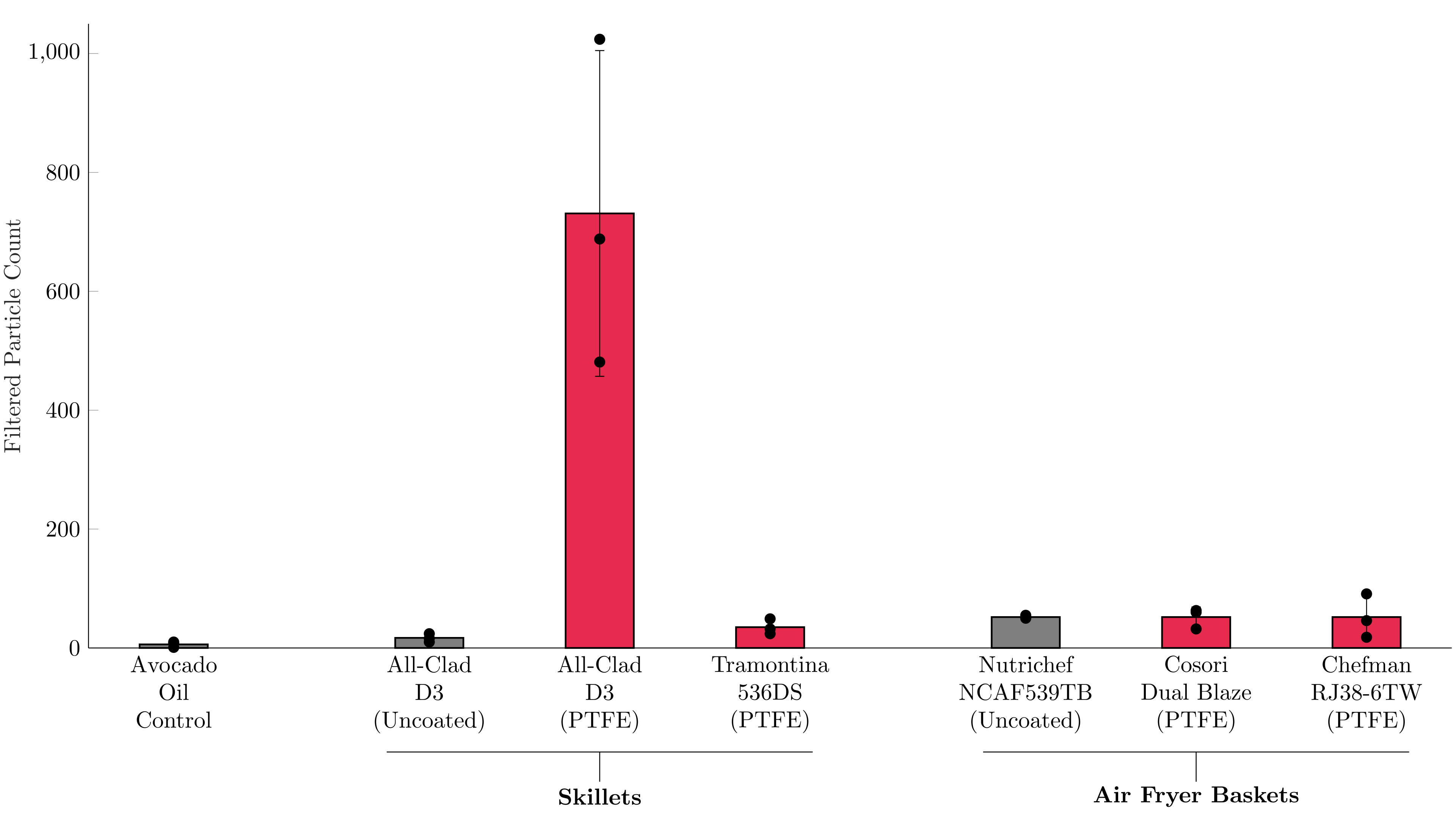
Common advice treats visible damage as the main warning sign for PTFE cookware: avoid using a pan once the coating is scratched, peeling, or worn. But our results show that particle shedding can occur before that point, while the coating still appears intact. The new All-Clad D3 PTFE skillets released far more detectable particles into cooking oil than the avocado oil control samples, the uncoated All-Clad stainless-steel skillets, and the other new cookware we tested.
These tests followed the common recommendation to avoid metal utensils with PTFE cookware. Even with only a plastic spoon used for stirring, the All-Clad D3 PTFE skillets released enough particles to be visible to the naked eye on the membrane filters.
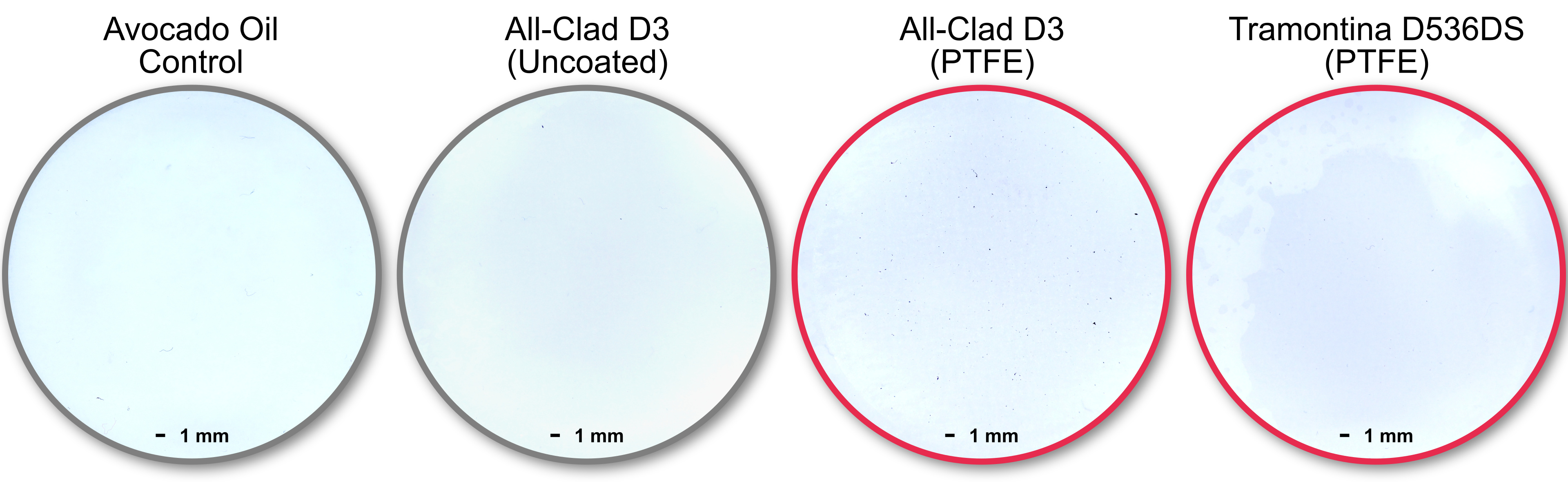
The new Tramontina PTFE skillets and PTFE-coated air fryer baskets didn't show the same new-condition pattern as the All-Clad skillets. Their particle counts were closer to the uncoated Nutrichef air fryer basket controls. However, that changed after wear, as the next section shows.
Mechanical Wear Increased Shedding From The Coated Products
After the new-condition test, we subjected each PTFE-coated product to a standardized mechanical wear procedure using sandpaper and scratch-test pens. The cookware was then washed and rinsed three times before the oil-stirring and filtration test was repeated.
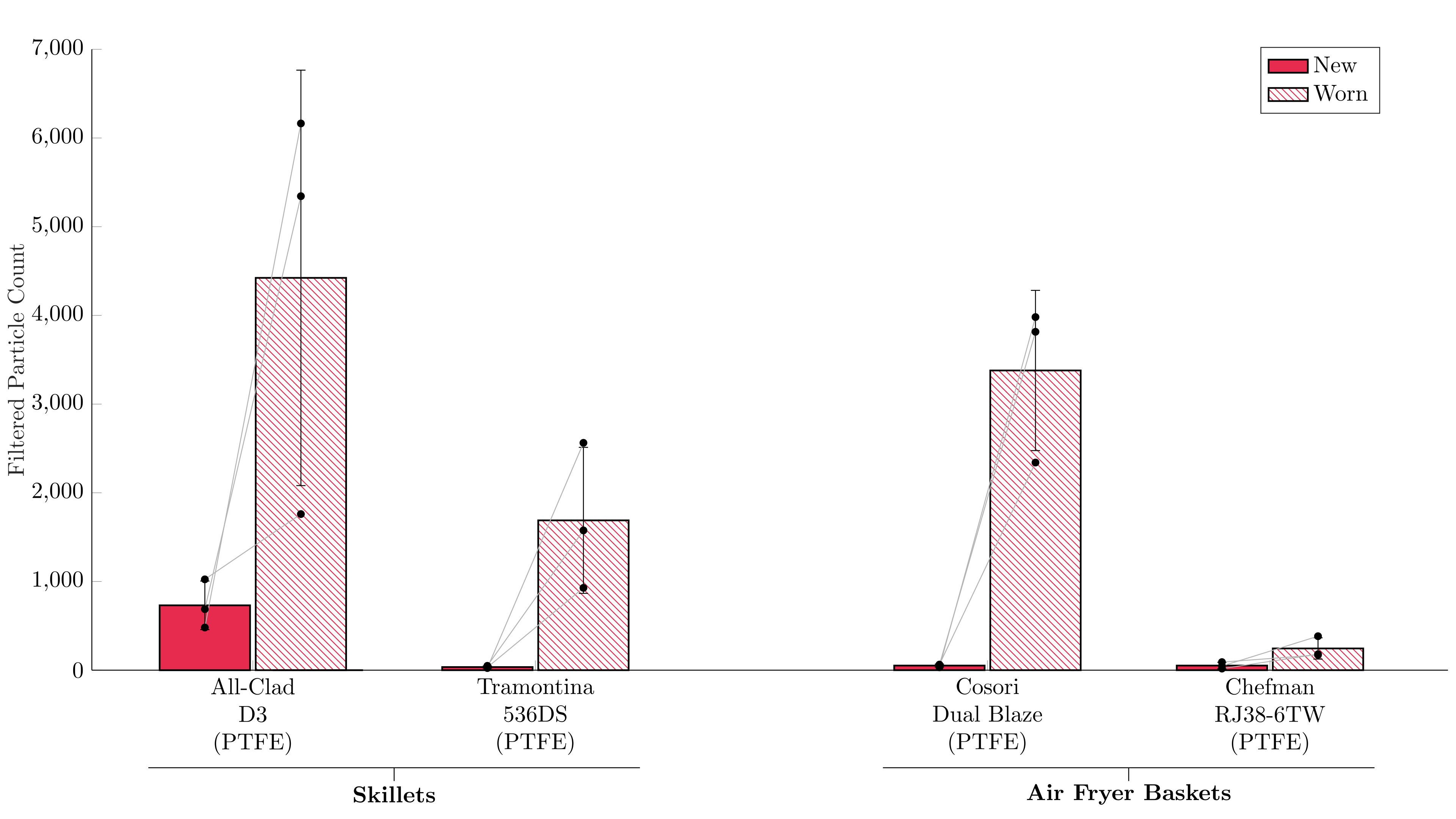
Our results show that the common advice to avoid using damaged nonstick cookware is grounded in a real phenomenon: wear increases particle shedding from every PTFE-coated product we tested. In the paired comparisons, every individual PTFE-coated skillet and air fryer basket released more particles after undergoing the wear procedure. The largest increases occurred in the All-Clad D3 PTFE skillets and Cosori Dual Blaze air fryer baskets, which were also the highest-cost coated products in our test set.
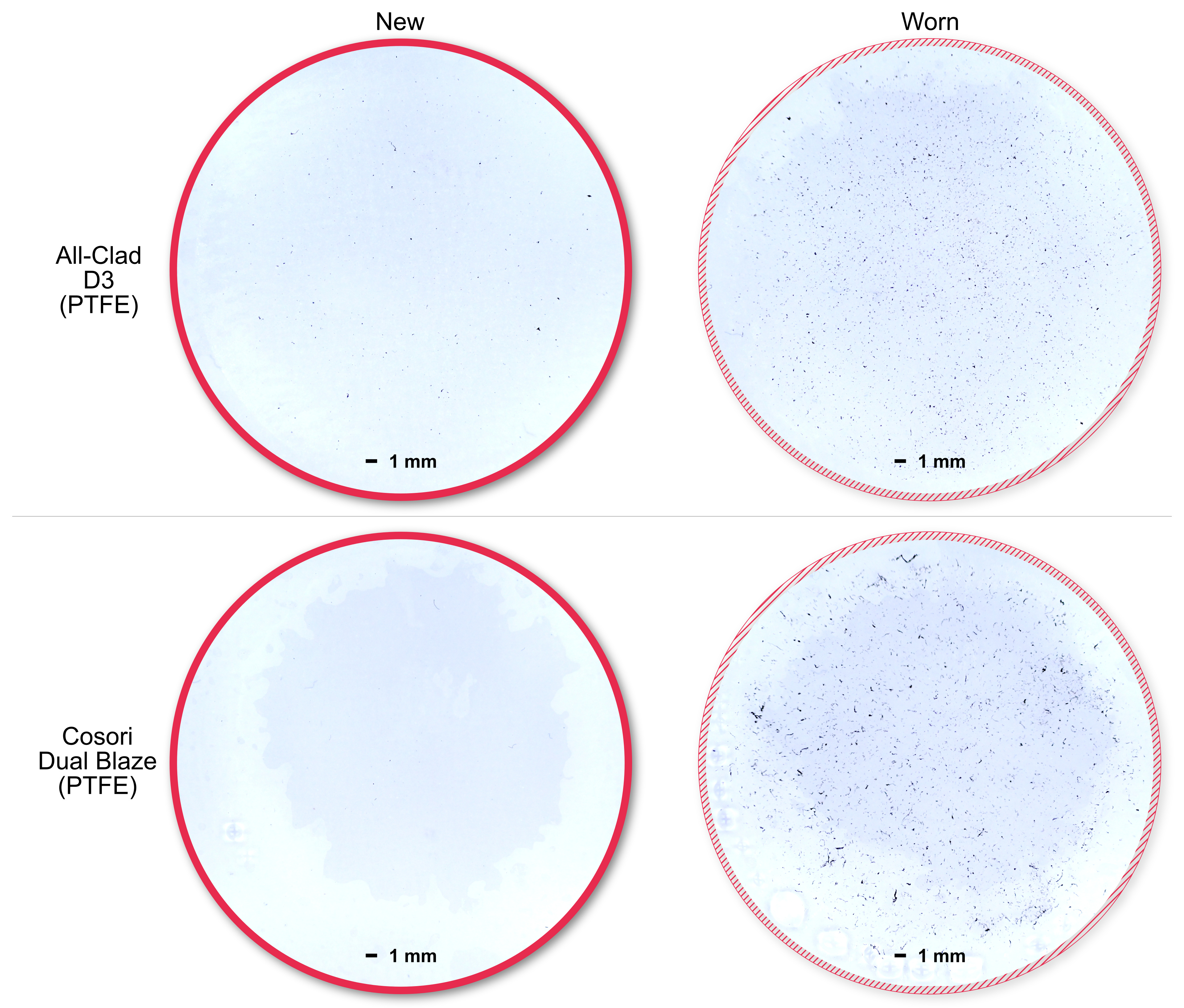
The representative membrane-filter photographs below provide a visual illustration of this trend. Compared with the new-condition samples, the worn-condition filters contained noticeably more dark particles, reflecting the higher particle counts measured after wear.
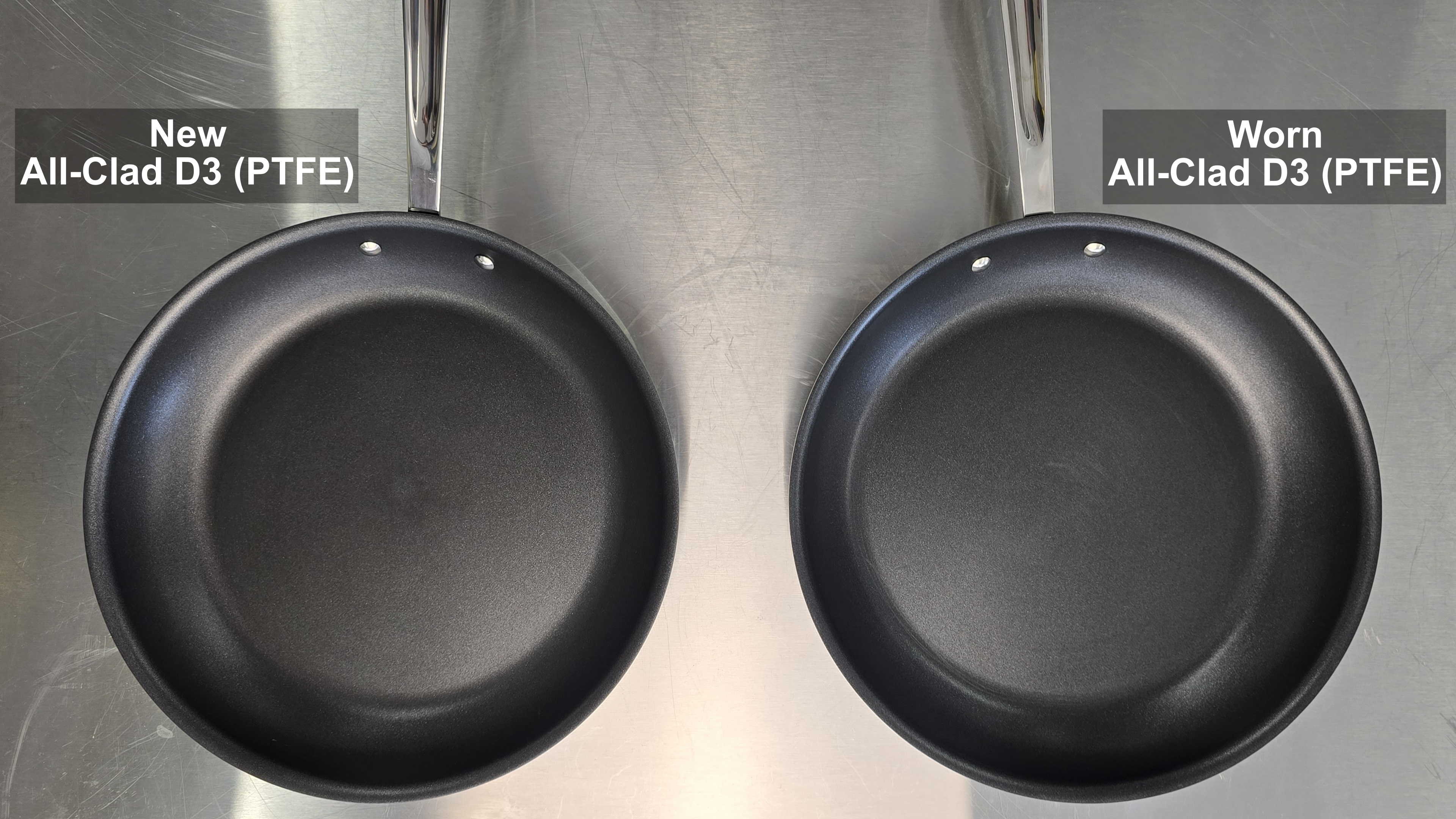
The challenge with the common recommendation to replace nonstick cookware once it becomes visibly damaged is that "visible damage" is not a clearly defined threshold. In our tests, the wear procedure produced only minor-looking scratches on the nonstick skillet coatings. Many consumers would likely view this level of damage as cosmetic and continue using the cookware. Yet even this relatively modest wear substantially increased the number of particles released into the oil.
The Higher-Cost Skillet Shed More, Not Less
Many consumers assume that more expensive nonstick cookware will have more durable coatings. That seems like a reasonable expectation, given that higher-priced cookware is often marketed as premium, long-lasting, or built to withstand years of cooking. Based on that logic, we expected the higher-cost PTFE-coated cookware in our test to shed fewer particles than the lower-cost alternatives.
Instead, we observed the opposite pattern amongst the skillets. The higher-cost All-Clad D3 PTFE skillet released substantially more detected particles than the lower-cost Tramontina PTFE skillet in both the new and worn conditions. This difference was apparent not only in the particle counts but also in the representative membrane-filter photographs.
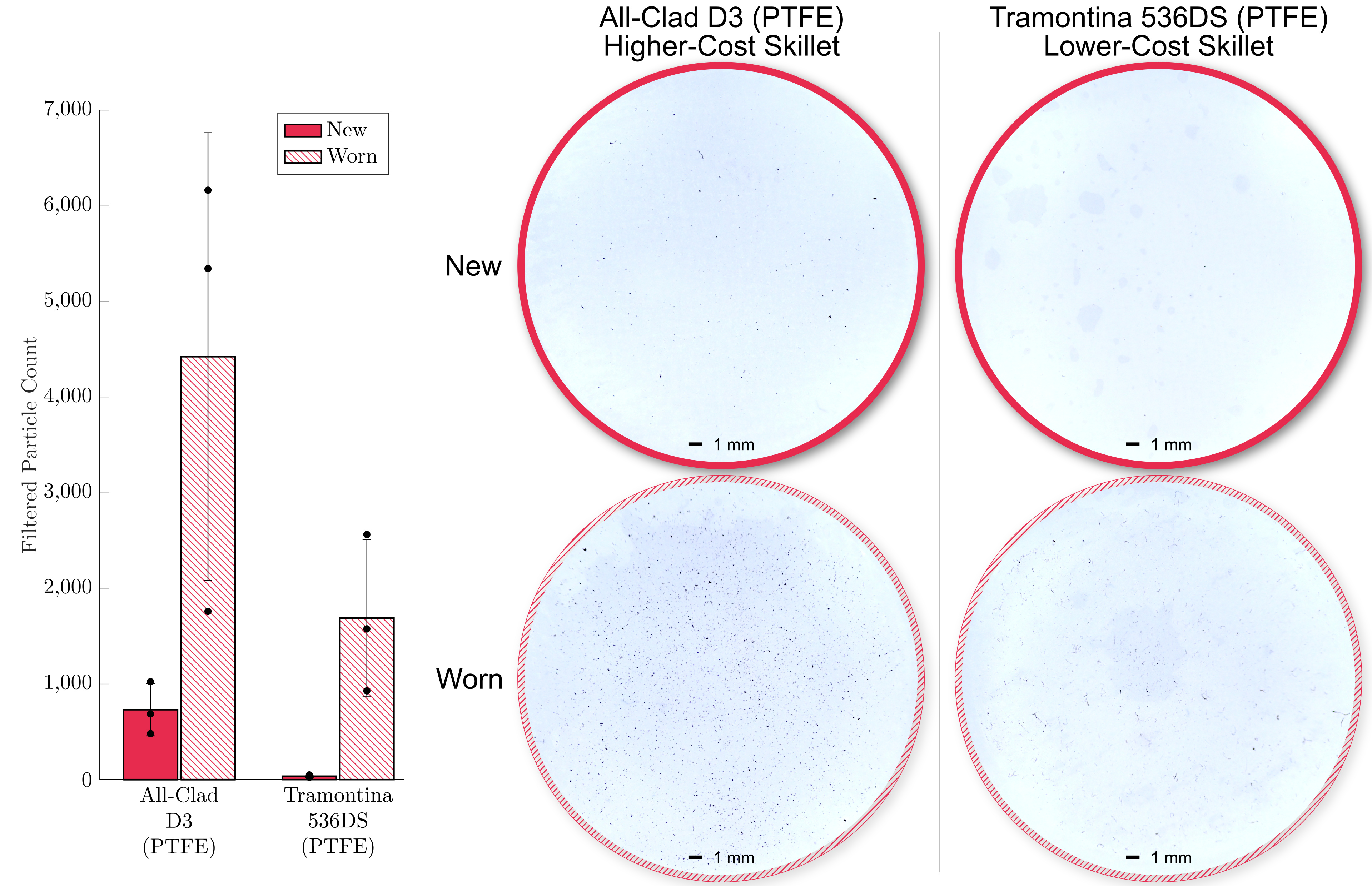
The finding highlights an important distinction between durability and particle release. A coating can appear durable and resist obvious failure while still shedding material from its surface during normal use. In our tests, the higher-priced skillet did not exhibit lower particle shedding despite its premium positioning.
One possible explanation is surface texture. During handling, the All-Clad coating felt noticeably rougher than the Tramontina coating. A rougher surface may contain more raised features or exposed edges that can be sheared off during use, although our imaging was not sufficient to confirm that mechanism directly. If so, even a plastic utensil could remove small particles from the coating surface. Abrasion and scratching could further amplify this effect by creating additional exposed edges and partially detached coating features.
This result does not mean that all expensive nonstick cookware sheds more particles than lower-cost alternatives. Instead, our findings suggest that factors such as coating design, surface texture, and wear behavior may matter more than price alone. Viewed through that lens, nonstick coatings may be better understood as consumable surfaces that gradually shed material over their service life rather than as permanently robust surfaces.
Most Detected Particles Were Small, Not Visible Flakes
Consumers are typically advised to replace nonstick cookware when the coating begins peeling or flaking. Implicit in that advice is the idea that coating loss into food should be obvious when it occurs.
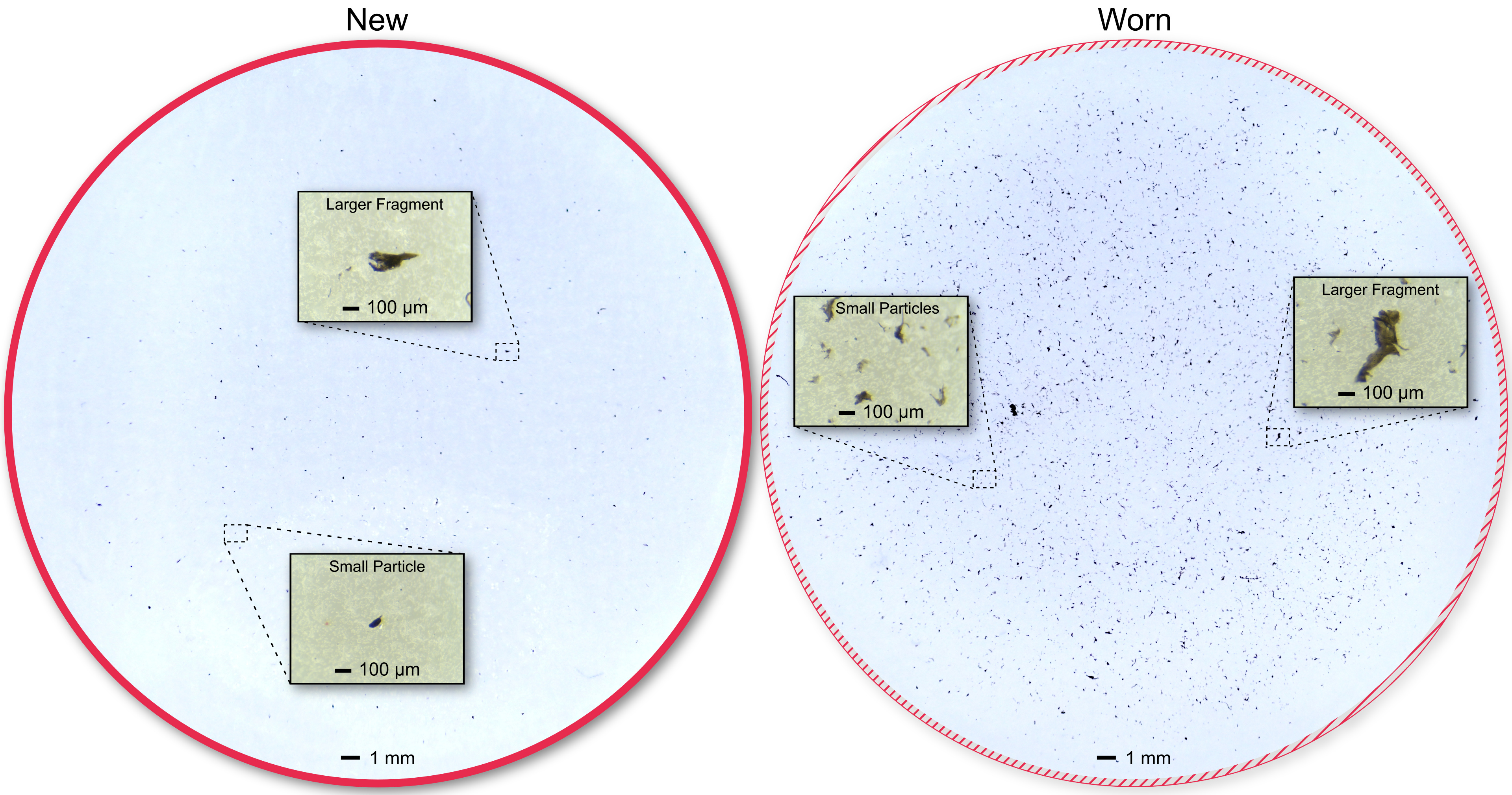
Our results suggest a different picture. To better understand the size of the released particles, we analyzed those recovered from the All-Clad D3 PTFE skillet, which produced the highest particle counts in our testing. In both the new and worn conditions, the particle population was dominated by relatively small particles rather than large visible fragments.
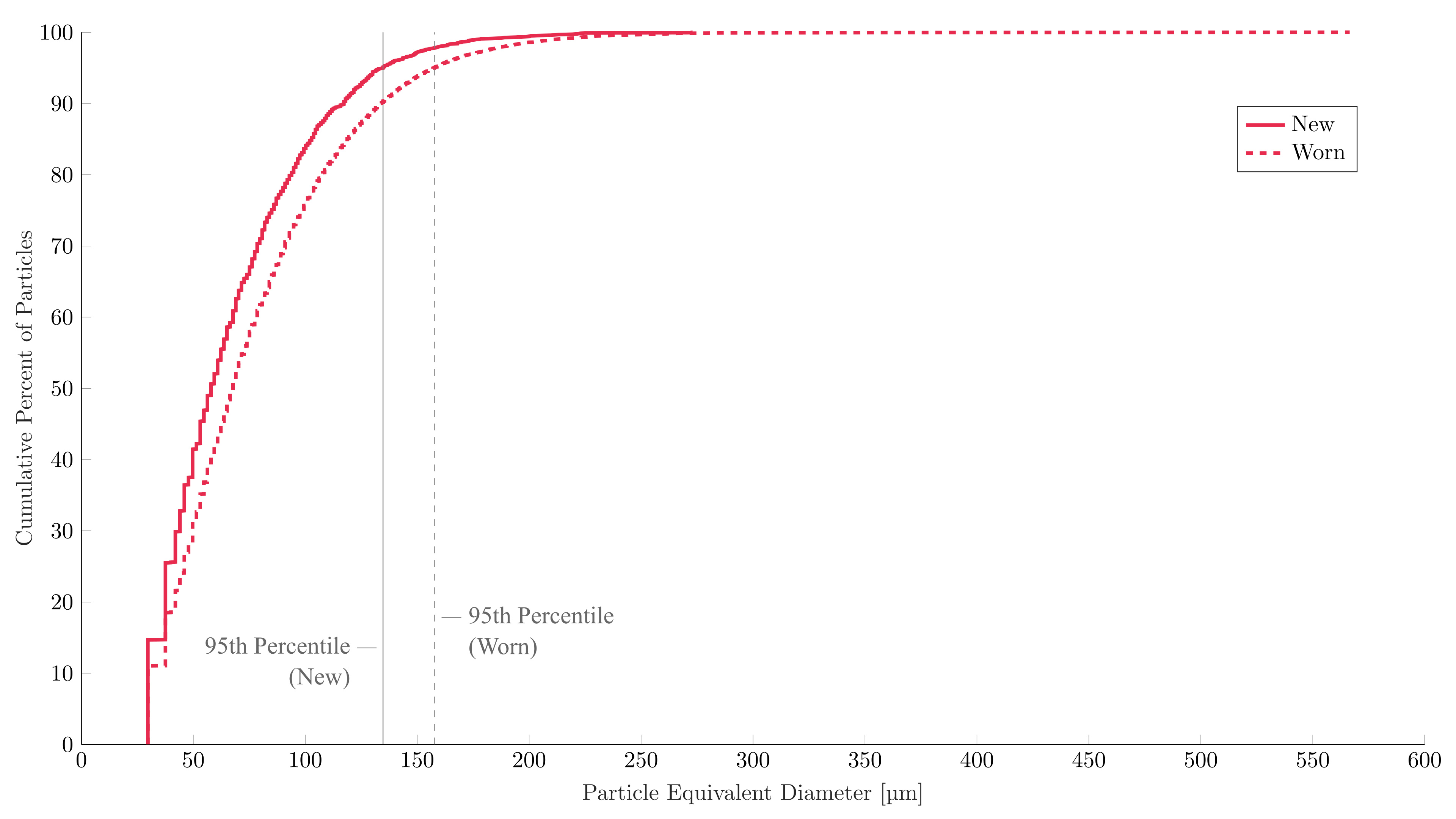
In the new condition, 95% of detected particles had an equivalent diameter below 135 µm, or about one-seventh of a millimeter. Mechanical wear shifted the distribution toward larger particle sizes, but even after wear, 95% of detected particles remained below 158 µm. In other words, the particle population was still dominated by relatively small particles rather than large visible chips.
That distinction matters because visible flaking is commonly treated as the warning sign that a nonstick pan should be replaced. Our results suggest that visible flakes may represent only the most obvious form of coating loss. Many of the particles recovered in our testing were small enough that they would likely go unnoticed in cooking oil or food, even though they were readily captured on the membrane filters.
The Takeaway: Nonstick Coatings Are More Consumable Than Durable
Cookware companies often describe nonstick coatings as durable, premium, reinforced, or safe when used as directed. Our results suggest a different way to think about PTFE coatings: as consumable surfaces that can shed material during their normal use.
In our tests, particle release was not limited to severe damage, misuse, or contact with metal utensils. We stirred avocado oil with a plastic spoon and then filtered the oil through membrane filters. Under those conditions, we recovered filter-visible particles from PTFE-coated cookware. Even brand-new cookware shed detectable particles, and particle counts increased after standardized wear. Importantly, most of the detected particles were small rather than large visible flakes, suggesting that coating loss may not always be obvious to the cook.
The results also challenge the assumption that more expensive nonstick cookware will necessarily release less material. In our skillet testing, the higher-cost All-Clad D3 PTFE pan shed substantially more particles than the lower-cost Tramontina pan. More broadly, this finding highlights an important distinction between durability and particle shedding. A coating can appear durable and resist obvious failure while still gradually losing material during normal use.
This study measured particle release, not health risk. We did not investigate what happens after ingestion, measure chemical exposure from the particles, or translate particle counts into health outcomes. However, our findings indicate that PTFE coatings can release particles during normal use, and shedding increases with wear.
For consumers who wish to minimize potential exposure to PTFE coating particles, the simplest approach may be to treat nonstick cookware as a specialized tool rather than a default choice. Instead, reach for uncoated cookware, such as stainless steel, cast iron, carbon steel, or glass, whenever practical.
Read The Full Methodology
For readers interested in the detailed test procedures, contamination controls, imaging methods, and particle-analysis workflow, we have published the complete methodology separately.