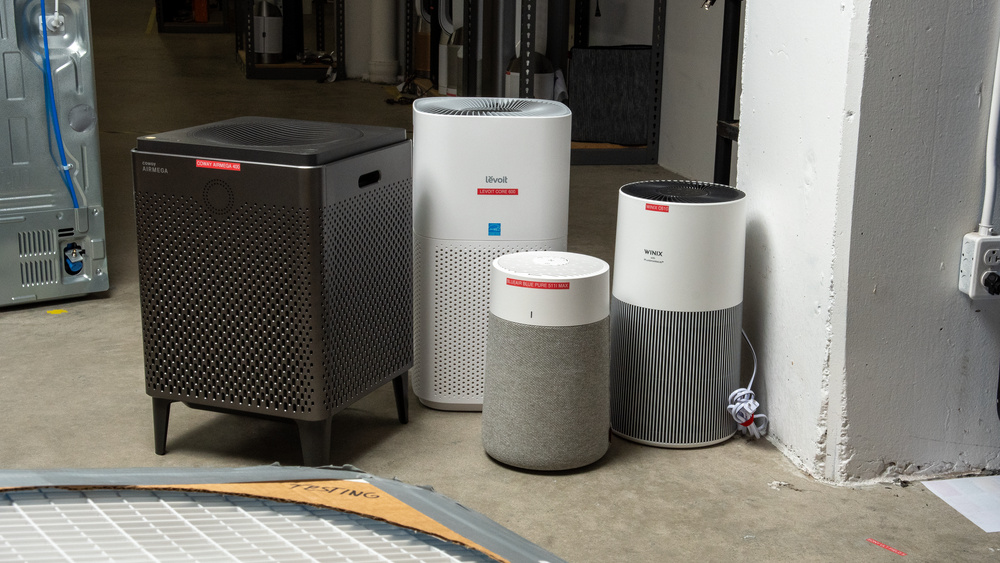
Basements can be challenging environments for household air purifiers to operate in. Even smaller basements tend to have more square footage to cover than the average large room, so something that provides a high clean air delivery rate (CADR) is required. Beyond that, an air purifier in a basement will need to contend with dust, pet dander, and, in worst-case scenarios, mold spores; thankfully, these particles tend to be on the larger side, and most units with HEPA-grade or even near HEPA-grade filtration systems will be up to the task. If you don't want to have to go into your basement and fiddle with settings every now and then, particle sensors and an automatic fan speed adjustment feature are nice added touches that can make for a more pleasant user experience.
We've tested more than 50 air purifiers, and below are our recommendations for the best air purifiers for basements based on our test results. Here are the most important things to look for:
- Clean Air Delivery Rate (CADR): Basements, as a general rule, tend to be bigger than most other spaces in your home, with even smaller partial dens typically being upwards of 500 ft2 (46.5 m2). A CADR higher than 320.0 (543.7 m3/hr) is a pretty good starting point, but look for higher if you have an open-concept space. If you want an idea of how well-suited an air purifier is to your given space, take a look at our room sizing tool.
- Features: Air quality sensors and built-in Wi-Fi minimize the amount of necessary babysitting, which is helpful if you plan on running your air purifier while you're away from home, or if you simply don't want to run up and back down your stairs to make an adjustment.
- Footprint: Regardless of where and how you plan to use an air purifier, it's best to buy one that doesn't occupy more space than it needs and gives you more flexibility in terms of where to place it.
If you want a broader overview of the product landscape, check out our recommendations for the best air purifiers, the best air purifiers for large spaces, and the best air purifiers for mold.
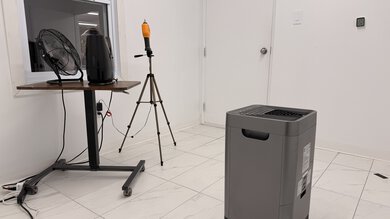
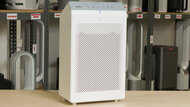
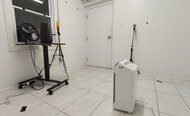
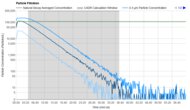
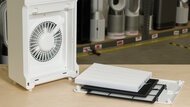
We buy and independently test air purifiers with no manufacturer samples, sponsorships, or pre-approved talking points. Each unit goes through the same standardized test bench, and the results are validated by multiple teams before being published on our website, so you can accurately compare them side by side.
This is all supported by readers like you, through paid memberships and your purchases through our links.
-
Best Air Purifier For Basements For Most People
 Particle Filtration Rate9.1Measured PM1.0 CADR711 m³/hr (419 CFM)Recommended Room Size @ Max Fan Speed60.7 m² (654 ft²)Low-Noise Particle Filtration Rate8.5Measured PM1.0 CADR381 m³/hr (224 CFM)Recommended Room Size32.5 m² (350 ft²)See all our test resultsNoise6.9
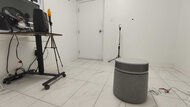
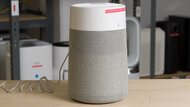
For most people, the best air purifier for basements is the Blueair Blue Pure 211i Max. While this unit isn't cheap, it's frequently on sale for under $300, a price point where it becomes a very compelling option if you're looking for a single unit that can handle the smaller open-concept dens at its highest fan speed, thanks to its near best-in-class performance. Its filter system consists of three mechanical filter stages: a washable fabric pre-filter for dealing with bits of pet fur or larger clumps of dust (available in a number of colors so you can match the air purifier to your decor), and a primary allergen filter with a separate activated carbon sheet for dealing with odors. Like most other Blueair units, it features an electrostatically charged layer that's meant to attract airborne particles to its main filter. This system produces ozone, a respiratory irritant, while running, though levels are rated to fall within safe limits. That being said, the main issue is that the system can't be disabled, which can be a dealbreaker for those with ozone sensitivity.
Beyond that, it's also quite well-equipped, with a particle sensor that tracks particle levels and allows it to automatically adjust its fan speed based on real-time air quality, and on-board Wi-Fi for remote control through a smartphone app so you can change settings or set up operating schedules without having to actually interact with the unit. Operating noise is on the higher end of the scale at higher fan speeds, which could be an issue if you have to set the unit up near a couch or armchair. It's also rather bulky, though its modern design makes it a bit less of an eyesore than other air purifiers.
-
Best High-End Air Purifier For Basements
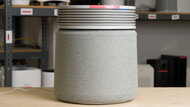
Particle Filtration Rate9.1Measured PM1.0 CADR729 m³/hr (429 CFM)Recommended Room Size @ Max Fan Speed62.2 m² (670 ft²)Low-Noise Particle Filtration Rate8.4Measured PM1.0 CADR361 m³/hr (213 CFM)Recommended Room Size30.8 m² (332 ft²)See all our test resultsNoise8.9If you're willing to pay a premium for strong room coverage with quieter operation, the Blueair Blue Signature Large is our high-end pick. It delivers similar air-cleaning performance to the cheaper Blue Pure 211i Max, but its lower operating noise and more living-space-friendly design make it especially well-suited to finished basements used as home theaters, offices, or dens. You aren't paying for a major increase in air-cleaning performance, though. Its maximum clean air delivery rate is only slightly higher than the 211i Max's, so the premium mostly goes toward a quieter, more polished user experience. The Signature Large can also double as functional furniture, with a flat top and optional legs that let you use it as a small end table.
Beyond those differences, the two units share many of the same features. The Signature Large uses a near-identical multi-stage filtration system to the Blue Pure, with a pre-filter for trapping dust clumps and fine fur, a particle filter for removing smaller airborne irritants like mold and pet dander, and activated carbon and mineral layers for reducing odors. Like the 211i Max, it also uses a particle-ionization system that draws particles toward an electrostatically charged filter layer and cannot be disabled. This may be a dealbreaker if you live with pets or are sensitive to ozone. Finally, Wi-Fi connectivity and a laser particle sensor let you check your basement's air quality or change settings remotely.
-
Best Upper Mid-Range Air Purifier For Basements
Particle Filtration Rate8.8Measured PM1.0 CADR617 m³/hr (363 CFM)Recommended Room Size @ Max Fan Speed52.7 m² (567 ft²)Low-Noise Particle Filtration Rate8.1Measured PM1.0 CADR275 m³/hr (162 CFM)Recommended Room Size23.5 m² (253 ft²)See all our test resultsNoise7.2If you're looking for a cheaper basement air purifier than the Blueair Blue Signature Large and find the oftentimes similarly-priced Blueair Blue Pure 211i Max's always-on ionizer to be a dealbreaker, consider the Levoit Core 600S. While the Levoit's max CADR is impressively high and generally sufficient for partial dens, it's still worth pointing out that either Blueair model will be faster at improving air quality in an equivalently sized space. As mentioned earlier, it lacks an ionization system and instead uses a conventional three-stage mechanical filtration system, which is still more than capable of handling airborne dust and mold. The Levoit is Wi-Fi enabled, allowing you to pair the device with your smartphone to view air quality estimates, adjust the fan speed, and receive filter change alerts through the companion app.
Beyond that, the 600S also features Google Assistant and Amazon Alexa integration, so you can control it using voice commands. It runs noticeably louder at both its maximum and minimum fan speeds than the Blueair Blue Signature Large, which can make it a distraction if you have it running nearby. On the upside, it has a slightly narrower footprint than the Blueair, making it easier to fit in tighter spots, though it can't be used as an end table.
-
Best Budget Air Purifier For Basements
Particle Filtration Rate8.1Measured PM1.0 CADR439 m³/hr (258 CFM)Recommended Room Size @ Max Fan Speed37.5 m² (404 ft²)Low-Noise Particle Filtration Rate7.6Measured PM1.0 CADR207 m³/hr (122 CFM)Recommended Room Size17.7 m² (190 ft²)See all our test resultsNoise8.5If you don't need the large-room performance of the Levoit Core 600S and would prefer something a little cheaper and quieter, consider the Winix 5530. At its highest fan speed setting, it runs a bit quieter and will present slightly less of a disturbance, though it doesn't provide the same level of performance as the pricier Levoit or Blueair Blue Signature Large. If you have a larger basement and expect the unit to cover the entire space itself, you'll have to purchase a second unit. Like the Levoit, this unit features a three-stage filtration system with a pre-filter for longer hair strands, a primary filter for fine dust and mold spores, and a carbon filter to eliminate odors. However, it also features the brand's bipolar ionization system, which is meant to neutralize fine airborne pollutants rather than cause them to clump together. This system produces a small amount of ozone while running, which Winix claims to fall well below harmful levels. Still, if you or someone in your home is particularly sensitive to ozone, you can disable this ionization system. It's also worth noting that we've tested particle filtration performance with the ionizer running on similar Winix models, and turning it off had very little impact on overall air cleaning performance.
There's a good array of extra features, too: you can set the unit to automatically adjust its fan speed, so you don't have to worry if air quality drops while you're asleep. You can also operate the air purifier remotely and set operating schedules with the smartphone app. Operating noise is slightly lower than that of the bigger Levoit, though it can still be a bit disruptive at its highest fan speed.
-
Best Air Purifier For Small Basements
Particle Filtration Rate7.0Measured PM1.0 CADR255 m³/hr (150 CFM)Recommended Room Size @ Max Fan Speed21.8 m² (234 ft²)Low-Noise Particle Filtration Rate7.0Measured PM1.0 CADR162 m³/hr (95 CFM)Recommended Room Size13.8 m² (149 ft²)See all our test resultsNoise9.0For those with smaller basements or who simply want an air purifier for a single basement room, who only require something compact, the Blueair Blue Pure 511i Max is worth a look. This compact unit doesn't offer the same level of performance as even the relatively affordable Winix 5530, as it'll take over 30% longer to achieve a similar level of air quality in an equivalently sized space at its highest fan speed. That said, it's also considerably more compact than the already decently small Winix, and you can set it up on a coffee table or bookshelf with room to spare. It's also exceptionally quiet, especially at its lowest fan speed, though it's worth noting that its performance degrades significantly in that configuration, to the point where it'd be best used in a basement bedroom or office.
Despite the significant gulf in capability, the 511i Max uses a similar filter configuration to the bigger and pricier Blueair Blue Pure 211i Max, with a three-stage mechanical filter system and an additional particle ionization system, which, unfortunately, can't be disabled. If you or someone in your household suffers from serious ozone sensitivity and you consider that a dealbreaker, look at something like the PuroAir 240, though its particle filtration rate does lag behind that of the Blueair.
-
Best DIY Air Purifier For Basements
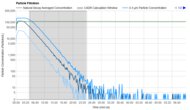
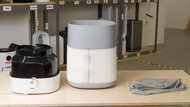
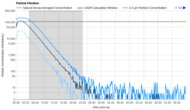
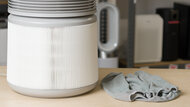
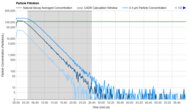
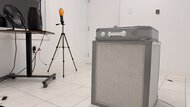
Particle Filtration Rate9.5Measured PM1.0 CADR943 m³/hr (555 CFM)Recommended Room Size @ Max Fan Speed80.5 m² (867 ft²)Low-Noise Particle Filtration Rate8.9Measured PM1.0 CADR636 m³/hr (375 CFM)Recommended Room Size54.3 m² (585 ft²)See all our test resultsNoise1.5If you're working on your basement or simply have an unfinished den and would like something that can keep dust and mold to a minimum, consider building your own Corsi-Rosenthal Box. We built our own by following this guide, which uses four 3M Filtrete air filter sets and a Lasko 20-inch box fan. This homemade option lacks the quality-of-life features of devices like the Blueair Blue Signature Large, with no particle sensor, Wi-Fi connectivity, or odor-absorbing carbon filter. Since you'll need to dispose of the filters at the end of their useful life, which can be as little as three months, this also incurs a higher long-term financial investment. A box fan is also quite loud while running, and it will be a nuisance if you use it in an area where you regularly entertain guests or simply relax to watch TV. It's worth pointing out that newer iterations of this design use multiple compact PC cooling fans instead to reduce noise (not to mention power consumption).
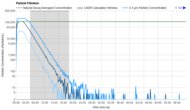
So, with all those caveats, why bother building a Corsi-Rosenthal Box? Well, even a basic unit such as this provides a higher clean air delivery rate than the majority of mass-market options, including the already exceptionally well-performing Blueair, and a full-sized Corsi-Rosenthal Box is over 20% faster to achieve the same level of air quality in an equivalently-sized room. This makes it ideal for larger basements and a stellar fit if you aren't concerned about aesthetics or operating noise.





Notable Mentions
-
Coway Airmega 400:
The Coway Airmega 400 is a high-end air purifier that offers similar performance to the Blueair Blue Signature Large at its highest fan speed. That said, it's also noisier and doesn't perform as well at lower fan speeds.
See our review -
NuWave OxyPure:
The NuWave OxyPure is a high-end air purifier with a unique washable filtration system that can help lower recurring costs compared to alternatives like the Blueair Blue Signature Large. That said, the Blueair performs better, runs quieter, and takes up less room.
See our review -
Corsi-Rosenthal Box with Single Filter:
If you only have a smaller unfinished basement with lower CADR needs and don't want to go through the hassle or expense of sourcing another quartet of furnace filters, consider building a Corsi-Rosenthal Box with Single Filter, which also takes up less room than a conventional Corsi-Rosenthal Box.
See our review -
Winix C909:
The Winix C909 is a good option if you're looking to buy a single unit for use in basements, and it runs even more quietly than the Blueair Blue Pure 211i Max. That said, it also has a lower maximum CADR and won't be quite as effective in larger spaces.
See our review
Recent Updates
Sep 24, 2026:
We've made slight changes to the text of this article to more clearly convey product details and market positioning. We've also ensured all our main picks are still available and represent the best fit for user needs.
Aug 20, 2026:
We've added the Blueair Blue Pure 211i Max as the new 'Best Air Purifier For Basements For Most People' pick, and replaced the Winix C610 with the Winix 5530 as the 'Best Budget Air Purifier For Basements' pick due to its superior overall performance. We've also added a buyer's guide to this article to help you find a basement air purifier.
What To Consider When Buying An Air Purifier For Basement Use
Clean Air Delivery Rate (CADR) And Coverage
Generally speaking, when considering an air purifier, it's best to measure the size of your own space, so you don't end up with too little performance for your needs. If you're looking at our reviews to help make that choice, pay close attention to the 'Particle Filtration Rate' test, particularly the 'Recommended Room Size @ Max Fan Speed' field. We've outlined a few examples of different basement sizes below, and what sort of CADR you should be aiming for when considering an air purifier.
-
500 - 650 ft2: Partial dens.
- Suitable CADR: 320.0 - 416.0 CFM (543.7 - 706.8 m3/hr)
-
650 - 1,000 ft2: Smaller full basements
- Suitable CADR: 416.0 - 640.0 CFM (706.8 - 1087.4 m3/hr)
-
1,000-1,700 ft2: Medium-sized full basements.
- Suitable CADR: 640.0 - 1088.0 CFM (1087.4 - 1848.2 m3/hr)
-
1,700 ft2 or more: Large open-concept basements. A space this size will likely require more than one air purifier for effective operation.
- Suitable CADR: 1088.0 CFM (1848.2 m3/hr) or greater.
It's also worth noting that basement ceiling heights can vary somewhat drastically, even within the same space. The above figures are based on an average ceiling height of 8.0 ft (2.4 m), which is typically considered "standard", but it goes without saying that higher ceiling heights will necessitate a higher CADR, while areas with lower ceiling heights will demand a lower CADR.
Given the relative size of the larger basements, if you're planning on maintaining a good level of air quality, it's best to consider purchasing multiple more affordably-priced air purifiers than a single high-end one, particularly if you have an open-concept den; even high-performance models like the Blueair Blue Signature Large will struggle to clear the air in sizes larger than 750 ft2 or so. Beyond that, you could also consider a whole-home air purification setup for your HVAC system, though that falls outside the scope of this article.
Features
There are a few features that are especially nice to have if you're shopping for an air purifier, regardless of where and how you plan to use it:
-
Air Quality Sensor Auto Mode
- This allows the air purifier to automatically adjust its fan speed setting in real time, without forcing you to fiddle with its onboard controls or a remote control, which is handy if you plan on setting up your air purifier in a basement, and you don't feel like checking on it periodically.
-
Remote Control/App
- An included remote control or a smartphone companion app also allows you to operate the unit without having to walk over to it.
All Reviews
The recommendations above are among the best air purifiers for basements for most people. We factor in price, visitor feedback, and availability.
That said, there's no single best option that will suit everybody; your choice will depend on your budget, the size of your basement, your tolerance for operating noise, and whether you prefer a device with convenience features like Wi-Fi connectivity. If you'd like to choose for yourself, here's the list of all our air purifier reviews, ranked by their clean air delivery rate.


