
The Coway Airmega 200M is an air purifier intended for medium-sized rooms. Under the skin, it's all but identical to the older Coway Airmega Mighty AP-1512HH, with the same filter system comprised of three physical layers and a built-in ionizer. It also has the same particle sensor, which automatically adjusts the fan speed based on current air quality or even turns it off entirely if air quality remains at an acceptable level for long enough.
Our Verdict
The Coway Airmega 200M is a very good choice for pet owners. It's fairly effective in capturing fine particles like cat dander. While you can't control the air purifier remotely using your smartphone, it does have an automatic fan speed adjustment feature. While it's a little noisy at higher fan speeds, which isn't ideal for pets that are sensitive to loud noises, it isn't too disruptive at lower speeds.
Impressive CADR.
- Automatic fan speed adjustment and 'Eco' setting.
- Makes quite a bit of noise at higher fan speeds.
The Coway Airmega 200M is a good option for your bedroom. It's a little on the larger side, especially for smaller bedrooms, but it still has a relatively small footprint for a machine capable of cleaning rooms this size. Like most air purifiers, you can easily switch off the display lights. You can't operate the Coway remotely using a smartphone app, but its built-in particle sensor does still result in a hands-off user experience; the device will automatically adjust fan speed depending on measured air quality, and the separate 'Eco' mode helps minimize noise and power consumption by turning the fan off if air quality is at an acceptable level for long enough.
- Display light shutoff.
Impressive CADR.
- Automatic fan speed adjustment and 'Eco' setting.
- No companion app for full remote operation.
- Makes quite a bit of noise at higher fan speeds.
The Coway Airmega 200M has a great particle filtration rate. At its highest setting, it can clear the air in a moderately sized room, like an office or bedroom, within an hour. As a result, it's a good fit for constant use in medium- to large-sized areas, such as dining or living rooms.
Impressive CADR.
- Makes quite a bit of noise at higher fan speeds.
Impressive CADR.
- Makes quite a bit of noise at higher fan speeds.
Changelog
- Updated Jul 16, 2026: We've updated this review to Test Bench 1.3.1, which adds an additional field to indicate whether an air purifier's filtration system is HEPA-certified. To read more about the changes, see the changelog.
- Updated Jun 18, 2026: We've updated this review to Test Bench 1.3, which adds a new 'Footprint' test that's meant to score an air purifier's dimensions. If you're interested in learning more about why we made this change, read our changelog article.
-
Updated Jun 17, 2026:
We added a link to the newly reviewed Coway Airmega 400 in the Noise section of the review for users seeking stronger air-cleaning performance as well as quieter performance.
-
Updated May 05, 2026:
We added a link to the newly reviewed Dyson HushJet in the Noise section of the review for users seeking better noise performance across all fan speeds.
Check Price
Differences Between Sizes And Variants
The Coway Airmega 200M is available in two color variants: 'Black' and 'White'. We tested the 'Black' variant.
Let us know in the comments if you come across any other variants.
Popular Air Purifier Comparisons
The Coway Airmega 200M is all but identical to the Coway Airmega Mighty AP-1512HH, with the two machines sharing the same filter system, motor, and user interface. Like its older sibling, it doesn't offer the same range of niceties as some alternatives, with no smartphone app or support for voice commands via Amazon Alexa or Google Assistant devices. However, if those features don't appeal to you and you simply want an air purifier with a relatively small footprint that can clean medium- to large-sized rooms, it's certainly a good option.
The Winix C610 is a better overall choice than the Coway Airmega 200M. On the features side, the Winix offers a more complete experience, with app connectivity that lets you adjust settings, check air quality, and manage schedules remotely from your phone, something the Coway lacks entirely with no app support or remote operation of any kind. The Winix also has a smaller cylindrical design that's easier to fit around furniture or into tighter room layouts, while the Coway's wider, boxier shape feels more intrusive in smaller spaces. The Coway does have an edge at quieter fan settings, maintaining stronger air cleaning performance without needing to ramp up the fan speed as aggressively, making it a slightly better fit for quieter bedrooms or offices. It's also marginally quieter at its highest setting, though both units get fairly loud at max fan speed, enough to distract from watching TV or sleeping nearby.
The Winix 5530 outperforms the Coway Airmega 200M overall. Its particle filtration is stronger, its room coverage is broader, and it holds up better at quieter fan speeds. Both models are whisper-quiet on their lowest settings and get quite loud at full power, but the 5530 edges out the Coway at both ends of the range. It's also more compact and, unlike the Coway, offers app connectivity for remote control and air quality monitoring. Both units have automatic fan adjustment and optional ionization systems that can be turned off.
The Levoit Vital Pet Pro and Coway Airmega 200M each have their own strengths. The Coway delivers stronger particle filtration and broader room coverage, making it the better choice if maximum air-cleaning performance is your priority. The Levoit, on the other hand, is more user-focused, with conveniences like smartphone app connectivity for remote control, scheduling, and air quality monitoring, along with an Auto-Clean system that makes it easier to live with day to day. It also runs noticeably quieter at its higher fan speeds.
Test Results

The 'Air Quality' indicator light changes color based on current particle count:
- Blue: Clean
- Dark Purple: Polluted
- Red: Highly Polluted
To turn off the display's lights, press and hold the 'Ionizer' button for 3 seconds.


Like the Coway Airmega Mighty AP-1512HH, this air purifier's four-stage filtration system has only three physical filters: a pre-filter for trapping larger particles, a True HEPA filter, and a Carbon filter to minimize odors. The fourth 'stage' is the device's built-in ionizer, which imparts a negative charge to fine airborne particles, causing them to attract one another. From there, they form heavier clumps that fall out of the air, where you can clean them up. The downside of ionizers is that their operation produces ozone as a byproduct, which can irritate your lungs over time. If you don't want to use the ionizer, you can turn it off.
You'll need to clean the pre-filter under water or vacuum off any stuck-on debris and dust every two to four weeks.
You'll need to replace the True HEPA/Activated Carbon filter every 12 months and the carbon filter every six months. These two filters are sold in a single pack and can be purchased here.
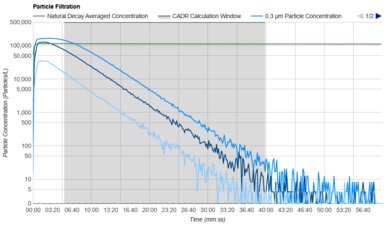
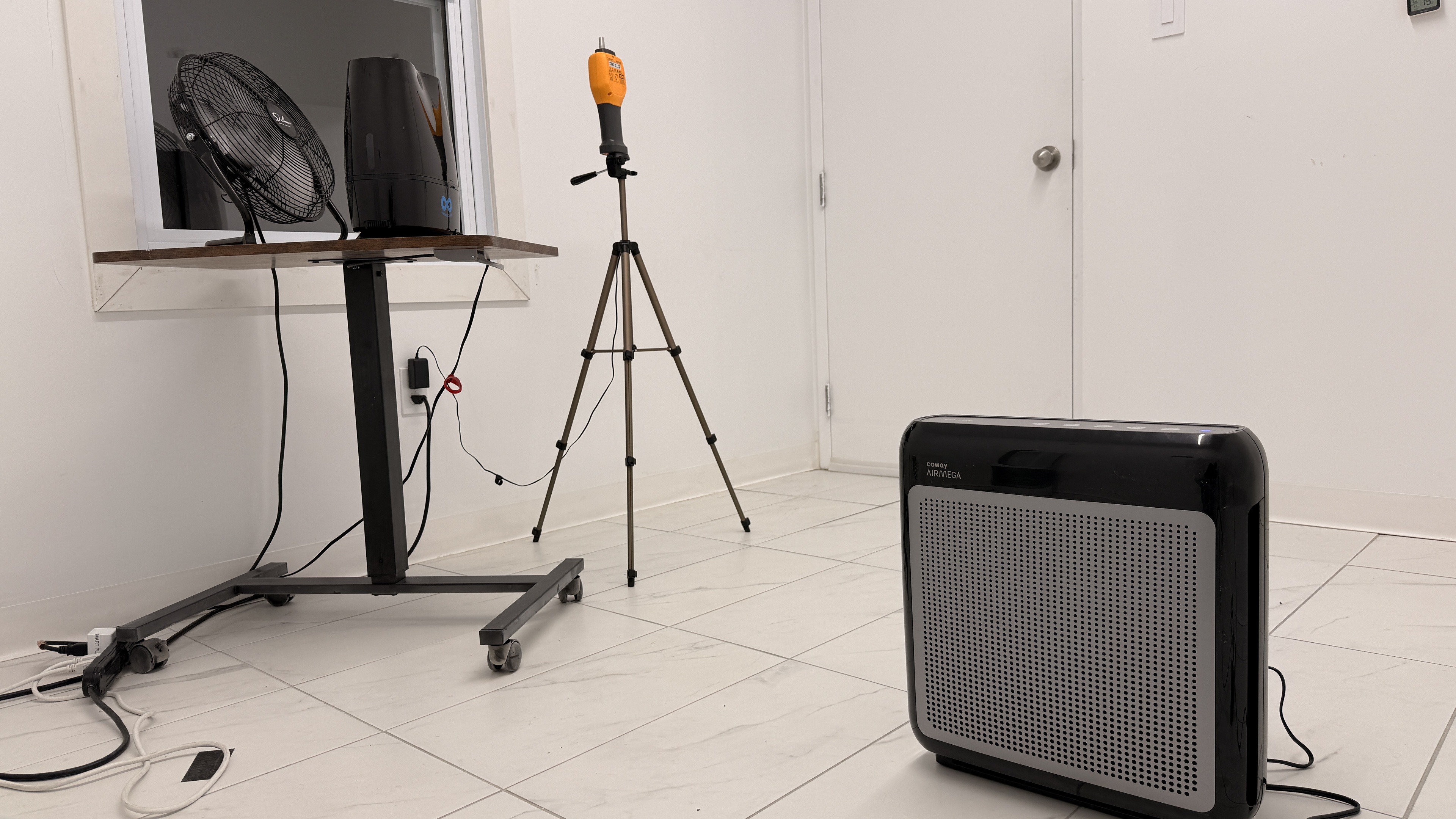
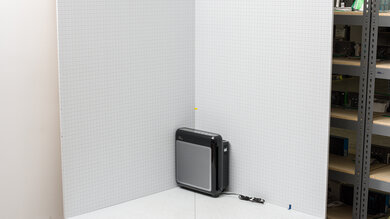
This unit's maximum particle filtration rate is impressive. At its highest fan speed (3), the Coway Airmega 200M can clear the air in medium to large areas, such as dining or living rooms.
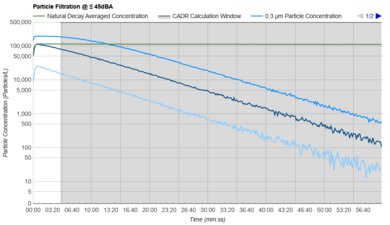
This unit can be pretty quiet, though that varies dramatically depending on your choice of setting. At its lowest fan speed, it's quite hushed, making it a good option for bedrooms or offices. That said, fan noise can be somewhat distracting in its highest fan speed, so keep that in mind if you're setting it up in a larger area where higher fan speeds are required for effective operation, such as a living room or dining area. Alternatively, if near-silent operation is what you're after, the Dyson HushJet is worth considering for its remarkably low noise levels across all fan speeds.
If you'd prefer an air purifier that's even quieter and better suited to larger rooms, consider the Coway Airmega 400.