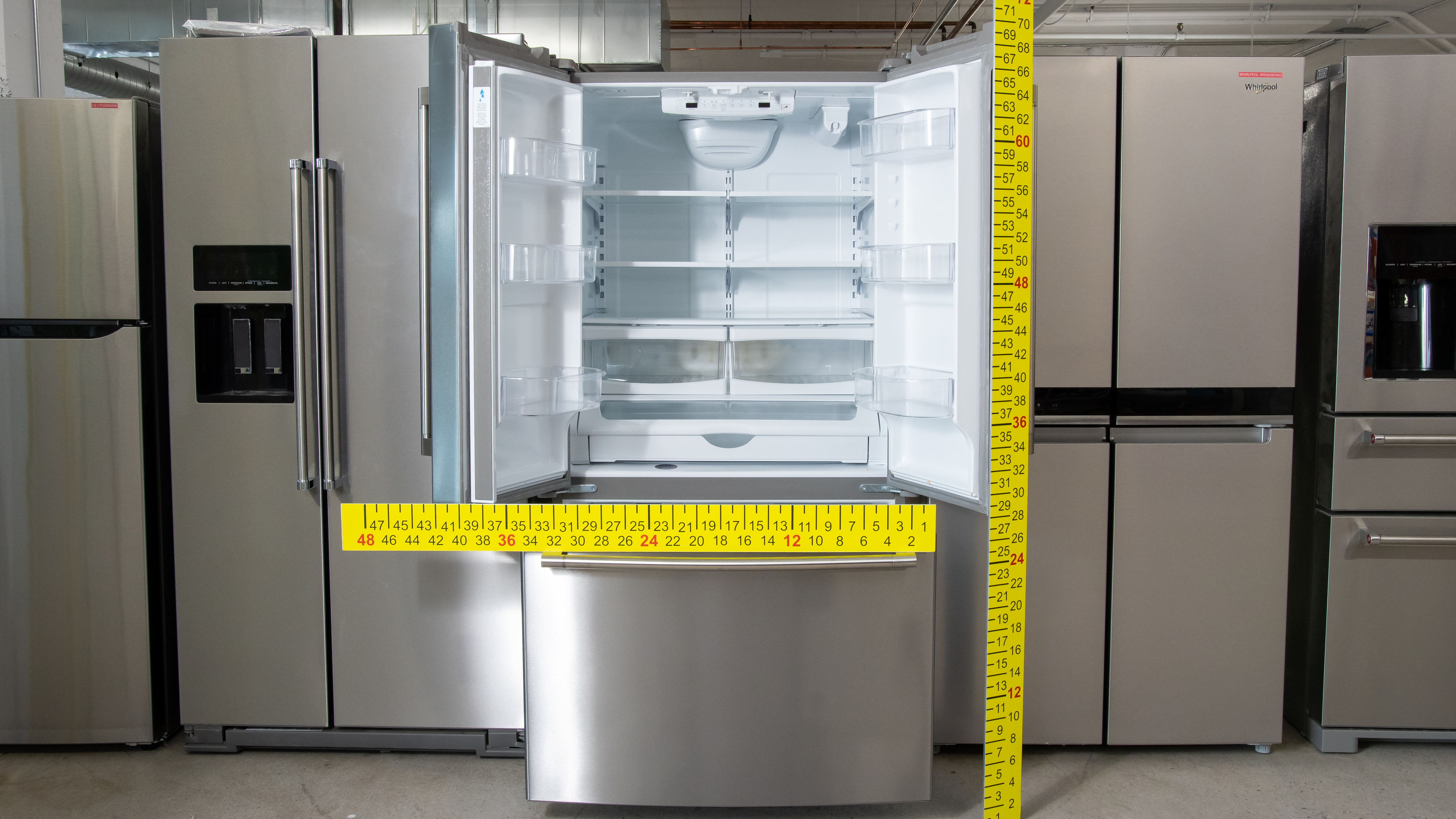
Refrigerators are sold by width, and at first glance, these may appear to be standard widths. Finding the right size fridge may seem as simple as measuring the opening in your kitchen cabinets or the space beside your kitchen counters, but there's more than initially meets the eye to find the perfect fit. You should keep other considerations in mind when it comes to fridge sizes, like clearance allowances and whether you want your fridge to fit flush with your counters, so it's certainly not a one-size-fits-all situation. It's also important to note that bigger isn't always better when it comes to fridge sizes; just because a model is wider than a narrower option, it doesn't mean it will have more usable space. That's why we measure the usable storage capacity of every fridge we test, and have included all the results compared to the advertised storage capacity of our first twenty review models below in their respective sizes.
Our fridge size guide is here to help you understand refrigerator sizes and the clearance they require. This way, you won't find yourself trying to jam a fridge into a space where it won't fit.
Test results
Refrigerator sizes are classified by width and occasionally by depth, but hardly ever by height. In North America and many other parts of the world, fridges are sold based on their dimensions in inches. Some refrigerator types may be unavailable in certain widths; you won't find 24-inch French door fridges, 28-inch side-by-side fridges, or 36-inch top freezer, bottom freezer, or all-fridge models.
Manufacturers advertise refrigerator and freezer capacity based on the total internal space the evaporator cools, and capacity scales up with width. But wider fridges are higher-end and have more internal hardware like shelves, drawers, and ice makers that limit usable space, so there can be overlap between actual capacities in the various width classifications.
Standard Widths
You should think of these widths not as actual dimensions, but more as a class of spaces in which you can fit these fridges. Refrigerators are sold predominantly by width, and their true dimensions are almost always a little lower so that they'll fit.
Less than 24 INches
Fridges less than 24 inches wide aren't your usual kitchen fridge. Instead, these are compact fridges with limited interior space, and they tend to be minifridges, convenience fridges, bar fridges, or secondary fridges. That said, some 22-inch designs might be suitable for single people living in small spaces who don't cook much or who shop for groceries frequently.
Advertised total capacity: 2-9 cubic feet
24 Inches
This is the minimum practical fridge width for primary use in a kitchen, intended for one person and designed for small spaces like apartments. In order to maximize interior volume for the narrow width, some manufacturers make 24-inch fridges deep and tall. These are usually bottom freezer designs with freezer drawers, so you won't have to reach far back into a narrow, deep freezer. There are a few rare examples of 24-inch fridges with separate temperature-controlled drawers, making them '3-door' refrigerators. There are also a few high-end 24-inch refrigerators with ice makers. This is an uncommon width, especially in North America, and you'll find a limited selection of 24-inch refrigerators.
Advertised total capacity: 5-13 cubic feet
28 - 29 Inches
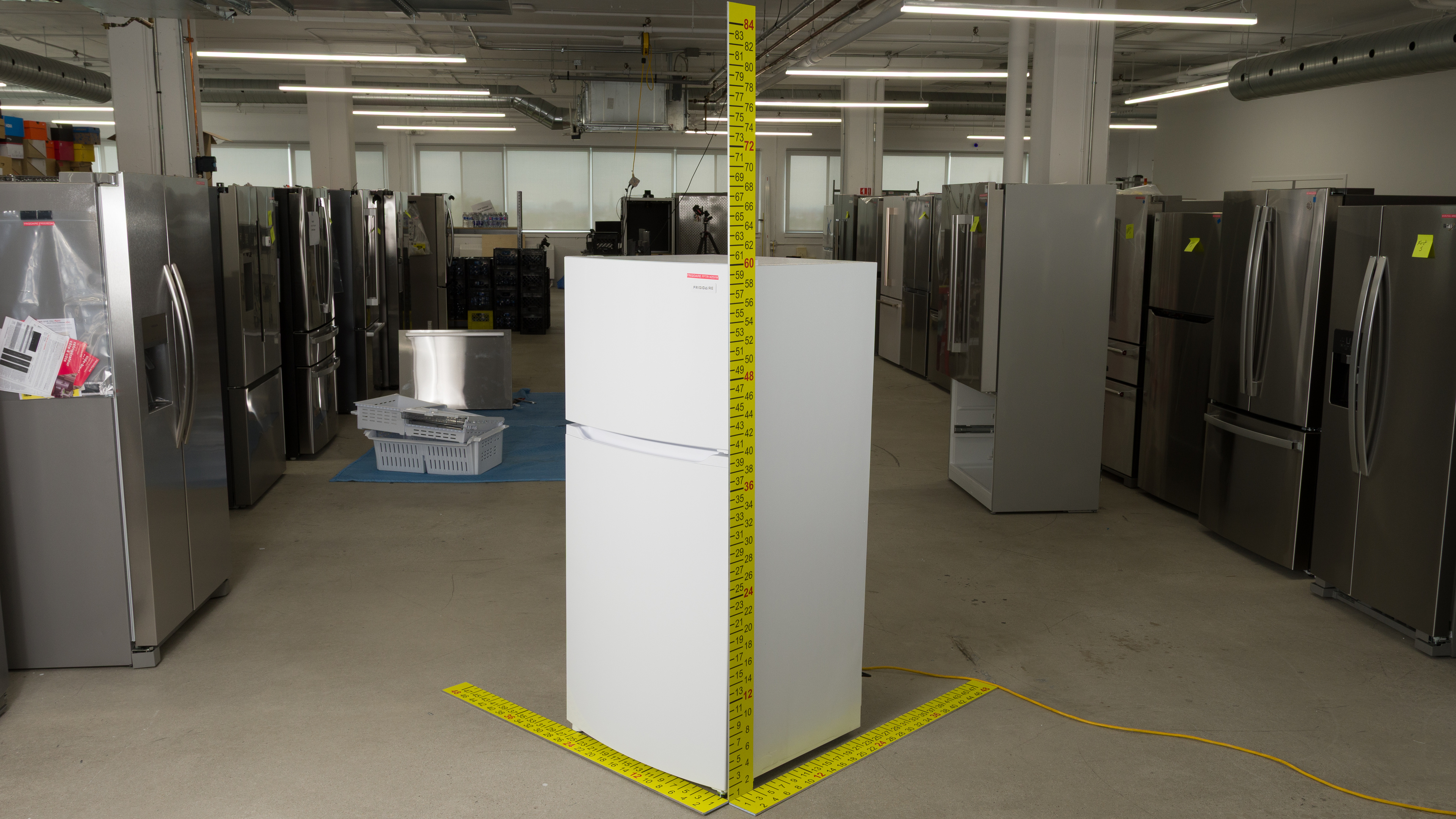
These fridges are still narrow but provide more capacity than 24-inch fridges. They're suitable for one or two people but may be too small for families. The 28-inch width is more common than the 24-inch width, so there's a greater selection. There are 29-inch widths available, but they're rare. These fridges are mostly top freezer designs, with some bottom freezer models and, very rarely, French door and 4-door models with a separate temperature-controlled drawer. Ice makers are still uncommon in this size class.
Since there's already so little space in this category, ice makers and counter-depth designs will reduce interior capacity even further, as we see in the Frigidaire FFTR1425VW.
Advertised total capacity: 14-18 cubic feet
| Refrigerator | Actual Width, inches | Advertised Refrigerator Capacity, cubic feet | Usable Refrigerator Capacity, cubic feet | Advertised Freezer Capacity, cubic feet | Usable Freezer Capacity, cubic feet |
|---|---|---|---|---|---|
| Frigidaire FFTR1425VW | 27.50 | 10.0 | 8.9 | 3.9 | 2.5 |
30 - 31 - 32 Inches
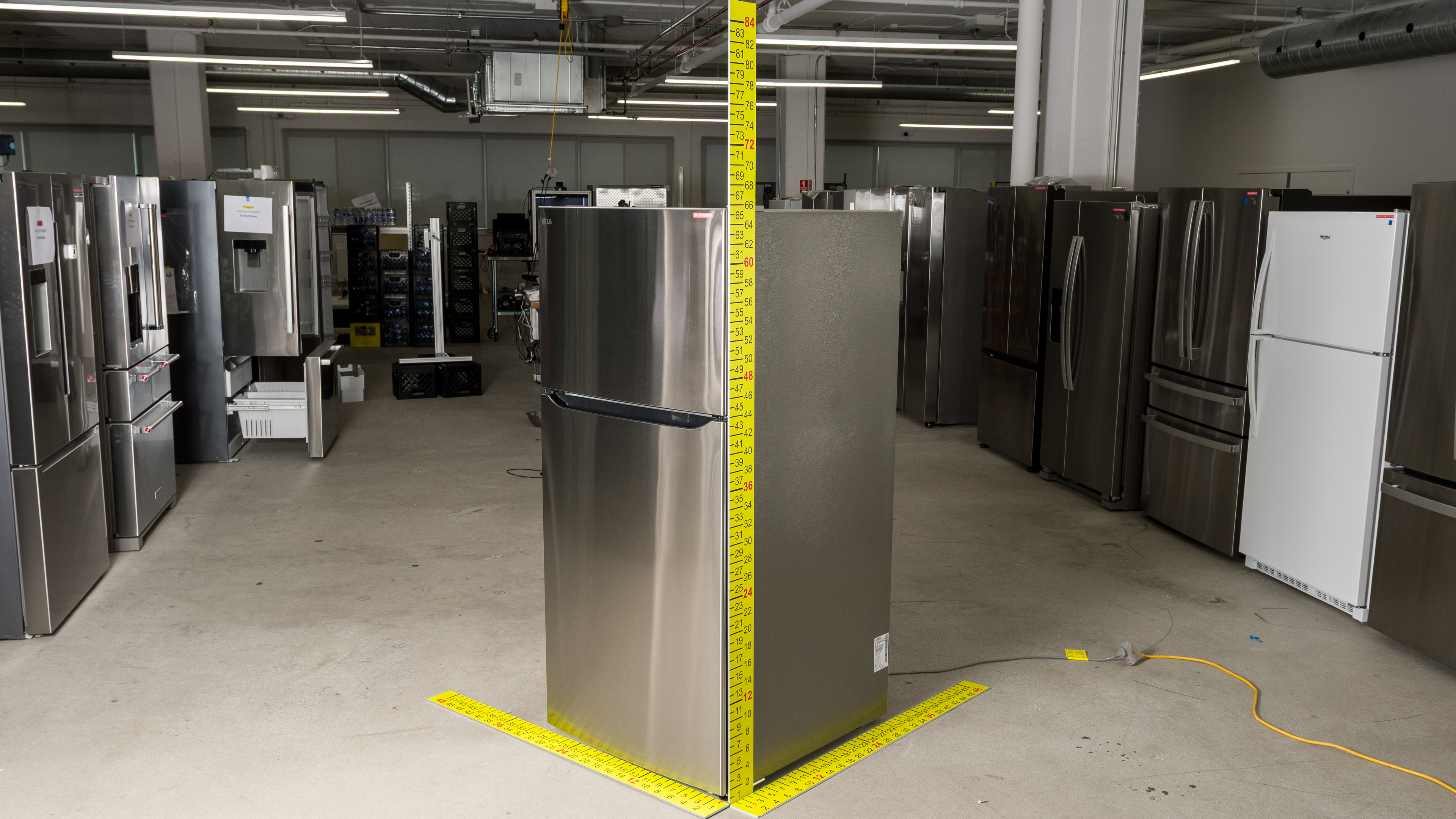
This size is more popular than narrower fridges, with a wide selection available. These fridges are suitable for small and medium-sized families. The 30-inch width is extremely common, with 31, 31.5, and 32-inch sizes available but harder to find. Top freezer models are still the predominant type in this size range, but you'll find quite a few bottom freezer and French door designs as well. There are even some all-fridge models in this size. Ice makers are more widely available, though sometimes they're an optional extra, and there are also a few with in-door, externally-accessible water and ice dispensers.
These fridges provide more capacity than the narrower 28-inch fridges, and since there are predominantly top freezer designs in this category, these fridges have similar capacities. The ice maker and ice bucket take up a lot of space in these narrower freezer compartments, so usable freezer capacity will be fairly low if you install the ice maker.
Advertised total capacity: 15-22 cubic feet
| Refrigerator | Actual Width, inches | Advertised Refrigerator Capacity, cubic feet | Usable Refrigerator Capacity, cubic feet | Advertised Freezer Capacity, cubic feet | Usable Freezer Capacity, cubic feet |
|---|---|---|---|---|---|
| LG LTCS20020S | 29.75 | 14.7 | 10.8 | 5.5 | 3.8 |
| Frigidaire FFTR1835VW | 30.06 | 13.4 | 11.0 | 4.9 | 4.0 |
33 - 34 Inches
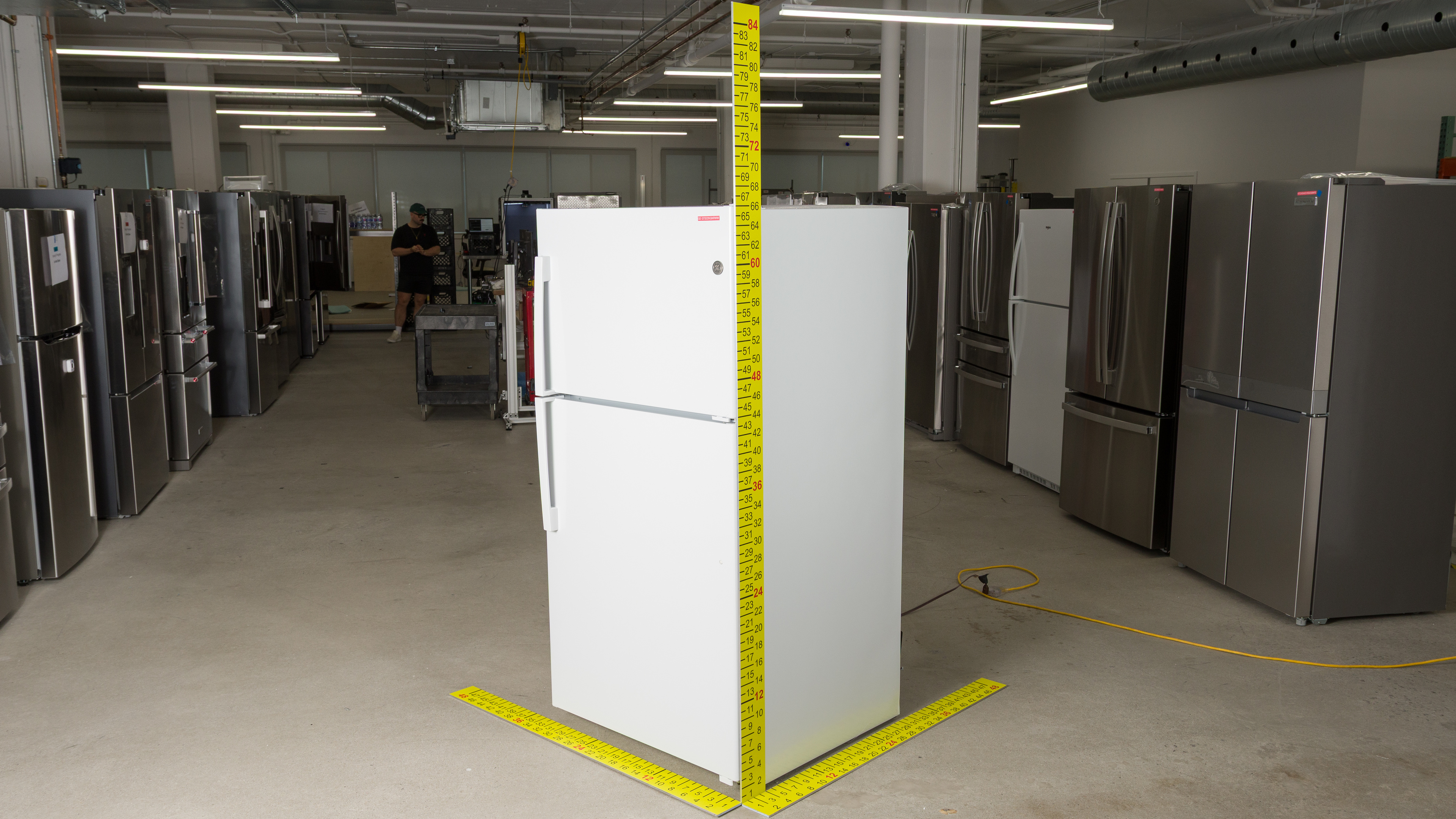
This is also a popular size class. These fridges are suitable for medium and even large families. The majority of fridges in this class are 33 inches wide, with very few 34-inch models, and no 35-inch widths. This size is wide enough to permit side-by-side types, and top freezer, bottom freezer, and French door designs are common. There are a few 4-door and 5-door models in this size class as well, along with some all-fridge designs. It's easy to find ice makers in these fridges, either built-in or as optional accessories, and in-door water and ice dispensers are available in higher-end models.
There's more interior space in this width category, and since top freezer designs are still the most common here, there's little hardware preventing you from using the maximum amount of interior space. There's room for an ice maker in the freezer, and having one in a fridge of this width doesn't impact freezer capacity too badly. However, side-by-side designs in this width category, like the Whirlpool WRS321SDHZ, have very narrow compartments, especially in the freezer. This leads to restricted usable capacity in the fridge and very little usable capacity in the freezer. Note that the 33-inch Whirlpool WRS321SDHZ has even less usable capacity in both the fridge and freezer than a 30-inch top freezer model.
Advertised total capacity: 15-30 cubic feet
| Refrigerator | Actual Width, inches | Advertised Refrigerator Capacity, cubic feet | Usable Refrigerator Capacity, cubic feet | Advertised Freezer Capacity, cubic feet | Usable Freezer Capacity, cubic feet |
|---|---|---|---|---|---|
| Whirlpool WRT311FZDW | 32.69 | 14.4 | 11.5 | 6.1 | 5.2 |
| GE GTS22KGNRWW | 32.69 | 15.3 | 11.3 | 6.7 | 5.3 |
| Whirlpool WRS321SDHZ | 33.06 | 14.6 | 10.6 | 6.8 | 3.6 |
36 INches
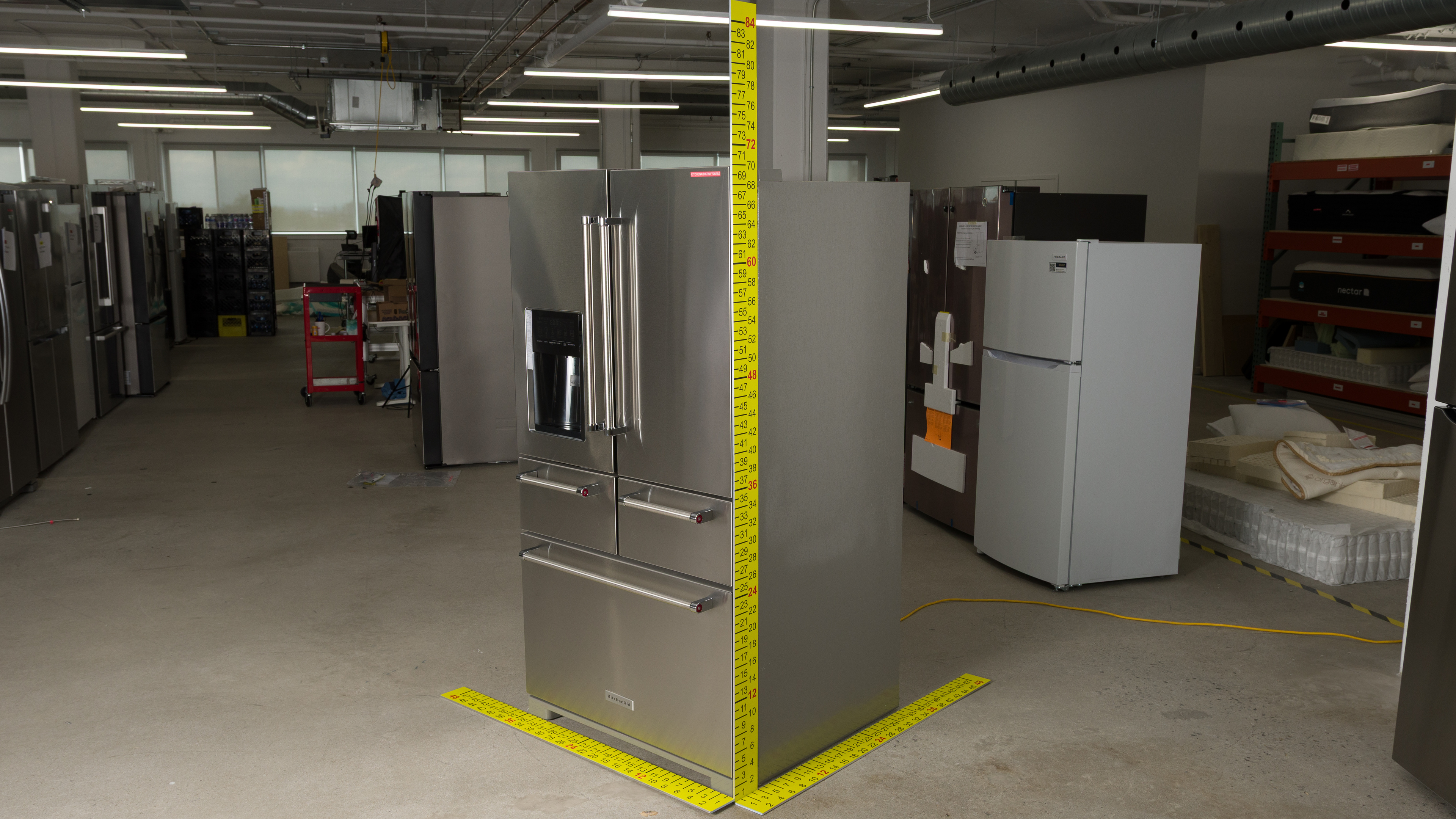
These are some of the largest refrigerators available for consumers. You won't find 36-inch top freezer, bottom freezer, or all-fridge models since the swing-out door would be too wide and heavy, needing too much front clearance. Instead, French door designs dominate, with a few side-by-side, 4-door, and 5-door models available. Most of these premium fridges come with ice makers, and many also have in-door water and ice dispensers. Manufacturers put great effort into this size, and new features appear here first, like touchscreens and transparent double-door beverage compartments.
Due to the great variety of storage options in fridges of this size, usable capacities can vary widely. The French door Samsung RF32CG5400SR offers the largest refrigerator capacity of any fridge we've tested so far, but its freezer capacity is restricted by a short upper drawer. On the other end of the scale, the side-by-side KitchenAid KRSC703HPS offers lower capacity in the fridge than a 30-inch top freezer model. And note that the counter-depth Bosch 800 Series B36CT80SNS delivers lower usable capacity in the fridge than the standard depth Bosch 500 Series B36FD52SNS, and a very low capacity in the freezer since it has to accommodate two compressors and their associated hardware in the back, leading to a very shallow freezer compartment.
Advertised total capacity: 15-32 cubic feet
| Refrigerator | Actual Width, inches | Advertised Refrigerator Capacity, cubic feet | Usable Refrigerator Capacity, cubic feet | Advertised Freezer Capacity, cubic feet | Usable Freezer Capacity, cubic feet |
|---|---|---|---|---|---|
| Bosch 100 Series B36FD10ENS | 35.63 | 18.0 | 13.2 | 8.0 | 4.6 |
| Bosch 500 Series B36FD52SNS | 35.63 | 18.0 | 13.2 | 8.0 | 4.6 |
| KitchenAid KRSC703HPS | 35.63 | 13.6 | 9.2 | 9.0 | 5.4 |
| Bosch 800 Series B36CT80SNS | 35.63 | 14.8 | 10.3 | 6.0 | 3.2 |
| Frigidaire FRSS2623AS | 35.75 | 16.6 | 12.9 | 9.0 | 5.2 |
| GE Profile PGE29BYTFS | 35.75 | 20.1 | 13.0 | 8.6 | 3.8 |
| Samsung RF32CG5400SR | 35.75 | 21.3 | 15.1 | 9.2 | 4.3 |
| Whirlpool WRS588FIHZ | 35.75 | 17.6 | 12.8 | 11.1 | 8.3 |
| Samsung RS27T5200SR | 35.75 | 17.9 | 14.6 | 9.5 | 7.1 |
| GE Profile PVD28BYNFS | 35.75 | 19.3 | 12.2 | 8.6 | 4.4 |
| KitchenAid KRQC506MPS | 35.75 | 12.0 | 9.7 | 7.4 | 4.1 |
| Samsung Bespoke RF30BB6200QL | 35.81 | 21.1 | 14.0 | 9.0 | 3.5 |
| KitchenAid KRMF706ESS | 35.81 | 18.2 | 11.7 | 7.6 | 4.0 |
| LG LRFLC2706S | 35.94 | 17.9 | 11.6 | 8.6 | 4.6 |
Greater than 36 Inches
These non-standard refrigerators are rare and quite expensive. They're derived from commercial or restaurant fridges and are intended for large homes with very large families. Due to their size and weight, they require special installation. There are a few 37 and 43-inch models, but 42 and 48-inch refrigerators are more commonly available in this size class. Ice makers are standard, but not all come with ice and water dispensers since manufacturers focus more on style and capacity rather than features. Side-by-side models are more practical in this size class because there's enough room for a decently wide freezer, though there are a few French door designs as well. Many of these large fridges are intended as built-ins, where they're installed directly into kitchen cabinetry, and a number of them accommodate custom front panels.
Advertised total capacity: 21+ cubic feet
Depth
Unlike with widths, you'll only find two categories for a fridge's depth: standard or counter depth. However, there's a wide variance between manufacturers and even between different models from the same manufacturer.
Standard depth
Traditionally, most fridges are between 30 and 36 inches deep. These have now become known as "standard depth" refrigerators due to the advent of shallower fridges.
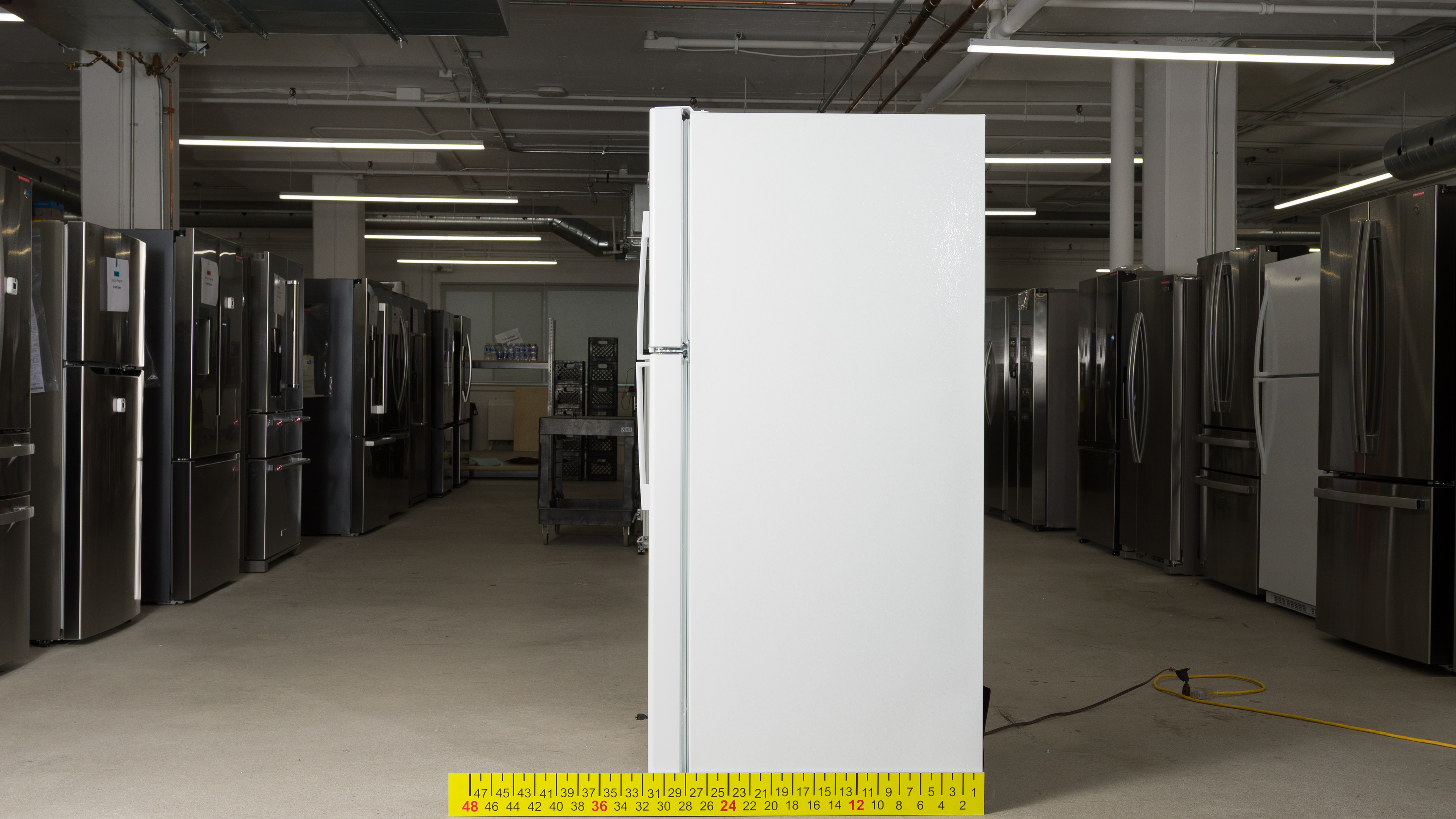
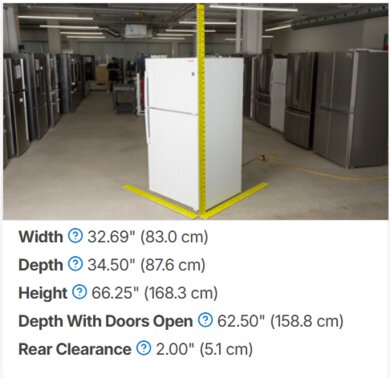
Door clearance will be an issue with these models, especially for wide top freezer-type refrigerators. With a 33-inch wide standard depth top freezer fridge like the GE GTS22KGNRWW, you'll need more than 62 inches of front clearance away from the wall for the fridge body and the wide swing-out doors.
| Refrigerator | Actual Depth, inches | Depth with Doors Open, inches | Actual Width, inches | Advertised Refrigerator Capacity, cubic feet | Usable Refrigerator Capacity, cubic feet | Advertised Freezer Capacity, cubic feet | Usable Freezer Capacity, cubic feet |
|---|---|---|---|---|---|---|---|
| Frigidaire FFTR1835VW | 30.13 | 56.75 | 30.06 | 13.4 | 11.0 | 4.9 | 4.0 |
| Whirlpool WRT311FZDW | 32.31 | 61.63 | 32.69 | 14.4 | 11.5 | 6.1 | 5.2 |
| Whirlpool WRS321SDHZ | 32.63 | 48.75 | 33.06 | 14.6 | 10.6 | 6.8 | 3.6 |
| Bosch 100 Series B36FD10ENS | 33.00 | 52.00 | 35.63 | 18.0 | 13.2 | 8.0 | 4.6 |
| LG LTCS20020S | 33.63 | 60.50 | 29.75 | 14.7 | 10.8 | 5.5 | 3.8 |
| Samsung RS27T5200SR | 34.00 | 51.03 | 35.75 | 17.9 | 14.6 | 9.5 | 7.1 |
| Samsung Bespoke RF30BB6200QL | 34.19 | 48.44 | 35.81 | 21.1 | 14.0 | 9.0 | 3.5 |
| GE GTS22KGNRWW | 34.50 | 62.50 | 32.69 | 15.3 | 11.3 | 6.7 | 5.3 |
| Frigidaire FRSS2623AS | 35.00 | 50.38 | 35.75 | 16.6 | 12.9 | 9.0 | 5.2 |
| Bosch 500 Series B36FD52SNS | 35.00 | 54.00 | 35.63 | 18.0 | 13.2 | 8.0 | 4.6 |
| Whirlpool WRS588FIHZ | 35.19 | 50.50 | 35.75 | 17.6 | 12.8 | 11.1 | 8.3 |
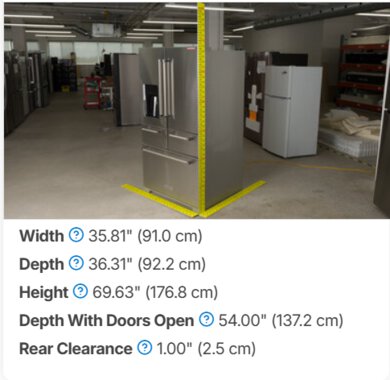
| KitchenAid KRMF706ESS | 36.31 | 54.00 | 35.81 | 18.2 | 11.7 | 7.6 | 4.0 |
| Samsung RF32CG5400SR | 36.38 | 52.75 | 35.75 | 21.3 | 15.1 | 9.2 | 4.3 |
| GE Profile PGE29BYTFS | 36.75 | 54.75 | 35.75 | 20.1 | 13.0 | 8.6 | 3.8 |
| GE Profile PVD28BYNFS | 36.75 | 54.75 | 35.75 | 19.3 | 12.2 | 8.6 | 4.4 |
Counter Depth
If you're placing a standard-depth fridge between countertop surfaces, it'll stick out, blocking counter access and preventing easy passage between counters along a wall and a kitchen island with a narrow aisle. So manufacturers developed "counter depth" refrigerators, designed so that the front surface is reasonably flush with the edge of a counter. Counter-depth fridges aren't standard either, but are typically between 23 and 32 inches deep.
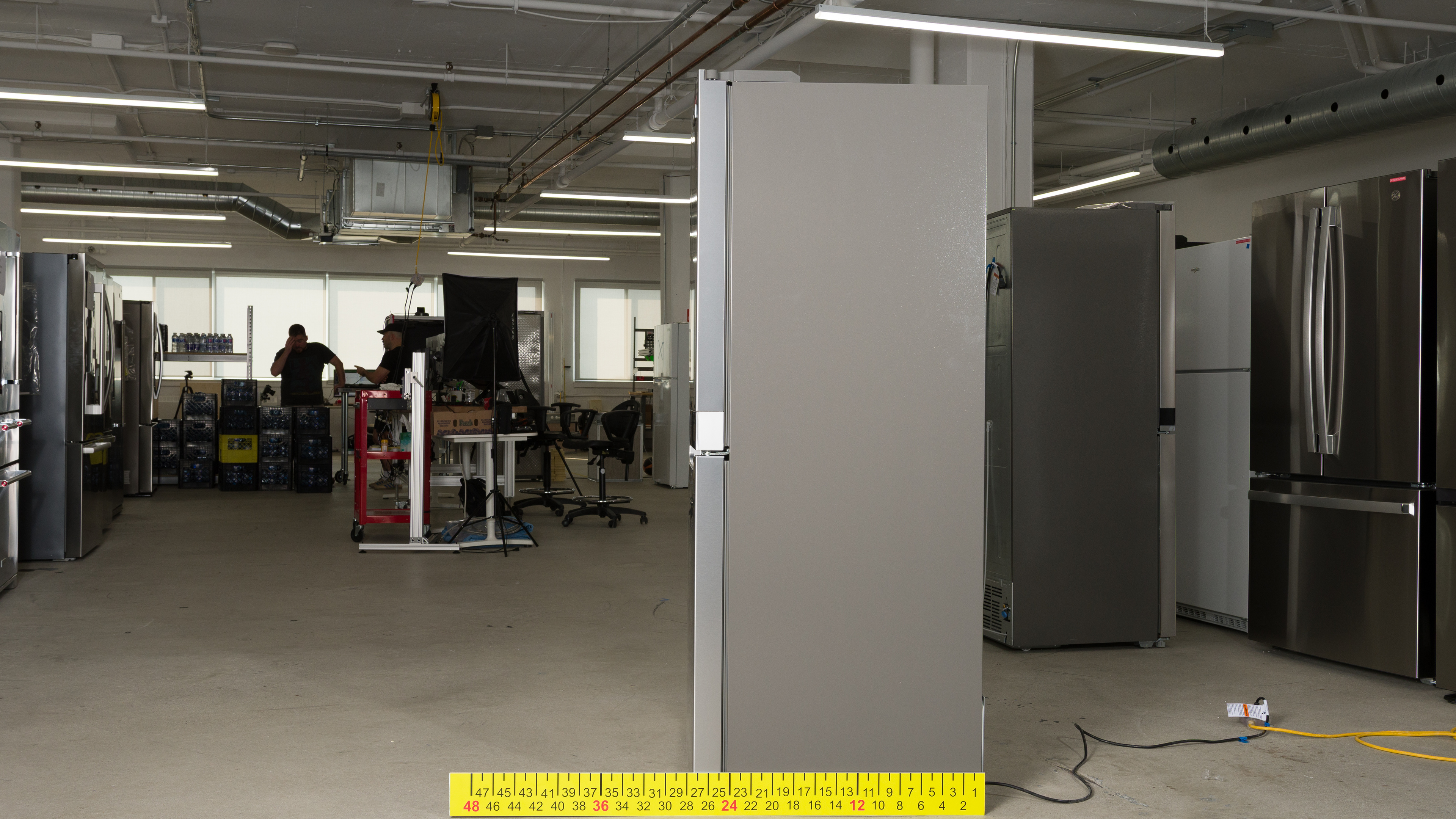
| Refrigerator | Actual Depth, inches | Depth with Doors Open, inches | Actual Width, inches | Advertised Refrigerator Capacity, cubic feet | Usable Refrigerator Capacity, cubic feet | Advertised Freezer Volume, cubic feet | Usable Freezer Capacity, cubic feet |
|---|---|---|---|---|---|---|---|
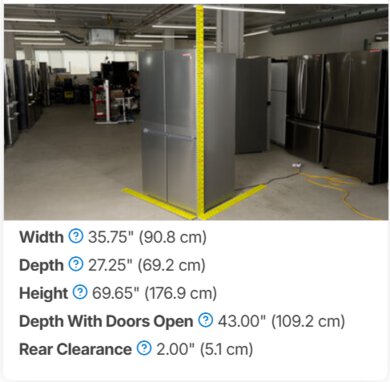
| KitchenAid KRQC506MPS | 27.25 | 43.00 | 35.75 | 12.0 | 9.7 | 7.4 | 4.1 |
| Frigidaire FFTR1425VW | 29.31 | 53.56 | 27.50 | 10.0 | 8.9 | 3.9 | 2.5 |
| KitchenAid KRSC703HPS | 29.63 | 45.25 | 35.63 | 13.6 | 9.2 | 9.0 | 5.4 |
| Bosch 800 Series B36CT80SNS | 31.13 | 44.56 | 35.63 | 14.8 | 10.3 | 6.0 | 3.2 |
| LG LRFLC2706S | 31.63 | 49.00 | 35.94 | 17.9 | 11.6 | 8.6 | 4.6 |
Standard Heights
There's no standard height for refrigerators, but you'll find most fridges are between 60 and 72 inches high. In a kitchen with 8-foot ceilings, you should be able to fit a wall-mounted cabinet on top of a fridge, so you won't find fridges that go right to the ceiling. Bottom freezer, side-by-side, and French door designs tend to be the tallest to provide more capacity over top freezer models.
There's more to fridge sizes than just the dimensions, though. Unfortunately, it's not simply a matter of fitting the largest fridge you can into the space in your kitchen. You need to measure and add extra space on all sides for clearance.
Clearance
Squeezing a fridge into a space with no clearance will create problems. You should provide clearance on all sides for a fridge to fit and to function properly. Manufacturers all have different recommendations, so consult your manual or the manufacturer's website to be sure.
Back clearance
You need some clearance behind the fridge to provide ventilation to the machine compartment that contains the hot compressor and dissipates heat from the condenser. The hot components also evaporate water produced during the defrost cycle, so this needs ventilation as well.
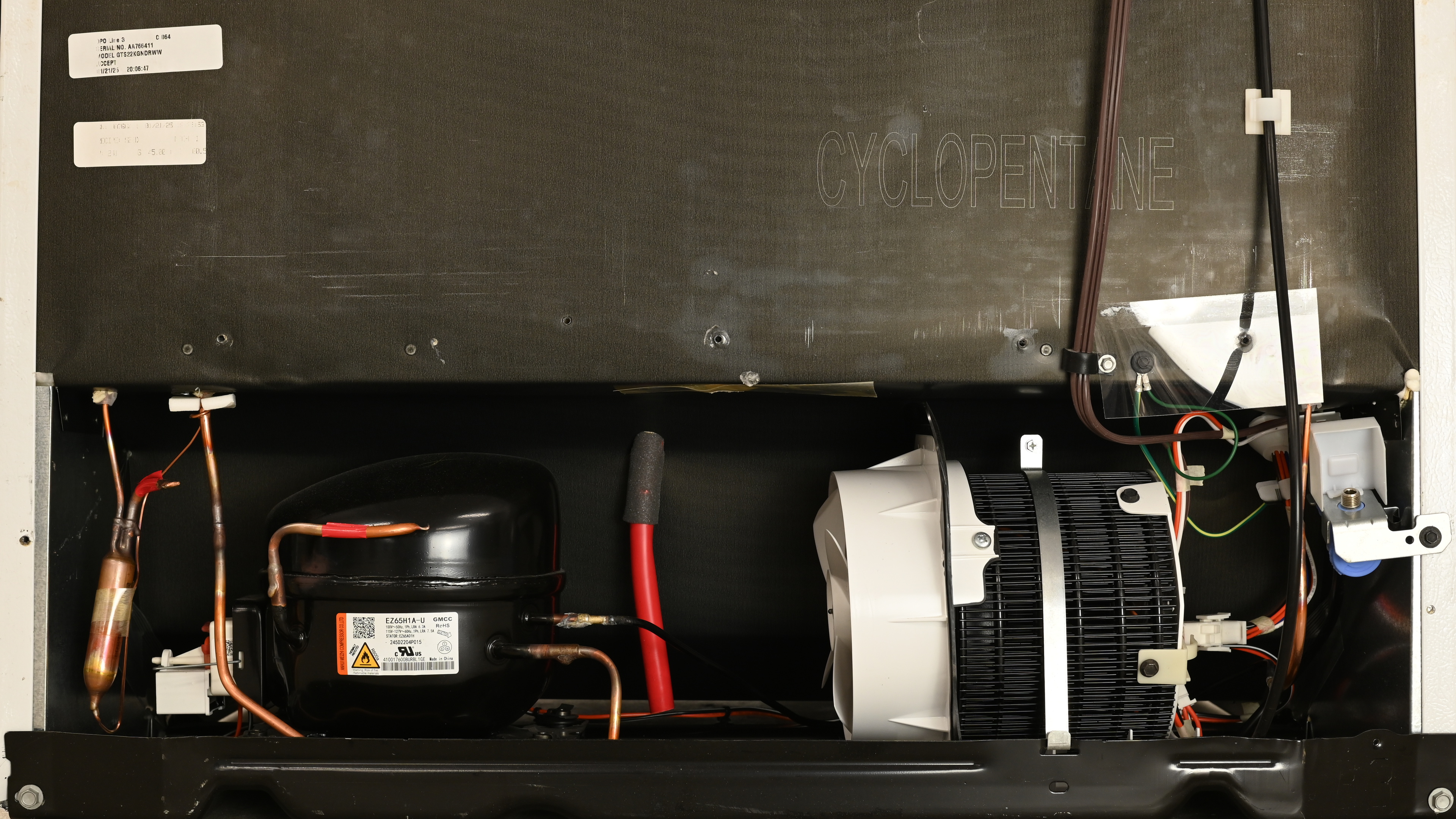
You should include clearance for the electrical plug and the water connection as well. Manufacturers recommend 1-2 inches of clearance in the back.
Side clearance
Normally, the requirement for side clearance is very minimal, just enough to slide the fridge in and out of its space: 1/8th of an inch. However, there are three exceptions:
- Some refrigerators use skin condensers where the condenser runs along the inside of the side walls. It transfers its heat to the walls, so these need more ventilation and clearance. Consult your manual to be sure, but you'll need 1-2 inches of side clearance with these fridges.
- Door hinge pins are located in the center of the door depth, so when you open the door, a small portion of the door's thickness will pivot out wider than the fridge body. If you have deep cabinets on the door hinge side of the fridge or if the fridge is located in the corner of your kitchen, allow 2 inches of clearance so that you can open the door. Note that many fridges have reversible doors so that you can position the hinge on the side that's most appropriate for your kitchen.
- If you position your refrigerator in the corner of your kitchen and the wall is on the door hinge side, allow extra clearance so that the door handles don't contact the wall. A fridge without handles will reduce this clearance requirement, or you can reverse the door if your fridge allows.
top clearance
The refrigerator will need about 1 inch of clearance from a cabinet mounted above. This is for ventilation, to allow for hot air coming off the back bottom to rise over the fridge and out of the enclosed space.
front clearance
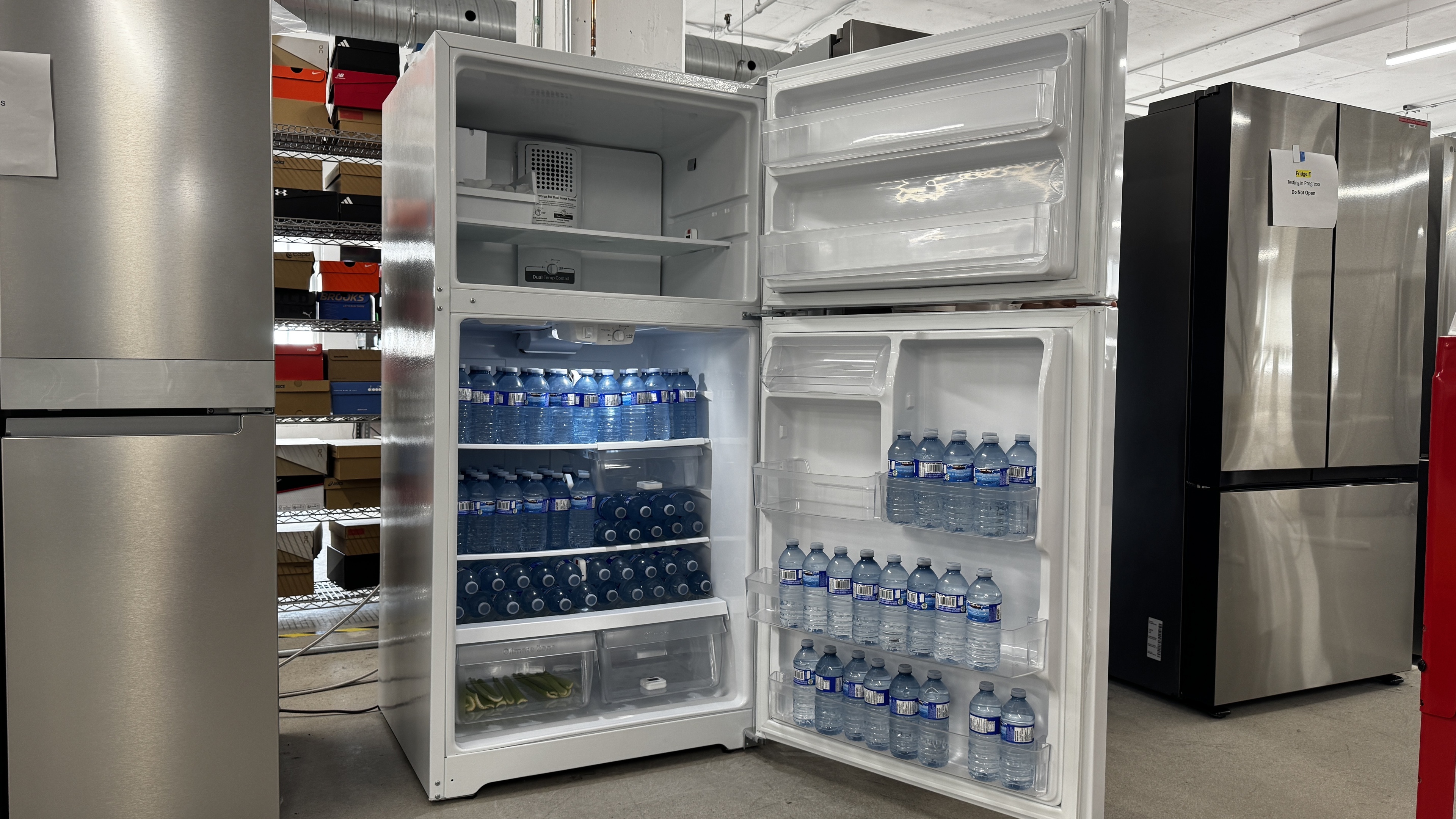
This is only a consideration if you have the fridge mounted against a wall, with a kitchen island in front and an aisle in between, or if you have a very narrow kitchen. You should allow clearance for the doors to swing out, or they might hit cabinets or other appliances in front of the fridge. Top freezer and bottom freezer models need the most clearance. They need the entire width of the door plus a little extra to allow it to swing a bit past 90 degrees open.
 |
 |
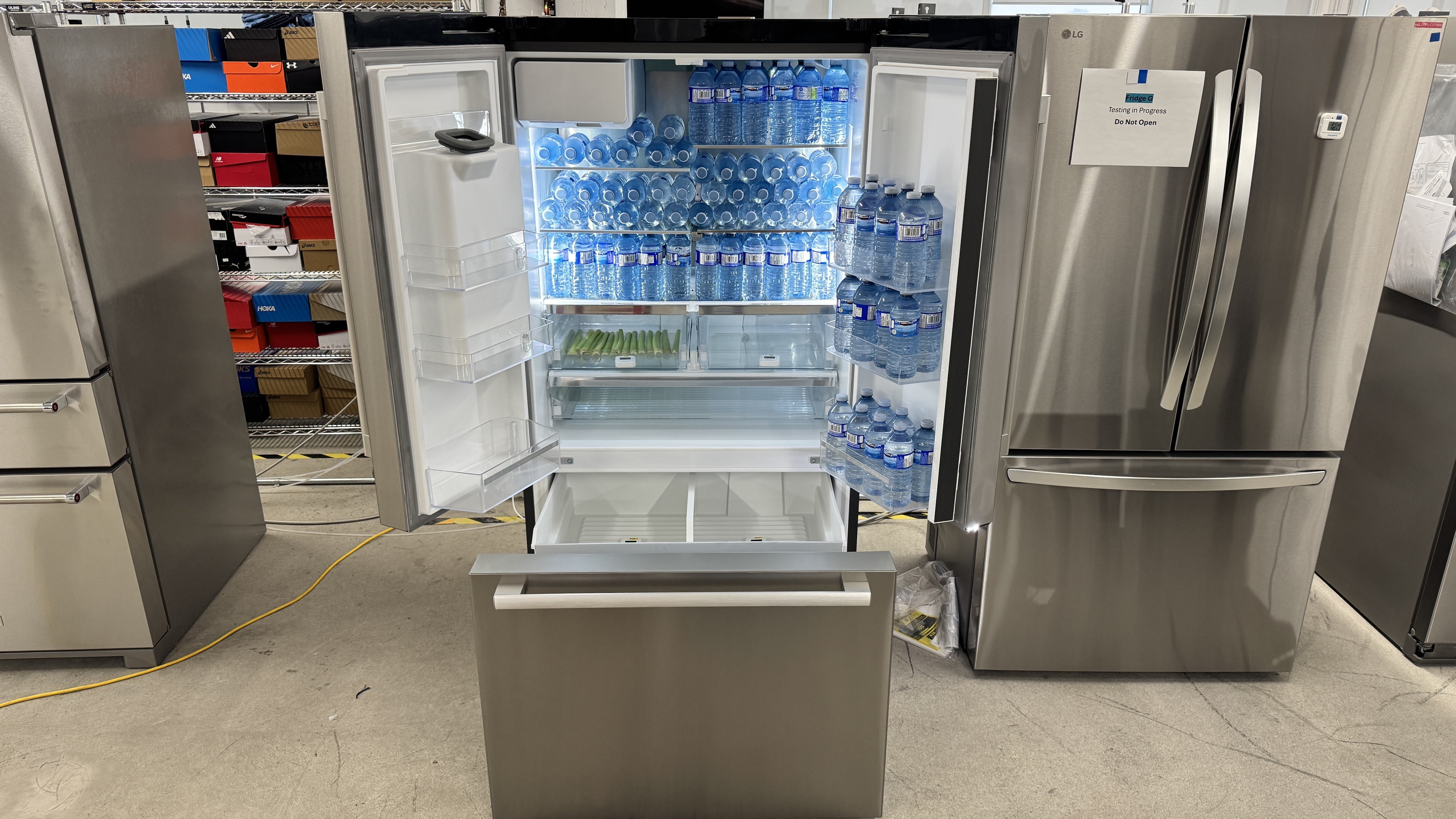
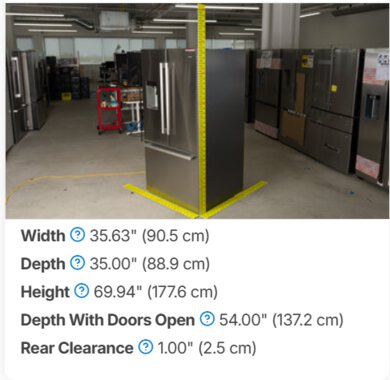
French door models with their half-width doors need half of the refrigerator width of clearance for the fridge portion, but many of these have full-width pull-out freezer drawers that require at least the fridge depth's worth of clearance.
 |
 |
Most 4-door models don't need as much clearance for the doors, but they do need adequate clearance for the pull-out drawers in the fridge and freezer.
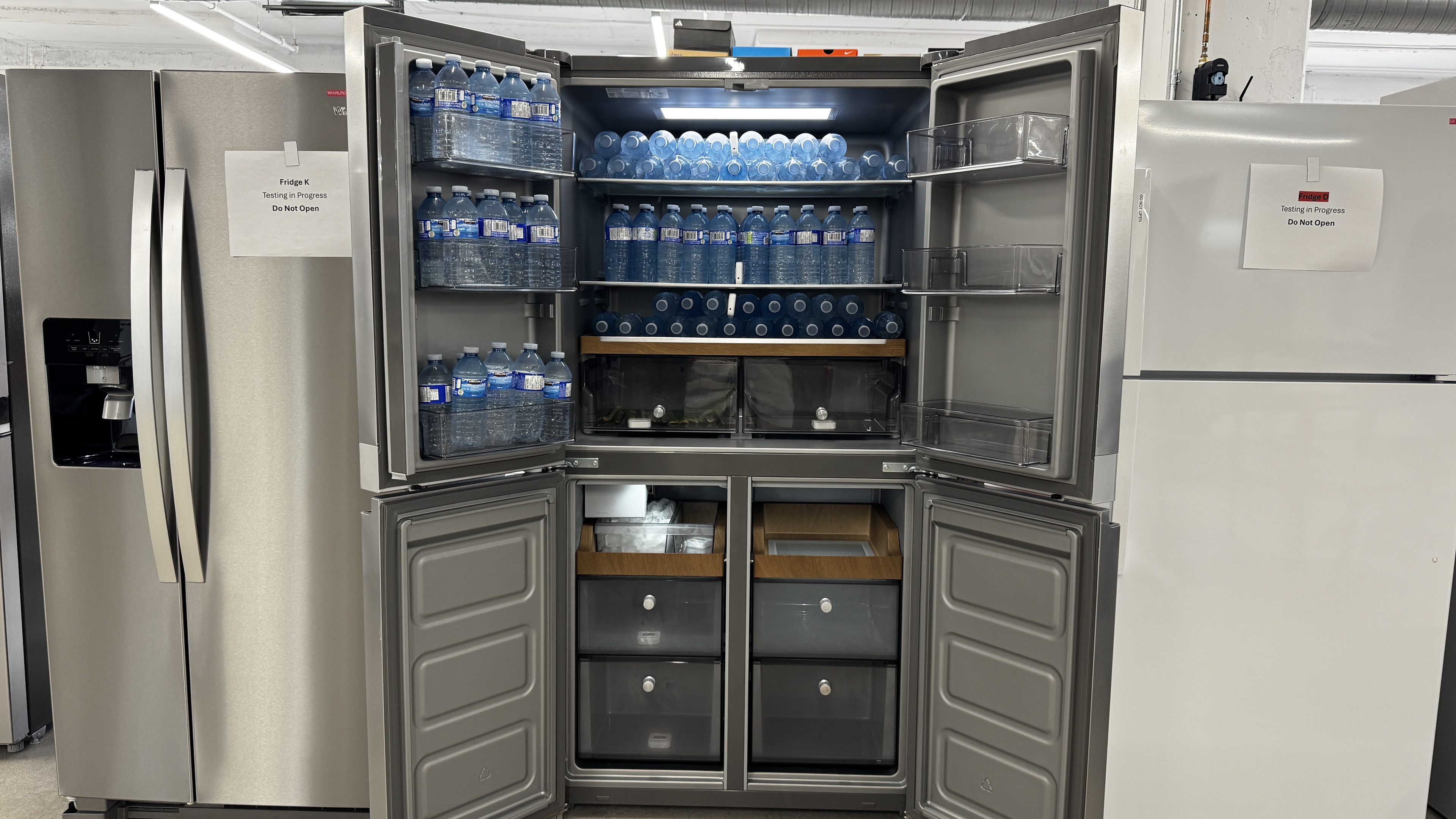 |
 |
The 5-door models are like French door refrigerators in that they need the most front clearance for their pull-out freezer drawer.
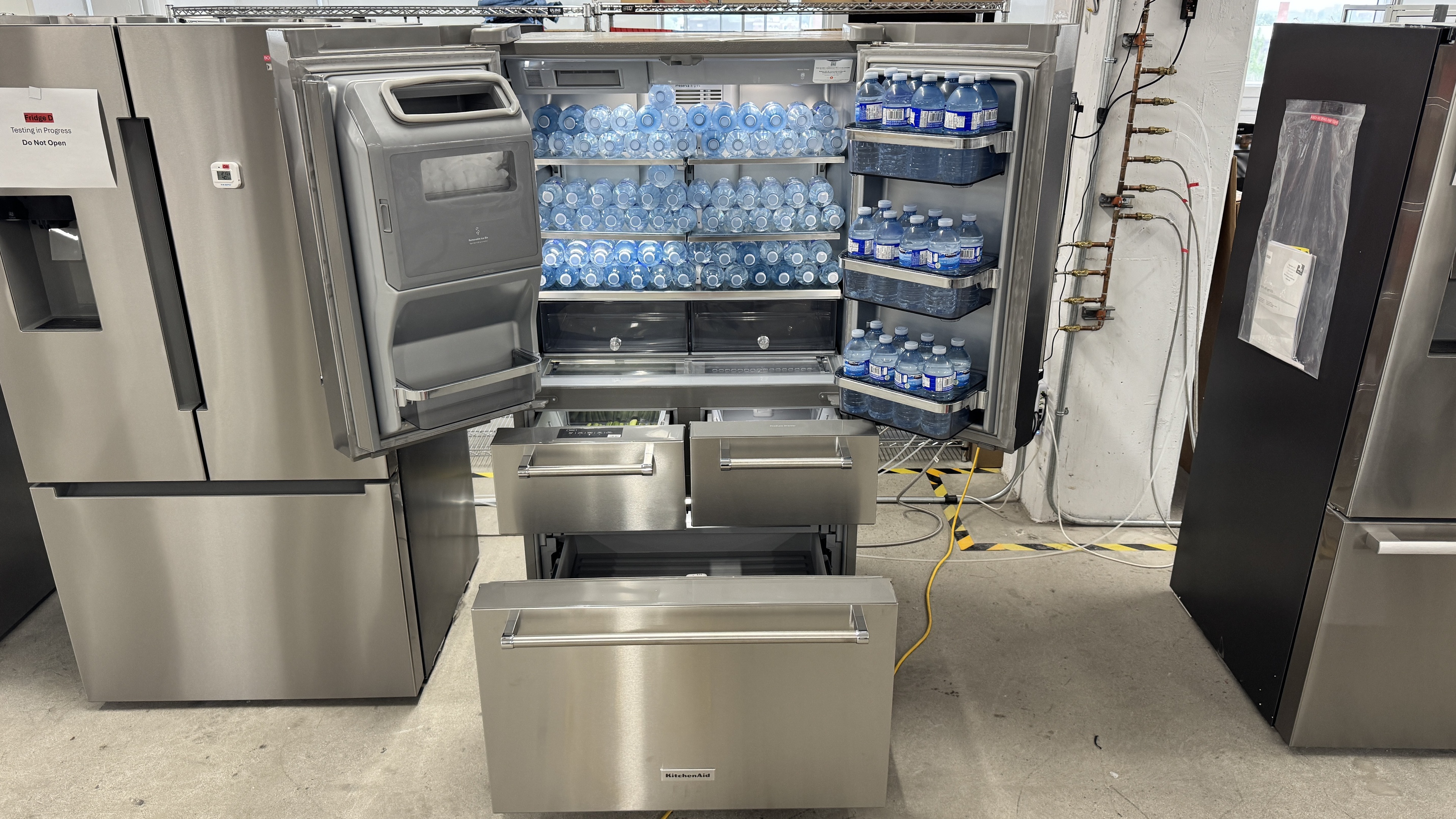 |
 |
Conclusion
So it's not just a matter of buying the largest fridge that your budget will allow. You have to measure or plan the space beforehand to make sure that your shiny new fridge will fit, that you can open the doors, that the doors won't hit anything, and that the fridge has enough ventilation to work properly. Our refrigerator size guide, along with a little measuring and planning in advance, will save you a lot of trouble later!
Fridge sizes are quite closely related to their type, so be sure to check out our article Refrigerator Types Explained. Or if you want to learn more about how these major appliances work, you can read our deep dive on How A Refrigerator Works.