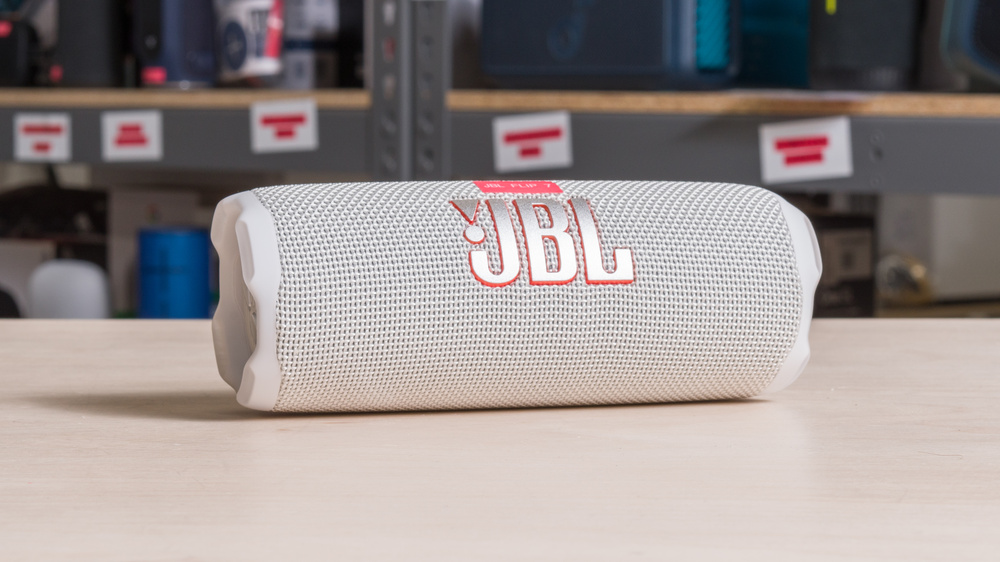
The JBL Flip 7 is one of the smallest of the brand's tubular Bluetooth speakers, about the size and shape of a water bottle. While not much has changed between it and the previous JBL Flip 6, like a high IP rating against dust and water exposure and the option to add more speakers for a louder party, the brand has also added AI, Auracast, and a novel system for adding accessories called PushLock.
Our Verdict
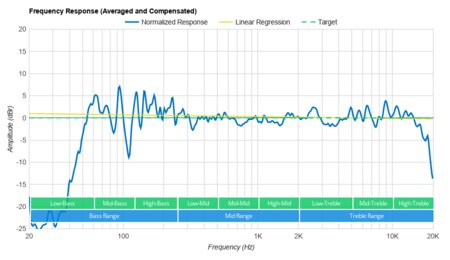
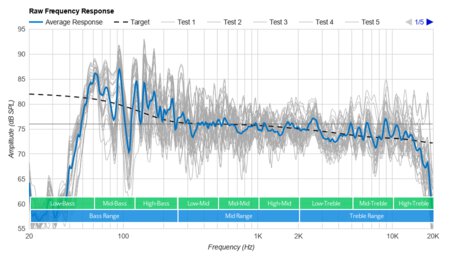
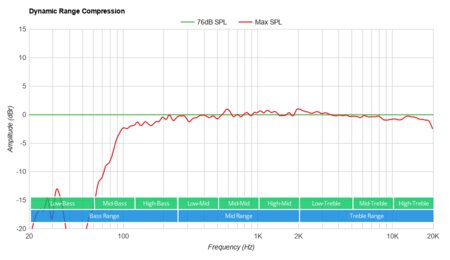
The JBL Flip 7 is okay for music. Its small size limits its bass reproduction, so basslines lack weight and punch. That said, voices and higher-pitched instruments sound clear and balanced, and you can adjust the EQ settings in the companion app. It's a mono speaker, so it necessarily downmixes your audio, though you can pair a second compatible JBL speaker for stereo. It also tends to compress in the lows, so if you listen close to max volume, the bass sounds weaker.
Multi-device pairing.
Graphic EQ and presets.
Unimpressive battery life.
Downmixes stereo audio to mono.
The JBL Flip 7 is disappointing for videos and movies. Unfortunately, this speaker has high enough latency that it can result in a mismatch between your audio and your video. It's a bit lower if you use the USB-C port for a wired connection. Still, it downmixes to mono and isn't very immersive when it comes to blockbuster action flicks, robbing bassy explosions of their rumble, especially at high volumes.
Graphic EQ and presets.
Unimpressive battery life.
High latency.
Downmixes stereo audio to mono.
The JBL Flip 7 is great for podcasts. It's small enough to tote from room to room or on the patio, and since it reproduces mids and treble with clarity, voices sound natural. You can also connect to two devices simultaneously, so you can control the speaker seamlessly from your phone or laptop.
Multi-device pairing.
Graphic EQ and presets.
Unimpressive battery life.
The JBL Flip 7 doesn't have a microphone, so there's no voice assistant capability.
The JBL Flip 7 is decent for use outdoors. It gets loud enough for a small to medium room, and its clear reproduction of voices and higher-pitched instruments is useful if you're listening outside. It has an IP68 rating, and it's advertised to withstand a one-meter drop, so it can handle the elements, and it fits into most cupholders and backpacks. You can add a second compatible speaker via Auracast or sync several compatible speakers in Party Mode. Its controls are intuitive and simple to use. Unfortunately, the battery life falls short of the advertised time, and while you can extend it by switching to PlayTime Boost, the extra time comes at the cost of frequency response accuracy, by rolling off bass.
IP68 rating.
Multi-device pairing.
Unimpressive battery life.
Downmixes stereo audio to mono.
Changelog
- Updated Jul 28, 2026: This review has been updated to Test Bench 1.0.1. This includes the Test Bench 1.0 updates to all of our Sound tests: Frequency Response Accuracy, Raw Frequency Response, Directivity, and Loudness, as well as the revised Low-Frequency Extension calculation and related DRC updates introduced in Test Bench 1.0.1. There have also been text changes throughout the review, including to the usages and product comparisons, where applicable, to match these results. You can read more about these changes in our Test Bench 1.0 changelog and Test Bench 1.0.1 changelog.
- Updated Jul 13, 2026: This review has been updated to Test Bench 1.0, which includes new results for all of our Sound tests: Frequency Response Accuracy, Raw Frequency Response, Directivity, and Loudness. There have also been text changes made throughout the review, including to the usages and product comparisons, to match these results. You can read more about these changes in our changelog.
-
Updated Jan 30, 2026:
The Portability section was updated to mention the JBL Grip.
-
Updated Oct 01, 2025:
A comparison to the Turtlebox Ranger was added in the Battery section.
Check Price
Differences Between Sizes And Variants
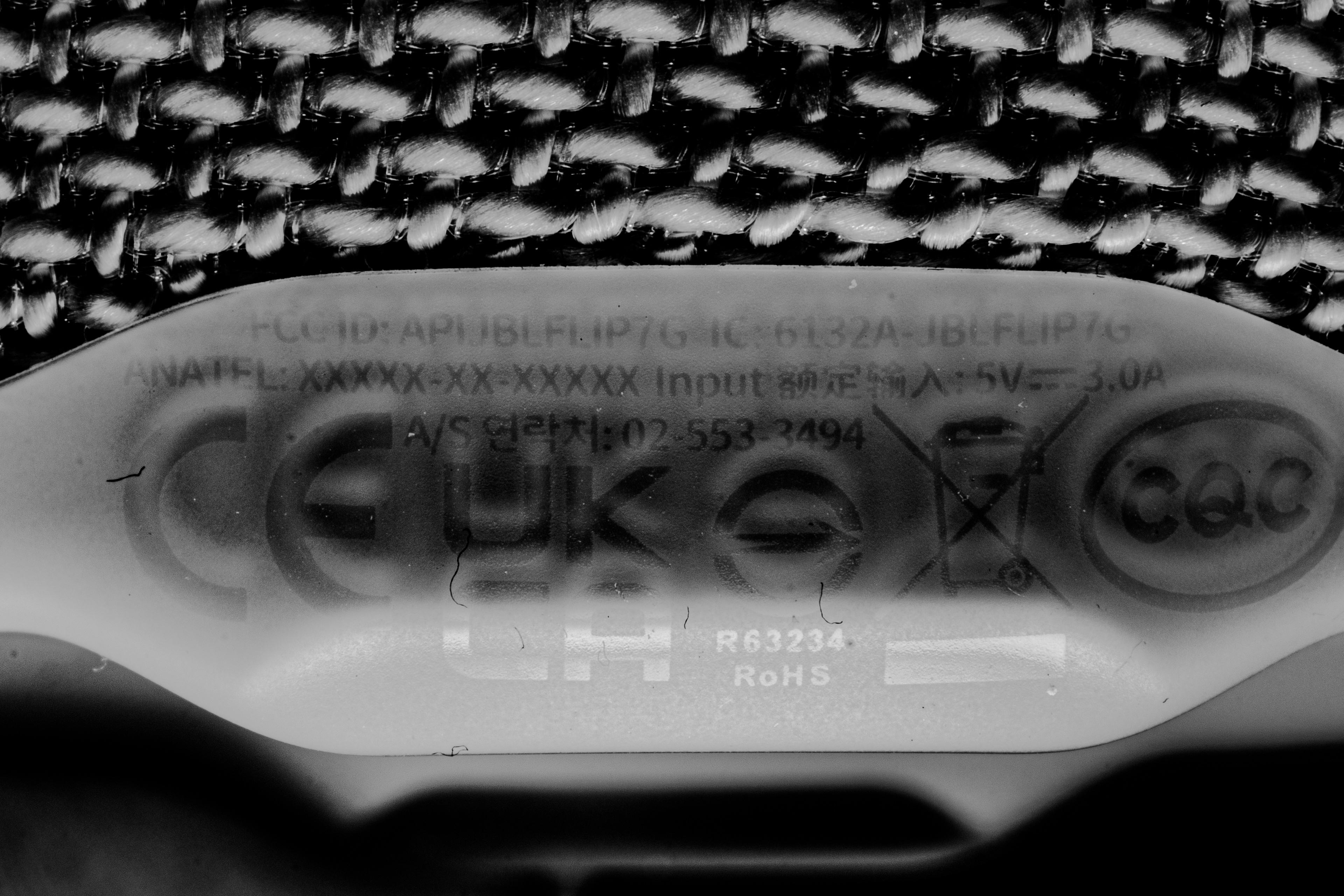
The JBL Flip 7 comes in several eye-catching colors, all of which we expect to perform the same. Our unit is 'White' (here's a photo of its label). You can also choose from 'Blue,' 'Red,' 'Black,' 'Squad,' 'Purple,' and 'Pink.'
If you encounter any other variants of this speaker, let us know in the forums, and we'll update our review.
Popular Speaker Comparisons
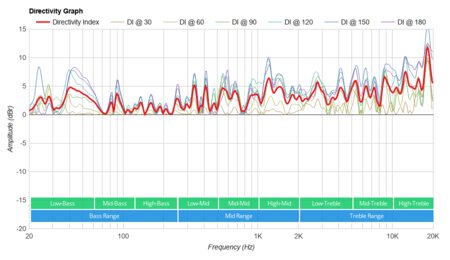
The JBL Flip 7 is the smaller sibling of the JBL Charge 6, which, despite the lower number, is actually from the same generation of portable speakers. Due to its larger size, the Charge 6 houses a larger battery, effectively doubling its battery life compared to the Flip 7, and it offers greater low-end extension for a bit more even bass. You can even pair them using Auracast for Party Boost Mode, or add a second Flip 7 for a stereo pair. That said, if you own the previous JBL Flip 6, you can't pair it with the Flip 7, which has been the case with nearly every new generation of Flip and Charge speakers: they're not backward-compatible. New to the Flip 7 is USB-C audio for a wired connection, which is absent on the Flip 6. Looking at other options on the market, the Ultimate Ears BOOM 4 is a similar size and weight compared to the Flip 7, with considerably better directivity, meaning it sounds almost the same from all angles, and a longer battery life. However, the Ultimate Ears lacks a wired connection.
For more speakers you can take on the go, check out the best outdoor speakers. Get the lowdown on the best JBL speakers and the best speaker brands.
The JBL Charge 6 is the step-up model from the JBL Flip 7, and despite the number difference, they're from the same generation of speakers. They share similar tech specs: Auracast for pairing with other compatible JBL speakers, graphic EQ, and Play Time Boost (to extend the battery life). The Charge 6 weighs about double that of the Flip 7, though it's still portable. Due to its larger size, it reproduces more low-end. The Charge 6 also has more than twice the battery life. The central reason to buy the Flip 7 is that it's smaller and offers similar tech in a smaller package, but it's hampered by a little more compression at max volume and a lower battery life.
The JBL Flip 7 and JBL Flip 6 are so alike that price may determine your choice, and you can't mix and match the generations for stereo pairs. However, there are some differences. The Flip 7 has a slightly higher IP68 rating and is advertised as drop-resistant up to 1 meter, compared to the Flip 6's IP67 rating. The Flip 7 also lets you skip back a track on the controls, and it adds a USB audio connection. Choosing PlayTime Boost lets you extend the battery life. That said, the Flip 6 has most of the same features and functionality as the next gen.
The JBL Flip 7 is better than the JBL Grip for most people, unless your priority is picking the smallest speaker. The Flip 7 sounds a bit better, gets louder, and supports wired USB-C audio for lossless and low-latency audio for viewing videos. It also shares the same app as the Grip, so you get a graphic EQ, optional stereo pairing, and party mode in both. The Grip has the advantage of being smaller, but that means it also puts out a touch less bass.
In most respects, the JBL Flip 7 is a better speaker than the Beats Pill. Even though the JBL is a touch smaller, it feels better-built, and you can tweak the speaker's sound to your taste using the EQ in the companion app, but the Beats app doesn't have an EQ. That said, the larger Beats has a battery that lasts a couple of hours longer off a single charge, and it has a mic that works with your phone's voice assistant. If you need hands-free control, the Beats is the way to go. For most people, the JBL offers a better balance of features.
Test Results
for pictures & test results
for pictures & test results

for pictures & test results