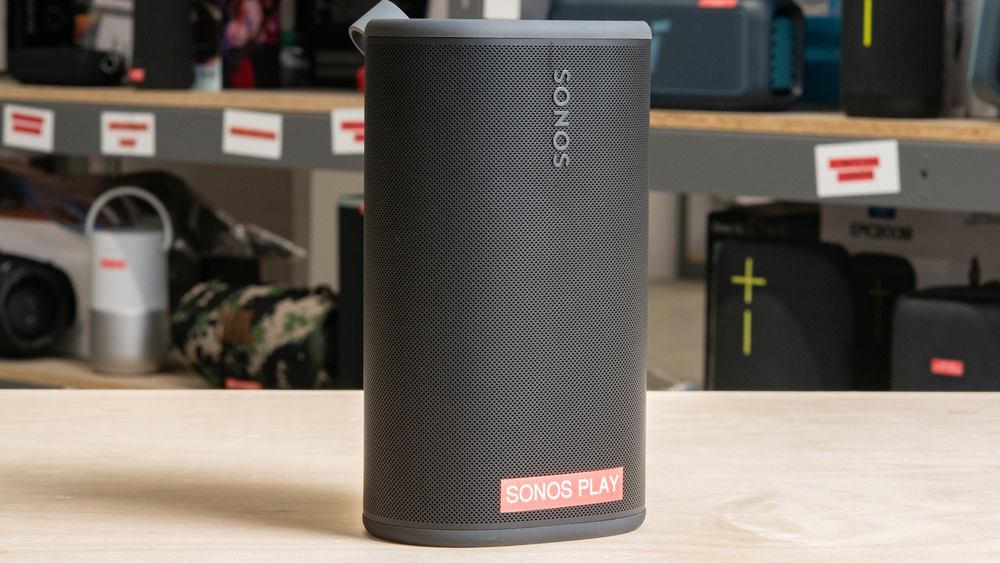
The Sonos Play is a portable speaker with smart features. Positioned between the Sonos Roam 2 and the Sonos Move 2 in both size and price, it promises to deliver the best of both worlds, with an advertised 24-hour battery life and an IP67 rating, complemented by Wi-Fi connectivity and voice assistant integration. Its compact, cylindrical shape makes it easy to stow in backpacks and tote bags for weekend trips, but its charging dock also makes it a good option for your kitchen or living room, too.
Our Verdict
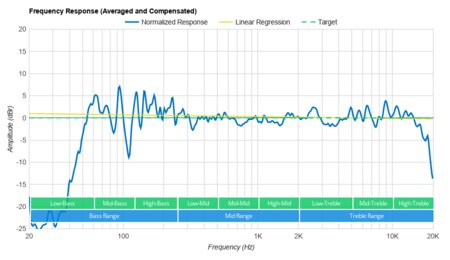
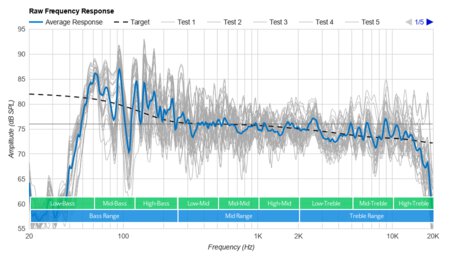
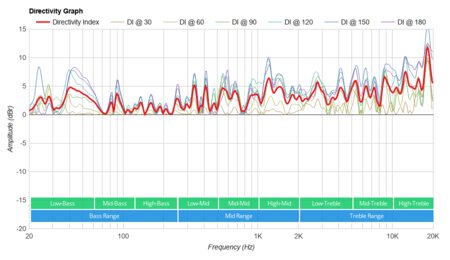
The Sonos Play is okay for music. It doesn't produce much in the way thumpy low end, but there's enough high-bass to give basslines some definition. And the mid-range is very balanced, ensuring vocals and lead instruments sound clear and natural, though the recessed treble means higher-pitched sounds lack a little detail. There are a number of sound-shaping features that can enhance your listening experience too, like Trueplay room correction and loudness-dependent EQ, though there's no graphic EQ for granular tweaks. The speaker's cylindrical design gives it excellent directivity, and it can play stereo content without downmixing, too. It gets reasonably loud, though it's a small speaker best suited to smaller rooms.
12 hours of continuous battery life.
Plays back stereo audio without downmixing.
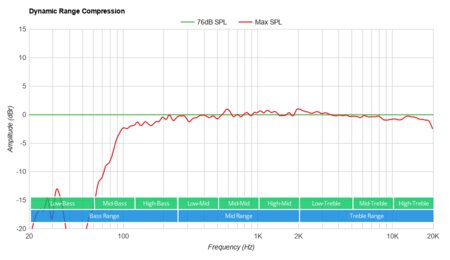
Some bass-range compression at higher volumes.
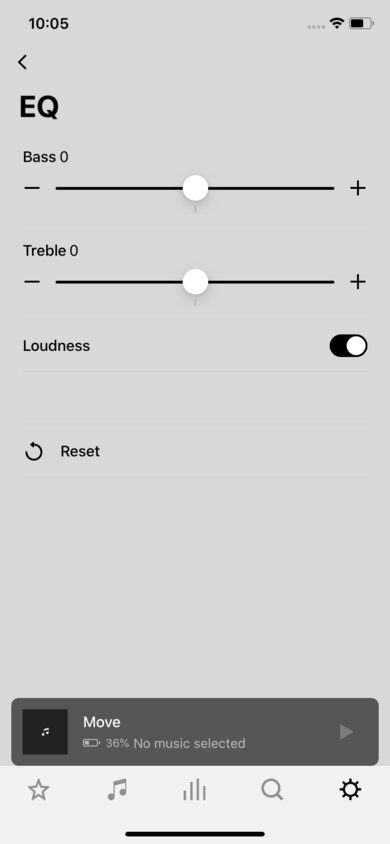
No graphic EQ.
The Sonos Play is okay for videos and movies. The balanced mid-range renders vocals and dialogue accurately, though the lack of low and mid-bass can rob action sequences of their intensity. Its excellent directivity and ability to play stereo content without downmixing are a boon for movie-watching, though the drivers' proximity to each other doesn't allow for much separation within the stereo field. It gets reasonably loud and stays clean at max volume, though it works best in smaller rooms. Latency with iOS devices over Bluetooth and AirPlay is among the lowest we've tested, and Android latency isn't bad either, which helps mitigate lip-sync errors between your audio and video. Different apps and devices compensate for latency differently, though.
Very low latency with iOS devices.
Plays back stereo audio without downmixing.
Some bass-range compression at higher volumes.
No graphic EQ.
The Sonos Play is good for podcasts. The balanced mid-range reproduction helps render your favorite hosts' voices smoothly and naturally, and the speaker gets loud enough for listening in smaller rooms. There's very little compression at max volume, so dialogue stays clean as you turn it up. Its compact size and 12-hour battery life, coupled with its convenient charging dock, make it a versatile choice: keep it parked in the kitchen for podcasts while cooking, or bring your favorite show on the road. Its excellent directivity ensures that most listening angles around the speaker yield similar-sounding audio reproduction.
12 hours of continuous battery life.
Very low latency with iOS devices.
No graphic EQ.
The Sonos Play is outstanding for use with voice assistants. When connected to Wi-Fi, it has built-in Alexa functionality for integration with your Amazon devices, but there's also some limited support for Siri, though you're confined to music-related commands, and you'll need an iOS device. The built-in mic does a fantastic job of picking up voice commands, even in crowded rooms when you're far away. You can also use Sonos Voice Control if you lack a compatible voice assistant setup, which gives you hands-free control over many music playback-related functions.
Built-in mic picks up commands very easily.
The Sonos Play is a good choice for outdoor use. It's IP67 rated for protection against dust damage and water submersion, though the manufacturer advises you not to play audio while the speaker is in the water. Still, the speaker's construction is very sturdy, and the 12 hours of battery life should get you through a day trip without needing a recharge. Its mid-range is balanced, though it lacks the low- and mid-bass needed to get a dance floor moving. It gets reasonably loud and has very little compression at max volume. The portable design means that it can easily be stowed in a hiking backpack or weekend bag, too, though it's not as compact as some speakers specifically designed for on-the-go use.
12 hours of continuous battery life.
IP67 rating.
Some bass-range compression at higher volumes.
Changelog
- Updated Aug 28, 2026: This review has been updated to Test Bench 1.0.1. This includes the Test Bench 1.0 updates to all of our Sound tests: Frequency Response Accuracy, Raw Frequency Response, Directivity, and Loudness, as well as the revised Low-Frequency Extension calculation and related DRC updates introduced in Test Bench 1.0.1. There have also been text changes throughout the review, including to the usages and product comparisons, where applicable, to match these results. You can read more about these changes in our Test Bench 1.0 changelog and Test Bench 1.0.1 changelog.
- Updated Aug 11, 2026: This review has been updated to Test Bench 1.0, which includes new results for all of our Sound tests: Frequency Response Accuracy, Raw Frequency Response, Directivity, and Loudness. There have also been text changes made throughout the review, including to the usages and product comparisons, to match these results. You can read more about these changes in our changelog.
- Updated May 06, 2026: Review published.
- Updated May 01, 2026: Early access published.
Check Price
Differences Between Sizes And Variants
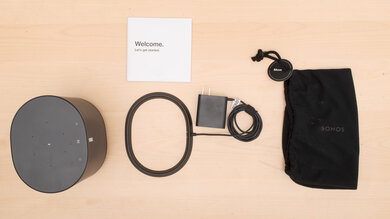
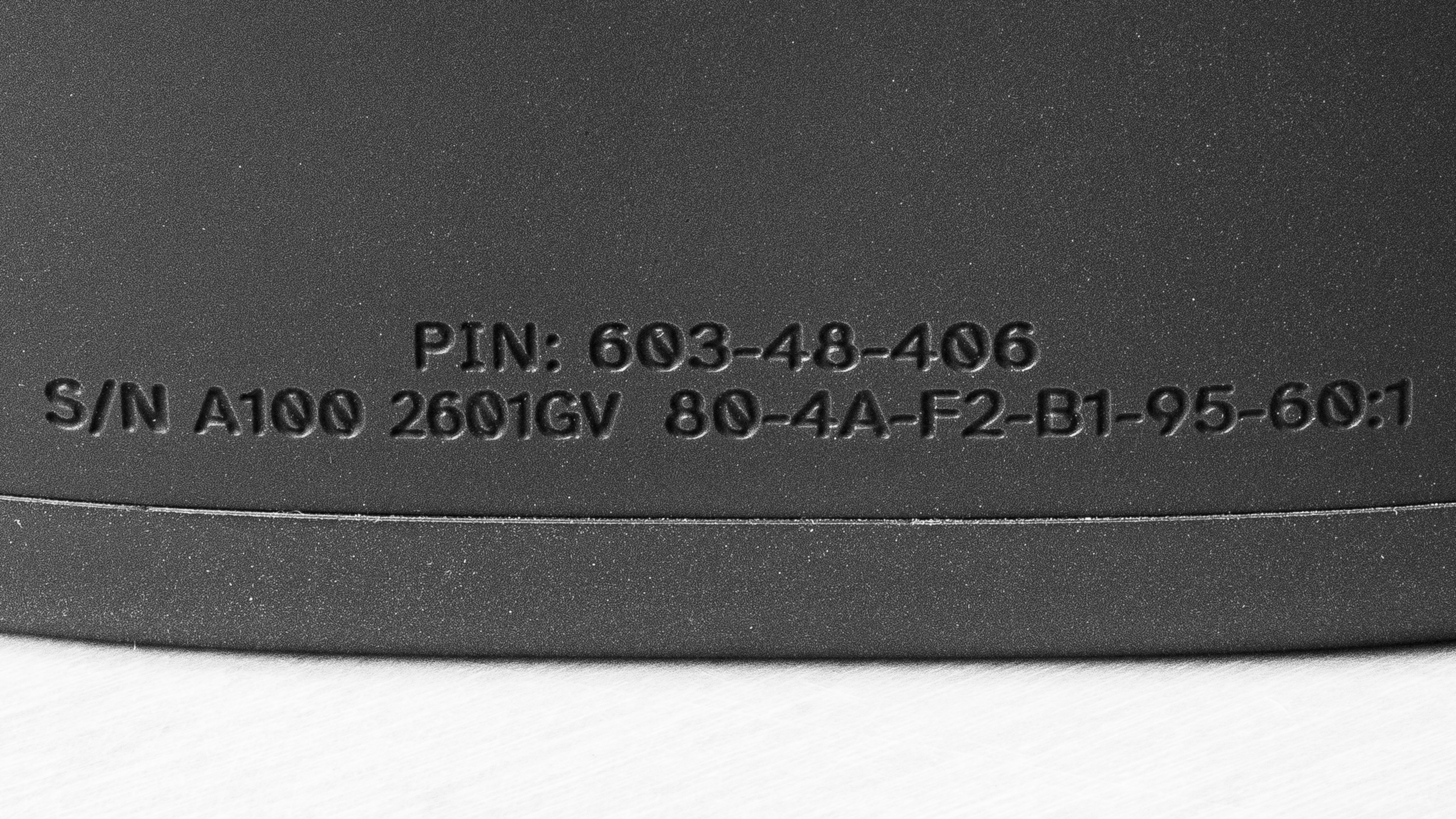
The Sonos Play comes in two color variants: 'Black' and 'White.' We tested the 'Black' variant (and took a photo of its label), but we expect other variants to perform similarly.
If you encounter another variant of this speaker, please let us know in the comments, and we'll update our review.
Popular Speaker Comparisons
The Sonos Play is a wireless speaker that bridges the gap between hyper-portable speakers, like the Sonos Roam 2, and the more home-oriented features and performance of larger speakers, like the Sonos Move 2. As a result, it boasts a 12-hour battery life for all-day use, and it comes with a dedicated charging dock that can keep it perpetually charged if you plan on keeping it parked in one place. The dock doesn't come with a wall adapter, though, so you'll need to provide your own. That said, it's not as feather-light as the Roam 2 and lacks the room-filling top volume of the Move 2. If you're looking for something in the same weight class but need a bit more battery life and top-notch directivity, the Ultimate Ears MEGABOOM 4 gives you around 20 hours without needing a recharge. This comes at the expense of the Sonos' voice assistant support and Wi-Fi compatibility, though, which is common with cheaper speakers and limits their use as home speakers.
Looking for more options? Check out our recommendations for the best Bluetooth speakers, the best small Bluetooth speakers, and the best waterproof Bluetooth speakers.
The Sonos Play is the Sonos Move 2's more portable sibling. Though the two have similar battery life, the Play's lighter design makes it easier to stow in a bag for a weekend trip, and it features a more resilient IP67 rating against dust and water damage. If volume and bass output are the priority, the Move 2 is likely a better option: it can get louder, and there's less compression in the bass range as you crank the volume. Both speakers are excellent choices for home use, with built-in Alexa support and Wi-Fi compatibility. But if you also want to take your speaker on the go, the Play is the better choice.
The Sonos Roam 2 is a more portable option than the Sonos Play, but it falls short in battery life and sound quality. Both speakers are IP67 rated for protection against dust and water submersion, but the Play uses slightly higher-quality materials. It can get a little louder and has double the continuous battery life. That said, if you're looking for a speaker that can be slung in a pocket or attached to your bike, the Roam 2 is one of the most portable speakers out there. It's a fair bit cheaper, too, and can be a great gateway into the Sonos ecosystem.
The Ultimate Ears MEGABOOM 4 boasts a longer, 20-hour battery life and better directivity than the Sonos Play, though the Sonos is a better choice if you need voice assistant and Wi-Fi support. Both speakers are very portable and can easily be carried around in one hand. The Ultimate Ears is a bit lighter, though, and can float in water. Both speakers have a slightly warm sound.
The Sonos Play and the WiiM Sound are aimed at different kinds of buyers. The Sonos is the better all-around choice if you want one speaker for both home and travel: it has a built-in battery, an IP67 rating, AirPlay support, and hands-free Alexa, making it much more versatile around the house, on a patio, or packed for a weekend away. The WiiM Sound is a wired home speaker, so it isn't trying to win that fight. Instead, it's a better fit if you want a stationary streaming hub with deeper app control, lots of sound customization options, Bluetooth and Wi-Fi playback, and a wired Ethernet connection. Just note that the WiiM lacks AirPlay.
Test Results
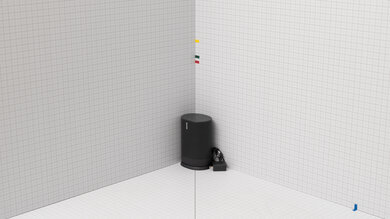
for pictures & test results
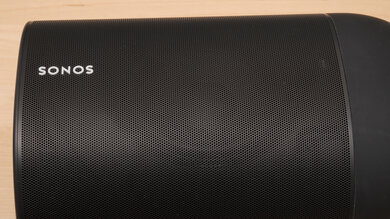
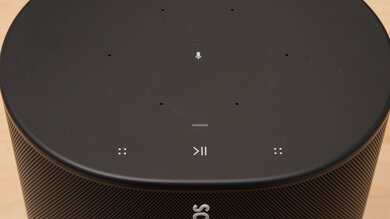
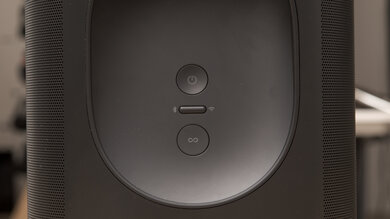
for pictures & test results

for pictures & test results