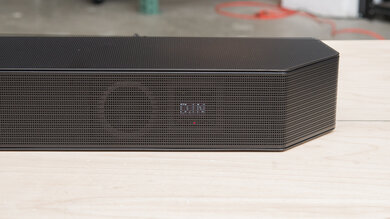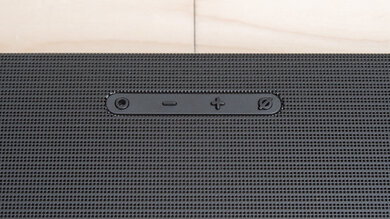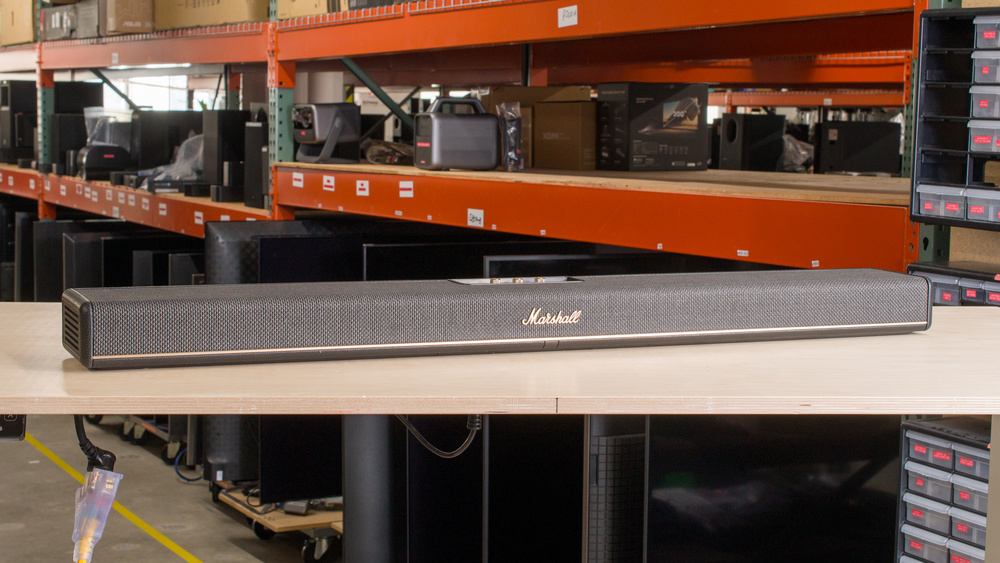
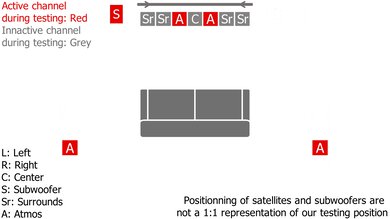
The Marshall Heston 120 soundbar is the British brand's first entry into the soundbar space. Designed in Sweden, the bar features two integrated subwoofers with a four-radiator system and a 5.1.2 channel count. It has the visual language commonly associated with speakers and amplifiers, featuring satisfying knobs rather than capacitive controls or plasticky controls. With an expensive launch price for a standalone bar, the Heston 120 needs more than pedigree to compete with giants like Sonos and Samsung in the TV sound space.
Our Verdict
The Marshall Heston 120 is good for mixed usage. Thanks to its integrated subwoofers, the bass-range performance isn't as anemic as other standalone bars, making it a good option for a variety of music genres, and decent for cinematic movies. Plus, the bar's low audio latency means gamers won't be distracted by egregious A/V desync in shooters or rhythm games.
Low audio latency via HDMI In and eARC.
Supports room correction.
Integrated subwoofers lacks in sub-bass output.
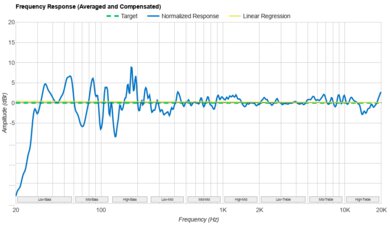
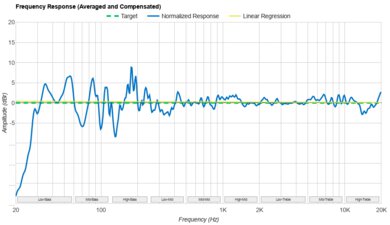
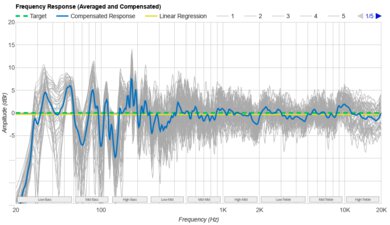
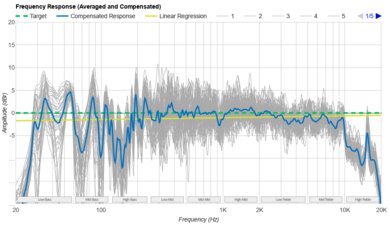
The Marshall Heston 120 is good for dialogue reproduction and classic TV shows. Its stereo reproduction is well-balanced and gets plenty loud, though the center channel overemphasizes the high bass, resulting in somewhat boomy dialogue. Still, the bar has wide format support for any physical or digital media, and a dedicated 'Voice' mode if you want to ensure you catch quippy dialogue.
Dedicated 'Voice' mode.
Supports common formats including DTS:X and Dolby Atmos.
Integrated subwoofers lacks in sub-bass output.
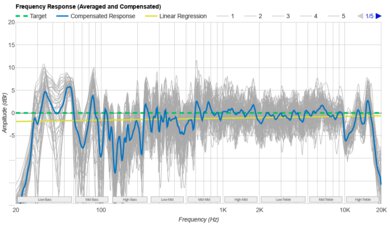
The Marshall Heston 120 is good for music reproduction. It has a balanced stereo frequency response, and its integrated subwoofers do a decent job bringing some low-frequency energy to your tunes. Though, as you'd expect, it doesn't compare to a soundbar with a dedicated subwoofer. On the plus side, the bar allows you to connect a third-party active subwoofer and comes with support for Spotify and TIDAL Connect. You can also tune the sound signature with the app's 5-band EQ.
SUB OUT supports third-party active subwoofers.
5-band graphic EQ.
Integrated subwoofers lacks in sub-bass output.
The Marshall Heston 120 is satisfactory for movies. While its stereo frequency response is well-balanced and has a decent amount of bass thanks to its integrated subwoofers, it won't compare to soundbars with discrete satellites and subwoofers. If you're limited on space, it's a solid option and supports common audio formats for digital and physical media like DTS:X and Dolby Atmos. You also have access to sound enhancement features like room correction and the option to expand the setup with the brand's Heston Sub 200 or your own third-party active sub. That said, you'll be disappointed if you have older gear, since the bar has no Optical input.
SUB OUT supports third-party active subwoofers.
Supports room correction.
Supports common formats including DTS:X and Dolby Atmos.
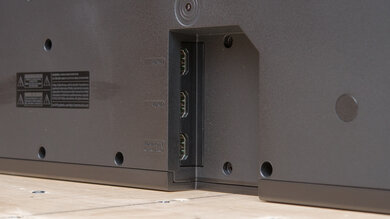
No Optical input.
Integrated subwoofers lacks in sub-bass output.
Check Price
Differences Between Sizes And Variants
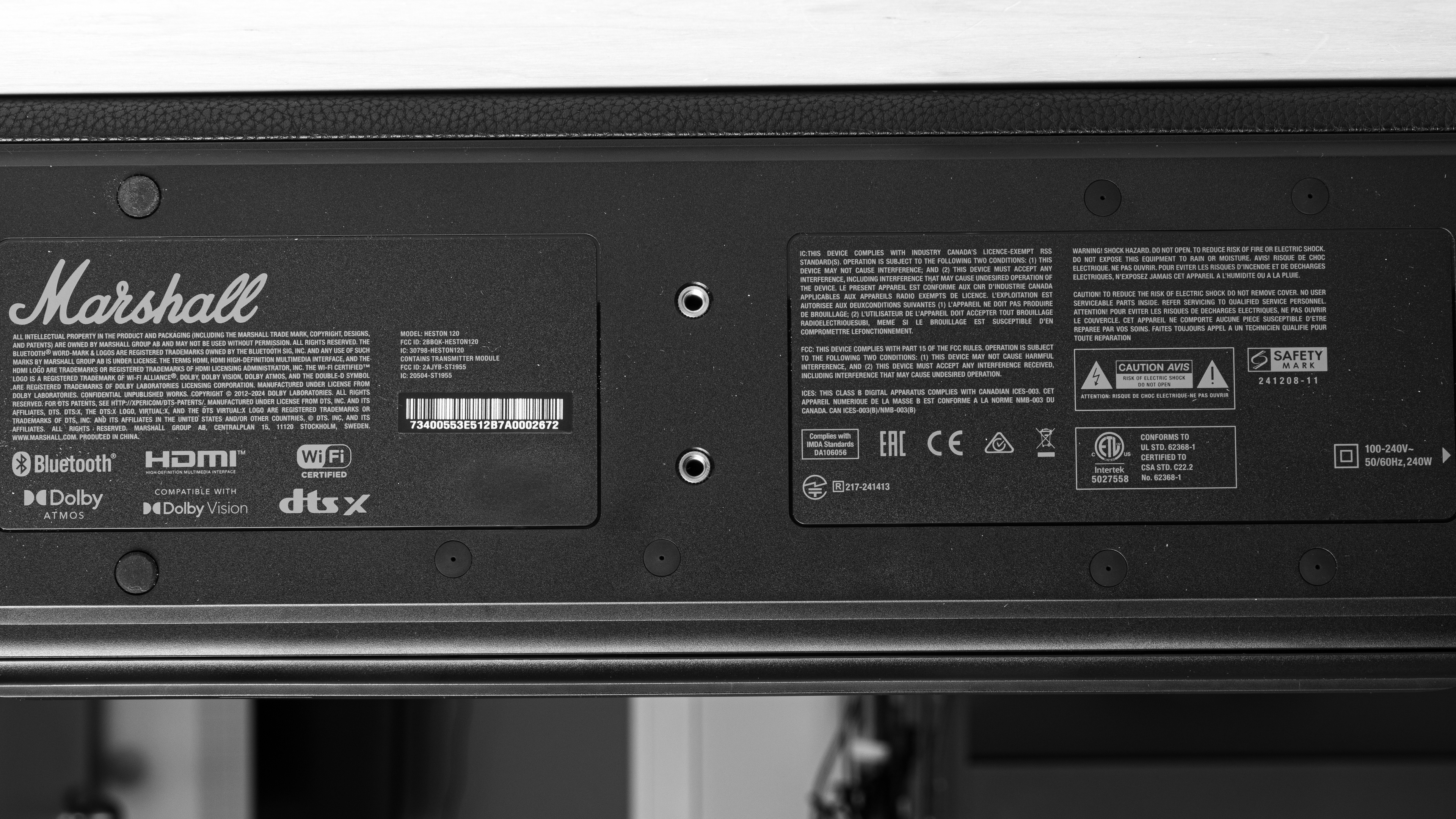
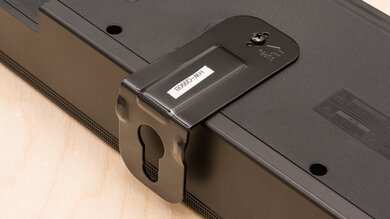
The Marshall Heston 120 only comes in 'Black.' You can also buy the soundbar bundled together with the Heston Sub 200 (also 'Black'). Here's the soundbar's label.
If you encounter another variant, let us know in the comments, and we'll update our review.
Popular Soundbar Comparisons
The Marshall Heston 120, while a compelling 5.1.2-channel standalone soundbar, faces stiff competition in its release-price bracket. The Klipsch Flexus Core 300, for example, has a similar dual-integrated subwoofer setup with a wider stereo soundstage and more balanced Atmos output. While the Klipsch has a higher latency, it has an Optical input, making it the better option for setups that rely on the connection. Plus, you can expand the Klipsch with satellites and a subwoofer, while you're limited to just a subwoofer on the Marshall.
Standalone bars aren't the only option here, either. Products like the JBL Bar 1300XMK2, the Samsung HW-Q990D, the Samsung HW-Q990F, and even the Nakamichi Shockwafe Ultra 9.2 eARC come with dedicated subwoofer(s) and satellites and a slew of device-specific features, like battery-powered surrounds (JBL) or discrete front, side, and rear surrounds (Nakamichi).
If you're limited on space, check out our picks for the best all-in-one soundbars and the best soundbars with a sub. But if you have room for satellites and cash to splash, consider one of our picks for the best soundbar.
The Marshall Heston 120 and Sonos Arc Ultra both work as all-in-one soundbars with integrated subwoofers. They trade blows in a number of ways, so there's no definitive winner. The Marshall has better connectivity since it supports HDMI In, has a SUB OUT, and has more wireless connection options. However, the Sonos's stereo, center, and surround channels get louder, making it the better option for movies acoustically. Both have room correction, but the Sonos lacks a graphic EQ or presets. If you plan on expanding your setup in the future, the Sonos has a better upgrade path, since you can incorporate compatible speakers and a sub to create a full surround setup.
The JBL Bar 500MK2 and Marshall Heston 120 are slightly different soundbar setups. The JBL has a dedicated sub, which provides more low-frequency extension and sub-bass rumble, while the Marshall has two up-firing drivers for reproducing height information. Despite its up-firing drivers, the Marshall isn't much better than the JBL at reproducing convincing height cues. However, the addition of a sub puts the JBL ahead in most acoustic performance metrics, though it has a warmer sound than our in-room target. The JBL also supports Optical while the Marshall doesn't, making it the better pick if your gear only works with the connection.
The Klipsch Flexus Core 300 and Marshall Heston 120 are similar standalone bars that trade blows. They both have a SUB OUT that works with third-party subwoofers and a similar 5.1.2-channel count with dual integrated subs. The Marshall comes out ahead in audio latency performance, but it doesn't support Optical inputs like the Klipsch. However, the Klipsch is better for video passthrough since it can handle 4k @ 120Hz HDR signals while the Marshall cannot. If you're planning on expanding your setup, the Marshall only offers a branded sub, while the Klipsch can be upgraded with satellites, too.
The Marshall Heston 120 and KEF XIO, while similar bars, have some major differences. First, price: the KEF is significantly more expensive than the Marshall. While you can see the extra spend in premium materials and finish on the KEF, it doesn't translate to better performance across the board. For the most part, the KEF is performs better acoustically, with a slightly more balanced stereo sound, and louder surround, center, and height channel output. However, it doesn't have a room correction feature and has doesn't have a graphic EQ like the Marshall. The KEF lacks an HMDI In port while the Marshall doesn't support Optical. Making the Marshall the better option if you're lacking ports on your TV and the KEF the better option if you have older gear that uses Optical for audio.
Test Results
for pictures & test results
for pictures & test results
for pictures & test results
for videos & test results

for videos & test results