- 80.0%WHD @ 94 dB SPL
- 20.0%WHD @ 104 dB SPL
While you can call any alteration to the waveform of a signal between two points of a system distortion, harmonic distortion refers to the unintended generation of harmonics (frequencies that are integer multiples of a fundamental frequency). It's worth keeping in mind that distortion in general isn't necessarily a negative, and can even be considered a positive when applied in an artistic manner (e.g., equalization and electric guitar pedals).
In sound reproduction, however, harmonic distortion is considered a flaw since it indicates the presence of frequencies that weren't included in the original content. This can color the sound and make the music sound impure, harsh, or muddy. Still, distortion is very difficult to hear unless headphone drivers are pushed in volume far beyond what's considered safe for human enjoyment. Harmonic distortion shouldn't be a critical part of your buying decision, but if you're curious about all the fine details, keep reading.
We perform harmonic distortion tests at 94 dB SPL and at 104 dB SPL. In addition to graphing the total harmonic distortion (THD) ratio and second and third order harmonics from these results, we calculate the headphones' weighted average THD for the mentioned sound pressure levels.
Test results
When It Matters
It's important to have headphones that produce low amounts of harmonic distortion if you're looking for clean and pure sound reproduction. An example of this is for audio mastering applications or critical listening, especially when there's a preference for a clean and uncolored reproduction, like in classical music.
However, moderate and, even in some cases, high amounts of harmonic distortion aren't very audible to humans. Even in our own research, trained listeners have a hard time discerning harmonic distortion when well past amounts typically experienced on most headphones. Except for extreme cases, when headphones use extremely cheap components or lack quality control, harmonic distortion performance shouldn't be a deciding factor. When audible, harmonic distortion can deteriorate the sound reproduction by making it muddy, colored, or harsh, especially at higher volumes, since harmonic distortion tends to rise as the volume is increased.
Our Tests
The test signal for our THD measurements is the same as our frequency response test signal. As part of our Acoustic Response Pass, we use a logarithmic chirp swept between 20Hz and 20kHz. We place the headphones on our B&K 5128, which is connected to our Audio Precision AP517b Analyzer.
We perform the measurements at two different intensity levels: 94 dB SPL and 104 dB SPL. This allows us to test headphones at varying loudness levels that conform to industry standards. While we use a sample rate of 96kHz for analog headphones, the sample rate varies for Bluetooth headphones. As a result, the THD results are capped at 10kHz since harmonics of higher frequencies would fall beyond the edge of what's considered audible to humans. We then apply 1/9 octave smoothing to the final THD graph.
Total Harmonic Distortion
Harmonic distortion is the generation of overtones that are a whole-number multiple of their respective fundamental frequencies. Inharmonic distortion differs from harmonic distortion by being the sum of the overtones that aren't integer multiples of the fundamental frequency. For example, if the original signal is a 100Hz sine wave, a system with second-order harmonic distortion would output a 200Hz tone in addition to the original 100Hz signal, and a system with inharmonic distortion would output a non-integer multiple, like 273Hz, in addition to the input. A noisy system would produce a random signal even in the absence of an input. Our test focuses on total harmonic distortion (THD), which refers to the ratio of the sum of the powers (RMS amplitude) of all the harmonics to the power (RMS amplitude) of the fundamental frequency.
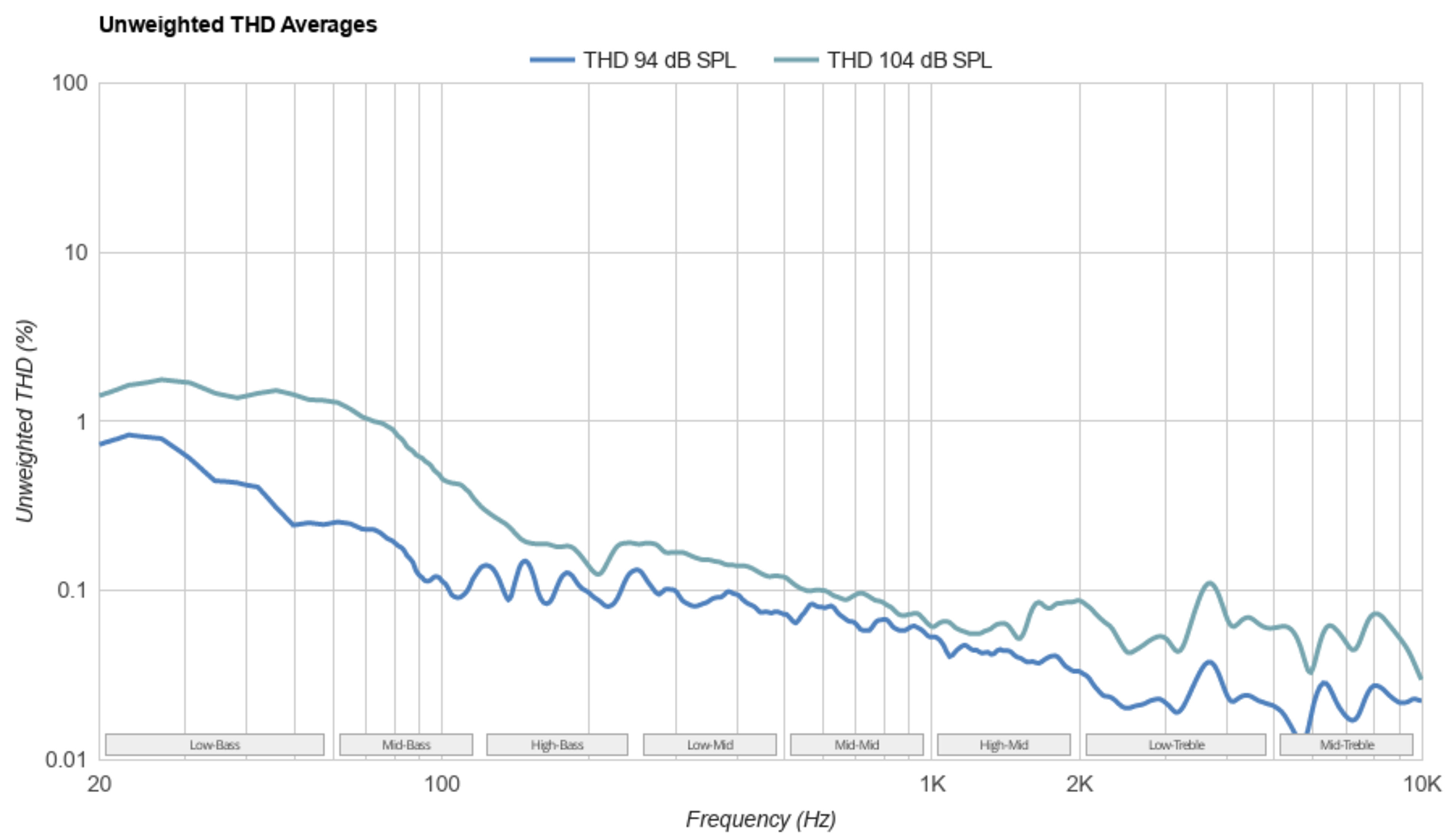
Harmonics Levels
For those curious to see an intermediate step between the THD ratio graph and weighted THD average metric, we provide a graph that illustrates the second and third harmonics at 94 and 104 dB SPL. We also include the A-weighting curve to further demonstrate how headphones' distortion performance translates to the weighted averages.
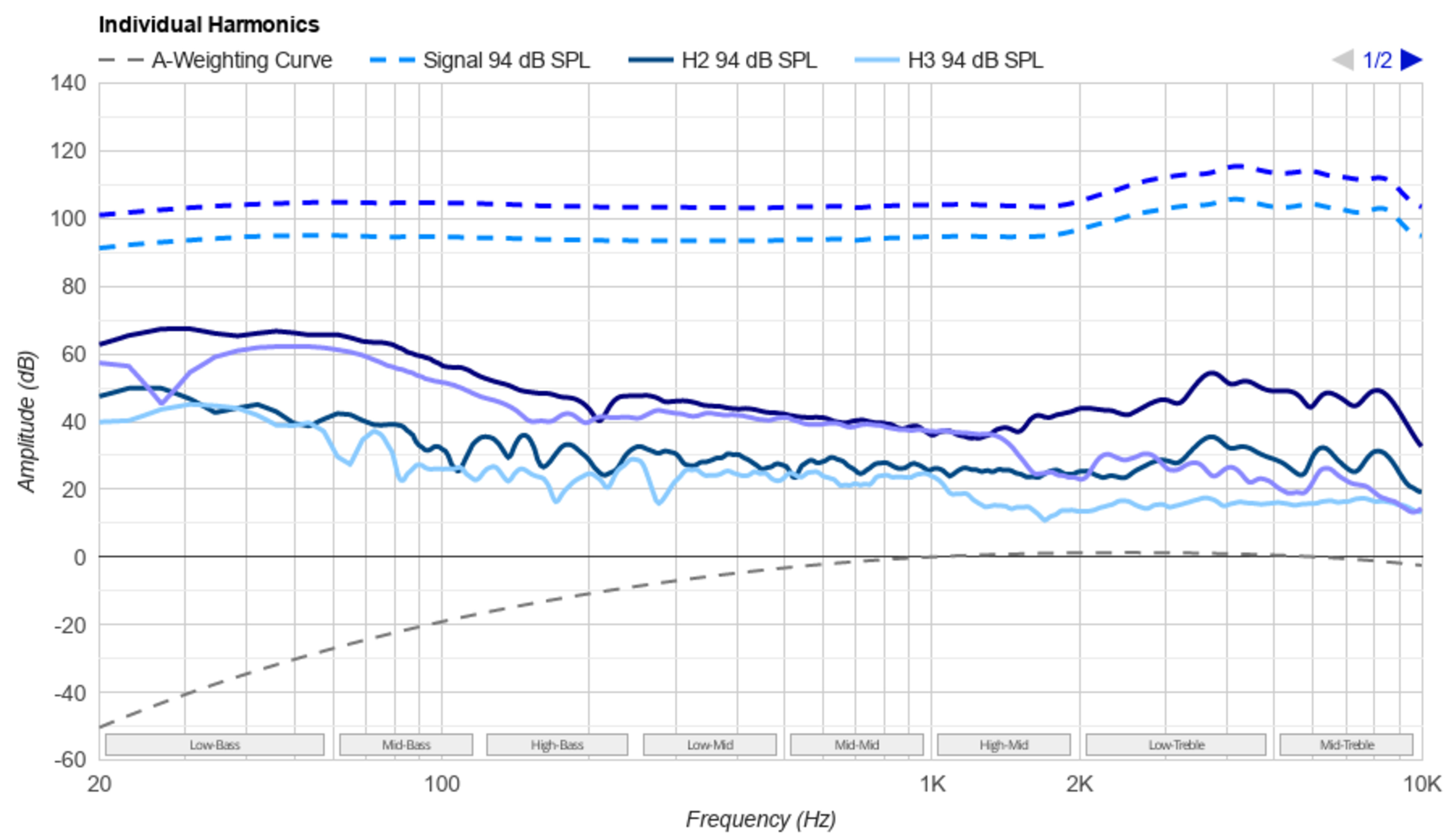
Weighted THD @ 94
Our test software (Audio Precision) calculates the THD (total harmonic distortion) of the 94 dB SPL pass as a percentage of the fundamental frequency's power. Since speakers and headphones tend to produce more distortion in lower frequencies, and human hearing is less sensitive to low-frequency harmonic distortion, we apply a weighting filter that takes individual harmonics into account. Higher harmonics are given more weight using the weighting coefficient -n²/4, first used by D. Shorter (Voishvillo, 2005). We A-weight these harmonics to account for the relative loudness the human ear perceives before an average is computed.
Weighted THD @ 104
The THD (total harmonic distortion) of the 104 dB SPL pass is measured in the same way as the 94 dB SPL one described above but with the volume set to 104 dB SPL during the acoustic pass instead. While listening at this level can be inadvisable, it's worth considering the equal-loudness contours first suggested by Harvey Fletcher and W.A. Munson, which means that lower frequencies will lack the perception of loudness, even at this amplitude (Yost, 2020). Mid-range frequencies, by contrast, will be perceived as much louder. While most modern headphones' frequency responses feature such low levels of distortion that they will be inaudible even to trained ears, there are occasional outliers. Ultimately, however, we provide this measurement to meet current industry standards and showcase the headphones' acoustic properties better.
Analysis
Although THD generally increases as the volume increases, some headphones show a decrease in THD in certain frequency bands as the volume increases.
As mentioned before, humans are quite tolerant of high levels of THD, especially in the bass range. As you can see below, some of the well-reputed and sought-after headphones produce seemingly significant amounts of THD. This doesn't mean that they're bad or unlistenable: the distortion produced by their drivers can be measured by our measuring rig but doesn't translate to a perceptible change in sound quality. You can check out this video by Julian Krause that explores our ability to perceive harmonic distortion in polyphonic music and test tones of different frequencies. We also establish in our own investigation with trained listeners that thresholds of detection for harmonic distortion are a good deal higher than typical listening levels.
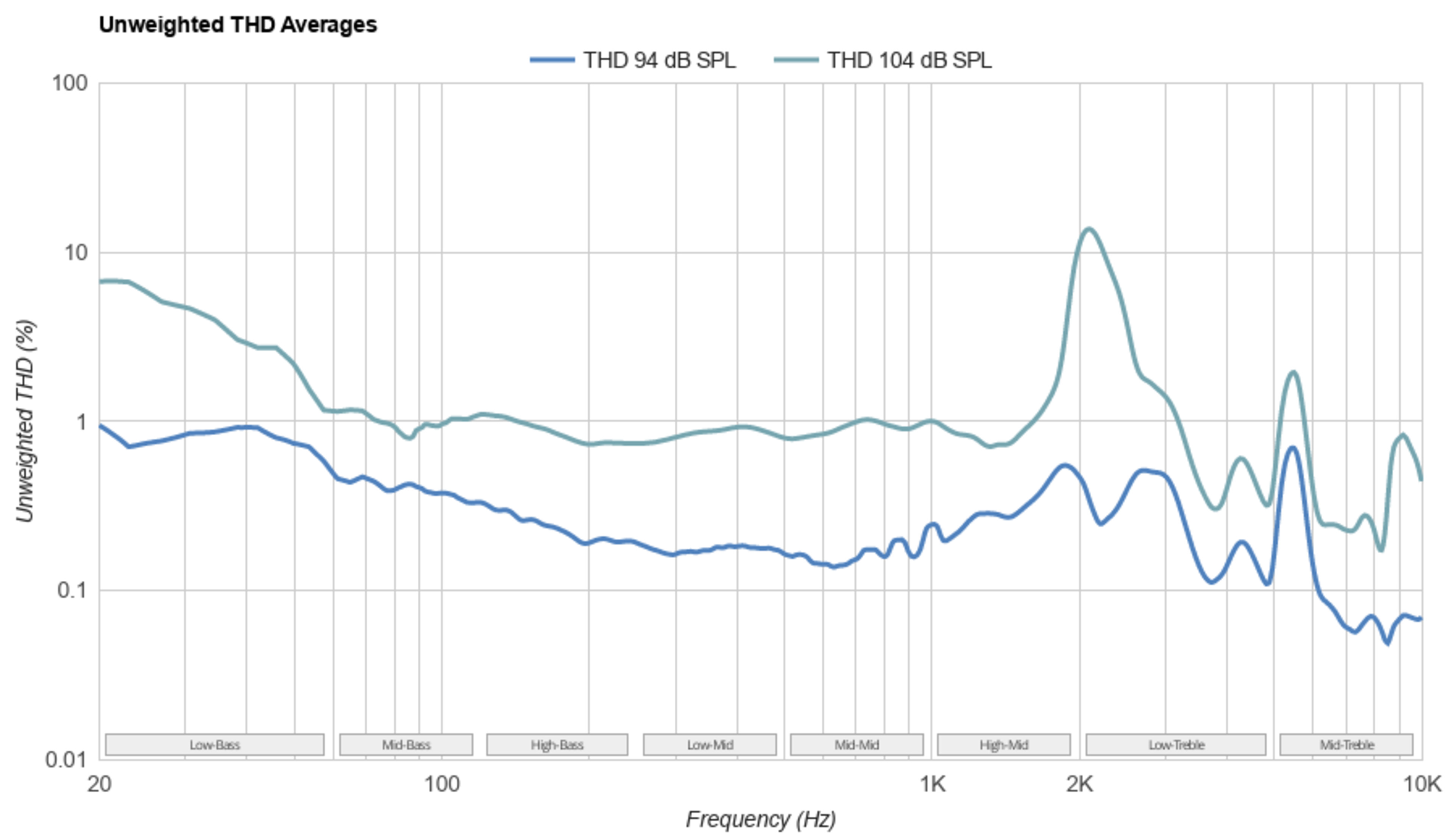
One of the factors that affects the audibility of THD is masking. Auditory masking occurs when the perception of one sound is affected by the presence of another sound. In the case of spectral masking, when two tones near in frequency are produced, the louder tone drowns out the quieter one. Therefore, lower-order harmonic distortion tends to be less audible since it has a better chance of being masked by the fundamental frequency. This also means that spikes in THD tend to be more audible than a constant elevation in THD.
Conclusion
In summary, while THD is the most established measure of distortion for headphones and other audio devices, it comes with certain limitations. Almost all commercially available headphones will exhibit levels of distortion that are imperceptible to the trained human ear at regular levels and with musical content (not test tones). While we apply a weighting filter to our measurements that factors in equal-loudness contours and the greater sensitivity of our ears to high-order harmonic distortion, our harmonic distortion tests still come with limitations (which are explored further below). That said, our measurements can still give general insight into the acoustic properties of the headphones we test.
Additional Information
Although THD has been a staple of audio measurements and specifications, studies have shown that there is only a moderate correlation between the THD response of a device and its perceived audio fidelity (Temme et al., 2014) (Geddes et al., 2003). Depending on the ratios between the different harmonics produced by a device, auditory masking, and other psychoacoustic effects, headphones with high THD levels can produce very few audible effects. This could also be because harmonic distortion is measured with a single tone sweep, which may not be able to put headphones under as much load as a full-spectrum, bass-heavy piece of music. The denser nature of polyphonic music can result in a larger number of intermodulation products that are less easily masked (Voishvillo, 2006). Therefore, it's possible for more audible distortion to be detected in full-spectrum music, though this falls outside the scope of our tests.
Other methods for measuring distortion, such as inter-modulation distortion (IMD), multi-tone distortion, non-coherent distortion (Brunet et al., 2006), and PEAQ (Perceptual Evaluation of Audio Quality), have been proposed and studied . Among these, non-coherent distortion has been proven to be a more significant indicator of audio fidelity. New methods have been developed for interpreting THD, such as the GedLee metric, which incorporates auditory masking and other psychoacoustic phenomena into their calculations.
Works Cited
Brunet, Pascal and Temmes, Steve. 'A New Method for Measuring Distortion using a Multitone Stimulus and Non-Coherence,' Audio Engineering Society 121st Convention Papers, Listen, 2006.
Geddes, Earl R., and Lidia W. Lee. 'Auditory Perception of Nonlinear Distortion,' GedLee LLC, 2003.
Temme, Steve, et al. 'The Correlation between Distortion Audibility and Listener Preference in Headphones', Listen. Harman International, 2014.
Voishvillo, Alexander. 'Assessment of Nonlinearity in Transducers and Sound Systems – from THD to Perceptual Models,' Audio Engineering Society - 121st Convention Papers, 2006. 2.
Yost, William A. 'It is too loud!' The Journal of the Acoustical Society of America, vol. 148,2 2020: R3.
Recent Updates
March 11, 2026: We've updated this article to reflect recent findings from our literature review and investigation into distortion, and as a part of Test Bench 2.1.