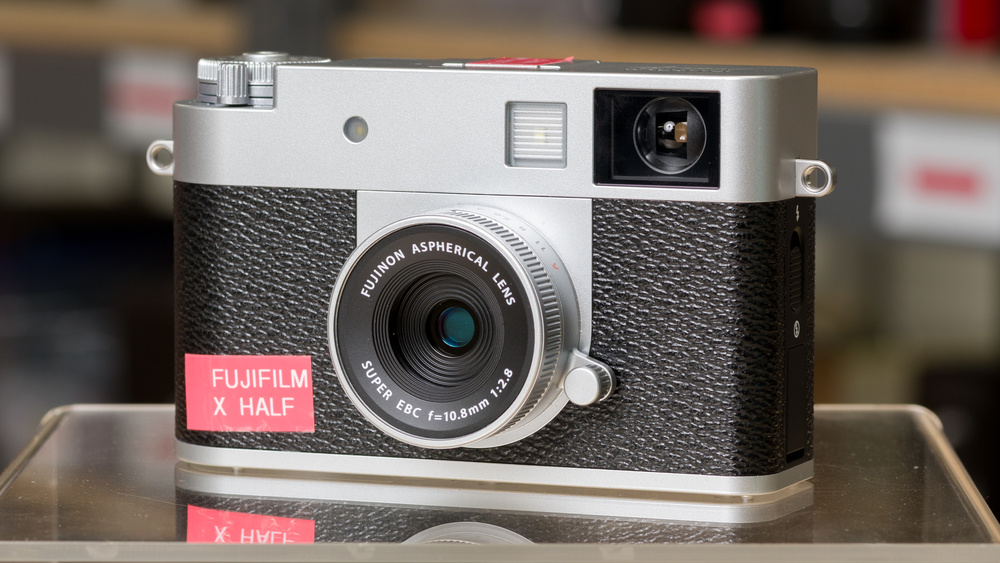
The Fujifilm X half is a compact, photo-centric point-and-shoot camera that aims to mimic the film-shooting experience. It uses a 17.74 MP vertically oriented 1-inch sensor combined with a 32mm full-frame-equivalent lens. This means the photos it shoots have a vertical 3:4 aspect ratio. This camera offers a distinctive shooting experience through its vertical orientation, optical viewfinder, and film-inspired controls, such as a film-style frame advance lever. It aims to encourage a slower and more deliberate approach to photography. It also includes features like 2-in-1 mode, which lets you combine two vertical photos side by side, and a film simulation workflow that locks you down to a single "roll" of film for a set number of frames. Together, these features reinforce Fujifilm's emphasis on a creative, analog-inspired process rather than technical performance.
Our Verdict
From a technical standpoint, the Fujifilm X half is disappointing for travel photography. It's a slow camera that only shoots JPEGS. However, this is a bit by design, as it's meant to encourage the user to slow down the process and provide a shooting experience closer to what you'd get with a film camera. The multiple film simulations or even the film-shooting workflow can seem gimmicky if you want more control over your camera's settings, but for some, the restrictions and invitation to explore these color profiles can be fuel for creativity.
Fun film simulations that encourage experimentation.
Unique shooting experience that aims to replicate shooting on a film camera.
Very portable design.
Excellent good battery life.
Camera feels laggy across the board.
Doesn't shoot RAW.
The Fujifilm X half is awful for landscape photography from a technical standpoint. It doesn't shoot RAW, which can be limiting if you're trying to capture as much detail as possible, and the vertical orientation is far from ideal for landscapes. That said, if it's only for casual shooting, you can play around with the film simulations to add some flair to your photos. The camera is also very small and portable, which is a nice plus for casual shooting.
Fun film simulations that encourage experimentation.
Unique shooting experience that aims to replicate shooting on a film camera.
Very portable design.
Excellent good battery life.
Camera feels laggy across the board.
Doesn't shoot RAW.
The Fujifilm X half really is bad for wildlife and sports photography. It can only shoot at one frame at a time, and its focusing system really isn't made to track fast-moving subjects. Its only redeeming factor is that it can shoot at a relatively quick 1/2000 shutter speed, which is quick enough to freeze movement.
Very portable design.
Excellent good battery life.
Camera feels laggy across the board.
Doesn't shoot RAW.
The Fujifilm X half is a bad vlogging camera. It can only shoot 1-minute clips and in a 1080p/24fps format. The sensor's vertical orientation can also be a detriment if you want to film in a regular landscape format. That said, it does work well for short-form videos, which are filmed in portrait mode anyway. There's also no tilt screen, which makes it even harder to frame.
Very portable design.
Excellent good battery life.
Camera feels laggy across the board.
Bad for video across the board.
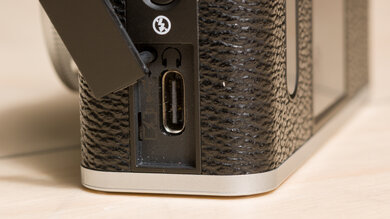
The Fujifilm X half is, simply put, a bad video camera. It can only film 1-minute clips, and the video quality isn't good. The camera's microphone is also extremely basic, and you don't have the option to add an external microphone. A headphone adapter is included in the box to monitor audio, but its usefulness is debatable at best.
Excellent good battery life.
Camera feels laggy across the board.
Bad for video across the board.
The Fujifilm X half is a bad action video camera. Its small size is pretty much its only redeeming factor. The video it shoots is in a vertical orientation that's not well-suited for this use. It can also only shoot 1-minute clips, and the videos it produces aren't detailed at all.
Excellent good battery life.
Bad for video across the board.
The Fujifilm X half doesn't shoot RAW.
Doesn't shoot RAW.
Performance Usages
Check Price
Differences Between Sizes And Variants
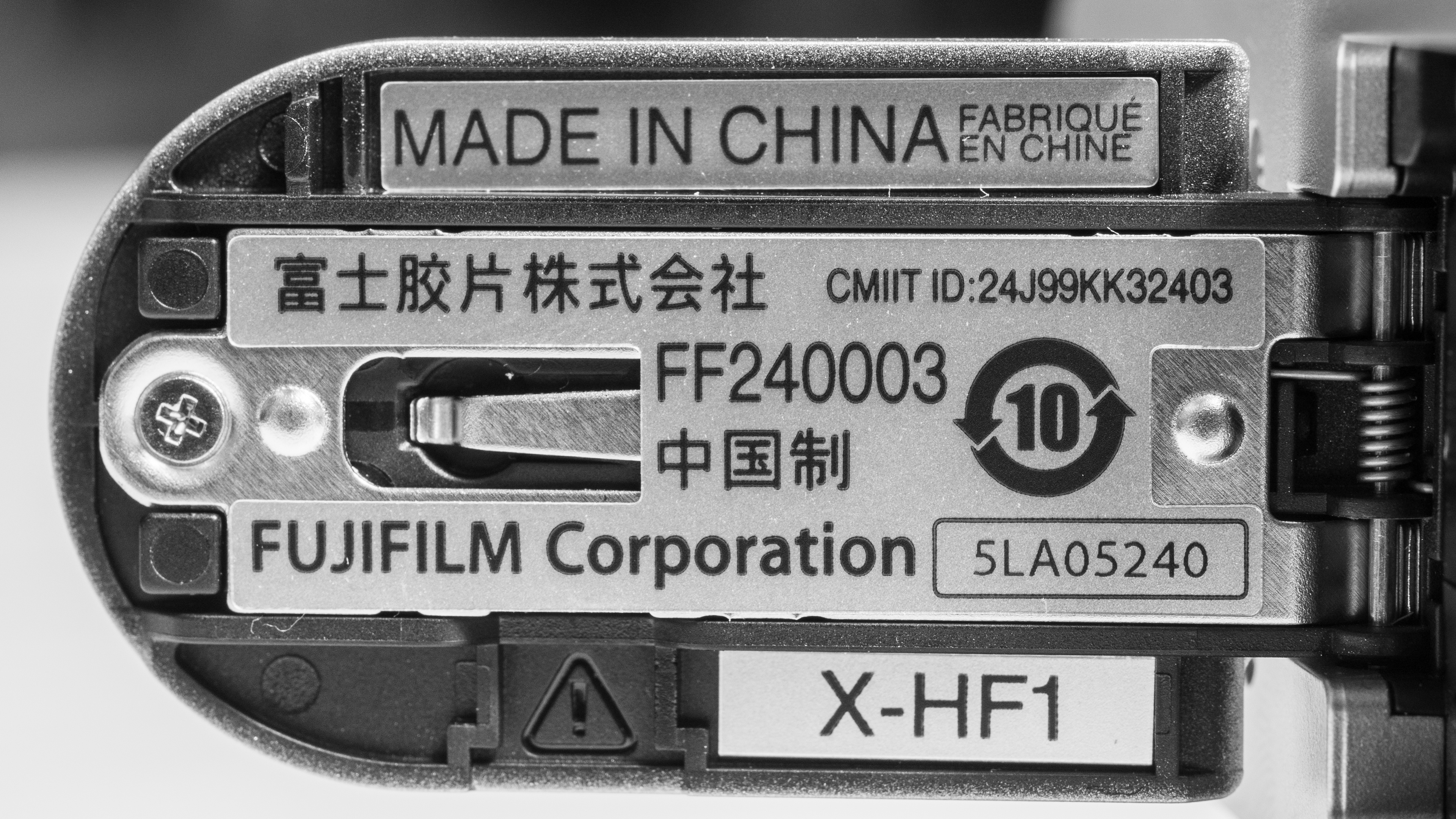
The Fujifilm X half comes in three different variants: Silver, Charcoal Silver, and Black. We bought our unit in the Silver colorway. You can see a photo of our unit's label here.
Popular Camera Comparisons
It's difficult to compare the Fujifilm X half with other cameras, as its proposition is quite unique. Other point-and-shoots in its price range, like the Canon PowerShot SX740 or the Panasonic LUMIX ZS99, are a lot more feature-rich technically. They include zoom lenses, 4K video, and tilt screens. The Lumix even includes RAW support, which gives you a lot more leeway to edit your pictures. What these cameras don't offer, however, is the whimsical shooting experience that the Fujifilm provides. This is what makes or breaks this camera, depending on what you're looking for. The inherent limitations and quirkiness that Fujifilm designed into the camera, whether it's the vertically oriented sensor, the film mode, which does its best to mimic the experience of shooting on an old film point and shoot, or even the inclusion of an optical viewfinder rather than an electronic one, are intentionally restrictive characteristics. While you don't have RAW to rely on for editing, Fujifilm compensates with its multiple film simulations, which can really help add flair and creativity to photos. Having a physical exposure compensation dial and an aperture ring also helps ground the shooting experience compared to relying on a screen. The pace at which you'll have to shoot, both because of the camera's design and its unfortunate sluggishness, forces you to slow down your photo-taking process compared to what you'd tend to do with a regular modern camera or your smartphone.
Nevertheless, it's difficult to ignore the asking price for such a technically limited camera. This would have been easier to justify if the camera had a more premium build. The plastic body, while lightweight, doesn't feel particularly sturdy, and the film advance lever lacks any mechanical resistance, making it feel a bit flimsy. The slow processing and often unresponsive touchscreens also don't help make this the seamless experience it could otherwise be. Still, this remains quite a unique offering, and if Fujifilm's proposition suits your needs and wants for a camera, it can definitely be a fun experience.
For more options, check out our recommendations for the best point-and-shoot cameras, the best cheap and budget cameras, and the best compact cameras.
The Canon EOS R100 is a much more capable camera than the Fujifilm X half. Where the Fujifilm focuses on offering a unique shooting experience that aims to replicate point-and-shoot film cameras from yesteryear, it does so with inherent limitations. It doesn't shoot RAW, offers very limited video capabilities, and has a very basic focusing system. The Canon, on the other hand, is a complete camera with interchangeable lenses. It shoots RAW and offers much better image quality in both video and photo.
The RICOH GR III and the Fujifilm X half are point-and-shoot cameras with fairly different use-cases. While the RICOH is equipped with a large APS-C sensor that can shoot RAW and deliver excellent overall image quality, the Fujifilm is more focused on giving a shooting experience that aims to mimic a film camera. Its technical performance is much more basic, and much of what makes this camera is the film simulations, which give the photos it takes a specific look straight out of the camera.
The Panasonic LUMIX ZS99 is a more versatile camera compared to the Fujifilm X half. It has a much better autofocus system and can shoot RAW photos and 4K video. It also includes a zoom lens that'll give you much more flexibility. That said, the Fujifilm is quite a unique offering that focuses instead on providing a "back-to-basics" shooting experience that's limited by design. It also includes film simulations that can help you add flair to your pictures without delving into editing. While they're both portable point-and-shoot cameras, both cameras offer very different experiences.
The Canon PowerShot ELPH 360 HS A and Fujifilm X half are point-and-shoot cameras that offer quite different shooting experiences. The Fujifilm is a unique take on this segment. It has a vertically oriented sensor that shoots 3:4 pictures and focuses on providing a film-like photo-shooting experience. Its main attribute is Fuji's film simulation modes, which allow you to play around when it comes to the pictures' color profiles. The Canon is a much more run-of-the-mill camera. It's even more portable and includes a 12x zoom lens, which gives you a lot more flexibility.
Test Results
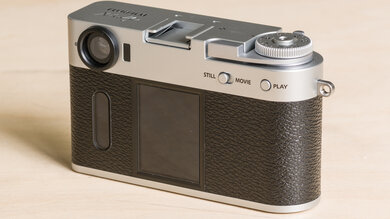
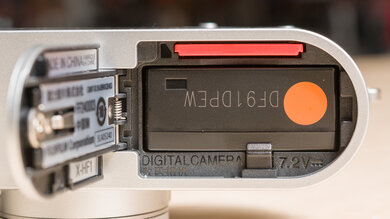
The Fujifilm X half has okay build quality, though it feels cheaper than some of Fujifilm's other cameras. In some ways, its construction is similar to that of the Fujifilm X-T200, though with a few improvements. The entire camera is made of plastic and covered in a rubbery coating, but the moving parts, buttons, and dials are well assembled and feel sturdy. The shutter button, in particular, has good tactile feedback and feels satisfying to press. The exposure compensation dial is less impressive, as it is somewhat difficult to use, with the power switch and lever partially blocking it. Similarly, the film advance lever lacks any mechanical feedback, which is a missed opportunity, as it would have made a big difference. On the positive side, the battery and SD card compartments use a locking, spring-loaded plastic door that is reasonably sturdy. The lens cover and wrist strap hooks, which are fixed to either side of the body, also feel solid and secure.
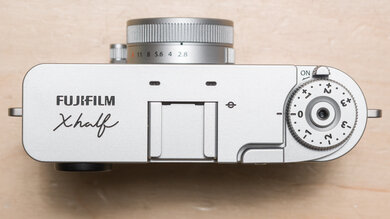
The body includes an aperture ring on the lens and an exposure compensation dial on the top right, below the shutter button. Although there is a "shoe mount", it's unfortunately a cold one, which means it only provides a mechanical connection to hold accessories but cannot transfer power or data between the device and the camera.
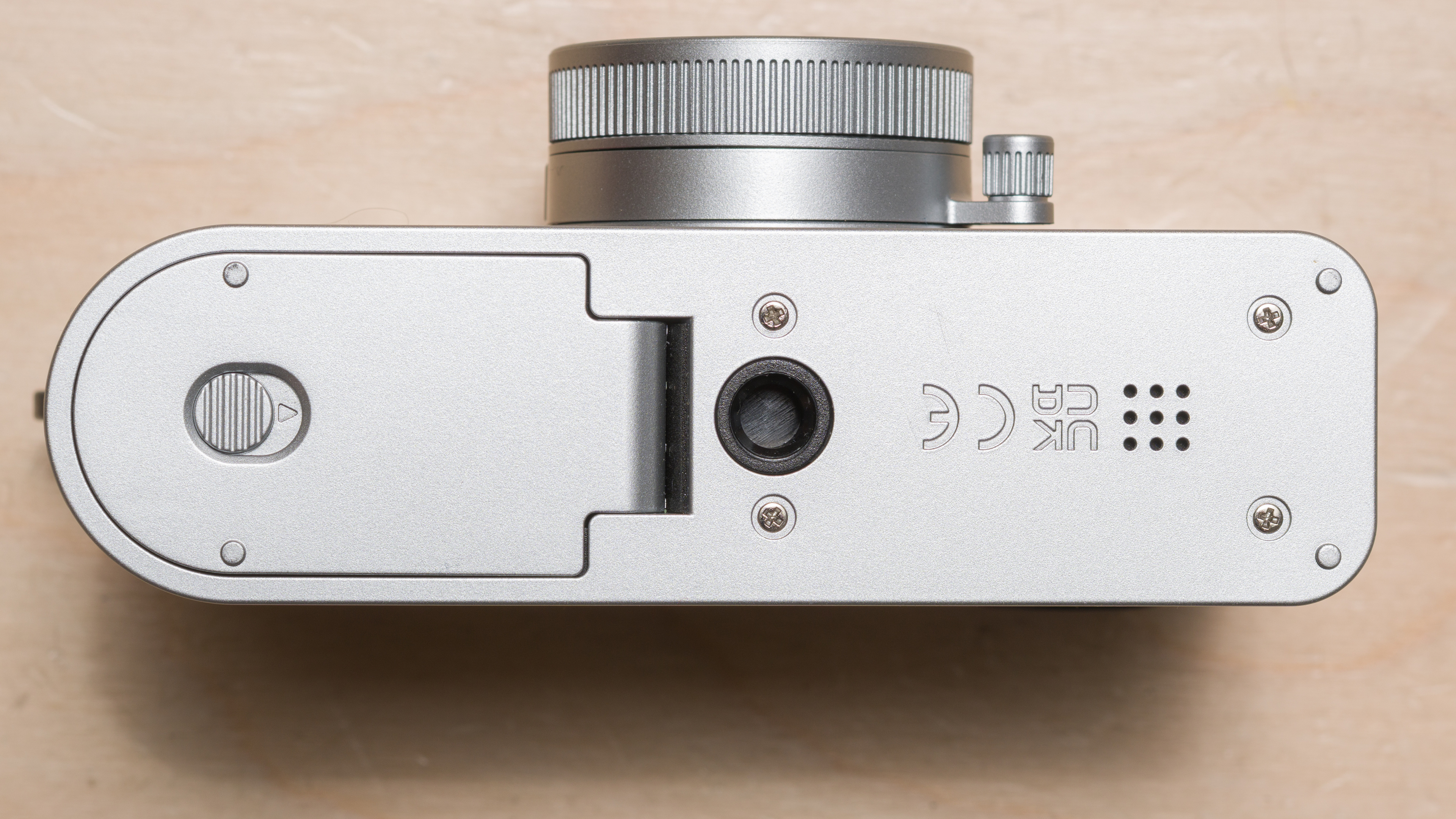
The underside gives you access to the battery and a standard 1/4-inch tripod mount.
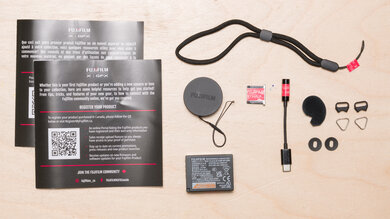
- User documentation
- Hand Strap
- Lens cap
- Battery
- Cold shoe cover
- Headphone adapter
- Metal strap clip and accessories
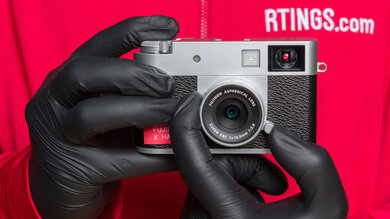
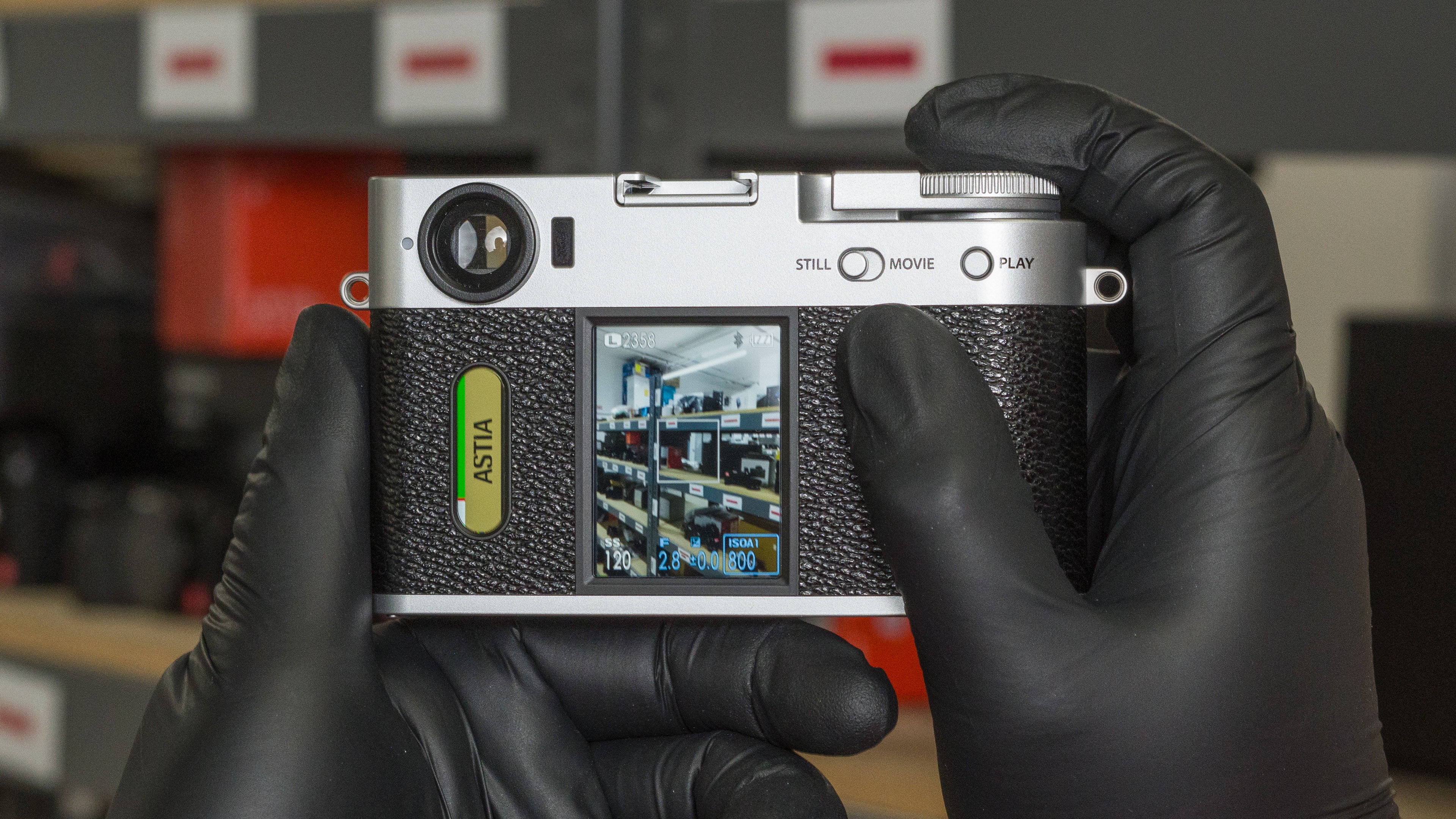
The Fujifilm X half takes a somewhat unconventional approach to ergonomics, with most of the camera's controls built around the touchscreen rather than physical buttons and dials. This is a bit counterintuitive, given that much of its philosophy is aimed at reproducing a vintage film-camera shooting experience. The aperture and exposure compensation are controlled by physical dials on the lens and on the top of the camera, respectively, while shutter speed and ISO are adjusted through the touch menus. These settings are easy enough to change when using the display, but they're essentially impossible to change while looking through the viewfinder. This means the camera generally requires two-handed operation rather than letting you reach everything with a single thumb if you plan to adjust your settings manually. Other than that, there's a simple physical switch to switch between photo and video modes, and a single button for playback.
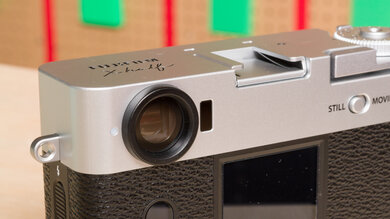
The completely flat body has no hand grip, but its rubbery texture and relatively thick design provide a secure hold, while the wide, unobstructed area on the back gives the thumb plenty of room to rest. The small, flat-mounted viewfinder is another ergonomic compromise, with its minimal hard eyecup making it less comfortable to use than the viewfinders found on conventional Fujifilm cameras.
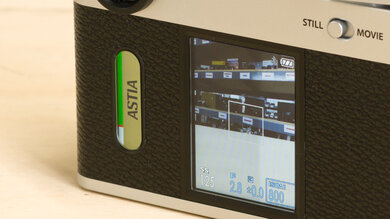
The screen is vertically oriented similarly to the rest of the camera. It's relatively dim, and the touch interface can be quite laggy, which isn't ideal since many of the camera controls require interacting with the screen.
There's a secondary screen that's used to quickly swap film simulations while shooting or as part of the menu navigation when you're delving into your device settings.
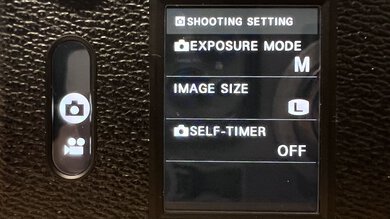
The Fujifilm X half has a very simple and approachable menu system, though it feels quite laggy when navigating through it quickly. The main menu is accessed by swiping left on the display, with its different sections arranged as tabs along the left side. These can be changed by tapping the icons or swiping up, and most of the available options are clearly labeled and largely self-explanatory.
One of the camera's more unique features is its 2-in-1 image mode, which lets you take one photo, wind the camera using the lever, and then take a second shot. The two vertical images are stitched side by side as a single file. The combination can also consist of one still image and one movie. A similar effect can be created later in the X-Half app using any images from the camera.
The X half also includes a Film Camera mode that simulates the experience of shooting with a film camera. It is accessed by swiping down on the main display, after which you choose a film roll based on one of the film simulations, select the number of shots (36, 54, or 72), decide whether to include a date stamp, and choose the exposure mode. Once started, the camera is locked into the mode and operates entirely through the optical viewfinder, with no live view available. After each exposure, the advance lever must be cranked manually before taking the next shot. The film roll cannot be exited normally once it has started; removing the battery or SD card will cancel the roll and end the process. Photos also cannot be viewed directly on the camera; instead, they require the X-Half app to transfer and "develop" the images on a smartphone.
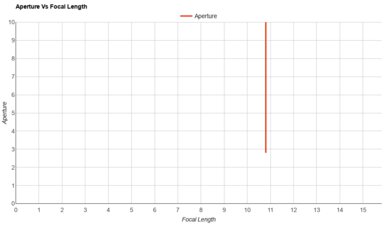

The sensor on this camera is oriented vertically, which means you'll get portrait-oriented 3:4 photos.
There is no continuous shooting drive mode on this camera; it can only shoot one shot at a time.