
Point-and-shoot cameras are a natural choice for travel thanks to their compact sizes and built-in zoom lenses, making it a breeze to capture all your memories abroad without having to lug around a bulky kit with multiple lenses. While smartphone cameras have continued to improve, and they're usually the camera you've already got on you, some point-and-shoots offer improved image quality with larger sensors than the ones typically found in phones, while others offer longer zoom ranges that you simply can't get with the physically limited lenses on your smartphone. We still included a compact interchangeable-lens camera that's very easy to carry around when combined with a compact prime lens.
We've bought and tested over 125 cameras in our lab, and below, you'll find the best travel cameras to buy in 2026. If you don't mind carrying a larger kit with interchangeable lenses, check out our picks for the best mirrorless cameras for travel. If you're specifically after beautiful landscape shots of destination vistas, you might also want to check out our best cameras for landscape photography. Alternatively, if you're less interested in snapping places and more interested in the people that populate them, see our picks for the best street photography cameras.
We've independently purchased over 125 cameras and tested them using a standardized methodology. All the results are available to help you make the right purchasing decision for your needs, with objective, data-driven reviews. We keep every product in our lab inventory to ensure we can go back, retest models, and verify that all the information we provide is still accurate.
-
Best Compact Camera For Travel
 Travel Photography7.3Landscape Photography6.9Sports & Wildlife Photography7.2Vlogging7.4Studio Video6.6Action Video4.6Raw Photo6.3Body Type:Point and ShootMirrorless:YesSee all our test resultsSensor Size:1-inch
It ain't cheap, but the Sony RX100 VII is the best compact travel camera we've tested. Sony has perfected the formula for compact zoom cameras with its RX100 series. This latest model features a stacked 1-inch sensor that delivers blazing-fast burst rates and great image quality for its class, along with a pop-up viewfinder and flash, a large tilting screen, and a zoom lens—all packed into an incredibly portable camera.
While it doesn't have the widest zoom range on this list, its 24–200mm full-frame equivalent focal length still gives you a fair amount of range, offering some flexibility for framing and composition. The camera also has a highly effective autofocus system, ensuring your subjects stay in focus, even in busier settings. That said, like most compact cameras, it has a pretty short battery life, though you can always pack a spare battery or portable power bank to charge it on the go.
-
Best Mid-Range Compact Camera For Travel
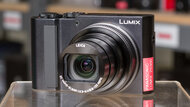
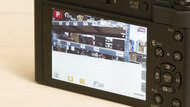
Travel Photography7.3Landscape Photography7.0Sports & Wildlife Photography6.8Vlogging5.1Studio Video6.6Action Video3.5Raw Photo6.5Body Type:Point and ShootMirrorless:YesSee all our test resultsSensor Size:1-inchIf the Sony RX100 VII is out of your price range, the Panasonic LUMIX ZS300 is another pocketable travel zoom with a very versatile lens. Its 15x zoom is even more versatile than the Sony. It handles wide street scenes and distant details alike, and the retractable design lets it slip easily into a jacket pocket or a small bag. The 1-inch sensor captures more detail and handles noise better than the smaller sensors in most travel zooms, and dynamic range is satisfactory at base ISO, so you keep detail in bright skies and shaded foregrounds in the same frame. When the light gets dimmer, optical stabilization is effective enough to shoot handheld at slower shutter speeds. Two command dials and a control ring around the lens also give you more manual control than most compacts this size.
Panasonic did cut some corners to get to this price point with a 1-inch sensor. It dropped the viewfinder from the ZS200, this model replaces, and the screen is fixed, so framing high-and low-angle shots takes more effort. The contrast-based autofocus system is another weakness. Tracking drops subjects after a few frames, so you'll need to keep the subjects under the focus point yourself. If you can find it close to its MSRP, the Canon PowerShot G7 X Mark III is another great mid-range option. It has a comfortable finger grip and thumb rest, and the tilt-out screen can flip up for selfies or vlogs. It also features a 1-inch stacked sensor and quick 16 fps burst shooting. The built-in lens has a fairly versatile 24–100mm equivalent focal length, which is a shorter zoom range than the LUMIX, but still wide enough to give you some flexibility with framing.
-
Best Budget Compact Camera For Travel
Travel Photography5.9Landscape Photography3.0Sports & Wildlife Photography6.0Vlogging6.5Studio Video6.3Action Video3.6Raw Photo0.0Body Type:Point and ShootMirrorless:YesSee all our test resultsSensor Size:1/2.3-inchThe Canon PowerShot SX740 is one of the best point-and-shoot cameras to get if you're on a tighter budget. It uses a smaller sensor than the more premium options above, so there's a slight trade-off in image quality. On the upside, its built-in lens has a 40x optical zoom range, giving you a remarkably wide focal length range of 24–960mm. Though it doesn't have a viewfinder, the camera's tilt screen can flip up for selfies or waist-level shots, and it's incredibly portable.
Of course, the most cost-effective choice if your budget is really tight is to simply use your smartphone! Most smartphone cameras these days feature pretty impressive processing to compensate for their smaller sensors, which means you can still get great results despite some hardware limitations. The best part is that you've likely already got a smartphone on you, so it won't cost you anything extra or take up more space in your luggage. Still, if you want the shooting experience of a dedicated point-and-shoot camera, the PowerShot SX740 has quite a bit of value for its price.
-
Best Large Sensor Camera For Travel
Travel Photography7.8Landscape Photography7.8Sports & Wildlife Photography7.7Vlogging6.2Studio Video8.7Action Video5.7Raw Photo7.9Body Type:Large Sensor CompactMirrorless:YesSee all our test resultsSensor Size:APS-CWhile you'll still get great images from 1-inch sensor cameras like our top pick, the Sony RX100 VII, there are a select few compact cameras that feature even larger sensors that'll give you better dynamic range and more flexibility in low light. The best of these is the highly popular Fujifilm X100VI. With one of the highest-resolution APS-C sensors on the market, it can capture images with stunning levels of fine detail. Beyond that, this is one of the most full-featured compact cameras you'll find, with a hybrid optical/electronic viewfinder, in-body image stabilization (IBIS), and advanced video features. Unlike the Sony, the built-in lens on the Fuji has a fixed 35mm equivalent focal length, so you'll have less flexibility with far-away subjects, but it delivers superior image quality and has a wider aperture.
All that said, this is not the most compact of compact cameras. It's substantially bulkier than the RX100 VII and the other picks on this list. If, however, you don't mind a more pared-down system, the RICOH GR IIIx makes for a fantastic alternative to the X100VI. It also features an APS-C sensor and IBIS, but in a much more discreet and significantly more portable design. Of course, you'll be giving up a viewfinder, a tilting screen, and video-shooting features here, but it's the best pocket camera for travel if you want an APS-C camera that's truly pocketable. It's also much cheaper than the Fujifilm while delivering a very similar overall image quality.
-
Best Compact Vlogging Camera For Travel
Travel Photography7.4Landscape Photography7.2Sports & Wildlife Photography7.3Vlogging7.8Studio Video7.4Action Video4.6Raw Photo6.5Body Type:Point and ShootMirrorless:YesSee all our test resultsSensor Size:1-inchWhile the previous picks are more photography-oriented, travel vloggers should take note of the Sony ZV-1, the best point-and-shoot camera for travel vlogging. Though it doesn't have a viewfinder, it features a fully articulated screen, making it easy to monitor yourself while recording or to take the odd selfie. On top of that, it has vlogging-specific features like a detachable windscreen to reduce ambient noise when recording outside.
The Sony ZV-1 II has since replaced it and features a wider-angle lens that's a good fit for walk-and-talk vlogs. However, the newer model doesn't have optical stabilization, and its digital stabilization feature crops in some of that wider field of view. For those reasons, the original ZV-1 is still our top pick here, especially since you can get it for cheaper. It checks all the boxes for a compact, all-in-one travel vlogging camera.
-
Best Compact Interchangeable Lens Camera
Travel Photography7.9Landscape Photography8.0Sports & Wildlife Photography7.4Vlogging8.5Studio Video9.2Action Video6.0Raw Photo8.0Body Type:SLR-StyleMirrorless:YesSee all our test resultsSensor Size:APS-CThe Fujifilm X-M5 is Fujifilm's most affordable mirrorless camera and one of the most compact interchangeable-lens cameras you can buy. Pair it with a small prime like Fujifilm's XF 27mm f/2.8 R WR, and the whole kit fits in a jacket pocket. It's actually quite a bit smaller than the X100 VI above. It shares its 26-megapixel APS-C sensor with fourth-gen models like the Fujifilm X-T4, so image quality is great, with excellent dynamic range for high-contrast scenes. Its autofocus tracks moving subjects well overall, and burst shooting is decently quick. Fujifilm also fit in enough physical controls for a hands-on shooting experience, including a dedicated film-simulation dial for changing the look of your images in-camera. Video is a real strength for the price, with internal 10-bit 4:2:2 capture, Log profiles, and 6.2k open-gate recording.
Keeping the size and price down comes with compromises. There's no viewfinder, which makes framing harder on sunny days, and no IBIS to steady your handheld shots. The small body also feels cramped if you have larger hands. Video has its own quirks, as rolling shutter is very noticeable in 4k and the camera can overheat during long recordings in more demanding modes. If you want a viewfinder instead of a fully-articulating screen, the older, and slightly bigger, Fujifilm X-T30 II delivers the same great image quality and dedicated control dials, though its video features are more limited and its AF system is less reliable. While we haven't tested it yet, we expect the newer Fujifilm X-T30 III to split the difference by pairing the X-M5's processing with the photo-focused body of the X-T30 line.





Notable Mentions
-
Panasonic LUMIX ZS99:
The Panasonic LUMIX ZS99 is a great alternative to the Canon PowerShot SX740, but mostly if it's on sale. It adds RAW support, has a great zoom range, and easy-to-use creative shooting modes for beginners. That said, the Canon is noticeably smaller, and its zoom range is even more impressive.
See our review -
Leica D-Lux 8:
While it's essentially a Panasonic LUMIX LX100 II with some modest upgrades, the Leica D-Lux 8 fills a niche in the premium compact market that will suit many travel photographers. While it doesn't offer the reach of the Sony RX100 VII, its 24–75mm lens hits a sweet spot, and its multi-aspect-ratio sensor design gives you unique framing options. But that price tag is still a hard sell.
See our review -
Canon PowerShot G5 X Mark II:
While it's now discontinued, if you're able to snag a Canon PowerShot G5 X Mark II, it's an outstanding alternative to the Panasonic LUMIX ZS300. Its zoom lens doesn't have as much range, but it's an excellent compact camera with a 1-inch sensor, a tilt screen, and a small viewfinder that's quite useful on sunny days.
See our review
Recent Updates
Sep 29, 2026:
The Panasonic LUMIX ZS300 replaces the Canon PowerShot G7 X Mark III as our 'Best Mid-Range Compact Camera For Travel', with the Canon moving down to an alternative because it's become too difficult to find at reasonable prices. We swapped the discontinued RICOH GR III for the RICOH GR IIIx as the pocketable alternative to the Fujifilm X100VI in the 'Large Sensor' category. We've also added the Fujifilm X-M5 under a new 'Best Compact Interchangeable Lens Camera' category.
Jan 27, 2025:
We added the Leica D-Lux 8 as a Notable Mention due to its unique sensor design and premium features.
Nov 01, 2024:
We reviewed our picks and brushed up some of the text throughout to ensure the article remains up to date.
Jul 30, 2024: We replaced the RICOH GR III with the Fujifilm X100VI as the 'Best Large Sensor Compact Camera For Travel' since it offers more features, but we've kept mention of the RICOH as a more portable alternative.
Jun 04, 2024: We replaced the Canon PowerShot G5 X Mark II with the Canon PowerShot G7 X Mark III as the mid-range pick because it has better availability. We also added mention of the HDF variant of the RICOH GR III.
All Reviews
Our recommendations above are what we think are currently the best point-and-shoot travel cameras for most people, according to their needs. We factor in the price, feedback from our visitors, and availability (no cameras that are difficult to find or almost out of stock in the U.S.).
If you would like to choose for yourself, here's the list of all our compact fixed-lens camera reviews. Be careful not to get caught up in the details. There is no single perfect camera. Personal taste, preference, and shooting habits will matter more in your selection.


