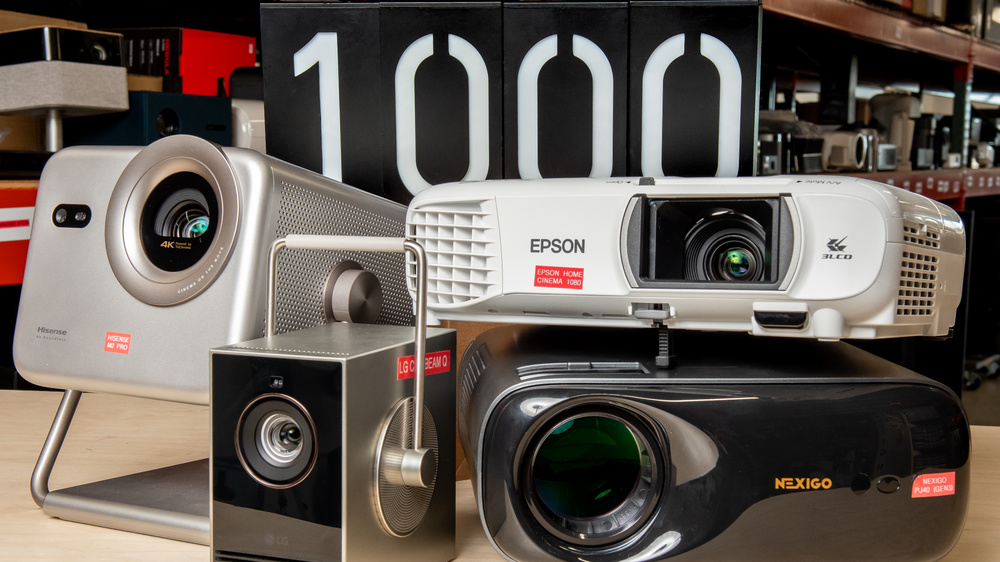
If you're looking for the best projectors under $1,000, there are quite a few options, although most of the best projectors in this segment are significantly cheaper than that. The projectors here are certainly good enough for most consumers. These models deliver a decent viewing experience, and many have great smart features, eliminating the need to spend more on an external streaming device. Typically, the more portable a projector is, the worse its image quality, so keep that in mind when shopping for the best projector for your needs. If you're unsure about the size of screen you can accommodate at your distance, you can also use our projector throw calculator to determine how each model fits your room.
We've bought and tested more than 85 projectors, and below, you'll find the best models to buy for under $1,000. You can also look at our best projectors under $500 or best budget and cheap projectors if you're looking for something even cheaper. For higher-end products, look instead at our recommendations for the best 4k projectors or best projectors. You can also vote on which ones you want us to purchase and test.
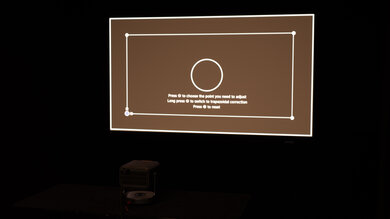
We've independently bought and tested over 80 projectors and published detailed results for each, so you can decide which one to buy. These have all been tested under the same standardized methodology, allowing you to compare them side by side. We still have all these projects in our lab, so we can continually go back and compare them to ensure our reviews are still accurate. All our test methodologies are also public on our website, so you can validate the results yourself.
-
Best Projector Under $1,000
 MoviesGamingBrightnessNative ContrastPre-Calibration Color AccuracyColor GamutImaging TechnologyLight SourceLampSee all our test resultsNative ResolutionPixel Shift 4k
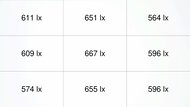
The Epson Home Cinema 2350 is the best overall projector to consider for around $1,000. It often sells for slightly above that mark, so it's worth watching for a sale, but it gives you a strong mix of brightness, image quality, and everyday flexibility for the money. Its bright image makes it a good fit for moderately lit rooms, and its pixel-shifted 4k resolution helps movies, shows, sports, and games look sharper and more detailed than they would on a basic 1080p projector. Its contrast isn't great for serious dark-room movie watching, so blacks can look a bit gray in very dark scenes, but it's a strong all-around choice for mixed use.
It's also easier to place than many projectors in this price range. The manual zoom lets you adjust the picture size without physically moving the projector, and the vertical lens shift helps you move the image up or down while keeping it properly lined up, so setup is less frustrating. It also works well for casual console gaming, as it's responsive enough at 4k @ 60Hz for non-competitive titles and players. To top it off, the unit includes an Android TV dongle with native Chromecast integration, so you don't need to hunt down an external dongle to watch any streaming apps. Overall, the Epson Home Cinema 2350 is the right pick near $1,000 for a bright, versatile projector that's easy to recommend for everyday movies, TV, sports, and casual gaming.
-
Best Budget Projector Under $1,000
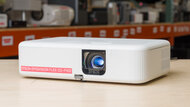
MoviesGamingBrightnessNative ContrastPre-Calibration Color AccuracyColor GamutImaging TechnologyLight SourceLampSee all our test resultsNative Resolution1080pIf the Epson Home Cinema 2350 is too expensive, the Epson EpiqVision Flex CO-FH02 is the best budget projector under $1,000. It's a much simpler projector, so you don't get the sharper pixel-shifted 4k image or better gaming performance of the 2350. However, it's also far cheaper and very bright, which matters a lot if you just want a large, watchable image in a living room, basement, or occasional backyard setup. Its 1080p image still looks clear for movies, shows, sports, and presentations, and it's very accurate out of the box, so colors look natural without much tweaking.
The main trade-off is that it's built more for brightness than cinematic picture quality. Blacks look gray in a dark room, so very dark movie scenes don't have much depth, and colors aren't especially vibrant. It also isn't a great choice for gaming, since controller inputs feel more delayed than they do on the 2350. Setup is fairly basic, too: its zoom gives you a bit of control over image size, and it can help straighten the picture vertically, but you'll still need to place and angle it more carefully than a projector with more advanced auto-setup tools. It does include an Android TV dongle for streaming, so you won't need to shop for an external device to watch streaming content. Overall, the CO-FH02 is the right pick if you want an affordable, very bright projector for casual big-screen viewing and don't need deep contrast, sharp 4k detail, or serious gaming performance.
-
Best Cheap Projector Under $1,000
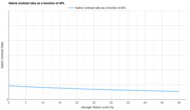
Home TheaterGamingBrightnessEffective ContrastPre-Calibration Color AccuracyColor GamutImaging TechnologyLight SourceLEDSee all our test resultsNative Resolution1080pIf you want something cheaper than the Epson EpiqVision Flex CO-FH02 or mostly watch in a dark room, the NexiGo PJ40 Pro is the best cheap projector under $1,000. It's basically the opposite of the Epson: the Flex is much brighter and works better with some lights on, while the NexiGo is dimmer but has much better contrast, so dark scenes look deeper and less washed out once the lights are off. Its 1080p image can look impressively punchy for the price, especially for movies and shows at night, though its colors are muted, and it benefits from calibration if you want the most accurate image.
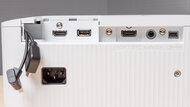
The NexiGo's other big advantage is convenience. It has a full Google TV smart platform built in, so you can stream from major apps without adding a separate dongle. It also has useful extras like Wi-Fi, Bluetooth, two HDMI ports, audio return support for a soundbar, and a fairly powerful built-in speaker system for casual use. It's not a great gaming projector, since controller inputs feel more delayed and it doesn't support smoother high-refresh-rate gaming, but it's a strong value if you want an inexpensive all-in-one projector for dark-room movies, shows, and general streaming.
-
Best Portable Projector Under $1,000
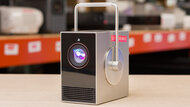
Home TheaterGamingBrightnessEffective ContrastPre-Calibration Color AccuracyColor GamutImaging TechnologyLight SourceLaserSee all our test resultsNative ResolutionPixel Shift 4kThe LG CineBeam Q is the best portable projector under $1,000. It's a very different product from the Epson Home Cinema 2350: the Epson is much brighter, has more accurate colors, and is the better choice for a more traditional living room setup, while the LG is the one to get when size, portability, and easy placement matter more. Its compact body and 360-degree rotating handle make it simple to carry from room to room, place on a shelf or table, or even aim upward at a ceiling. There's no built-in battery, so it still needs power, but at about 3.3 lbs, it's very easy to move around.
The main reason to pick the LG over other small projectors is its image quality in the right environment. It isn't especially bright, so you'll want the lights off for the best results, but its contrast is excellent. That means dark scenes have more depth and look less washed out than they do on many portable projectors. It has webOS built in for streaming apps, alongside wireless casting through AirPlay 2 and Miracast. Gaming is limited to 60Hz and is better for casual play than competitive gaming, but overall, the CineBeam Q is the standout portable pick under $1,000 if you want something compact that still looks good in a dark room.
-
Best Gaming Projector Under $1,000
MoviesGamingBrightnessNative ContrastPre-Calibration Color AccuracyColor GamutImaging TechnologyLight SourceLampSee all our test resultsNative ResolutionPixel Shift 4kIf gaming is your main priority under $1,000, the ViewSonic PX701-4K is the projector to get. It's not as well-rounded as the Epson Home Cinema 2350, as the Epson is much brighter, has more accurate colors, looks more vibrant, and is the better choice for movies, TV, sports, and mixed use. The ViewSonic's contrast is a bit better, so blacks have slightly more depth in a dark room, but it's less lively overall.
But what makes the ViewSonic stand out is how quick and flexible it is for games. It accepts 4k @ 60Hz signals for modern consoles, so menus and games still look sharp, but its real advantage is at 1080p, where it supports much smoother 120Hz and 240Hz gaming. That means fast motion looks clearer, and your controls feel more immediate, which is especially useful for shooters, racing games, and anything where quick reactions matter. Just know that it's barebones outside of gaming: there's no built-in smart platform, image setup is basic, and you'll probably want a streaming stick or console for apps. Overall, the PX701-4K is the right pick if you want a budget projector that prioritizes gaming speed over picture accuracy and convenience.



Notable Mentions
-
Epson Home Cinema 1080:
The Epson Home Cinema 1080 is the Epson Home Cinema 2350's predecessor and is very similar overall. Outside of the 1080's brighter image, the 2350 is an improvement across the board: deeper contrast, a wider color gamut, an included Android TV dongle, and much better gaming performance.
See our review -
Anker Nebula P1i:
The Anker Nebula P1i is worth considering versus the NexiGo PJ40 Pro if you're looking for a portable projector in that price range. The NexiGo offers noticeably superior picture quality, with a brighter and deeper image, alongside a wider color gamut. Still, the Anker is far more portable, with flippable speakers, a handle, and a full set of automated setup features.
See our review -
XGIMI Halo+:
The XGIMI Halo+ is a portable projector with an integrated battery, and it competes with the battery-less LG CineBeam Q. The XGIMI is brighter and easier to take anywhere, but the LG has much better contrast and a wider color gamut, so it looks noticeably better once the lights are down. Still, the Halo+ is much cheaper, making it the better value if you want a truly cordless setup.
See our review -
Anker Nebula P1:
The Anker Nebula P1 is a good alternative to the LG CineBeam Q if you value features over image quality. The Anker is dimmer, less colorful, and has worse contrast, but it offers a ton of features that help its versatility, such as integrated wireless speakers, lens protection, and mounting holes for a tripod. It's also the better gaming projector, with lower input lag than the LG.
See our review -
BenQ TH671ST:
The BenQ TH671ST stands out against the ViewSonic PX701-4K if you value image quality over sheer gaming performance. The BenQ has deeper contrast, is way more accurate out of the box, and is more colorful. It's also a decent 1080p @ 60Hz gaming projector, but it can't compete with the ViewSonic's array of resolutions and refresh rates, all with lower input lag.
See our review
Recent Updates
Jun 05, 2026:
We've refreshed this article with updated picks, current pricing context, and clearer recommendations to help users make better buying decisions.
Feb 04, 2026:
The ViewSonic PX701-4K is now in the Notable Mentions, as it's now sold for the same price as the superior Hisense M2 Pro. We've also updated the text throughout for improved clarity.
Dec 17, 2025:
The newly reviewed Hisense M2 Pro replaces the BenQ HT2060 as the Best Projector Under $1,000 due to being better all-around. The BenQ HT2060 is now in the Notable Mentions.
Oct 29, 2025:
The ViewSonic PX701-4K has been rebranded as the 'Best Gaming Projector Under $1,000,' to emphasize its gaming chops. Plus, the LG CineBeam Q is now the 'Best Portable Projector Under $1,000,' and the XGIMI Halo+ is instead the 'Best Value Portable Projector Under $1,000.'
Apr 18, 2025:
The BenQ HT2060 replaced the BenQ TH671ST as the 'Best Projector Under $1,000,' as the BenQ TH671ST's price has crept up lately, and the HT2060 is far superior in every aspect. The TH671ST is now in the Notable Mentions instead.
All Reviews
Our recommendations above are what we think are currently the best projectors under $1,000 to buy for most people. We factor in the price (a cheaper projector wins over a pricier one if the difference isn't worth it), feedback from our visitors, and availability (no projectors that are difficult to find or almost out of stock everywhere).
If you would like to do the work of choosing yourself, here is the list of all our reviews of projectors available under $1,000. Be careful not to get too caught up in the details. While no projector is perfect, many are good enough for most uses; however, avoid the worst models to ensure adequate quality.