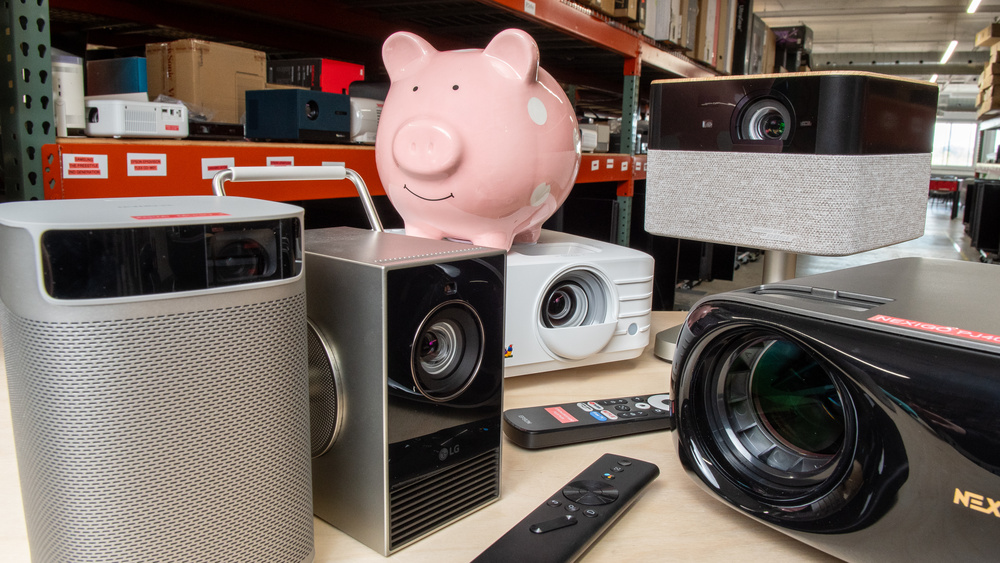
Cheap and budget projectors can give you a much larger image than most TVs at the same price, but they usually come with bigger tradeoffs than more expensive projectors. You often have to choose between brightness, contrast, portability, gaming performance, and smart features rather than getting everything in one package. Some models are bright enough for casual living-room or outdoor use but have weak contrast, while others look better in a dark room but need more careful placement or an external streaming device. Still, there's enough variety that most should be able to find something for your particular needs. If you're unsure about the size of screen you can accommodate at your distance, you can also use our projector throw calculator to determine how each model fits your room.
We've bought and tested more than 95 models, and below, you'll find the lowest-priced projectors to buy. If you're shopping for the cheapest projector possible, look at our best projectors under $500. For a more exhaustive list of projectors at all price points, look at the best projectors instead, or the best home theater projectors if you're shopping for a blacked-out room. If you don't specifically need a projector-sized image, our budget TV recommendations are also worth considering for a simpler living-room setup. You can also vote on which ones you want us to purchase and test.
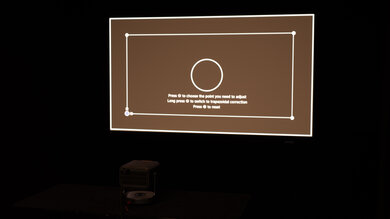
We've independently bought and tested over 80 projectors and published detailed results for each, so you can decide which one to buy. These have all been tested under the same standardized methodology, allowing you to compare them side by side. We still have all these projects in our lab, so we can continually go back and compare them to ensure our reviews are still accurate. All our test methodologies are also public on our website, so you can validate the results yourself.
-
Best Budget Projector
 Home TheaterOutdoorsBedroomGamingBrightnessContrastPortabilityColorGaming ResponsivenessProjector Type:Short ThrowNative Resolution:Pixel Shift 4kSee all our test resultsLight Source:Laser
The XGIMI Elfin Flip 4K is the best budget projector. What really makes it stand out from other budget models is its combination of solid image quality and versatility. It's a 4k (via pixel shift) projector that produces a sharp image, with decent contrast that remains consistent across different scenes. This gives the image enough depth to avoid looking flat or washed out. While it isn't bright enough for well-lit spaces, it gets bright enough to produce a punchy image in a dark room, especially thanks to its incredibly vibrant colors. It also delivers excellent gaming performance with a wide range of gaming features. It supports 4k @ 60Hz and 1080p @ 120Hz, letting you choose between a sharper image and smoother motion. Its incredibly low input lag rivals that of good gaming TVs and monitors, and it supports VRR to help reduce screen tearing.
It's also small and lightweight enough to easily carry around in a backpack. Although there's no lens shift to help center the image, the motorized zoom lens makes it easy to adjust the image size. It also has a wide range of screen adaptation features, including autofocus, automatic keystone correction, and obstacle avoidance, making setup quick and easy. Its one-axis gimbal also gives you some flexibility when positioning the projector vertically. It runs Google TV, giving you access to a large selection of apps and allowing you to skip using an external streaming device.
-
Best Budget 1080p Projector
Home TheaterOutdoorsBedroomGamingBrightnessContrastPortabilityColorGaming ResponsivenessProjector Type:Standard ThrowNative Resolution:1080pSee all our test resultsLight Source:LaserIf you like what the XGIMI Elfin Flip 4K offers, but you don't need 4k resolution or the gaming performance it provides, you can save some money and get the XGIMI Elfin Flip Laser. Since this is a 1080p projector, the image isn't as sharp as a 4k projector like our top pick. However, its contrast is a bit better than the 4k model, and it's a bit brighter, so you get a punchy image in a dark room that has solid depth to it. It's just as colorful as the higher-end model, so movies, shows, and games look vibrant. The biggest downside is that it's more limited in terms of gaming performance. It's limited to 60Hz, so you can't increase the refresh rate to get better motion clarity. It also lacks VRR to reduce screen tearing, and there's more input lag, which leads to a less responsive gaming experience. Still, the amount of input lag is low enough for casual gaming.
It has the exact same design as the Flip 4K, so it's still easy to put it into a bag to bring to a friend's house. Unfortunately, it doesn't have a motorized zoom lens, so you need to physically move it to adjust the size of the image. Outside of that, you still get almost the same set of screen adaptation tools, like autofocus and automatic keystone correction, and it has the same one-axis gimbal, so setting it up is still easy. You just need to make sure there's nothing in front of your screen, since it lacks an obstacle avoidance feature. Like our top pick, it runs Google TV, so you don't need to pair it with a streaming device to watch shows and movies.
-
Best Cheap Projector
Home TheaterOutdoorsBedroomGamingBrightnessContrastPortabilityColorGaming ResponsivenessProjector Type:Standard ThrowNative Resolution:1080pSee all our test resultsLight Source:LEDIf you just want a cheap projector that gets the job done inside your home, go for the NexiGo PJ40 Pro. Its image quality isn't as good as the XGIMI Elfin Flip Laser overall, but it does have better contrast, so it displays deeper blacks that give the image a bit more depth. Unfortunately, it's dimmer than the Flip Laser, and its colors are much more muted, so it doesn't look nearly as punchy or vibrant in a dark room. Its gaming performance is similar overall, as it's limited to 1080p @ 60Hz and doesn't support VRR to help reduce screen tearing, but it does have lower input lag. It's still not low enough for competitive titles like Call of Duty, but single-player titles are responsive enough that you're not at a big disadvantage during boss fights.
Like the Flip Laser, it doesn't support lens shift to help center the image, and it lacks a motorized zoom lens, so you need to physically move the projector to center and adjust the image size. It's also limited to manual focus, manual horizontal keystone, and automatic vertical keystone, and it doesn't have obstacle avoidance or a gimbal, so setup takes more time. Despite this, it's small enough to conveniently bring over to a friend's house or take outside. Finally, it runs the popular Google TV smart system, so you'll have no problem finding apps to download for watching shows and movies.
-
Best Budget Bright Projector
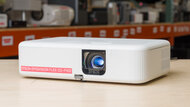
Home TheaterOutdoorsBedroomGamingBrightnessContrastPortabilityColorGaming ResponsivenessProjector Type:Standard ThrowNative Resolution:1080pSee all our test resultsLight Source:LampIf you want a budget projector for a brighter room, the Epson EpiqVision Flex CO-FH02 is the one to get. It's the only projector on this list that's bright enough to handle glare in a room with ambient lighting without the image looking severely washed out. However, its contrast is much worse than on a similarly priced option like the NexiGo PJ40 Pro, resulting in an image that lacks depth and looks flat, so only go for it if you really need a bright-room model. Fortunately, colors look a bit more vibrant than they do on the NexiGo, so the image doesn't look too dull. Its gaming performance is similar to the NexiGo, since it's limited to 60Hz and doesn't support VRR. Unfortunately, its input lag is quite high, so it's really only suitable for casual titles where responsiveness doesn't matter too much.
This projector doesn't offer much in terms of setup features, so you need to manually center it with your screen and move it to adjust the size of the image. Since it doesn't have mounting holes, it can't be easily mounted to a ceiling or a tripod. It's also a bit light on screen adaptation features, since it's limited to manual focus and manual horizontal keystone correction. However, it does offer automatic vertical keystone correction, which is useful since it can't be tilted vertically. Still, this is a projector that takes some time to set up properly, so it's not a great portable option. Fortunately, the built-in Android TV offers a big selection of streaming apps.
-
Best Cheap Portable Projector
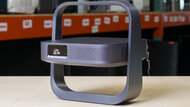
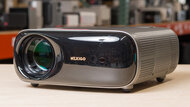
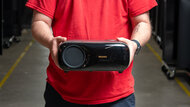
Home TheaterOutdoorsBedroomGamingBrightnessContrastPortabilityColorGaming ResponsivenessProjector Type:Standard ThrowNative Resolution:1080pSee all our test resultsLight Source:LEDIf you're just looking for a cheap, portable projector to bring camping or to your friend's house for the odd movie night, go with the XGIMI Vibe One. It has good enough contrast to give the image decent depth, but it's a very dim model, so it needs to be used in a dark space to avoid looking washed out. It's also not very colorful, so the image looks quite muted, but that's to be expected of a projector this small and cheap. It doesn't offer much for gaming, since it's limited to 60Hz and lacks VRR to reduce screen tearing, but it has low enough input lag to play casual titles like Mario Kart with your friends.
The biggest advantage this model has is its small size and built-in battery, making it highly portable. It doesn't have a zoom lens or lens shift, but that's expected from a portable model like this one. Fortunately, it still has a one-axis gimbal that allows you to tilt it vertically, which helps to center the image. It also has a good selection of screen adaptation features like autofocus and automatic keystone correction, so it's fairly easy to set up quickly. Its Google TV OS also adds to its portability, as you can download popular apps like Netflix to stream shows and movies, or stream content from your phone.


Notable Mentions
-
Hisense M2 Pro:
When the Hisense M2 Pro is on sale, it's priced similarly to the XGIMI Elfin Flip 4K. The Hisense is a bit brighter than the XGIMI, but its contrast is also slightly worse. Both models have equally vibrant colors, but the Hisense is more accurate. On the other hand, the XGIMI offers better gaming performance and is more portable, so the better option really comes down to what you value most.
See our review -
BenQ TH575:
The BenQ TH575 is priced similarly to the XGIMI Elfin Flip Laser. The BenQ is brighter and has the edge when it comes to contrast. However, it has significantly less vibrant colors than the XGIMI, leading to an image that looks dull. It's also less portable, harder to set up, has a louder fan, and isn't as versatile, making the XGIMI the better option for most people.
See our review -
Wanbo X5 Pro:
The Wanbo X5 Pro performs almost identically to the NexiGo PJ40 Pro, often at a similar price. They trade blows on some aspects, but the NexiGo has slightly better image quality, is more accurate out-of-the-box, and is far easier to calibrate, making it the better option for most people. Still, the Wanbo isn't nearly as noisy under load, which matters in quiet environments.
See our review -
Anker Nebula P1i:
The Anker Nebula P1i is a portable model sold for around the same price as the XGIMI Vibe One, and it's a good alternative if you prefer better sound over a built-in battery. The Anker has two 10W Dolby speakers that create a wider soundstage, and it's a bit brighter. However, the XGIMI has better contrast, and its lighter and more compact design makes it easier to carry around.
See our review
Recent Updates
Sep 11, 2026:
The BenQ TH575 was replaced with the XGIMI Elfin Flip 4K as our new top pick, since the XGIMI is the better option overall. The XGIMI MoGo 2 was also replaced with the XGIMI Vibe One in the 'Best Cheap Portable' category because the former is no longer available. A new 'Best Budget Mid-Range' category was added with the XGIMI Elfin Flip Laser in that spot to give readers more options. The 'Best Budget Gaming' and 'Best Budget Portable' sections were also removed, since the Flip 4K is the best budget gaming and best budget portable projector. Finally, we refreshed the Notable Mentions section to offer better alternatives to our current picks.
Jun 19, 2026:
The BenQ TH575 replaces the Epson Lifestudio Flex Plus as the 'Best Budget Projector' due to its mix of solid image quality and decent gaming performance; the Epson is now in the Notable Mentions. The Epson EpiqVision Flex CO-FH02 is also now the 'Best Budget Bright Projector,' as a bright-room alternative to the BenQ TH575.
May 06, 2026:
The Epson Home Cinema 1080 has been removed due to availability issues. We've also updated the Notable Mentions and swapped the NexiGo PJ40 (Gen 3) for the NexiGo PJ40 Pro due to the latter's smart OS implementation.
Mar 11, 2026:
Price creep has pushed the Hisense M2 Pro off the list; it has been replaced by the versatile Epson Lifestudio Flex Plus. The picks were slightly rewritten, and the XGIMI MoGo 2 was added as the 'Best Cheap Portable' option.
Dec 17, 2025:
The newly reviewed Hisense M2 Pro replaces the venerable BenQ HT2060 as the Best Budget Projector due to being better all-around. The BenQ HT2060 is now in the Notable Mentions.
All Reviews
Our recommendations above are what we think are currently the best budget-friendly projectors for most people to buy. We factor in the price (a cheaper projector wins over a pricier one if the difference isn't worth it), feedback from our visitors, and availability (no models that are difficult to find or almost out of stock everywhere).
If you'd like to do the work of choosing yourself, here's the list of all our projector reviews, with a price limit of $1,000. Be careful not to get too caught up in the details. While no projector is perfect, many are good enough for most uses; however, avoid the worst models to ensure adequate quality.