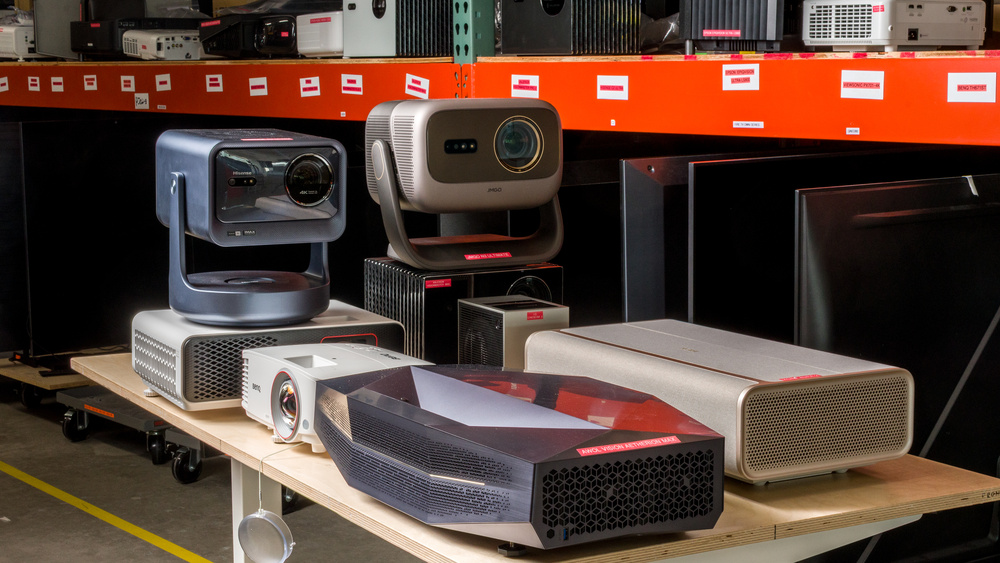
Are you cramped for space? Do you have a massive room and don't want your projector to stick out right in the middle of it? Consider an ultra-short-throw (UST) or short-throw (ST) projector. These projectors can be installed very close to the wall or screen you wish to project on, as an alternative to the traditional long-throw projectors, which you have to install far from the screen. Short-throw projectors have numerous advantages; they don't require as much space, their proximity to the screen helps with cable management, and they offer a more minimalist setup compared to traditional projectors. However, short-throw projectors are often more expensive than other projector types, so be aware of this when shopping. If you're unsure about the size of screen you can accommodate at your distance, you can also use our projector throw calculator to determine how each model fits your room.
We're here to help. We've purchased and tested over 90 projectors, and below, you'll find the best UST and ST projectors to buy. However, we only cover consumer models, not high-end products intended for enthusiasts. If you're shopping for a home theater projector and don't care whether it's a short-throw projector, check out the best projectors for home theater use. If you find these projectors too expensive for what they offer and would prefer a cheaper option, check out the best budget and cheap projectors. Taking your projector on the patio? Consider our picks for the best outdoor projectors. And don't forget that you can vote on which projectors you'd like us to purchase and put to the test!
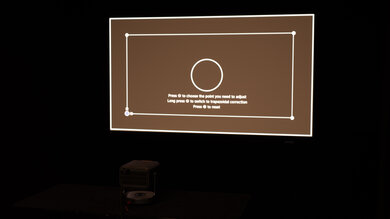
We've independently bought and tested over 80 projectors and published detailed results for each, so you can decide which one to buy. These have all been tested under the same standardized methodology, allowing you to compare them side by side. We still have all these projects in our lab, so we can continually go back and compare them to ensure our reviews are still accurate. All our test methodologies are also public on our website, so you can validate the results yourself.
-
Best Ultra-Short-Throw Projector
 Home TheaterGamingBrightnessEffective ContrastMinimum Throw RatioMaximum Throw RatioSizeLight SourceLaserSee all our test resultsNative ResolutionPixel Shift 4k
The AWOL Vision Aetherion Pro is the ultra-short-throw pick for people who want a high-end projector that lives right against the wall and performs best in a dark room. It's cheaper than the Valerion VisionMaster Max, which we also look at later as an option with a longer throw ratio, and while the Valerion is much brighter and easier to recommend for larger screens or rooms with some light on, the AWOL Vision has the same movie-first DNA: outstanding contrast, fantastic judder handling for smoother slow camera pans, and strong RBE handling to cut down on the rainbow flashes some people see on DLP projectors. Its pixel-shifted 4k image looks sharp, and its color gamut is extremely wide. Still, the projector's pre-calibration image accuracy is underwhelming, as it's way too warm out-of-the-box. Most users aren't likely to care, but purists will want to calibrate the unit.
It also compares well against the JMGO N3 Ultimate, which, like the Valerion VisionMaster Max, has a longer throw ratio than the AWOL Vision. The JMGO is brighter and usually less expensive, but the AWOL Vision is close behind for gaming. Controls feel extremely quick at 4k @ 60Hz, and it also supports high-refresh 1080p modes up to 240Hz for smoother, faster PC gaming. The main catch is brightness: at this price, the Aetherion Pro is dimmer than many competitors, so it's not the right choice if you want to fight ambient light. Overall, though, it's a standout UST projector if you want excellent dark-room movie performance, very strong gaming responsiveness, and a setup that sits just inches from the screen.
-
Best Mid-Range Ultra-Short-Throw Projector
Home TheaterGamingBrightnessEffective ContrastMinimum Throw RatioMaximum Throw RatioSizeLight SourceLED + LaserSee all our test resultsNative ResolutionPixel Shift 4kThe XGIMI AURA 2 is the more practical ultra-short-throw pick if you want a bright, all-in-one projector that sits right near the wall and costs less than the AWOL Vision Aetherion Pro. Its main advantages are brightness, price, and out-of-the-box accuracy: it's easier to use in a living room with some light around, and movies and shows look more natural without calibration. However, the AWOL is the much stronger dark-room performer. Its contrast is far better, so dark scenes have much more depth, and it also handles judder better, which means slow camera pans in movies look smoother. The AURA 2 is still a solid choice for casual viewing, but it isn't as cinematic when the room is pitch black.
The XGIMI is also less gaming-focused than the AWOL. Its input lag is low enough at 4k @ 60Hz for responsive gaming, so controls don't feel sluggish, but it doesn't have the AWOL's high-refresh gaming flexibility or top-tier responsiveness. As for features, the AURA 2 has a bit of everything. Its built-in Google TV platform gives you proper app support, so you can use it as an all-in-one living room display without immediately budgeting for a separate streamer. It also includes XGIMI's Intelligent Screen Adaptation 5.0 tools to help with focus, keystone correction, screen alignment, obstacle avoidance, and eye protection. Overall, the AURA 2 is the better-value UST if you want a brighter, cheaper, easier living-room projector, while the AWOL is the better choice for dark-room movie performance and serious gaming.
-
Best Budget Ultra-Short-Throw Projector
Home TheaterGamingBrightnessEffective ContrastMinimum Throw RatioMaximum Throw RatioSizeLight SourceLaserSee all our test resultsNative ResolutionPixel Shift 4kIf you want an ultra-short-throw projector at a more entry-level price, the LG CineBeam S is the best budget UST projector we've tested. UST projectors are expensive by nature, so it still costs more than many other 'budget' projectors, but it's much cheaper than stronger models like the XGIMI AURA 2. The trade-off is performance: the XGIMI is much brighter, more accurate out of the box, better for gaming, and generally delivers a more convincing big-screen image. The LG's advantage is that it's much smaller and lighter, so it works better if you want a compact UST that you can move around more easily or fit into a smaller space. Just keep your expectations in check: it has strong contrast and a wide color gamut, but its dim brightness means it's best used in a dark room with the curtains drawn.
That's not to say that it doesn't look good. Its pixel-shifted 4k image looks sharp. It runs LG's webOS platform, with a ton of built-in apps and casting support, so you don't need a dongle. Still, the UI on the unit is rather laggy, so keep that in mind. Setup is helped by autofocus, auto keystone, screen scaling and shifting, and wall color adjustment, which is useful if you're projecting onto a wall instead of a proper screen. Overall, if you want an affordable, compact UST for dark-room movie nights, the LG CineBeam S is an interesting budget option.
-
Best Short-Throw Projector
Home TheaterGamingBrightnessEffective ContrastMinimum Throw RatioMaximum Throw RatioSizeLight SourceLaserSee all our test resultsNative ResolutionPixel Shift 4kIf you want the best short-throw projector, one that prioritizes black levels and depth but with a longer throw ratio than a UST projector, the Valerion VisionMaster Max is the one to get. Its native contrast is amazing, giving dark scenes real weight and separation, and it's one of the rare projectors where the dynamic contrast option is genuinely worth using, since it can deepen blacks without any truly noticeable artifacting. It also has fantastic judder handling, so camera pans in movies look smooth without any obvious choppiness, and its RBE (Rainbow Effect) Reduction feature does a great job reducing the rainbow flashes some people see on DLP projectors. Add in its extremely wide color gamut and strong enough brightness for dim-room viewing, and movies look rich, saturated, and punchy once you turn the lights down.
It’s also more flexible to place than many short-throw projectors. Its lens lets it sit closer to the screen than a traditional projector, and its motorized zoom and vertical lens shift give you room to resize and line up the image without moving the whole unit or relying as much on digital correction. It also comes loaded with smart features, including a built-in streaming platform, casting support, and wireless connectivity. Gaming performance is great too, with low input lag and high-refresh-rate support, making games pretty responsive. Overall, the VisionMaster Max is the standout short-throw pick if you want premium movie performance, excellent contrast, smooth motion, and a full feature set.
-
Best Upper Mid-Range Short-Throw Projector
Home TheaterGamingBrightnessEffective ContrastMinimum Throw RatioMaximum Throw RatioSizeLight SourceLaserSee all our test resultsNative ResolutionPixel Shift 4kIf you want a solid short-throw projector for less than the Valerion VisionMaster Max, the JMGO N3 Ultimate is the pick to get. The Valerion is still the better dark-room home theater projector if movies are your top priority: it has deeper contrast, a useful dynamic contrast feature, fantastic judder handling, and a very effective feature to reduce RBE. The JMGO doesn't quite match that level of movie refinement, but it's brighter, very colorful, and still has strong enough contrast to give movies, shows, and games good depth in a dim room. Its pixel-shifted 4k image also looks crisp, so it still delivers the sharp, high-end-looking image you'd expect at this price.
The JMGO's biggest advantage is gaming. It feels very responsive at 4k @ 60Hz for consoles, and it can also run at 1080p @ 120Hz or 1080p @ 240Hz if you want smoother motion and a quicker feel for faster PC games. It's also easy to set up thanks to its two-axis gimbal stand, autofocus, automatic keystone correction, and screen alignment tools, so aiming and squaring the image doesn't take much effort. The main drawback is judder: it doesn't handle it very well, so camera pans look uneven if you're sensitive to choppy motion. Overall, the JMGO is the better pick if you want a brighter, gaming-focused short-throw projector that still looks great for everyday movies and shows, while the Valerion remains the stronger choice for dark-room movie enthusiasts.
-
Best Mid-Range Short-Throw Projector
Home TheaterGamingBrightnessEffective ContrastMinimum Throw RatioMaximum Throw RatioSizeLight SourceLaserSee all our test resultsNative ResolutionPixel Shift 4kThe Hisense C2 Ultra sits in a nice middle ground: when on sale, it costs less than the JMGO N3 Ultimate, but still gives you a bright, colorful, sharp short-throw image with enough gaming performance for most people. The JMGO is still brighter and much better for gaming, with noticeably lower input lag, so it's the stronger choice if you want the most responsive projector possible, but the Hisense holds up very well for movies and shows. Its pixel-shifted 4k image looks sharp, it's bright enough for dim living rooms, and its contrast is strong enough to give dark scenes good depth once you turn the lights down. It also has a very wide color gamut, so colorful movies and games look rich and vibrant.
It's still one of the most well-rounded short-throw gaming options in this price tier. Even if not quite as good as the JMGO, its input lag is low at 4k @ 60Hz for responsive console play, and it stays relatively snappy at high refresh 1080p, so it feels quick whether you are playing story games or something faster. The rotating gimbal stand, plus autofocus, auto keystone, and obstacle avoidance, help you get aligned quickly. VIDAA is built in with official Netflix support, so you can stream without a dongle. Overall, the C2 Ultra is the sweet spot if you want short-throw flexibility, excellent image quality, and legit gaming responsiveness.
-
Best Lower Mid-Range Short-Throw Projector
Home TheaterGamingBrightnessEffective ContrastMinimum Throw RatioMaximum Throw RatioSizeLight SourceLEDSee all our test resultsNative ResolutionPixel Shift 4kIf you mainly want a short-throw projector for competitive gaming and would rather pay less than the Hisense C2 Ultra, consider the BenQ X500i. By stepping down from the Hisense, you give up some of that premium all-around image quality, especially brightness, color richness, and the more cinematic look the C2 Ultra can deliver, but the X500i still puts a sharp 4k (pixel shift) image on screen and is easy to place in smaller rooms thanks to its short-throw lens. The BenQ also includes an Android TV 11 QS02 dongle, with Wi-Fi 6, Bluetooth, Chromecast, and AirPlay, so streaming is covered without buying extra hardware. Connectivity is also strong, with multiple HDMI inputs including one with eARC, plus a USB-C port with DisplayPort Alt Mode for direct connection from compatible laptops or handhelds.
Where the X500i really stands out is high-refresh-rate gaming. At 60Hz, the C2 Ultra is actually a bit faster, so there's no huge advantage for 60 fps console play. But once you step up to 120Hz or 240Hz, the X500i pulls clearly ahead of the Hisense, with noticeably lower input lag and a more responsive feel. If responsive high-refresh-rate gaming is your main priority, and you're willing to sacrifice some image quality in order to save some money, the X500i is the product you should be looking at.
-
Best Budget Short-Throw Projector
Home TheaterGamingBrightnessEffective ContrastMinimum Throw RatioMaximum Throw RatioSizeLight SourceLampSee all our test resultsNative Resolution1080pIf you like the short-throw flexibility and gaming focus of the BenQ X500i but want to spend much less, the BenQ TH671ST is a solid alternative. You give up a lot by stepping down, including the X500i's much sharper pixel-shifted 4k image, built-in streaming, and especially its high refresh 1080p at 120Hz and 240Hz with very low input lag. It's best used in dim lighting due to its alright but not exceptional brightness, but its contrast is decent for the price, and its out-of-the-box accuracy is strong enough that movies, TV shows, and games look natural without much tweaking. Its color gamut is also wide enough that most games look pretty punchy, especially when using the projector in a dark room.
It's also a simple, no-frills projector. There's no smart platform, Wi-Fi, or Bluetooth, so most people will want a streaming stick and external speakers. For gaming, it tops out at 1080p at 60Hz, but with Game Mode enabled, it's responsive enough for casual play and slower competitive titles at 60 fps. Overall, the TH671ST is the pick if you want an entry-level option for dark-room movie nights and occasional gaming, and you don't mind adding your own streaming and audio gear.










Notable Mentions
-
Hisense PX3-PRO:
The Hisense PX3-PRO is a solid alternative to the AWOL Vision Aetherion Pro if you're looking for a brighter projector that works well in brighter rooms, and you don't care so much about top-tier gaming performance. Still, for most people, the AWOL's contrast and extremely responsive input lag put it ahead.
See our review -
Epson EpiqVision Ultra LS300:
The Epson EpiqVision Ultra LS300 is a decent alternative to the XGIMI AURA 2 if brightness is your top priority. The XGIMI is the better projector in almost every other way, but the Epson gets much brighter, so it can make more sense if you're setting up in a very bright room and want a UST projector that can better fight through ambient light. Otherwise, stick with the XGIMI.
See our review -
Anker Nebula X1:
The Anker Nebula X1 is a fun short-throw alternative to the JMGO N3 Ultimate or Valerion VisionMaster Max if you care more about outdoor use and portability. It has a built-in handle, strong speakers, and an outdoor-friendly design. Still, the JMGO and Valerion are better living-room options with better gaming performance and more input options.
See our review -
BenQ TK700STi:
The BenQ TK700STi is a good alternative to the BenQ X500i if you want a cheaper short-throw gaming projector. It offers similarly low input lag at 1080p @ 240Hz and 4k @ 60Hz, but the X500i still wins overall thanks to its better contrast, wider color gamut, and superior out-of-the-box accuracy.
See our review
Recent Updates
Jul 03, 2026:
The JMGO N3 Ultimate is now the Best Upper Mid-Range Short-Throw Projector due to its fantastic brightness and best-in-class gaming features; all other picks were pushed downward on the list. Also, the AWOL Vision Aetherion Pro replaces the Hisense PX3-PRO as the Best Ultra-Short-Throw Projector due to its stellar contrast and top-tier gaming responsiveness.
Apr 29, 2026:
The XGIMI AURA 2's current price makes it a much stronger mid-range UST pick, so it replaces the Epson EpiqVision Ultra LS300 as our 'Best Mid-Range Ultra-Short-Throw Projector.' The LS300 moves to the Notable Mentions as a much brighter option for very bright rooms. We've also added the LG CineBeam S as our 'Best Budget Ultra-Short-Throw Projector' thanks to its compact design, low price for a UST unit, and decent dark-room performance.
Feb 20, 2026:
We added the Valerion VisionMaster Max as our new top pick for its amazing contrast and top-notch features. We've also converted our article to a price tier format. The other picks were lightly rewritten to clarify what you're gaining and losing when stepping down a tier.
Nov 19, 2025:
The Hisense C2 Ultra is now the 'Best Short-Throw Projector' due to its versatility and gaming prowess, while the BenQ X500i is now the 'Best Gaming Short-Throw Projector.' All other picks stay the same, but have been rewritten for clarity. The Notable Mentions have also been expanded.
Apr 14, 2025:
We made sure that our recommendations are still accurate and available for purchase.
All Reviews
Our recommendations above are what we think are currently the best short-throw projectors for most people to buy. We factor in the price (a cheaper projector wins over a pricier one if the difference isn't worth it), feedback from our visitors, and availability (no models that are difficult to find or almost out of stock everywhere).
If you'd like to do the work of choosing yourself, here's the list of the best short-throw projector reviews. Be careful not to get too caught up in the details. While no projector is perfect, many are good enough for most uses; however, avoid the worst models to ensure adequate quality.