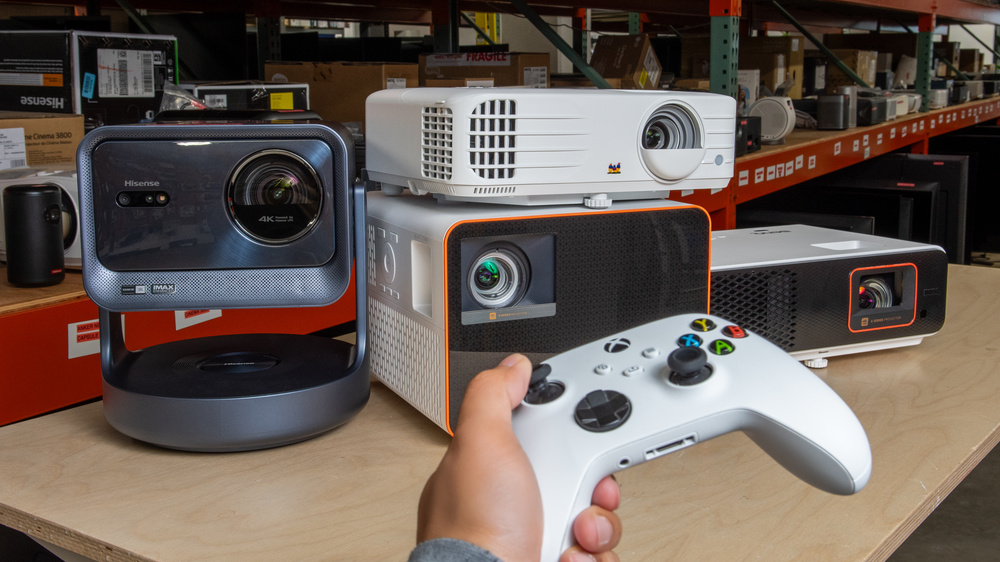
If you're looking for the best gaming projector, there are a few additional considerations beyond basic movie watching. In addition to good contrast and color, a gaming projector requires low input lag and support for higher refresh rates, both of which help make your gaming experience as responsive as possible. It also needs sufficient brightness to see what's happening, even in darker games or in brighter rooms. Not every "4k" or home theater model is a good fit here, so this list focuses on projectors that work well with modern consoles and PCs, whether you mostly play cinematic single-player titles or fast competitive shooters. If you're unsure about the size of screen you can accommodate at your distance, you can also use our projector throw calculator to determine how each model fits your room.
We've purchased and tested over 85 projectors, measuring input lag, refresh rate support, and overall picture quality to find the best gaming projectors available. Still, if you primarily want something more affordable and don't mind limited gaming performance, consider the best budget and cheap projectors. If you care more about 4k image quality than responsiveness, see our list of the best 4k projectors. And if your room has tight placement constraints and throw distance is a priority, consider the best short-throw projectors. You can also vote on which projectors you want us to purchase and test.
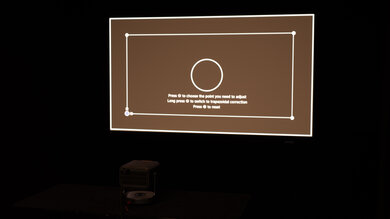
We've independently bought and tested over 80 projectors and published detailed results for each, so you can decide which one to buy. These have all been tested under the same standardized methodology, allowing you to compare them side by side. We still have all these projects in our lab, so we can continually go back and compare them to ensure our reviews are still accurate. All our test methodologies are also public on our website, so you can validate the results yourself.
-
Best Gaming Projector
 GamingInput LagSupported ResolutionsBrightnessEffective ContrastColor GamutPre-Calibration Color AccuracyImaging TechnologyLight SourceLaserSee all our test resultsNative ResolutionPixel Shift 4k
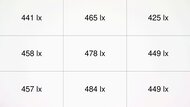
If you want the best gaming projector we've tested, get the JMGO N3 Ultimate. It delivers the kind of bright, colorful, high-contrast image that helps games look vibrant on a large screen, whether you're playing in a dark room or with some lights on. Its HDR support is also useful for games that use it well, since bright effects, colorful environments, and dramatic lighting have more impact than they do on most projectors. It still won't look as punchy as a high-end TV in HDR, but for a projector, it gives games a lively, engaging look instead of a flat or washed-out image.
Plus, the JMGO is also one of the most responsive projectors we've tested. In Game Mode, controller and mouse inputs feel quick, so it's a great choice for action games, shooters, racers, and other games where timing matters. It also supports VRR, which helps reduce screen tearing when a game's frame rate changes, and it can play at higher refresh rates in 1080p if you're willing to trade some sharpness for smoother motion; just keep in mind that the VRR feature has artifacting at high frame rates, making motion look choppy. Setup is another major strength: its motorized zoom, motorized lens shift, and two-axis motorized gimbal make it much easier to aim and size the image without constantly moving the whole projector. Overall, the JMGO is the best gaming option if you want strong picture quality, low input lag, and a flexible setup in one projector.
-
Best Mid-Range Gaming Projector
GamingInput LagSupported ResolutionsBrightnessNative ContrastColor GamutPre-Calibration Color AccuracyImaging TechnologyLight SourceLaserSee all our test resultsNative ResolutionPixel Shift 4kIf you want a strong gaming projector for less than the JMGO N3 Ultimate, get the Valerion VisionMaster Plus2. Compared with the JMGO, it isn't as bright, its contrast isn't as strong, and it's much less flexible to physically place, so the JMGO is still the better all-around projector if you want the most impressive large-screen image. However, the Valerion still gives you a sharp pixel-shifted 4k image with very wide color, so games look vibrant and detailed in a dim room.
It's also a very good gaming performer. It handles 4k @ 60Hz for modern consoles, and it can run at 1080p @ 120Hz or 1080p @ 240Hz if you're willing to lower the resolution for smoother motion and a more responsive feel. That's useful for faster PC games, shooters, racing games, or anything where quick input response matters more than maximum sharpness. Overall, the Valerion is the right pick if you want a more affordable gaming projector with high-refresh-rate support and strong image quality, as long as you don't need the JMGO's higher brightness, better contrast, or more flexible setup.
-
Best Lower Mid-Range Gaming Projector
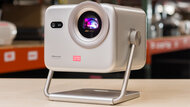
GamingInput LagSupported ResolutionsBrightnessEffective ContrastColor GamutPre-Calibration Color AccuracyImaging TechnologyLight SourceLaserSee all our test resultsNative ResolutionPixel Shift 4kThere are a few good projectors in the lower mid-range, but the Hisense M2 Pro stands out most for gaming. Compared with the Valerion VisionMaster Plus2, you give up some brightness, so the Valerion still produces a stronger image in a dim room. However, the Hisense is more compact, easier to fit into tighter spaces, and still gives you a sharp pixel-shifted 4k image with very good contrast and a wide color gamut. It's also accurate right out of the box, so games and movies look natural without needing calibration.
For gaming, the Hisense is a strong option. It feels responsive at 4k @ 60Hz for consoles, and it supports 1080p @ 120Hz and 1080p @ 240Hz if you want smoother motion and a quicker feel for PC gaming. Its 360-degree stand and automatic setup tools also make quick table placement much easier than with a more traditional projector. Overall, the Hisense is the best lower mid-range gaming pick if you want high-refresh-rate support, solid image quality, and everyday convenience at a lower price.
-
Best Budget Gaming Projector
GamingInput LagSupported ResolutionsBrightnessNative ContrastColor GamutPre-Calibration Color AccuracyImaging TechnologyLight SourceLampSee all our test resultsNative ResolutionPixel Shift 4kIf the Hisense M2 Pro is too expensive, the ViewSonic PX701-4K is the budget gaming projector to get. It's a bit brighter than the Hisense, which helps if you're gaming with a few dim lights on, but it's otherwise a clear step down in image quality. The Hisense has much better contrast, so dark scenes look deeper and more cinematic, while the ViewSonic's blacks look gray in comparison. Its colors are also washed out and inaccurate out of the box, so games don't look as rich or natural as they do on the Hisense.
Still, the ViewSonic gets the important basics right. It accepts 4k @ 60Hz signals for consoles, and its pixel-shifted 4k image looks sharp enough for menus, HUDs, and big-screen play. It also supports 1080p @ 120Hz and up to 1080p @ 240Hz, which lets you trade resolution for smoother motion and a quicker feel in fast games. Input lag is low in Game Mode, especially at those higher refresh rates, so shooters, racers, and action games feel responsive. Overall, the ViewSonic is the best budget gaming choice if you want a responsive projector with high-refresh-rate support and can live with a less accurate and less cinematic image.
-
Best Cheap Gaming Projector
GamingInput LagSupported ResolutionsBrightnessNative ContrastColor GamutPre-Calibration Color AccuracyImaging TechnologyLight SourceLEDSee all our test resultsNative Resolution1080pIf you want something cheaper and easier to move around than the ViewSonic PX701-4K, the Anker Nebula P1i is the best cheap gaming projector to get. It's a major step down in image quality: it's much dimmer, only has a 1080p resolution, doesn't support 120Hz gaming, and its weak contrast and limited color make games look flatter than they do on the ViewSonic. However, it's also far more portable, much easier to set up, and has extremely low input lag at 1080p @ 60Hz, so controller inputs feel quick and responsive.
That makes the Anker a good pick for casual gaming in a dark room, especially if you want a small projector you can move between rooms or bring to a friend's place. Its automatic setup tools, Google TV, casting support, and flip-out speakers make it feel more complete than most cheap projectors, so you don't need much extra gear to get started. Just keep in mind that it doesn't have a built-in battery, so you'll still need an external power source. Overall, the Anker is the right choice if you want a cheap, portable 60Hz gaming projector with great responsiveness and are willing to accept basic picture quality to get it.
-
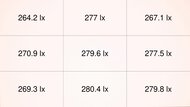
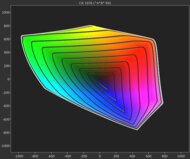
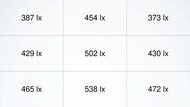
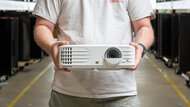
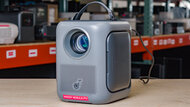
Best Portable Gaming Projector
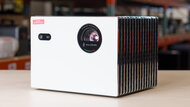
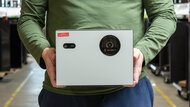
GamingInput LagSupported ResolutionsBrightnessNative ContrastColor GamutPre-Calibration Color AccuracyImaging TechnologyLight SourceLEDSee all our test resultsNative Resolution1080pIf you like the idea of the Anker Nebula P1i but want a better portable gaming experience, get the Anker Nebula P1. It costs more, but it's a clear upgrade over the P1i. Both are dim, 60Hz-only projectors, so they're best used in a dark room, but the P1 has better contrast, a wider color gamut, and more accurate color out of the box. That means games look less flat and more colorful than they do on the cheaper Anker, even if the image still doesn't have the brightness or impact of a bigger home projector like the ViewSonic PX701-4K.
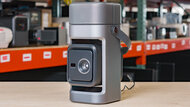
For gaming, the P1's main strength is responsiveness. Input lag is extremely low at 1080p @ 60Hz, so casual games, platformers, RPGs, and single-player action games feel quick and easy to play. It can also accept a 4k @ 60Hz signal and downscale it to 1080p, which is useful if you're connecting a console or streaming device that's already set to 4k. Still, its portability features are the real draw: it has a built-in carry strap, a built-in lens cover, detachable 10W wireless speakers, Google Cast, and easy setup tools that help with focus and image alignment when you move it around. It doesn't have a built-in battery, so you still need external power, but overall, the Anker Nebula P1 is the better choice if you want a portable 60Hz gaming projector and are willing to pay more than the P1i for better image quality, better speakers, and a more complete design.






Notable Mentions
-
XGIMI HORIZON 20 Max:
The XGIMI HORIZON 20 Max is an excellent alternative to the JMGO N3 Ultimate, especially if you also care a lot about movies. It has slightly better contrast, supports both HDR10+ and Dolby Vision, and handles judder much better. However, the JMGO is a bit brighter, more accurate out of the box, and much more responsive for gaming, so it’s the better choice for most gamers.
See our review -
BenQ X3100i:
The BenQ X3100i is an excellent gaming projector, with slightly lower input lag and a brighter image than the Valerion VisionMaster Plus2. Still, the Plus2 is the better all-around mid-range pick, with much better contrast, a wider color gamut, stronger movie performance, a more modern feature set, and a slightly lower price.
See our review -
BenQ X500i:
The BenQ X500i is a strong pick if you want a short-throw gaming projector that is very accurate out of the box, especially for dark-room play. However, the Valerion VisionMaster Plus2 is far brighter with a much wider color gamut, so it delivers a more vibrant, higher-impact image in most rooms, making it the better all-around choice unless you always play with the lights off.
See our review -
XGIMI HORIZON 20 Pro:
The XGIMI HORIZON 20 Pro is a great option if you want better overall image quality and a more polished movie experience. However, the Valerion VisionMaster Plus2 is usually a bit cheaper and has lower input lag for gaming, so it is the better choice if responsiveness and value matter more than picture quality.
See our review
Recent Updates
Jun 04, 2026:
We've added many picks to provide more options across multiple price points. We've also clarified our picks to focus on their gaming prowess, helping users make better decisions when it comes to gaming specifically.
Feb 24, 2026:
We added the Valerion VisionMaster Max as our new top pick for its amazing contrast and very responsive gaming. The Valerion VisionMaster Plus2 is now also our mid-range pick, thanks to its wide availability and very solid gaming chops. We've also converted our article to a price tier format. The other picks were lightly rewritten to clarify what you're gaining and losing when stepping down a tier.
Dec 17, 2025:
The Hisense C2 Ultra replaces the BenQ X3100i as the Best Gaming Projector due to its great image quality and very low input lag. The BenQ is now in the Notable Mentions instead.
All Reviews
Our recommendations above are what we think are the best gaming projectors for most people right now. We focus on models that balance low input lag, good motion handling, and solid overall image quality, and we factor in price (a cheaper gaming projector wins over a pricier one if the performance gap isn't worth it), feedback from our users, and availability (we avoid models that are hard to find or nearly out of stock).
If you'd rather choose for yourself, you can look at our full list of tested projectors and filter by what matters to you. Just try not to get lost in minor spec differences: no projector is perfect, but many are good enough for most games. The key is to avoid the worst performers and select something that suits your room, budget, and level of gaming commitment.