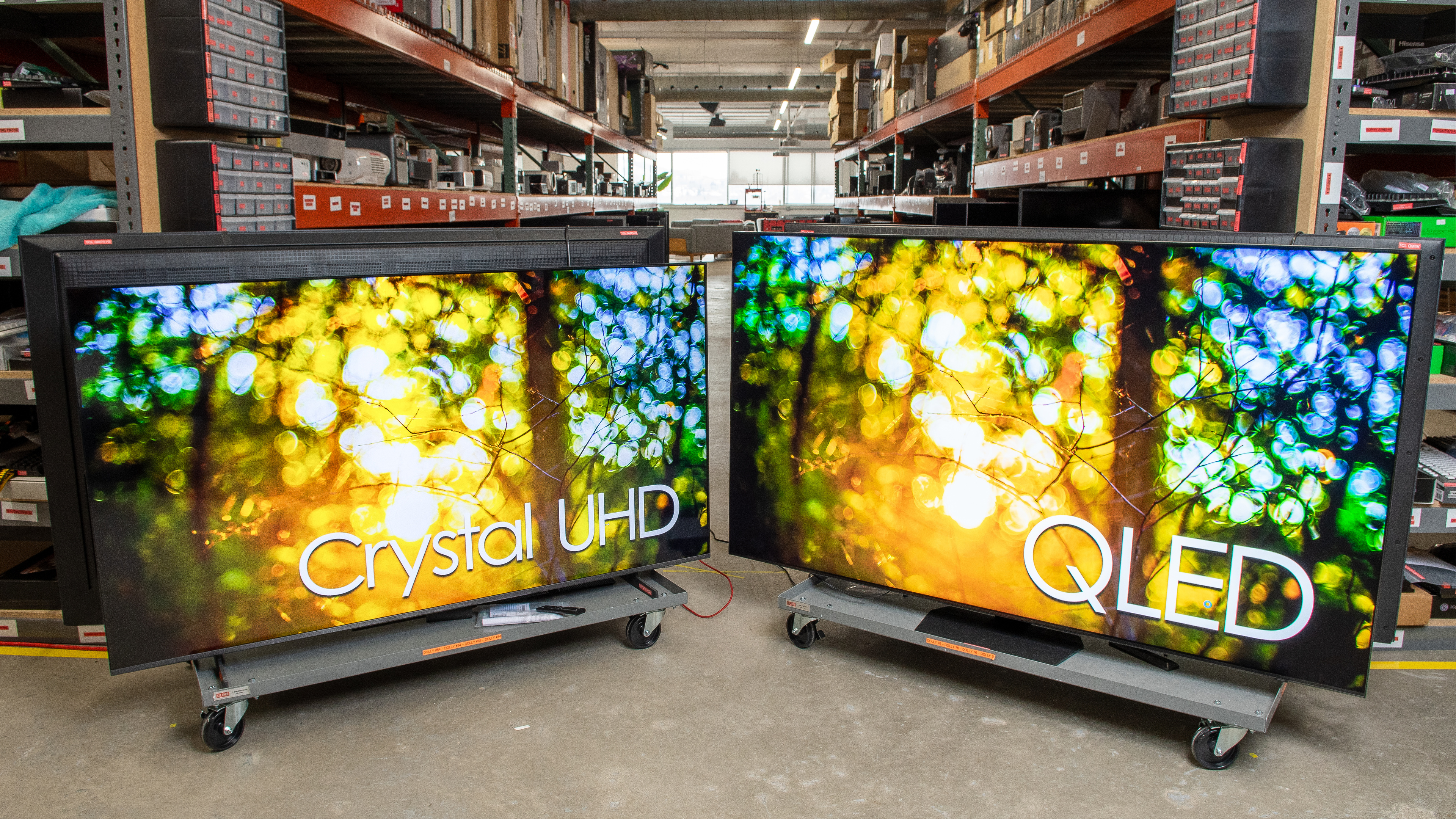
Crystal UHD and QLED are two marketing terms heavily used by Samsung Electronics to advertise their TVs. What's better between Crystal UHD vs QLED, though? Crystal UHD refers to Samsung's entry-level TV lineup, whereas QLED is used to market their mid-range and premium lineups. These terms refer to different technologies used to create colors, and unlike many marketing terms, they actually mean something. In this article, we'll break down how these lineups compare and help you choose between QLED vs Crystal UHD.
What Are They?
Samsung Electronics markets the bulk of their LED TV lineup as either Crystal UHD or QLED. Unlike many marketing terms, though, they actually refer to a technical difference between them, so seeing either one of these marketing terms on a TV actually tells you quite a bit about how they perform. The two terms cover Samsung's entire 4k TV lineup, from the cheapest entry-level models to their most premium LED models.
Crystal UHD
Crystal UHD is a marketing term used to market Samsung's entry-level TVs. You can identify these models by the presence of a "U" at the beginning of the model number, like the Samsung U8000F or the Samsung DU8000. These are all fairly basic TVs, with limited picture quality and few extra features. You won't find local dimming or high peak brightness on these sets, but they're still okay choices for a guest room or garage. TVs that fit into this category typically have very basic backlight systems that rely heavily on inefficient color filters. We'll get more into this later on, but the key takeaway here is that Crystal UHD TVs have limited colors.
QLED
Samsung's mid and premium LED lineups are all QLED, and you can quickly spot these by the "Q" at the beginning of the model number, like the Samsung QN90F or the Samsung Q7F 2025. Some of Samsung's other TVs also make use of the QLED marketing, including the Samsung The Frame Pro 2025. The key technical difference with QLED TVs is how they make colors. QLED TVs use quantum dot technology to convert blue light coming from the backlight into the red and green colors needed for each pixel.
Performance Differences
Now that we've covered some of the key marketing differences between Crystal UHD and QLED and how to spot them, let's get into some of the performance aspects so you know what to expect when choosing between Samsung QLED vs. Crystal UHD. The exact differences will always vary depending on the specific models you're considering, so always look at the individual reviews before making a buying decision. Not all QLED and Crystal UHD TVs are created equally, and some offer better value than others. This comparison will look at the capabilities of the technology, not specific results.
Contrast
There's no technical reason for any difference in contrast between Crystal UHD and QLED TVs. That being said, QLED TVs tend to have much better contrast, as they're all higher-end models in Samsung's lineup. While there's usually very little difference in native contrast, the mid- and higher-end QLED models, which Samsung markets as Neo QLED, all feature a local dimming feature to boost contrast. How well that feature works depends on the specific model you're looking at, but Samsung TVs tend to have very good local dimming, resulting in much higher max contrast on Neo QLED models than on the Crystal UHD lineup.
Brightness
QLED TVs are significantly brighter than Crystal UHD. Similar to contrast, there's no real technical reason for this. Samsung could choose to produce a Crystal UHD TV with high peak brightness, but as these are all lower-end models, they have very limited peak brightness. This makes QLED TVs a better choice for watching TV in a bright room or for HDR content.
Colors
The biggest difference between these two lineups is the range of colors they can produce. Unlike contrast and brightness, though, there's a technical explanation for this, and it has to do with how these TVs use their LED backlights to create the different colors they display. Crystal UHD TVs use a basic color filter system to produce colors. These color filters are very inefficient, as they work by simply blocking the unwanted portions of light from each subpixel, limiting the range of colors that the TV can display.
Samsung's QLED lineup uses something called quantum dots instead. Quantum dots are far more efficient than color filters at converting light, which drastically improves the purity of colors. QLED TVs can produce a much wider range of colors, resulting in a far more vibrant, lifelike image overall. While the exact performance varies depending on the specific model, all QLED TVs produce a wider range of colors than the Crystal UHD lineup.
Processing
Another big technical difference is the processor used by each lineup. The processor is responsible for just about everything a TV does, but you'll mainly notice it when upscaling low-resolution content or when displaying low-quality content. A better processor will result in a cleaner image, with fewer noticeable artifacts like macroblocking or posterization, while also respecting the creative intent and not smoothing over fine details.
Here, QLEDs again have a significant advantage, but the actual difference varies between individual models. The Crystal UHD lineup all use Samsung's proprietary Crystal Processor 4K, which is a fairly basic processor. It handles high-quality feeds well enough, but struggles to clean up lower-quality content, so if you watch a lot of older shows, you'll really notice the issues on a Crystal UHD model. The QLED models use a few different processors, but they all perform better than the Crystal Processor 4K.
Conclusion
Samsung's Crystal UHD lineup offers entry-level performance, with basic picture quality and a 4k resolution, but fewer features. Their QLED lineup covers a much wider range of price points, from mid-range models up to their highest-end 4k TVs, but they all offer better contrast, brightness, colors, and processing than the Crystal UHD lineup. Which one is best for you ultimately depends on your budget and what you're looking for, but there's no doubt that QLED offers better performance overall.