The TCL QM7K is a mid-range TV released in 2025. It sits below the TCL QM8K and replaces the 2024 TCL QM7/QM751G QLED. It supports both 4k @ 144Hz and 1080p @ 288Hz with VRR on its two HDMI 2.1 ports. It also has two HDMI 2.0 ports, one of which doubles as an eARC port with full Dolby and DTS advanced audio passthrough. The TV supports both Dolby Vision HDR and HDR10+ formats and runs version 12 of the popular Google TV smart interface, so it also has smart features like voice control and is loaded with a ton of streaming apps. We bought and tested the 65-inch model, but it's available in five sizes total: 55, 65, 75, 85, and 98 inches.
Our Verdict
The TCL QM7K is a very good mixed-usage TV. It's very bright, especially in SDR, so it can easily overcome glare in well-lit rooms. While it struggles a bit with glare from direct sources of light, it admirably handles glare from ambient sources, so it's truly a bright room standout, like when watching sports. It also excels in darker rooms due to its fantastic contrast and decent HDR brightness, even with its noticeable blooming; blacks are extremely deep on this TV, even when bright highlights are on screen. It's a colorful TV, though it's not very accurate in HDR; color purists might want to get it calibrated for the best possible experience. Its overall processing is good, so it handles sub-optimal content quite well.
Great black levels deliver deep blacks no matter the room context.
Quite colorful, especially in HDR.
HDMI 2.1 bandwidth, up to 4k @ 144Hz or 1080p @ 288Hz, and VRR support.
Easily bright enough in SDR for well-lit rooms.
Black levels and colors stay deep and punchy in brighter rooms.
Sub-par HDR pre-calibration accuracy.
Some visible glare when placed directly opposite bright lights or windows.
The TCL QM7K is very good for home theater use. While there's a bit more blooming around highlights than you'd like, the TV's contrast is otherwise fantastic. The contrast leads to extremely deep blacks even when bright HDR highlights are on screen, which easily compensates for the TV's decent but unexceptional HDR brightness. The TV is also very colorful in HDR, although, unfortunately, it's not very accurate; color purists will want to get this TV calibrated. Thankfully, accuracy isn't an issue when dealing with how bright HDR content is, as it mostly follows the content creator's intent, even if it's a bit uneven. It removes macro-blocking from movies streamed from apps and online sources very well, and it's decent at upscaling low-resolution content. Like most TVs, there's some stutter in shots with slow camera movements, but not everyone will be bothered by it. Finally, the TV supports Dolby Vision and HDR10+ and passes through both DTS and Dolby audio formats, making it very versatile.
Great black levels deliver deep blacks no matter the room context.
Great color volume in HDR.
Solid low-quality content smoothing.
Follows the content creator's intent very well.
Removes judder from almost all sources.
Sub-par HDR pre-calibration accuracy.
Fast-paced scenes and sports have visible artifacts.
Noticeable stutter in slow panning shots.
The TCL QM7K is a very good TV for brighter rooms. It's very bright and colorful in SDR, and it's impressive when placed in rooms with mixed lighting sources; it really diminishes the impact of most of that glare. Plus, the TV's black levels barely raise in brighter rooms. That said, avoid placing any lights directly opposite the panel, as it doesn't deal as well with those, although it still lessens their impact somewhat.
Colorful in SDR content.
Easily bright enough in SDR for well-lit rooms.
Black levels and colors stay deep and punchy in brighter rooms.
Some visible glare when placed directly opposite bright lights or windows.
The TCL QM7K is a very good TV for sports. It's very bright in SDR, and its reflection handling in indirect lighting conditions is impressive; it really diminishes the impact of most lights. Unfortunately, it doesn't fare as well with lights placed directly opposite it, but it's passable. You're in luck if you like to watch your sports from streaming services, as the TV really excels when smoothing out low-bitrate content; it's hard to notice any macro-blocking, although there's some minor loss of detail. The TV's SDR color volume is good, so jerseys look lively and colorful, and they also look exactly as they should due to the TV's great SDR accuracy. Unfortunately, there are some trails of unwanted colors and blur around the edges of fast-moving objects and players, which affects motion clarity. Like many LED TVs, its viewing angle isn't ideal for wide-angle viewing, as the image noticeably dims when viewed from the sides.
Colorful in SDR content.
Easily bright enough in SDR for well-lit rooms.
Solid low-quality content smoothing.
Black levels and colors stay deep and punchy in brighter rooms.
Image degrades somewhat when viewed from extreme angles.
Some visible glare when placed directly opposite bright lights or windows.
Fast-paced scenes and sports have visible artifacts.
The TCL QM7K is a solid TV for gamers. Its input lag is very low, and it supports every VRR mode and has a ton of supported resolutions, including 4k @ 144Hz and 1080 @ 288Hz. Its pixel transitions are decent, but they're fast for an LED, so any gamer used to that panel technology will be happy with this TV's responsiveness. Still, those used to OLEDs will notice some obvious motion blur, especially at lower refresh rates. The TV is very colorful in HDR, and its black levels are great, leading to an impressive HDR presentation overall.
Very low input lag.
Great black levels deliver deep blacks no matter the room context.
Great color volume in HDR.
HDMI 2.1 bandwidth, up to 4k @ 144Hz or 1080p @ 288Hz, and VRR support.
This TV has great expected reliability. Similar to direct-lit models, since the LEDs are housed directly behind the LCD layer, they're less likely to overheat and fail than edge-lit models. There's also no possibility of burn-in or image retention, so the type of content you watch doesn't affect its lifespan. Unlike direct-lit models, the LEDs are grouped together in zones, so a single failed LED will usually cause only one zone to fail, not the entire backlight.
No possibility of permanent burn-in.
Single LED failures affect only a single zone, not the entire backlight.
The TCL QM7K's brightness is very good overall, though it excels in SDR; it's easily bright enough to overcome glare in brighter rooms. Its HDR brightness is decent; highlights still pop noticeably, however, partly due to the TV's fantastic contrast.
Easily bright enough in SDR for well-lit rooms.
The TCL QM7K's black level is great. Its contrast is fantastic; blacks always look extremely deep, even when very bright highlights are on screen. Its lighting zone precision, however, is decent; there's some noticeable blooming around bright highlights, and this is also noticeable on an entirely black background, but it's not too distracting.
Great black levels deliver deep blacks no matter the room context.
The TCL QM7K's color performance is good. Its HDR color volume is great, and its SDR volume is good, so it's definitely a colorful TV. Unfortunately, it falters a bit when it comes to HDR accuracy, as it's just subpar. It's much more accurate in SDR, however.
Great color volume in HDR.
Colorful in SDR content.
Sub-par HDR pre-calibration accuracy.
The TCL QM7K has decent motion handling, especially when watching movies and shows. The TV is completely free from judder and micro-judder, except for 25p content being sent via a 60p signal, so there are subtle hiccups in motion if you're watching European content from an older device. Its stutter performance is sub-par, so you might notice some minor choppiness in scenes with slow panning shots, but not everyone will be bothered by it. Unfortunately, the TV does a subpar job of avoiding transition artifacts, leading to inconsistent colors and visible blur behind the edges of fast-moving colors in movies, shows, and sports.
Removes judder from almost all sources.
No micro-judder from most sources.
Fast-paced scenes and sports have visible artifacts.
Noticeable stutter in slow panning shots.
The TCL QM7K is responsive in its Game Master mode, with its very low input lag, support for a variety of VRR modes, and a large number of supported resolutions. Its pixel transitions are also relatively fast for an LED TV, especially at 144Hz. Still, there's some noticeable motion blur in many transitions, but it won't be noticeable to those used to gaming on an LED TV.
Very low input lag.
HDMI 2.1 bandwidth, up to 4k @ 144Hz or 1080p @ 288Hz, and VRR support.
Note: We're in the process of improving our tests related to image processing, but this score should give you a general idea of how a TV performs overall with its image processing capabilities.
The TCL QM7K's image processing is good overall. It particularly excels when smoothing out macro-blocking from low-bitrate content with its great low-quality content smoothing. Its PQ EOTF tracking is also great, if a bit uneven, as it mostly respects the content creator's intent. Its upscaling isn't quite as good; it's decent, but some details can be hard to make out. There's also some noticeable banding in a few HDR color gradients, but it's not excessive.
Solid low-quality content smoothing.
Follows the content creator's intent very well.
Performance Usages
Changelog
- Updated Oct 02, 2026: We converted this review to Test Bench 2.3. With this update, we've added a new Expected Reliability performance usage, a Lifetime Burn-In Potential test, and a new test box for the Longevity 3.0 test.
- Updated Sep 18, 2026: We converted this review to Test Bench 2.2.1, adding a new Dumb TV test for whether or not the TV can be used offline.
-
Updated Jun 08, 2026:
Mentioned the newly reviewed TCL QM7L in the HDR Color Volume section.
-
Updated May 12, 2026:
We bought and tested the Samsung QN80H, and added a mention of it in the Contrast section of the review.
Check Price
Differences Between Sizes And Variants
We bought and tested the 65-inch TCL QM7K, and these results also apply to the 55-, 75-, 85-, and 98-inch models. The 98" model has two feet instead of a center stand as the smaller sizes have.
Note: TCL hasn't yet confirmed the number of dimming zones for each model size, although they did say that the model line has up to 2500 dimming zones on the bigger model.
| Size | Model | Dimming Zones | Game Accelerator |
|---|---|---|---|
| 55" | TCL 55QM7K | Unknown | 240 |
| 65" | TCL 65QM7K | 966 | 288 |
| 75" | TCL 75QM7K | Unknown | 288 |
| 85" | TCL 85QM7K | Unknown | 288 |
| 98" | TCL 98QM7K | ~2500 | 288 |
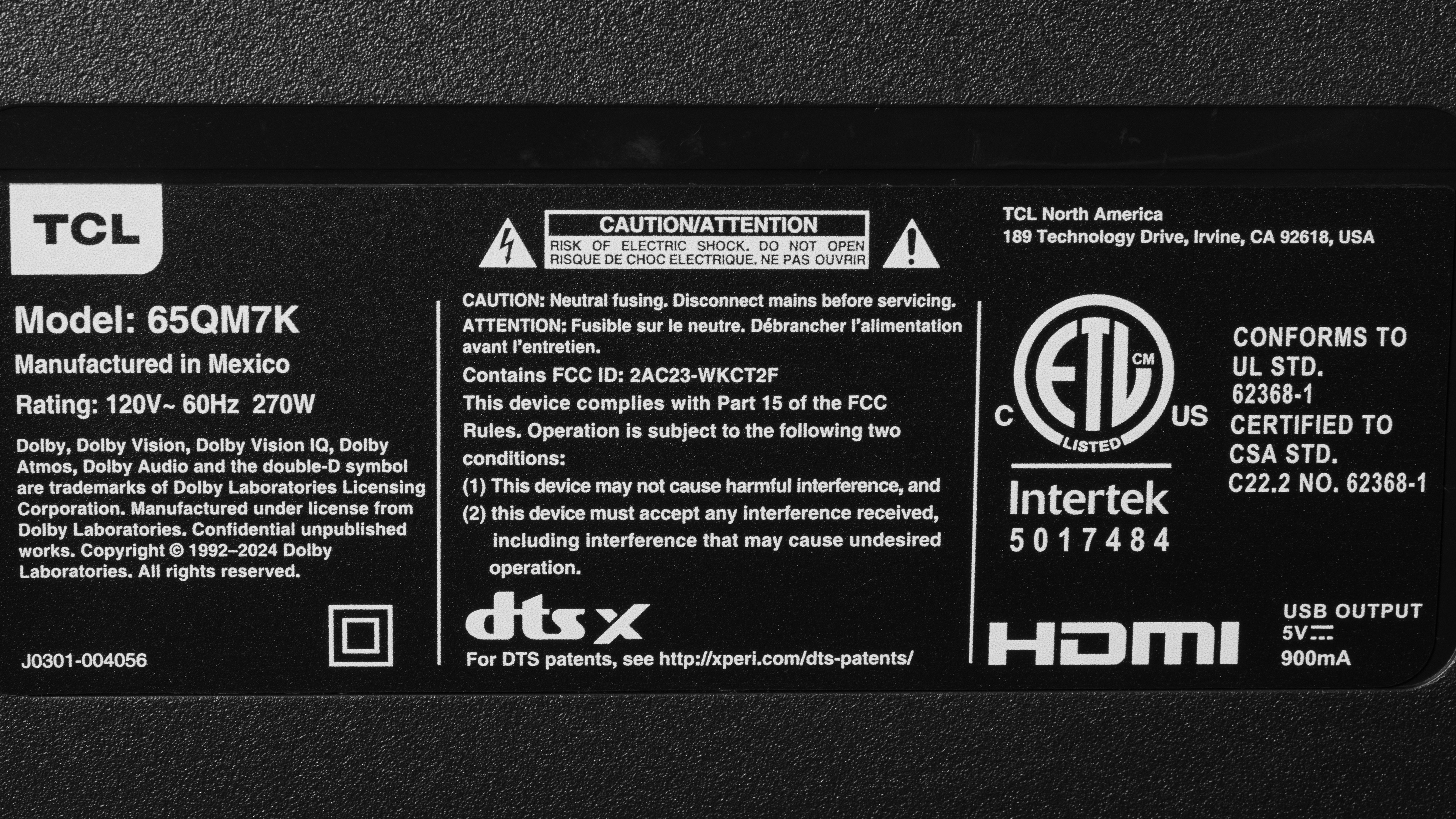
You can see our unit's label.
Popular TV Comparisons
The TCL QM7K is a very good TV, with no real flaws. It has fantastic contrast, is very bright in SDR, and handles mixed reflections quite well. It's also a very good TV for gamers, thanks to its relatively quick pixel transitions and a plethora of gaming features. The TV is similar to 2024's TCL QM7/QM751G QLED, the LG QNED92A, and the Hisense U7N, yet is a bit better overall due to its far superior contrast and better gaming features, so go for the QM7K over those if you can find it at a competitive price. It's also far better than similarly priced competing models, like the Samsung QN70F.
For more options, check out our recommendations for the best TVs, the best QLED TVs, and the best 4k gaming TVs.
The QM7L is a bit better than the TCL QM7K overall, but the QM7K does have some advantages. The QM7L is much brighter, so it does a better job handling glare in a bright room. That extra brightness also allows highlights to pop out more in HDR content, and it has an advantage when it comes to color vibrancy. On the other hand, the QM7K offers clearer motion when gaming, and it doesn't overbrighten HDR content nearly as much as the QM7L does.
The TCL QM7K is better than the TCL QM6K. The QM7K is brighter, has much better contrast, and is more colorful than the QM6K, delivering a much more impressive experience overall. The QM6K is, however, more accurate, but it doesn't do much to offset the QM7K's performance advantage.
The Hisense U7SG is much better than the TCL QM7K. The Hisense gets a lot brighter, so bright highlights in HDR stand out better, and bright scenes are more vivid and realistic. The Hisense also looks a lot better in a bright room, thanks to its higher SDR peak brightness and much better anti-reflective coating.
The TCL QM8K is significantly better than the TCL QM7K. The QM8K gets a lot brighter, delivering bright highlights in HDR and a more impactful HDR experience overall. This higher peak brightness also translates to a better bright-room experience, as the QM8K can overcome more glare in a bright room. The Mini LED local dimming feature on the QM8K is also better, resulting in less haloing around bright spots in the scene.

We buy and test dozens of TVs yearly, taking an objective, data-driven approach to deliver results you can trust. Our testing process is complex, with hundreds of individual tests that take over a week to complete. Most of our tests use specially designed test patterns that mimic real content, but we also use the same sources you have at home to ensure our results match the real-world experience. We use two main tools for our testing: a Colorimetry Research CR-100 colorimeter and a CR-250 spectroradiometer.
Test Results
for pictures & test results

for pictures & test results

for pictures & test results

The TCL QM7K's HDR brightness is decent. Highlights stand out during darker scenes, especially combined with its fantastic contrast. If you'd prefer a brighter TV, check out the Hisense U7SG instead, as it's considerably brighter in HDR.
We tested with Local Contrast set to 'High' as it makes for brighter highlights. Here are the results with it set to 'Low':
Local Contrast 'Low,' Peak:
- 2%: 1233 cd/m²
- 10%: 1711 cd/m²
- 25%: 1354 cd/m²
- 50%: 841 cd/m²
- 100%: 507 cd/m²
Local Contrast 'Low,' Sustained:
- 2%: 872 cd/m²
- 10%: 1602 cd/m²
- 25%: 1338 cd/m²
- 50%: 840 cd/m²
- 100%: 506 cd/m²
Here are measurements with Dynamic Tone Mapping (DTM) set to each of its three settings, all in the 'Movie' HDR Picture Mode:
Results with DTM set to Detail Priority:
- Hallway Lights: 550 cd/m²
- Yellow Skyscraper: 301 cd/m²
- Landscape Pool: 310 cd/m²
Results with DTM set to Balance:
- Hallway Lights: 506 cd/m²
- Yellow Skyscraper: 289 cd/m²
- Landscape Pool: 231 cd/m²
Results with DTM set to Brightness Priority:
- Hallway Lights: 528 cd/m²
- Yellow Skyscraper: 298 cd/m²
- Landscape Pool: 248 cd/m²
If you want a TV with superior HDR brightness, consider the Hisense U8QG.
for pictures & test results

for pictures & test results

for pictures & test results

The TV is a bit brighter when set to Game Master (the Game Mode equivalent).
Here are measurements with Dynamic Tone Mapping (DTM) set to each of its three settings, all in Game Master:
Results with DTM set to Detail Priority:
- Hallway Lights: 588 cd/m²
- Yellow Skyscraper: 358 cd/m²
- Landscape Pool: 352 cd/m²
Results with DTM set to Balance:
- Hallway Lights: 561 cd/m²
- Yellow Skyscraper: 360 cd/m²
- Landscape Pool: 342 cd/m²
Results with DTM set to Brightness Priority:
- Hallway Lights: 599 cd/m²
- Yellow Skyscraper: 360 cd/m²
- Landscape Pool: 373 cd/m²
The TCL QM7K has amazing SDR brightness and is easily bright enough even for well-lit rooms. If you're looking for an even brighter TV, check out the Samsung QN90F instead.
for pictures & test results

The TCL QM7K's contrast is fantastic. It's excellent even with local dimming disabled, but with it enabled, the TV's blacks stay extremely deep at all times. The extra zones help it deliver much better contrast than competing models like the Samsung QN80H.
for pictures & test results

The TV's lighting zone precision is decent, but it's significantly better than competing models, like the Samsung QN70F. There's some visible blooming around bright highlights or text when they're against a black background, making blacks look less deep. It's a lot worse overall than the step-up model, the TCL QM8K, with more haloing around subtitles and black bars in movies.
for videos & test results

The TV has decent lighting zone transitions. Still, there is some visible darkening on the leading edge of bright objects, with noticeable haloing.


for pictures & test results

for pictures & test results

The TV's black uniformity is good, although there's noticeable blooming around bright highlights when local dimming is enabled. With local dimming disabled, the screen is more uniform, yet blacks are noticeably raised, and there's some noticeable clouding and dirty screen effect on the right side of the screen.
for pictures & test results

for pictures & test results

The TCL QM7K's SDR color volume is good. It has great coverage of the commonly used DCI-P3 color space, although it can't quite fully display bright greens, yellows, and oranges. The TV's coverage of the wider BT.2020 space is alright; its color volume isn't quite good enough to fully display most colors, with the exception of some magentas. It has much better colors than more expensive models from competing brands, like the Samsung QN80F.
| Volume ΔE³ | DCI-P3 Coverage |
BT.2020 Coverage |
|---|---|---|
| L10 | 94.65% | 71.91% |
| L20 | 93.81% | 70.66% |
| L30 | 94.86% | 71.53% |
| L40 | 92.17% | 70.74% |
| L50 | 90.30% | 69.94% |
| L60 | 88.84% | 68.70% |
| L70 | 87.87% | 63.34% |
| L80 | 87.21% | 60.64% |
| L90 | 87.05% | 60.28% |
| L100 | 88.48% | 65.67% |
| Total | 89.42% | 66.06% |
for pictures & test results

for pictures & test results

The TV has great HDR color volume. Dark saturated colors are displayed well due to the TV's fantastic contrast. The TV displays most colors at high luminance levels, but it does struggle a bit with magentas.
If you want even better HDR color volume, check out the 2026 TCL QM7L.
for pictures & test results

for pictures & test results

for pictures & test results

The TCL QM7K's SDR pre-calibration accuracy is great. All colors are slightly overrepresented in grays, but not by much, making the TV's color temperature just a tad too cold overall. Color accuracy is also great, with very minor color mapping issues throughout. Unfortunately, the TV's gamma is too bright in all scenes except the very darkest ones.
for pictures & test results

for pictures & test results

for pictures & test results

The TV's SDR image accuracy is fantastic after calibration. White balance is now almost perfect, and the TV's color temperature is now exactly on target, and so is gamma. Color accuracy is also vastly improved, as only some blues and cyans still have color mapping issues.
You can see our full calibration settings.
for pictures & test results

for pictures & test results

The TCL QM7K's HDR pre-calibration accuracy is sub-par. Blues are overrepresented in mid-grays and above, making the TV's color temperature very cold. Color accuracy is mediocre, with severe color mapping issues in most colors.
for pictures & test results

for pictures & test results

The TV's HDR accuracy after calibration is very good. White balance is now decent, although it still has some accuracy errors in mid-grays. Nevertheless, color temperature is now almost exactly on target. Color accuracy is also improved, although many colors are still off target.
for pictures & test results

The TCL QM7K has great PQ EOTF tracking, but it's rather inconsistent. All mastered content weaves below and above the curve, meaning that content is either overbrightened or underbrightened depending on how bright the content is. Still, overall, the TV stays close to the baseline curve.
The TV hard clips when it reaches its peak brightness with content mastered at 600 and 1000 nits, but no roll-off is necessary since the TV is bright enough to fully display most content mastered at those brightness levels. There's a roll-off near the TV's peak brightness to maintain details in highlights in content mastered at 4000 nits.
for pictures & test results

The TCL QM7K has very good low-quality content smoothing. It does an excellent job at smoothing out artifacts in low-bitrate content, but there is some loss of detail.
for pictures & test results

The TV does a decent job at upscaling low-resolution content like DVDs or lower-resolution streams. Details are somewhat clear, but finer details are hard to make out.
for pictures & test results
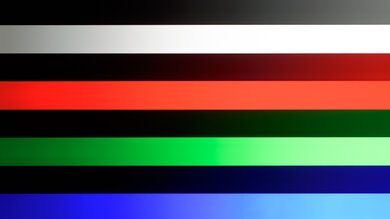
The TV's HDR native gradient handling is decent. Still, there's noticeable banding in dark grays and reds, and in brighter greens. Other color gradients have minimal banding.
The TV has very low input lag at all resolutions and refresh rate combinations when set to Game Master.
The TV supports all common resolutions up to 4k @ 144Hz on two of its four HDMI ports.
The TV supports all three types of variable refresh rate (VRR) technology to reduce screen tearing. Its VRR range caps out at 144Hz or 288Hz, depending on the resolution.
for pictures & test results
for pictures & test results

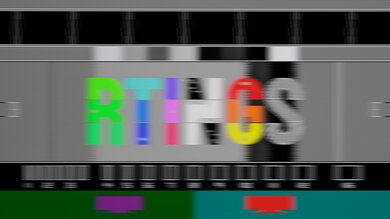
The TV's CAD at its maximum refresh rate is quite decent. There's a fair amount of overshoot when transitioning from black or dark shades to a brighter one, causing inverse ghosting. Still, overall, it provides consistent performance without excessive motion blur.
for pictures & test results

for pictures & test results

The TV's CAD at 120Hz is okay. Still, it has much more overshoot here than at its maximum refresh rate, leading to noticeable inverse ghosting.


for pictures & test results

The TV is fully compatible with everything the PS5 offers, like 1440p @ 120Hz and 4k @ 120Hz, as well as HDMI Forum VRR. It also supports Auto Low Latency Mode, so you don't have to worry about manually switching to Game Master to get the lowest input lag.
for pictures & test results

The TV is fully compatible with everything the Xbox Series X|S offers, including 1440p @ 120Hz, 4k @ 120Hz, HDMI Forum VRR, FreeSync Premium Pro, and Dolby Vision gaming. It also supports Auto Low Latency Mode, so you don't have to worry about manually switching to Game Master to get the lowest input lag.
for videos & test results
for pictures & test results
for pictures & test results
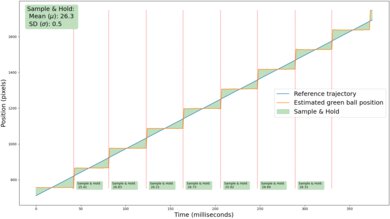
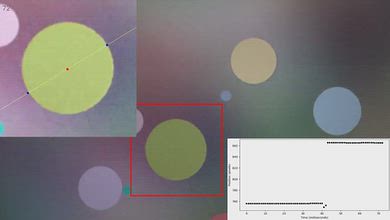
Due to the TV's relatively fast response time, there's some stutter when watching movies and TV shows that's most noticeable in slower panning shots. However, not everyone will notice it.
for videos & test results
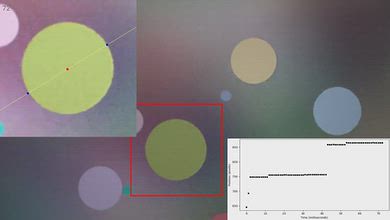
for pictures & test results

for pictures & test results
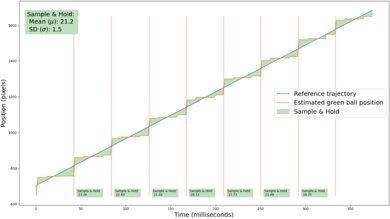
The TV's motion interpolation feature does a very good job of mitigating stutter. Low frame rate content is smoothed out well when using the interpolation setting that's equivalent to 30fps, resulting in motion that looks mostly fluid and very consistent, even in shots with slow camera movements.
for pictures & test results
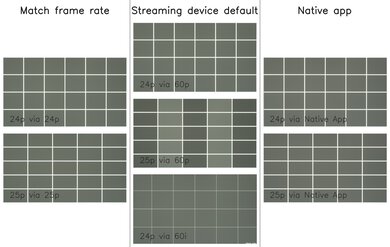
The TV removes judder from all sources when watching movies or shows that are in 24p. To remove 24p judder from 60p and 60i sources, like a cable box, Motion Clarity needs to be set to 'On' with sliders set to '0.' However, this setting only works with 24p content. The TV doesn't entirely remove judder from 25p content being sent via 60p, but frame times aren't too inconsistent, so motion is just a bit jittery. Fortunately, the TV removes 25p judder if you're using an external device like an Apple TV that has a 'Match Frame Rate' feature or when using the TV's native apps.
for videos & test results
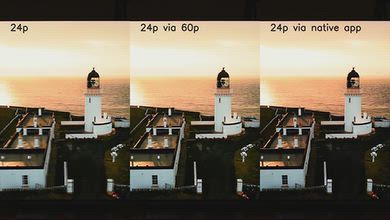
for videos & test results
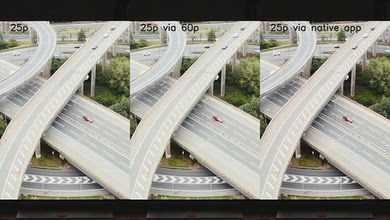
The TCL QM7K only has micro-judder present in scenes with complex motion when watching 25p content via a 60p signal, like when using an older streaming device that doesn't have a feature to match the outputted signal to the frame rate of the content. These micro-judders occur every 5-10 seconds, so they're pretty noticeable. Outside of that, there's no micro-judder in 24p and 25p content.
for pictures & test results

for pictures & test results

The TV has a great response time when watching content, although it's worse when coming out of dark states, leading to some motion blur. There's also noticeable overshoot in many transitions, leading to some inverse ghosting.
for pictures & test results
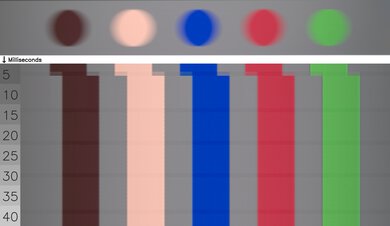
for pictures & test results
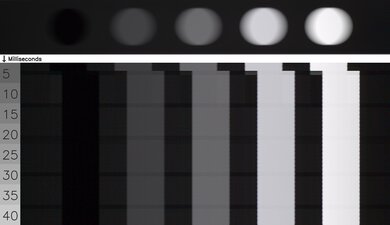
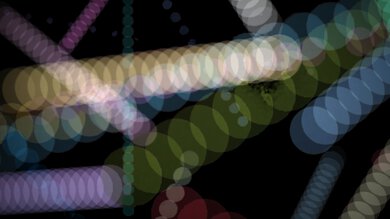
The TCL QM7K has subpar color transitions when watching movies, shows, and sports. It does an adequate job of keeping colors pure during RGB transitions, but there's still some unintended intermediate colors present. For instance, there's some yellow mixed in around blues in fast-paced scenes and sports, which affects color consistency.
Unfortunately, the TV does a poor job of keeping the edges of fast-moving objects consistent with the center, leading to blur trails in movies, shows, and sports with a lot of motion.
for pictures & test results

The TCL QM7K uses pulse width modulation (PWM) to dim its backlight. Fortunately, it flickers at an incredibly fast 10,400Hz in all picture modes and at all brightness levels, so it's not noticeable.
for pictures & test results
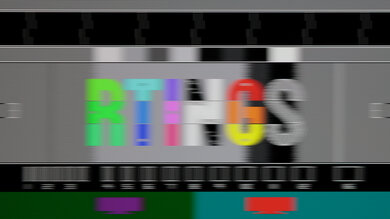
for pictures & test results
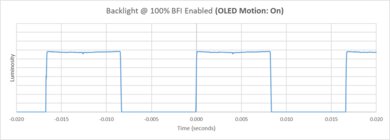
The TV has an optional backlight strobing feature, commonly known as black frame insertion. This feature is meant to reduce persistence blur and improve the appearance of motion. It works at both 60Hz and 120Hz, though there is some obvious image duplication. Note that enabling this feature reduces the panel's overall brightness.
for pictures & test results

for pictures & test results

The TCL QM7K's direct reflection handling is okay. It somewhat reduces the intensity of direct light sources, such as a lamp placed opposite the screen, though it's not very effective. Still, it's a clear improvement over the TCL QM7/QM751G QLED and the LG QNED92A. If you're in a bright room, though, check out the Hisense U7SG instead, as its matte anti-reflective coating effectively eliminates direct reflections.


for pictures & test results

for pictures & test results

The total reflected light of this TV is impressive; it really lessens the impact of overall reflections. Unfortunately, it does so with some obvious light banding.
for pictures & test results

The TV has decent color saturation in a bright room. Still, there's some minor color degradation in well-lit conditions, but you're unlikely to notice it.
for videos & test results
for pictures & test results

for pictures & test results

for pictures & test results

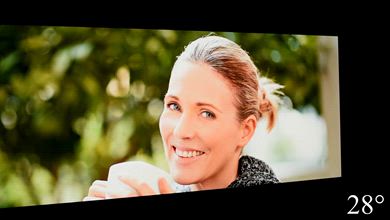
The TCL QM7K isn't the best TV for a wide seating arrangement, but it'll do an alright job. As you move off-center, there's gamma shifting and brightness loss, and colors look increasingly washed out as you move farther from center. The TV performs quite well with color shifting, so colors don't hue shift (i.e., change color) unless you're viewing it from a very wide angle.
for pictures & test results

for pictures & test results

The TV has okay gray uniformity, but there's some dirty screen effect toward the center of the screen, and the sides are a bit darker than the center. Its uniformity is a bit better on very dark or near-black screens, but the sides are cloudier than the center.
for pictures & test results

for pictures & test results

The TV uses a BGR (Blue-Green-Red) subpixel layout instead of the traditional RGB layout. This doesn't cause any issues for video or gaming content, but it can be a problem for PC monitor use, as it impacts the text clarity, although not everyone will notice this.
The TV uses quantum dots to achieve high color peaks with excellent separation between blues, greens, and reds. This gives the TV great color purity and allows it to display a very wide color gamut.
TVs with LCD panels, like this one, are immune to permanent burn-in.
for pictures & test results

for pictures & test results

The TCL QM7K has HDMI 2.1 bandwidth on HDMI ports 1 and 2, with both supporting up to 4k @ 144Hz. HDMI 4 has eARC but is limited to HDMI 2.0 bandwidth, which is nice as you're not losing out on an HDMI 2.1 port when you connect a soundbar to the TV. Unfortunately, the TV doesn't support ATSC 3.0, so over-the-air broadcasts are limited to 1080p.
The TV supports eARC, which lets you pass high-quality, uncompressed audio to a compatible receiver or soundbar through an HDMI cable. It supports all major audio formats, so you don't have to worry about compatibility with external sources.
for pictures & test results

The TCL QM7K has a nice overall design, even if it's mostly made of plastic.
for pictures & test results

The TV comes with a height-adjustable center-mounted stand that doesn't require a large table to set it on. At its lowest position, the stand lifts the TV about 2.2 inches above the table, and at its highest, about 3.5 inches, which is high enough for almost any soundbar.
Footprint of the 65-inch stand: 15.47" x 14.49".
for pictures & test results

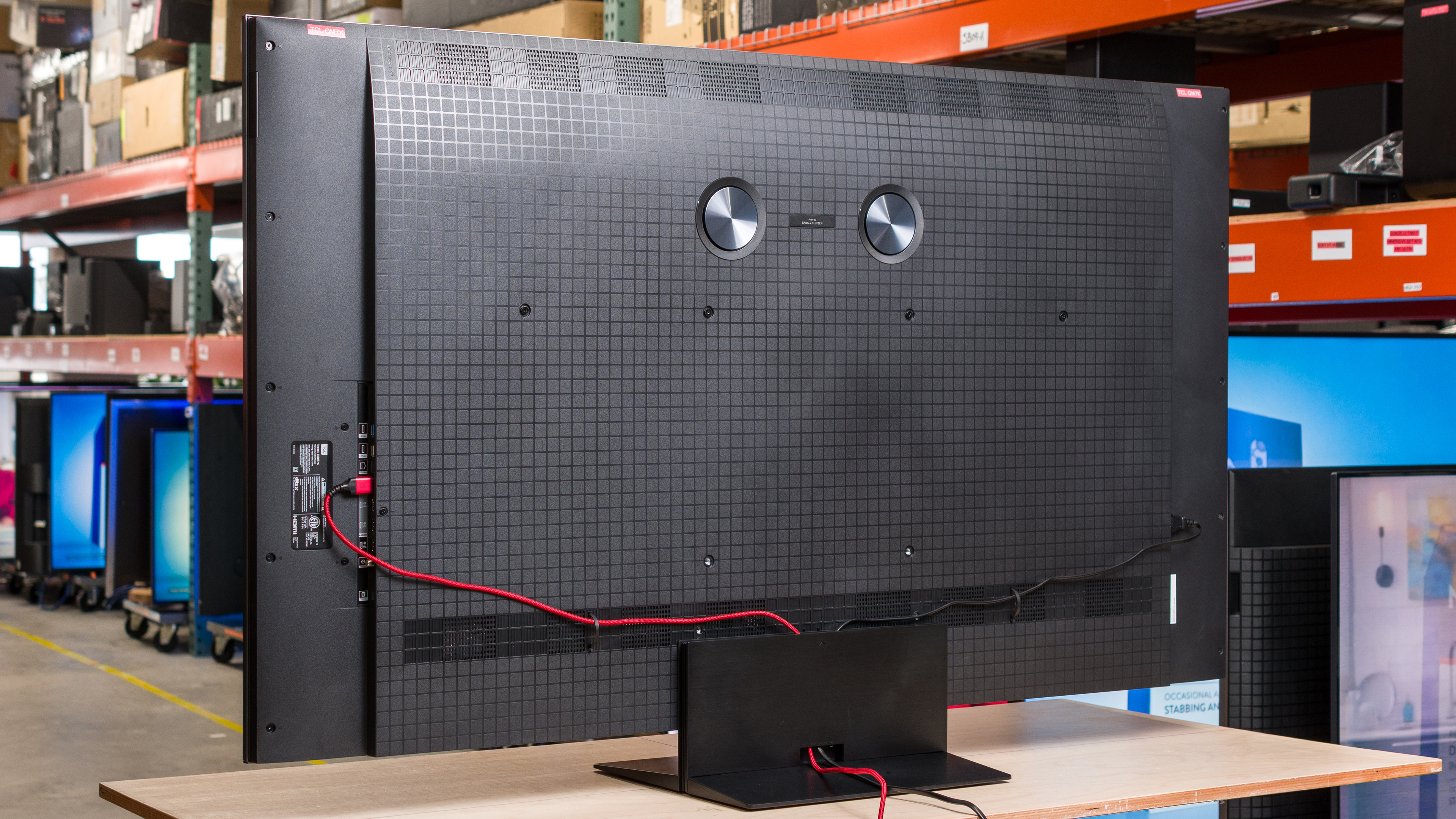
The back of the TV is made of plastic, with a grid-like pattern. All inputs except the power connector are on the right side of the TV when facing the front, and they're easy to access if you have the TV wall-mounted. The TV has clips on the back for cable management.


for pictures & test results

The TV has decent build quality. The back is made of plastic and flexes quite a bit near the middle, but it's not a worry.
for pictures & test results

The remote has quick-access buttons for the most popular streaming services and a built-in microphone for voice commands. It's also backlit.

for pictures & test results

Unfortunately, like almost all TVs on the market, the smart interface contains ads, and you can't disable them.
for pictures & test results

There's a single button on the bottom middle of the TV that you can use to switch inputs and power the TV on/off. There's also a small switch you can use to turn the TV's built-in microphone on or off.
for pictures & test results

- Setup guide
- Remote
- 2x AAA batteries
- Power cable
- Cable ties
for pictures & test results

The TV has a subpar frequency response. Its low-frequency extension response is bad, so there's very little bass. Its maximum volume is also quite low, so this isn't a good TV for a loud room. Otherwise, the TV's sound profile is quite balanced, as dialogue is very easy to understand.