Many TVs use a technique known as pulse width modulation (PWM) to adjust the intensity of the backlight. This technique introduces flicker that can be very distracting to people sensitive to it, ranging from slight discomfort all the way to intense headaches and nausea. Our Flicker test measures the frequency and type of flicker used by the TV and determines whether it's flicker-free or not.
Test results
Test Methodology Coverage
We added this test as part of our 1.0 test bench update. It's evolved a bit over the years, and in our 1.2 test bench update, we split the BFI test off to a separate test and added a 'Flicker-Free' test. The way we measure the PWM flicker frequency has remained the same across all test benches, so these results are directly comparable across any review. We removed the scoring from this test as part of the 2.0 update and renamed it from 'Flicker-Free' to 'Flicker.' Learn how our test benches and scoring system work.
| Transition Artifacts | 1.0 | 1.2 - 2.2 |
|---|---|---|
| Flicker-Free | ❌ | ✅ |
| PWM Dimming Frequency | ✅ | ✅ |
What Is PWM?
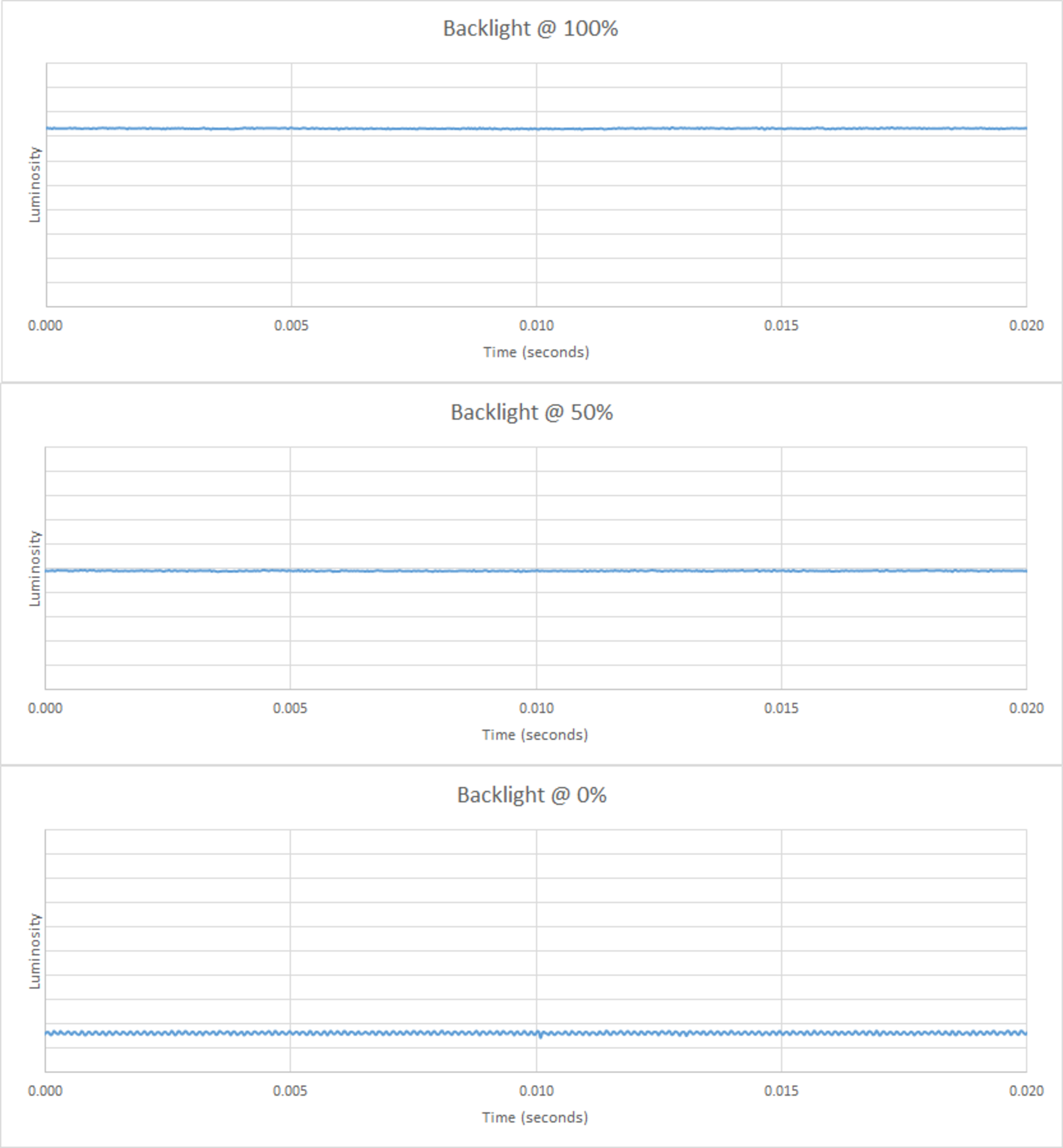
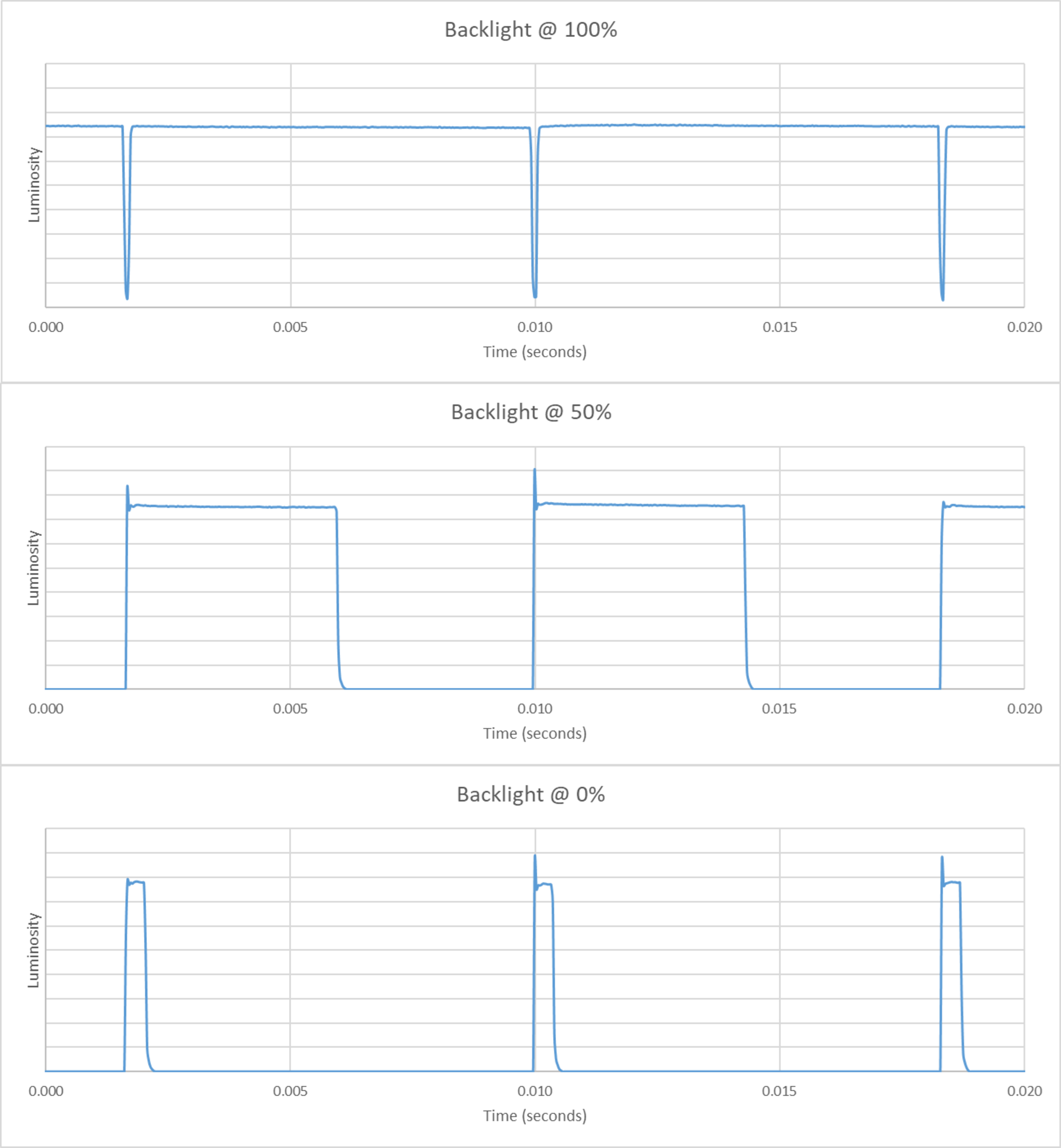
Most TVs can't directly change the intensity of the light emitted from the backlight LEDs. They rely on a different technique known as pulse width modulation, or PWM for short. Instead of reducing the current flowing to the LEDs, PWM works like a light switch by turning the lights on and off. By adjusting how long the LED is held on and off, which is called the duty cycle, the TV can reduce how bright the LEDs appear to you, the viewer.
Take the two examples above. The backlight chart shows the luminosity of the LEDs on each TV over time, measured with the backlight setting set to 100%, 50%, and 0%. On the Sony X80K (left), you can see that the light output from the LEDs doesn't change over time on each line, but as we decrease the backlight setting, the luminosity decreases. This is known as DC or direct dimming. Looking at the UT8000, though, you can see that it behaves very differently. The peak luminosity of the LEDs is roughly the same in all three charts, but the amount of time they stay lit, the duty cycle, decreases as we reduce the backlight setting. At 0%, the duty cycle is extremely low. At 100%, the duty cycle is nearly 100%, but not quite.
These examples show two extremes. The Sony is completely flicker-free, whereas the LG is about as bad as it gets. Most TVs are somewhere in the middle, using a combination of PWM and direct dimming, and most TVs have a much higher flicker frequency. PWM is also different from black frame insertion (BFI), which is an intentional flicker pattern that most TVs can add to reduce the amount of persistence blur.
Our Tests
The goal of this test is to evaluate whether flicker is present or not when all optional flicker settings are turned off. This test is done in the best pre-calibration SDR settings, but we also check other picture modes, as some TVs behave differently in certain modes. We display a white window on the TV and use a ThorLabs photodetector connected to a Rigol DS1102E oscilloscope to measure the flicker pattern and PWM frequency.
We repeat the test with the backlight setting set to 0%, 50%, and 100%.
Flicker-Free
This test simply confirms if the TV is flicker-free in its accurate mode or not. To pass this test, the TV needs to show a completely horizontal line on all three lines of the graphs shown above. Some TVs are flicker-free at 100% but not at lower settings, so those TVs fail this test. Some TVs, like all OLEDs, show a slight blip that coincides with the TV's refresh rate. This isn't PWM, though, so you'll see that these TVs show a PWM Dimming Frequency of 0Hz, but they fail the flicker-free test.
PWM Dimming Frequency
This test measures the frequency of the backlight flicker in the accurate picture mode. Some TVs show multiple overlaying PWM patterns, and in these cases, we show the highest flicker frequency. A frequency of 0 indicates that a TV doesn't use PWM (but isn't necessarily flicker-free). If a TV flickers, a higher number is better and is less likely to cause discomfort.
Conclusion
Nearly all LEDs on the market use high-frequency PWM to adjust their light output, from LED light bulbs in your kitchen to the LEDs that make up the backlight of your TV. TVs that use low-frequency PWM can cause headaches and discomfort in some people, though, so understanding how a TV's backlight flicker behaves is an important consideration, especially if you're sensitive to flicker.