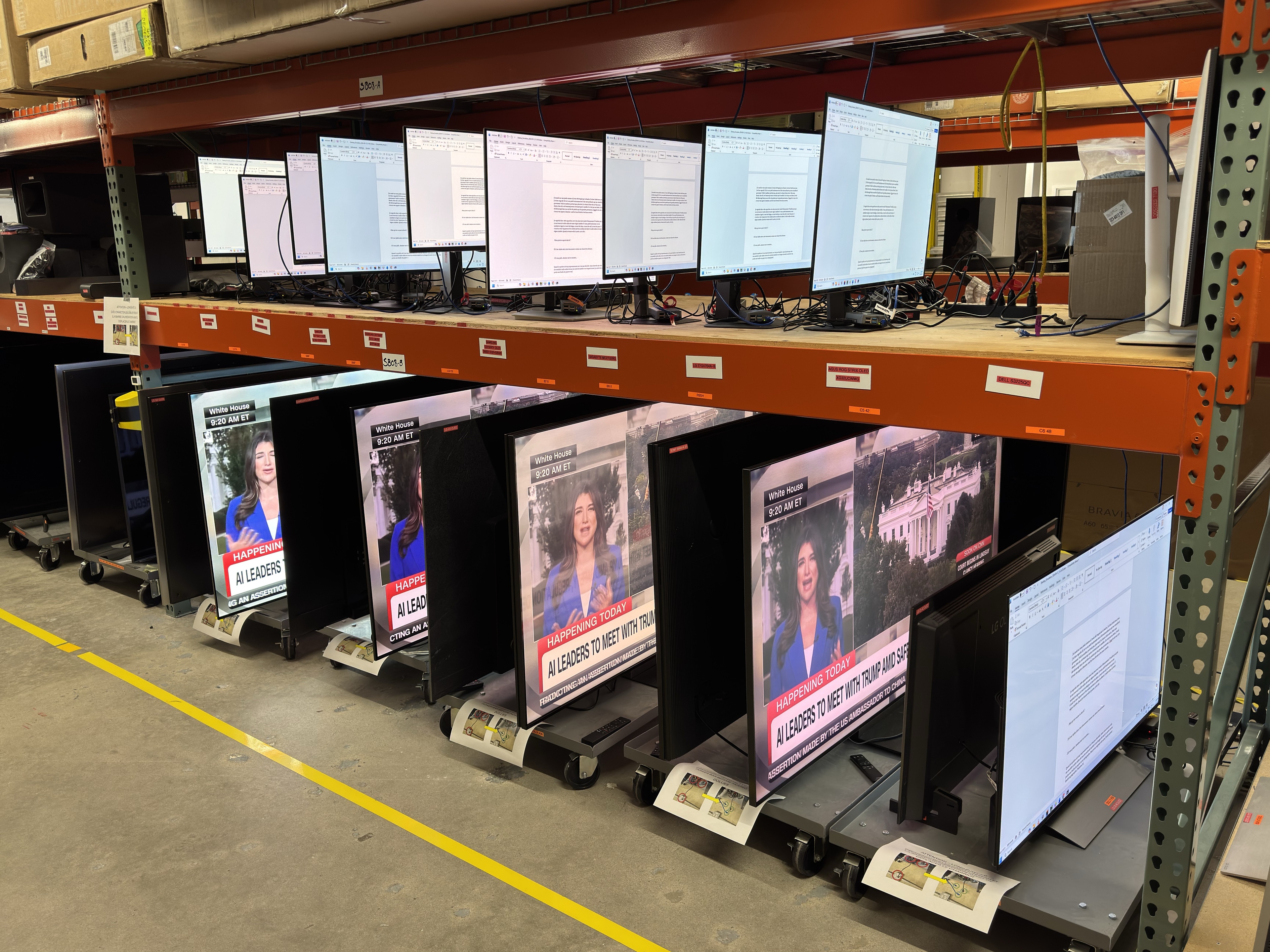
Our original longevity test ran 100 TVs for about 2 years, with most TVs cumulating over 18,000 hours of runtime each. We learned a lot about TV longevity during that time. For example:
- Thin, edge-lit TVs are far more likely to fail early. Edge-lit TVs pack the LEDs closely together in a very narrow space along the bottom edge. This can cause these TVs to overheat easily, leading to LEDs failing, light guide plates cracking, and all reflector sheets warping. These issues often start as minor uniformity issues, like a bright line streaking up from the bottom edge of the screen. Eventually, though, the TV will fail entirely within a few years of regular usage.
- Direct-lit TVs place the LEDs differently and are less likely to fail. When they do, though, a single failed LED will often cause the entire backlight to fail at once. These TVs will often work perfectly for years, and then suddenly you'll go to turn it on, and there'll be no image on the screen.
- Full-array TVs use a similar LED structure to direct-lit TVs, but they're wired differently, with LEDs grouped together in zones. The advantage to this is obvious: when an LED fails, only that zone is affected. On a TV with thousands of zones, a single failed zone might not even be immediately noticeable, so these TVs tend to last the longest.
- We also learned that OLED burn-in is still an issue, even on modern TVs, with cumulative exposure to static elements. As long as you watch a variety of content, though, it's not expected to be an issue for most people.
As useful as this information is, it also paints an incomplete picture. TVs have continued to evolve over the last few years, with new and improved OLED panels and RGB Mini LED backlights, but we don't know much about how long these new technologies should last. Our monitor burn-in test was also flawed because it didn't reflect normal daily usage.
Introducing Longevity 3.0!
To better understand how display technology has improved over the last 3 years, we're launching our new accelerated reliability test: Longevity 3.0! We're taking a more targeted approach with this test. We're limiting the field to 12 TVs and 12 monitors, for a total of 24 products at the start of the test. The 24 products we're testing at launch were chosen because they use different panel technologies not included in our original test. Display technology has continued to evolve, with ever-brighter OLED panels and new backlight technologies that could significantly impact how long your display lasts. We'll also consider adding new TVs and monitors to the list if any new, ground-breaking tech comes out.
As in our previous test, these TVs will be running a live CNN stream for the next two years or so, and we'll stop to take measurements every 2 months. Our approach to monitor testing will be a bit different this time, though. Instead of running CNN, the monitors will display pre-recorded video clips showing a mixture of extended gaming sessions and desktop productivity use. The desktop videos also showcase multitasking and will vary between test groups, with one test exploring the impact of some common tips when using the desktop, like dark mode, to see whether they make a difference. The gaming clips include a mixture of short and extended gaming sessions, some lasting a few hours, to showcase the impact of bright UI elements from games on burn-in. The exact test schedule and weighting of gaming versus productivity also vary between test groups.
We're also running a separate test to measure the impact of sunlight on OLED panels. We want to see whether sunlight can really damage your OLED panel over time.
Goal
The main goal of the longevity test is to better understand how long more recent panel technologies should last. To better understand this and see how they compare to older panels, we're running an accelerated test with 12 TVs and 12 monitors over the next two years. We're looking for any issues with the displays as they age, tracking brightness and uniformity over time, and taking photos of test slides to monitor for burn-in. As with the original test, the goal here is to examine broader market trends. The sample size is too small to draw any conclusions about specific models.
Products
As we mentioned above, there are 12 TVs and 12 monitors running on the new test. Two TVs that we tested as monitors are also being tested with the monitor video loop. We're also open to adding new products to the test as they come out, especially if any new display technologies reach the market while the test is running. This means that not all products will finish the test at the same time.
| TVs | Monitors |
|---|---|
| LG G6 OLED | LG 27GX790B-B |
| Samsung S95H OLED | Samsung Odyssey OLED G73SH |
| LG C6 OLED | Asus ROG Strix OLED XG32UCWMG |
| Samsung S95F OLED | Gigabyte MO27Q28G |
| LG C5 OLED | LG 27GX704A-B |
| Samsung S90F OLED | HyperX OMEN OLED 27q |
| LG G5 OLED | Dell Alienware AW2726DM |
| Sony BRAVIA 7 II | Samsung Odyssey OLED G81SF S27FG810S |
| Hisense UR8SG | Dell S3225QC |
| Samsung R95H | Samsung Odyssey OLED G80SH S32HG802S |
| Sony BRAVIA 9 II | LG C6 48 OLED |
| TCL RM9L | LG C5 42 OLED |
TVs
For this test, we've used our existing inventory shelving to set up a dedicated area for the longevity test. The setup is the exact same as our original longevity test. Each TV is connected to a Yodeck media player via HDMI, and each streamer is connected via Ethernet to a central server. It allows us to control the content being displayed on all TVs and monitors at once. The Yodeck streamers also support HDMI-CEC, allowing us to remotely control the TVs and turn them on and off according to a fixed schedule. All TVs are displaying the exact same content: a live stream of the U.S. version of CNN, untouched, with all commercials and breaks intact.
The TVs are set to their most accurate, post-calibration picture settings, with a few changes. Most TVs run at their maximum brightness in SDR, but the LG C5 OLED, Samsung S90F, and LG G5 OLED are luminance-matched, so the white banner on CNN is about 470 nits. Running these three TVs at the same luminance allows for a more direct comparison of OLED EX, RGB Tandem OLED, and QD-OLED to see how they handle burn-in.
Monitors
The monitors are a bit different, as they'll display pre-recorded videos of a mix of productivity and gaming content, still through the Yodeck player. The exact schedule for the monitors varies by unit, and we're running 6 separate tests to address different questions about monitor longevity and burn-in. The monitors are luminance-matched with a 100% slide at 197 nits, ensuring you can easily compare results across models.
Each monitor will be set up in its more accurate SDR picture mode, with peak luminance off. We're doing it this way to luminance-match the monitors, so you can more easily compare the results.
-
Group 1: 100% Productivity (Windows Light Mode)
- LG 27GX704A-B (WOLED)
- Samsung Odyssey OLED G80SH S32HG802S (QD-OLED)
-
Group 2: 100% Productivity (Windows Dark Mode)
- GIGABYTE MO27Q28G (WOLED)
- Dell S322QC (QD-OLED)
-
Group 3: 75% Productivity / 25% Gaming (Windows Light Mode)
- Asus ROG STRIX OLED XG32UCWMG (WOLED)
- Samsung Odyssey OLED G81SF S27FG810S (QD-OLED)
-
Group 4: 50% Productivity / 50% Gaming (Windows Light Mode)
- HyperX OMEN OLED 27Q (QD-OLED)
- Samsung Odyssey OLED G73SH S32HG732S (WOLED)
-
Group 5: 25% Productivity / 75% Gaming (Windows Light Mode)
- LG 27GX790B-B (WOLED)
- Dell Alienware AW2726DM (QD-OLED)
-
Group 6 (TVs as Monitors): 100% Productivity (Windows Light Mode + Dark Mode)
- LG C5 42" (Dark Mode Only)
- LG C6 48" (Light Mode Only)
Test Schedule
The test schedule is designed to keep all displays on most of the time, with four on/off cycles per day to allow them to run their OLED compensation cycles. The schedule is the same every day.
| Daily Schedule | ||
|---|---|---|
| Time (24h) | TV Power Status | Cycle Length (h) |
| 00:00 | ON | 2.0 |
| 02:00 | OFF | 0.5 |
| 02:30 | ON | 4.0 |
| 06:30 | OFF | 1.5 |
| 08:00 | ON | 9.0 |
| 17:00 | OFF | 0.5 |
| 17:30 | ON | 4.0 |
| 21:30 | OFF | 0.5 |
| 22:00 | ON | 2.0 |
| Daily Totals | |
|---|---|
| ON | 21 h |
| OFF | 3 h |
Sunlight Test
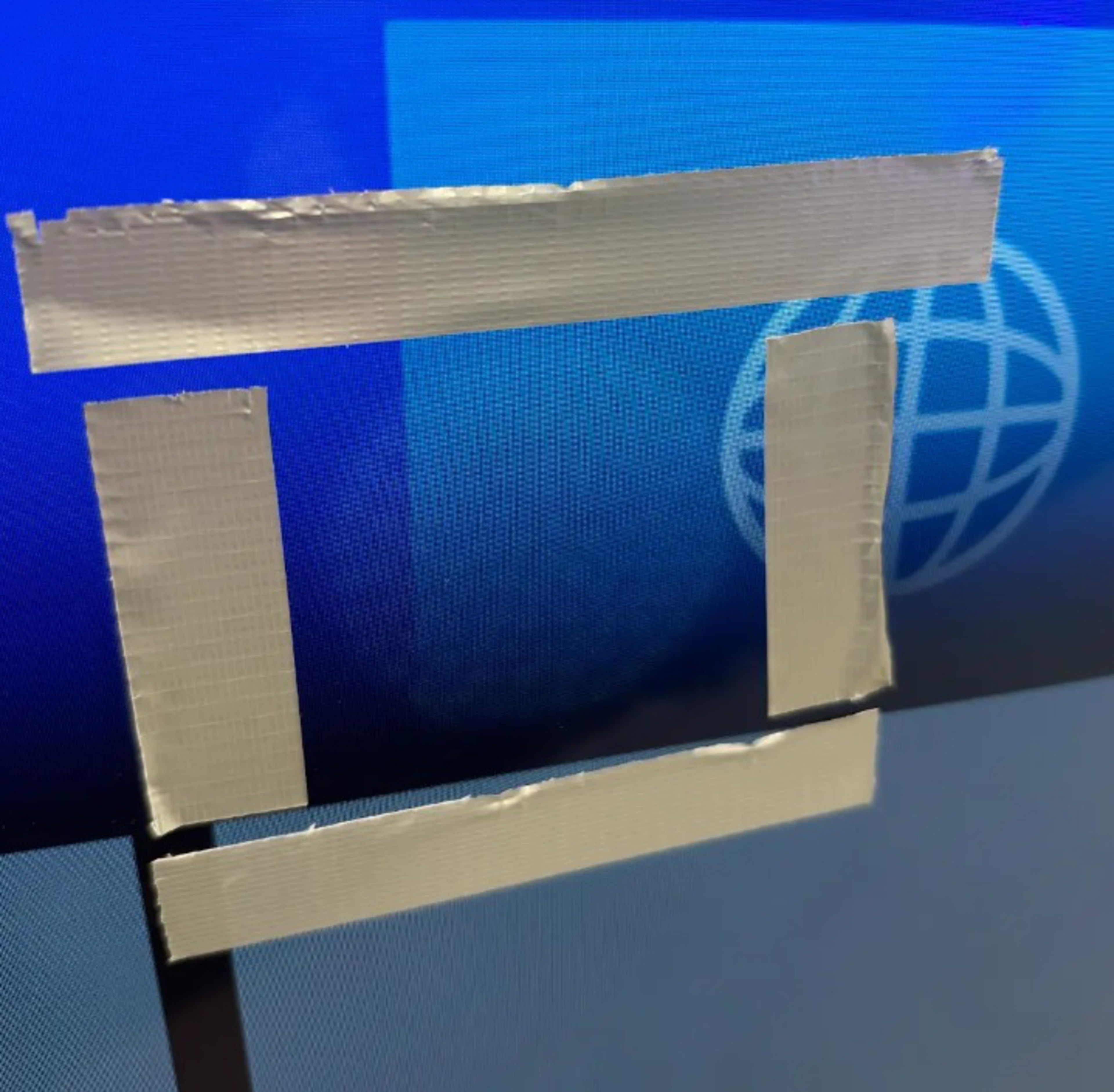
We're also launching a separate test to investigate claims that sunlight is harmful to OLED panels. Above you can see an example of this. To test the theory quickly, we exposed an LG A1 OLED to a flashlight emitting UVA light at around 395nm for about 4.5 hours. The TV was powered off while the flashlight was on, but it still caused a degraded ring on the screen. The panel was cool during this time, and the image retention wasn't caused by heat degradation. It cleared up after we ran a pixel cleaning cycle on the TV.
To test the effects of sunlight on displays, we'll place six displays (three monitors and three TVs) in front of windows in our lab to observe how they degrade over time. We're placing a stencil in front of each display to block the sun on part of it, so we can see exactly what impact the sun has on the display over time. These displays aren't running on the standard longevity test and will be powered off for the duration of the test, but we'll post updates from time to time.
The six displays on the sunlight test are:
| LCDs | OLED |
|---|---|
| Hisense U6N | LG B4 OLED |
| Dell S2725DC | Samsung S90D OLED |
| AOC AGON PRO AG276QZD2 | |
| ASUS ROG SWIFT OLED PG27AQDP |
The two LCD displays in this test are the control group, as we don't expect sunlight to affect their panel uniformity.
October 2, 2026
Today marks the official start of the Longevity 3.0 test! Stay tuned to this space for the latest updates and announcements. The initial measurements have been uploaded to each review on the test as Month 00.
Longevity 3.0 Test - Uniformity Slides And Brightness Graphs (Last Updated 10/2/2026)
Below this, you can see a table of the uniformity slides from our bimonthly updates, along with graphs showing brightness changes over time. The latest slides will always be available here as we process and upload new results.
