See the previous 2.2.1 changelog.
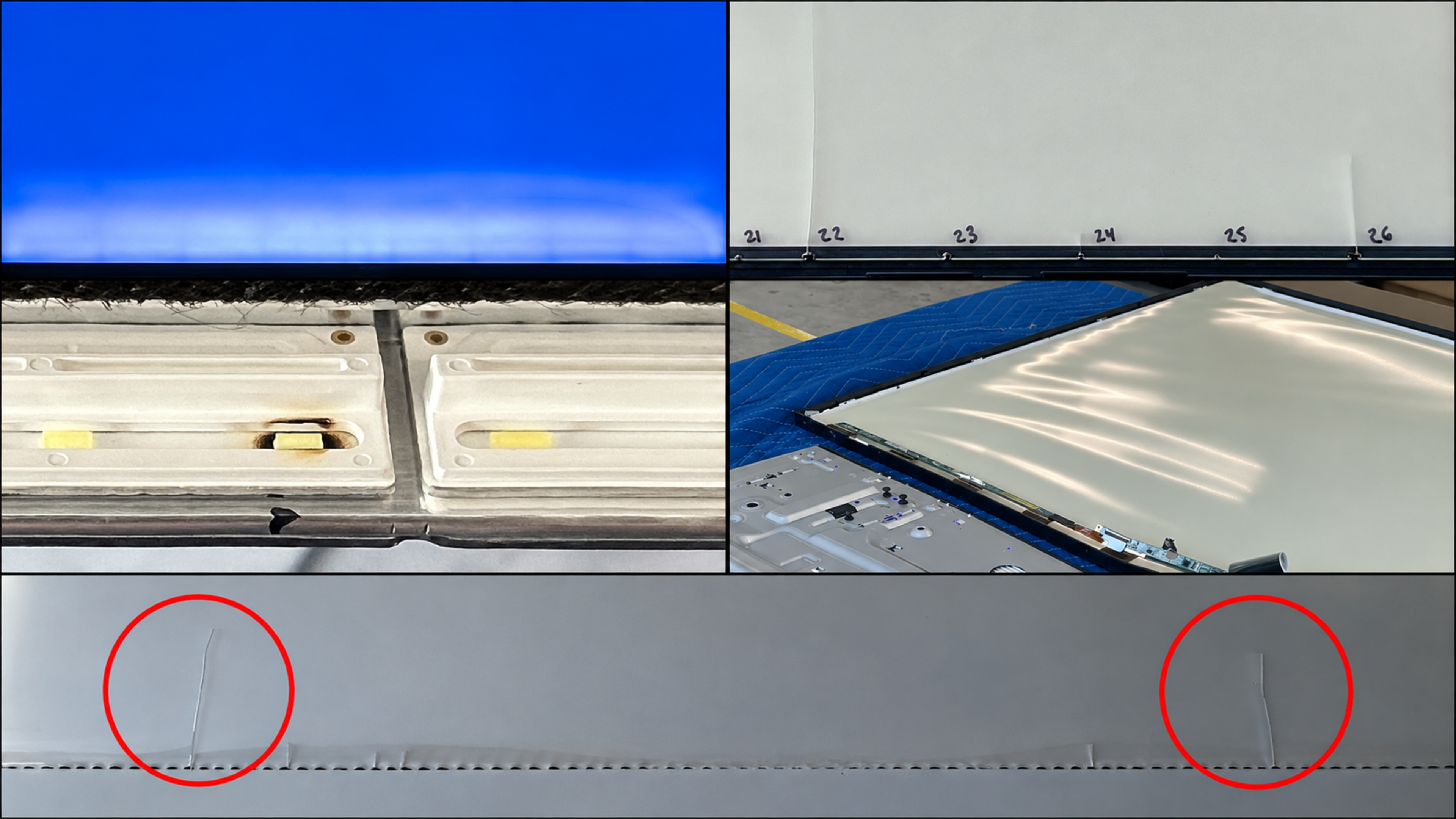
Goal
When you're buying a new TV, you don't just want it to look good and make it easy to find your favorite shows; you want it to last. Nobody can tell you exactly how long a new TV will last, though, especially when the technology is constantly evolving. That being said, our extensive research into TV longevity and OLED burn-in has taught us a great deal about how the components under the hood of a TV degrade over time. For example:
- We've learned that thin, edge-lit TVs are far more likely to fail early. Since the LEDs are often very closely packed in a narrow space along the bottom edge, these TVs tend to overheat easily, causing LEDs to fail, light guide plates to crack, and reflector sheets to warp.
- We learned that direct-lit TVs are less likely to fail, but when they do, a single failed LED will often cause the entire backlight to fail at once. Full-array TVs, on the other hand, are likely to fail in individual zones. On a TV with thousands of zones, a single failed zone might not even be immediately noticeable, so these TVs tend to last the longest.
- We also learned that OLED burn-in remains an issue, even on modern TVs, with cumulative exposure to static elements. As long as you watch a variety of content, though, it's not expected to be an issue for most people.
The goal of this test bench update is to give you an objective metric that takes all of those lessons and provides you with an objective way to compare how long different TV technologies should last.
What's New In 2.3
- Added a new "Expected Reliability" performance usage at the top of the review.
- Added a new "Lifetime Burn-In Potential" section.
- Added a new "Burn-In Risk" test in this section.
- Added a new "Longevity" section
- Added a "Uniformity Pictures" dropdown with multiple pictures.
- Added a "Longevity Graph" to show the brightness changes over time.
This new performance usage provides you with a scored estimate of how reliable a TV should be. It's not going to tell you how many years a TV will last with any certainty, but by comparing two models, you can see whether one is expected to be more reliable than the other. This usage builds on the lessons learned from our original accelerated longevity test and assigns a score to the backlight technology used; for example, we know that a direct-lit TV is expected to last longer than an edge-lit one.
Longevity 3.0
Along with this test bench, we're also happy to announce the launch of Longevity 3.0! This test takes a slightly different approach from the original. The goal of this test is to better understand how recent advances in display technology have affected longevity. To do that, we're testing 12 TVs that use newer technologies, like RGB Mini LED backlights or RGB Tandem OLED panels. These TVs will be running the same live CNN feed we used for the original test, with built-in breaks to allow the OLEDs to run their compensation cycles. There will also be 12 monitors running on the test, including 2 TVs that we originally tested as monitors. Check out our launch article for more details on our Longevity 3.0 test.
We are retesting popular models first. So far, the test results for the following models have been converted to the new testing methodology. However, the text might be inconsistent with the new results.
91 TVs Planned To Be Updated
We are also planning to retest the following products over the course of the next few weeks:
- Amazon Ember Artline 2026
- Hisense CanvasTV 2024
- Hisense CanvasTV 2026
- Hisense QD6QF
- Hisense QD7N
- Hisense QD7QF
- Hisense U65QF
- Hisense U6N
- Hisense U6SF Pro
- Hisense U75QG
- Hisense U7N
- Hisense U7SG
- Hisense U8N
- Hisense U8QG
- Hisense UR8SG
- Hisense UR9SG
- LG B4 OLED
- LG B5 OLED
- LG B6 OLED 2026
- LG B6E OLED
- LG C4 OLED
- LG C5 OLED
- LG C6 OLED 2026
- LG C6H OLED
- LG G4 OLED
- LG G5 OLED
- LG G6 OLED
- LG Gallery 2026
- LG MRGB95B
- LG QNED75B
- LG QNED85A
- LG QNED92A
- LG UA77
- LG UT75
- Panasonic W95A
- Panasonic Z8BA OLED
- Panasonic Z95B OLED
- Roku Pro Series 2025
- Samsung 77S90H OLED
- Samsung M70H
- Samsung M80H
- Samsung Q7F 2025
- Samsung Q8F 2025
- Samsung QN70F
- Samsung QN70H
- Samsung QN80F
- Samsung QN80H
- Samsung QN90D
- Samsung QN90F
- Samsung QN990F 8K
- Samsung R85H
- Samsung R95H
- Samsung S85F OLED
- Samsung S90D OLED
- Samsung S90F OLED
- Samsung S90H OLED
- Samsung S95F OLED
- Samsung S95H OLED
- Samsung The Frame 2026
- Samsung The Frame Pro 2025
- Samsung The Frame Pro 2026
- Samsung U7900F
- Samsung U8000F
- Samsung U8000H
- Sony A95L OLED
- Sony BRAVIA 2 II
- Sony BRAVIA 3
- Sony BRAVIA 3 II
- Sony BRAVIA 5
- Sony BRAVIA 7
- Sony BRAVIA 7 II
- Sony BRAVIA 8 II OLED
- Sony BRAVIA 8 OLED
- Sony BRAVIA 9
- Sony BRAVIA 9 II
- Sony X90L/X90CL
- TCL Q651G
- TCL Q77K
- TCL QM5K
- TCL QM6K
- TCL QM751G
- TCL QM7K
- TCL QM7L
- TCL QM7L Pro
- TCL QM8K
- TCL QM8L
- TCL QM9K
- TCL RM9L
- TCL S551G
- TCL X11L
- Vizio Mini LED Quantum 4K
