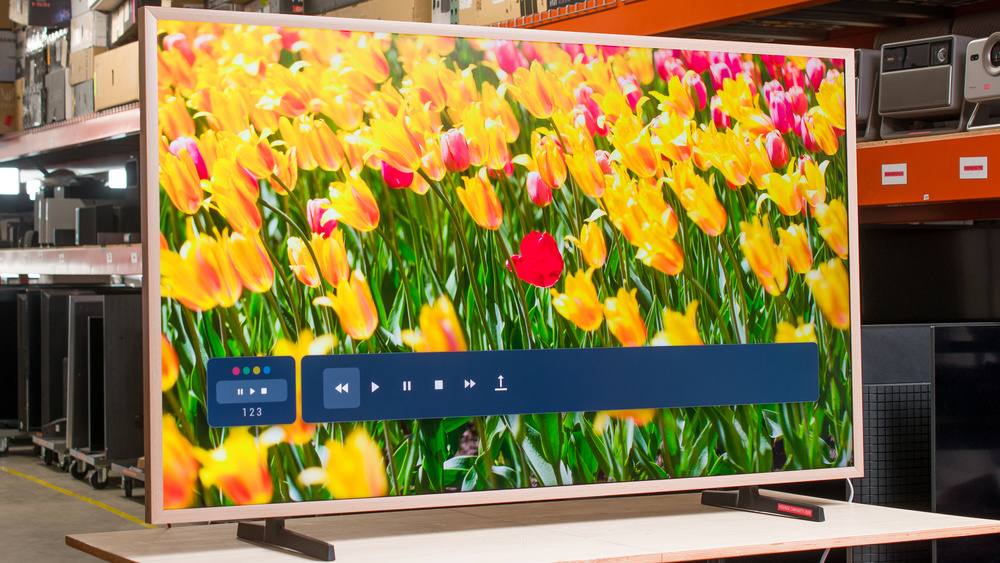
The Hisense CanvasTV 2026, also known as the Hisense S7SG, is a gallery-style TV released in 2026 as the replacement for the original Hisense CanvasTV 2024. Like other similar models, it's available with replaceable frames that go around the screen, making it look like a piece of art that blends in with your surroundings. Internally, you'll find the Google TV smart interface and a wide selection of features, including HDMI 2.1 bandwidth on two of the inputs, a high refresh rate mode for gaming, and a matte anti-reflective coating. We bought and tested the 65-inch model, but it's also available in a 50-, 55-, 75-, and 85-inch size.
Our Verdict
The Hisense Canvas TV is just an okay TV overall. It's best-suited for watching shows during the day, even in a bright room, as it's bright enough to overcome glare in SDR, and the matte screen nearly eliminates glare. It's not as good for watching movies in a dark room due to its low contrast and lack of local dimming. It's also not well-suited for watching sports or gaming due to its very slow, uneven response time, as motion is very blurry and there are noticeable color and edge artifacts.
Matte anti-reflective coating effectively eliminates glare from direct reflections.
Cleans up low-quality content well.
Good peak brightness in SDR.
Low contrast and no local dimming.
Image degrades from the sides.
Motion is very blurry.
Mediocre screen uniformity.
The Hisense S7 is an unremarkable TV for watching movies in a home theater. It has poor black levels, with low contrast and no local dimming, so dark scenes are noticeably washed out. It also has just okay colors, with sub-par accuracy out of the box, but decent color volume. On the other hand, it has great format support, including support for Dolby Vision and all common audio formats, making it a great choice for physical media collectors.
Judder-free with most content.
Excellent PQ EOTF tracking.
Low contrast and no local dimming.
Motion is very blurry.
Bright highlight details in HDR fall flat.
The Hisense Canvas TV is a very good TV for use in a bright room. It's bright enough in SDR to overcome glare during the day, and its matte anti-reflective coating essentially eliminates glare. Ambient light also has very little impact on picture quality, with only a slight change in black levels and a minor impact on perceived color volume.
Matte anti-reflective coating effectively eliminates glare from direct reflections.
Good peak brightness in SDR.
Ambient light has very little impact on picture quality.
The Hisense Canvas TV is a mediocre TV for watching sports. It has good visibility during the day, with high peak brightness in SDR and excellent reflection handling. It also processes low-quality content well, with great upscaling, so it's a great choice for watching streaming sports channels. On the other hand, it's not well-suited for a wide seating arrangement, as the image degrades rapidly from the sides. Motion doesn't look good as it has a slow response time, and there are noticeable, unwanted intermediate colors.
Matte anti-reflective coating effectively eliminates glare from direct reflections.
Cleans up low-quality content well.
Good peak brightness in SDR.
Image degrades from the sides.
Motion is very blurry.
Mediocre screen uniformity.
Noticeable color artifacts in fast-action.
The Hisense Canvas TV is mediocre for gaming. It has low input lag, it supports VRR, and it has a high refresh rate, so it can take full advantage of modern gaming consoles and PCs. There's also very little difference in picture quality when you switch to the dedicated Game Mode. On the other hand, it has very high CAD at any refresh rate, so motion is incredibly blurry.
Wide selection of gaming features.
Good peak brightness in SDR.
Motion is very blurry.
This TV has sub-par expected reliability. Our extensive testing has shown that due to concentrated heat, edge-lit TVs like this one are likely to experience significant durability issues and early failure, including warped reflector sheets, cracked light guide plates, and burnt-out LEDs. On the other hand, there's no possibility of long-term image retention or burn-in, so the content you watch doesn't affect the TV's expected lifespan.
No possibility of permanent burn-in.
Edge-lit TVs are prone to early failure.
Uniformity issues from warped reflector sheets and cracked light guide plates are common.
The Hisense S7 has decent peak brightness. It's bright enough to overcome glare during the day when watching SDR content. It's not bright enough to deliver a truly impactful HDR experience, though, and small highlight details don't stand out at all.
Good peak brightness in SDR.
Bright highlight details in HDR fall flat.
The Hisense Canvas TV has poor black levels. It has a very low native contrast ratio, so blacks are raised, and dark scenes look washed out. It also lacks a local dimming feature to improve it.
Low contrast and no local dimming.
The Hisense Canvas TV has okay colors. It's not very accurate out of the box in either SDR or HDR, with a noticeably cool color temperature that gives it a noticeably blue tint. It has decent color volume, though, with good coverage of the DCI-P3 color space, but limited coverage of wider spaces.
Noticeably cool color temperature out of the box.
Poor color accuracy before calibration.
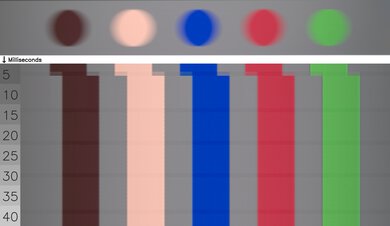
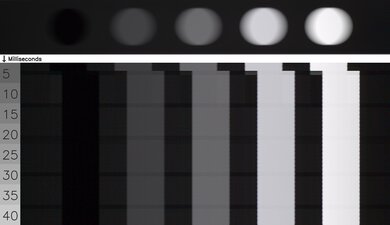
The Hisense Canvas TV has just okay motion handling when watching content. It removes judder from most sources automatically, ensuring smooth frame pacing, and there's no micro judder. On the other hand, it has a terrible response time, so motion is incredibly blurry. The flip side of this is that there's relatively little stutter in slow-panning shots.
Judder-free with most content.
Motion is very blurry.
Noticeable color artifacts in fast-action.
The Hisense Canvas TV has mediocre responsiveness when gaming. It has low input lag and a high max refresh rate, so it should feel responsive, but it has poor motion handling. This results in considerable delay between your actions and what you see on the screen, and games don't feel responsive overall.
Wide selection of gaming features.
Motion is very blurry.
Note: We're in the process of improving our tests related to image processing, but this score will give you a general idea of how a model performs overall with its image processing capabilities.
The Hisense Canvas TV has great processing. It does a great job cleaning up low-quality streams, but there's some loss of fine details. It also upscales low-resolution content well. HDR content is processed properly, with great PQ EOTF tracking and good gradient handling.
Excellent PQ EOTF tracking.
Cleans up low-quality content well.
Some loss of fine details when cleaning up low-quality content.
Performance Usages
Changelog
- Updated Oct 02, 2026: We converted this review to Test Bench 2.3. With this update, we've added a new Expected Reliability performance usage, a Lifetime Burn-In Potential test, and a new test box for the Longevity 3.0 test.
- Updated Sep 18, 2026: We converted this review to Test Bench 2.2.1, adding a new Dumb TV test for whether or not the TV can be used offline.
-
Updated Jul 21, 2026:
We added more details on the art mode to the Interface section of the review.
-
Updated Jul 21, 2026:
We bought and tested the LG Gallery 2026 and added a comparison in the HDR Brightness section of the review.
Check Price
Differences Between Sizes And Variants
We bought and tested the 65-inch Hisense Canvas TV, which is also known by its model number, the Hisense S7G. There's no difference in performance with different sizes, and these results are also valid for the 50-, 55-, 75-, and 85-inch sizes.
| Size | US Model |
|---|---|
| 50" | 50S7SG |
| 55" | 55S7SG |
| 65" | 65S7SG |
| 75" | 75S7SG |
| 85" | 85S7SG |
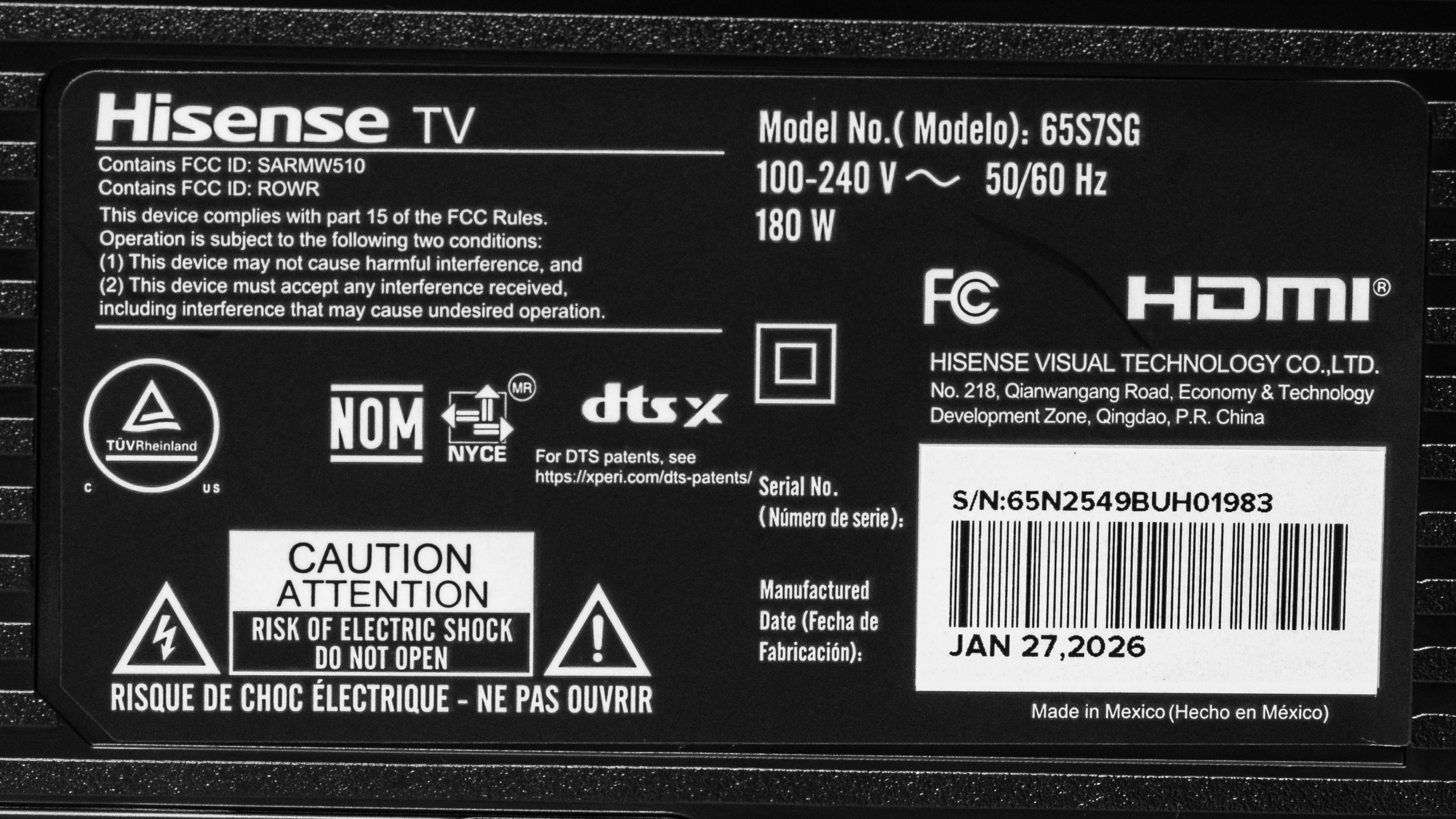
Our unit was made in Mexico in January 2026.
Popular TV Comparisons
The Hisense S7 is a very basic TV that's really only meant for consumers who care more about the aesthetic of the TV than they do anything else. It's an okay performer for watching shows during the day, and the matte coating is fantastic at reducing glare, but other than that, it's pretty plain and doesn't perform all that well. It falls well short of the performance offered by competing models like the Samsung The Frame Pro 2026. It also faces steeper competition than ever before, with new competing models like the Amazon Ember Artline 2026 and the LG Gallery TV.
See our recommendations for the best 4k TVs, the best budget TVs, and the best frame TVs.
The Hisense CanvasTV 2026 is a bit better than the Samsung The Frame 2026. They're pretty evenly matched overall, but the Hisense gets a bit brighter. This allows it to handle more glare for daytime viewing, and bright highlight details stand out a lot better.
The Samsung The Frame Pro 2026 is much better than the Hisense CanvasTV 2026. The Samsung gets a bit brighter in both SDR and HDR, so it can handle more glare during the day. The Samsung is also far more accurate out of the box, with better color mapping and white balance, and a far more neutral color temperature. The Samsung also adds a local dimming feature to help improve black levels, but sadly, it's a very basic system that doesn't actually do much to improve picture quality.
The Hisense CanvasTV 2026 is a much better TV than the LG Gallery TV. The Hisense delivers substantially better picture quality, with much higher peak brightness that allows it to overcome more glare in daytime viewing. The Hisense isn't as accurate out of the box, though, and most content has a bit of a blue tint to it. Finally, the Hisense can remove judder from almost all sources, so motion is smoother and more fluid when watching content.
The Hisense CanvasTV 2026 is better than the TCL NXTVISION. The Hisense is considerably brighter, so it can handle more glare for daytime viewing and HDR stands out a bit better at night. The screen coating is also better on the Hisense, and ambient light doesn't have as much of an impact on picture quality, especially contrast, when you're watching TV during the day.

We buy and test dozens of TVs yearly, taking an objective, data-driven approach to deliver results you can trust. Our testing process is complex, with hundreds of individual tests that take over a week to complete. Most of our tests use specially designed test patterns that mimic real content, but we also use the same sources you have at home to ensure our results match the real-world experience. We use two main tools for our testing: a Colorimetry Research CR-100 colorimeter and a CR-250 spectroradiometer.
Test Results
for pictures & test results

for pictures & test results

for pictures & test results

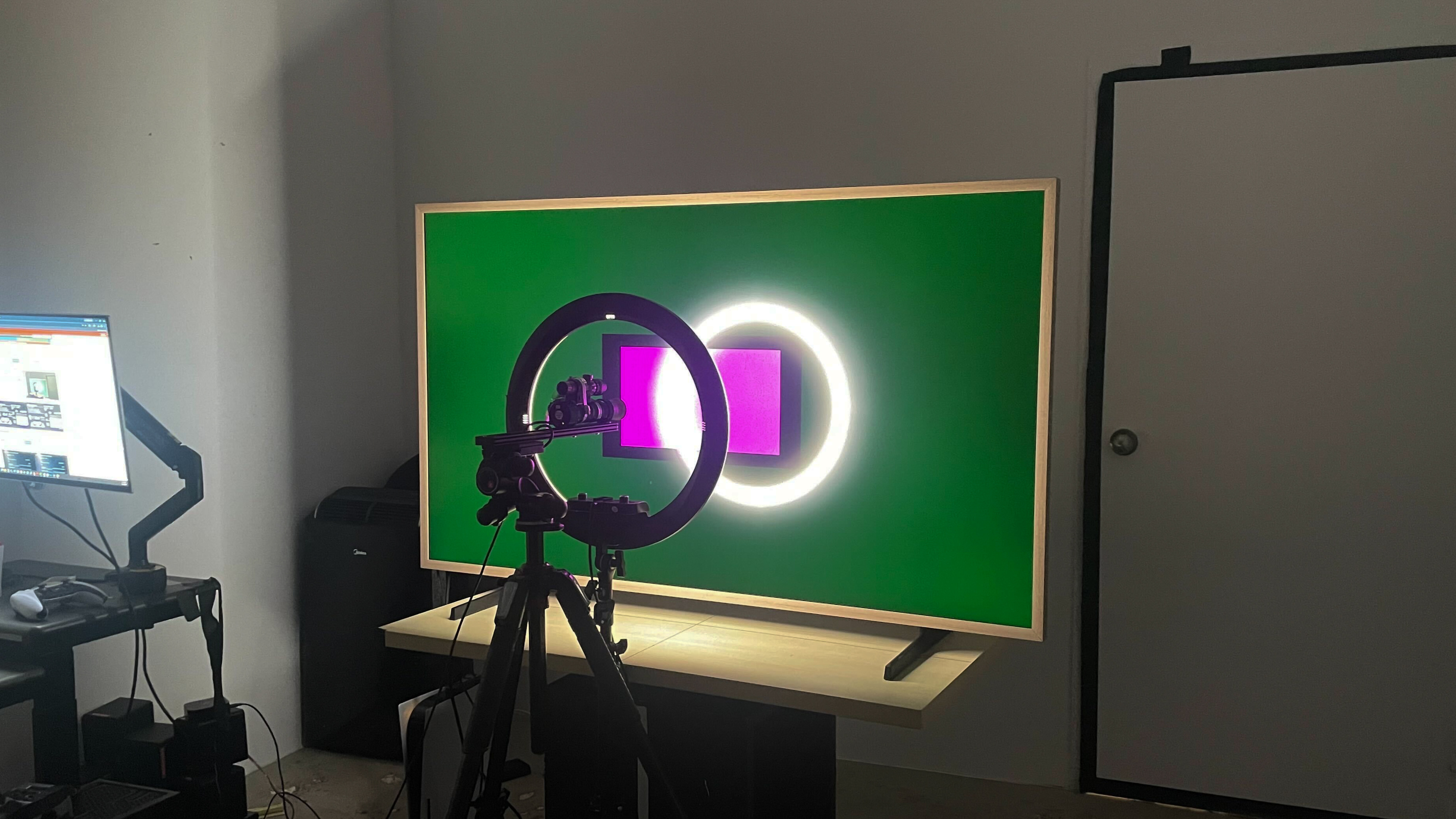
The Hisense Canvas TV has okay peak brightness in HDR. It's bright enough that most average HDR scenes look good, and it delivers a more impactful HDR experience than the LG Gallery 2026. Without local dimming, though, small specular highlight details don't stand out at all. Most HDR content looks flat.
If you prefer a brighter but less accurate image, here are the results with HDR Tone Mapping enabled:
- Hallway Lights: 530 cd/m²
- Yellow Skyscraper: 428 cd/m²
- Landscape Pool: 264 cd/m²
for pictures & test results

for pictures & test results

for pictures & test results

The TV is slightly brighter when you switch to Game Mode. It's still not bright enough to deliver a truly impressive HDR gaming experience, though, and bright highlights look flat.
If you prefer a brighter but less accurate image, here are the results with HDR Tone Mapping enabled:
- Hallway Lights: 415 cd/m²
- Yellow Skyscraper: 515 cd/m²
- Landscape Pool: 278 cd/m²
The SDR peak brightness of this TV is good. It's bright enough that it can overcome glare easily, even in a bright room.
for pictures & test results

The Hisense Canvas TV has poor contrast. The native contrast of the panel is low, so blacks look gray even in a dark room. It also lacks local dimming to further improve black levels.
for pictures & test results

This TV doesn't have a local dimming feature, so the unit can't brighten highlights without impacting the rest of the image. This means that blacks are always raised, and dark scenes end up looking washed out.
for videos & test results

This TV doesn't have a local dimming feature, so it can't adjust the backlight of individual zones to brighten up highlights without impacting the rest of the image. This means that there are no distracting flicker or brightness changes as bright highlights move between zones, as the TV doesn't have any.


for pictures & test results

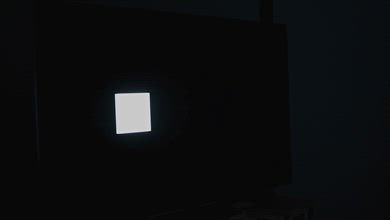
This TV has decent black uniformity. There are a few bright spots across the screen, but no obvious flashlighting around the edges.
for pictures & test results

for pictures & test results

The Hisense Canvas TV has decent color volume in SDR. It has good coverage of the DCI-P3 color space, but can't quite display the full range of reds and greens. It also struggles a bit more in lighter scenes. Coverage of the wider BT.2020 color space is very limited. Overall, it's not quite as colorful as some competing models like the Amazon Ember Artline 2026.
| Volume ΔE³ | DCI-P3 Coverage |
BT.2020 Coverage |
|---|---|---|
| L10 | 89.69% | 67.79% |
| L20 | 91.05% | 67.36% |
| L30 | 90.43% | 66.83% |
| L40 | 89.44% | 67.83% |
| L50 | 88.69% | 67.46% |
| L60 | 86.81% | 64.10% |
| L70 | 84.14% | 54.54% |
| L80 | 83.62% | 51.78% |
| L90 | 83.71% | 52.70% |
| L100 | 82.98% | 68.79% |
| Total | 86.42% | 60.52% |
for pictures & test results

for pictures & test results

This TV has decent color volume in HDR. It's limited by both its low contrast and its low peak brightness. Midtones are displayed well, but bright highlights and shadow details are lacking.
for pictures & test results

for pictures & test results

for pictures & test results

Unfortunately, this TV has poor accuracy in SDR out of the box. The white balance is noticeably off, with too much blue, especially in lighter shades. This gives it a noticeably cool color temperature. Gamma tracks a bit too high, so most scenes are darker than they should be. On the other hand, the color mapping is actually quite good, with just a few noticeable mapping errors across all colors.
for pictures & test results

for pictures & test results

for pictures & test results

Thankfully, this TV is easy to calibrate and it delivers fantastic results, but it does require a fairly aggressive calibration. There are still some minor color mapping errors, but it's not too bad.
See our full calibration settings.
for pictures & test results

for pictures & test results

The HDR pre-calibration color accuracy on this TV is mediocre. The white balance is good overall, but there are significant color errors across all colors. It also has a very cold color temperature, giving the TV a very noticeable blue tint out of the box.
for pictures & test results

for pictures & test results

The TV has fantastic accuracy in HDR after a full calibration. The color temperature is nearly perfect, and colors look much better. There are still significant luminance mapping issues, though, and dark shades are a bit off.
for pictures & test results

The PQ EOTF tracking is great, and midtones in most HDR content are displayed extremely close to the intended brightness level. Shadow details are raised, though, due to the TV's low contrast ratio and lack of local dimming. Content mastered at 600 and 1,000 nits rolls off sharply at the TV's peak brightness, and there's a more gradual roll off with content mastered at 4,000 nits.
for pictures & test results

The TV has great low-quality content smoothing. It does an excellent job smoothing out macro blocking and other compression artifacts, but there's a loss of some fine details.
for pictures & test results

The upscaling on this TV is great. Fine details are clear and easy to make out.
for pictures & test results
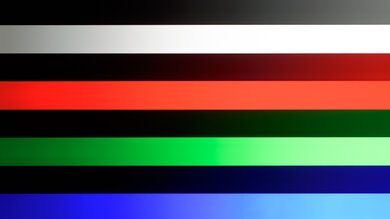
The gradient handling on this TV is good. There's some banding in bright shades of green, but everything else looks great.
The Hisense Canvas TV has excellent input lag. The 60Hz input lag is a bit higher than usual, but still low enough for a responsive gaming experience overall. It also offers a low-latency motion interpolation feature that works while gaming to improve the fluidity of motion. Unlike similar features like AMD's Fluid Motion Frames or NVIDIA's Frame Generation, this feature works with any source, even older consoles.
The TV supports all common resolutions up to 4k @ 144Hz, but only on two of its HDMI ports. The other two ports are limited to 4k @ 60Hz. It also supports up to 288Hz with 1080p signals. All supported formats also support proper chroma 4:4:4, which is essential for clear text from a PC.
This TV supports all three types of variable refresh rate (VRR) technology to reduce screen tearing. It works well with AMD sources, like an AMD GPU or any console across a wide refresh rate range, and it works with Low Framerate Compensation (LFC), ensuring your games remain nearly tear-free even when your frame rate drops very low.
Unfortunately, VRR doesn't work above 144Hz. While it's possible to enable it with a PC set to 1080p @ 288Hz, VRR doesn't actually work, and there's visible tearing.
for pictures & test results
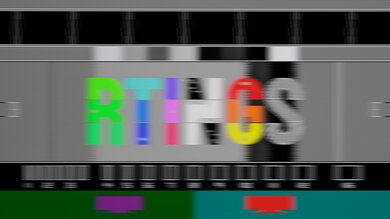
for pictures & test results

Unfortunately, this TV has bad CAD at the max 4k refresh rate of 144Hz. Nearly all transitions are extremely slow, resulting in very blurry motion when gaming. The Samsung The Frame 2026, which is a similar model overall, has much smoother motion at the same refresh rate.


for pictures & test results

The TV is fully compatible with everything the PS5 offers, like 1440p @ 120Hz and 4k @ 120Hz, as well as HDMI Forum VRR. It also supports Auto Low Latency Mode, so you don't have to worry about manually switching to Game mode to get the lowest input lag.
for pictures & test results

The TV is fully compatible with everything the Xbox Series X|S offers, including 1440p @ 120Hz, 4k @ 120Hz, HDMI Forum VRR, Dolby Vision, and FreeSync Premium Pro. It also supports Auto Low Latency Mode, so you don't have to manually switch to Game mode to get the lowest input lag.
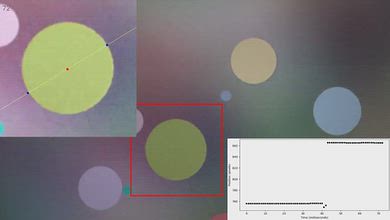

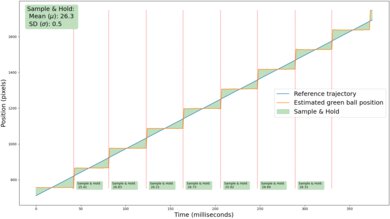
for videos & test results
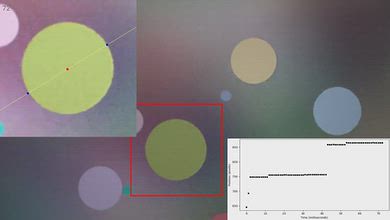
for pictures & test results

for pictures & test results
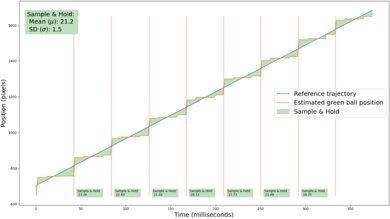
The motion interpolation feature on this TV does a great job reducing stutter without adding any unwanted soap opera effect. Adding low levels of interpolation significantly reduces the frame hold time, and the feature is extremely consistent, with very little variation between frames.
for pictures & test results
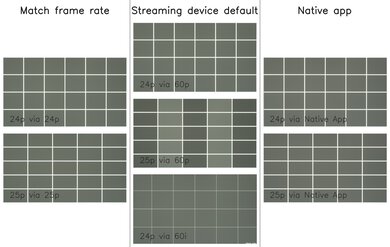
This TV removes judder from most sources. The TV doesn't entirely remove judder from 25p content being sent via a 60p source like an older cable box, as frame times are slightly inconsistent, so motion is a bit jittery.
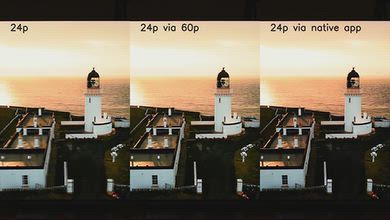
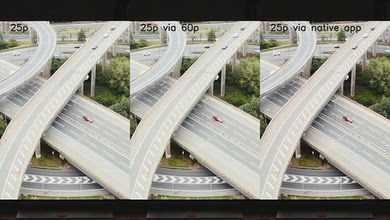


for pictures & test results

This TV uses pulse width modulation (PWM) to adjust the light output from the backlight. It any backlight setting below max it flickers at a low frequency, which causes image duplications and can cause headaches and eye strain. It's nearly flicker-free at the maximum brightness setting, flickering at a nearly constant 114 kHz instead.
Unfortunately, this TV doesn't have an optional backlight strobing feature, commonly known as BFI.
for pictures & test results

for pictures & test results

The matte anti-reflective coating does an excellent job reducing the intensity of direct, mirror-like reflections. Bright lights and windows are barely visible in the screen.


for pictures & test results

for pictures & test results

The total amount of reflected light on the screen is fairly low. Very bright lights are still sometimes noticeable, but there are no diffraction artifacts like rainbow smear.
for pictures & test results

Ambient light has very little impact on perceived color saturation.
for videos & test results

for pictures & test results

for pictures & test results

for pictures & test results

The Hisense Canvas TV has a mediocre viewing angle. It's not well-suited for a wide seating arrangement, as the image degrades rapidly as you move to the sides.
for pictures & test results

for pictures & test results

The gray uniformity of this TV is mediocre. The screen is noticeably patchy, with lots of dirty screen effect in the center, and the sides of the screen are a bit darker than the center.
for pictures & test results

for pictures & test results

The TV uses a BGR (Blue-Green-Red) subpixel layout instead of the traditional RGB layout. This doesn't cause any issues for video or gaming content, but it can be a problem for PC monitor use as it impacts the text clarity, although not everyone will notice this.
The TV uses a KSF phosphor coating to produce red light, with high peaks on reds and blues. This model does have good separation between colors, giving it solid color purity and a wide color gamut.
TVs with LCD panels, like this one, are immune to permanent burn-in.
for pictures & test results

for pictures & test results

Only two of the HDMI inputs support HDMI 2.1 bandwidth, the other two are limited to HDMI 2.0. The eARC port is on one of the low-bandwidth ports. This means it doesn't use up one of the high-bandwidth ports on the TV, but it also means you can't expand the number of high-bandwidth ports through an external receiver, either.
The TV supports eARC, which lets you pass high-quality, uncompressed audio to a compatible receiver or soundbar through an HDMI cable. It supports all major audio formats, so you don't have to worry about compatibility with external sources.
for pictures & test results

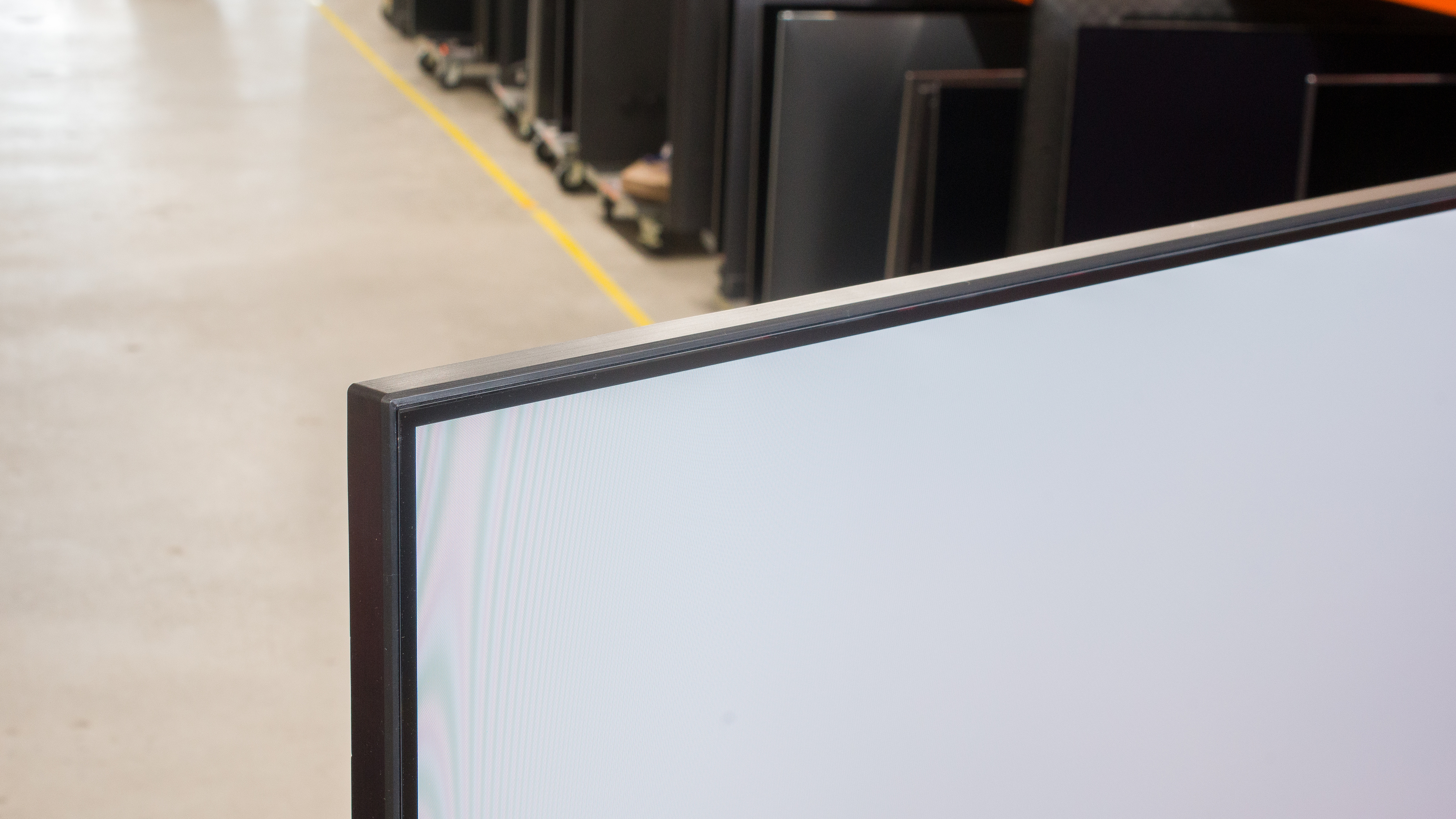
The Hisense Canvas TV has a nice design, with replaceable bezels that allow you to customize its look to match your decor. It comes with a wooden bezel in the box, but you can buy other designs.
for pictures & test results

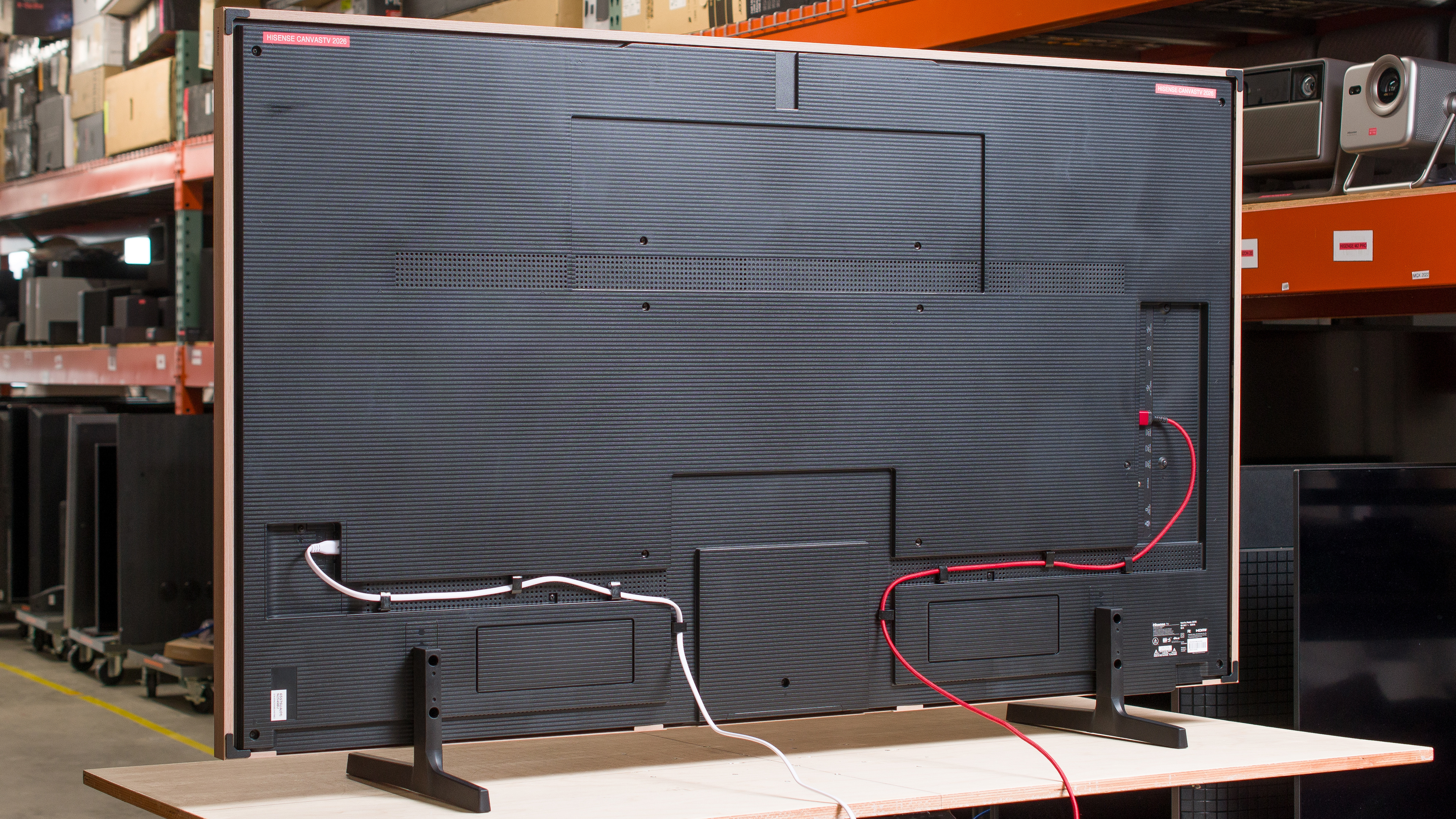
Two simple feet support the TV at either end. There's no alternative placement, so you'll need a wide cabinet if you're not wall-mounting it.
Footprint of the 65-inch stand: 39.4" x 15" x 3.1".
for pictures & test results

The back of the TV is plain and made entirely of plastic. Most of the inputs face to the side of the TV and are close to the edge, so they're easy to access even when the TV is mounted flush against the wall. There are clips on the back to help with cable management.


for pictures & test results

The Hisense Canvas TV has excellent build quality. It's most made of plastic, but the wooden bezel that comes with the TV is made of metal and feels more premium than competing models like the Samsung The Frame Pro 2026.
for pictures & test results

The remote is backlit, and has a built-in mic.
for pictures & test results

The TV ships with version 12 of the very popular Google TV smart interface. This is an older version of the interface, and most manufacturers have moved on to version 14 in 2026, so this is a bit disappointing.
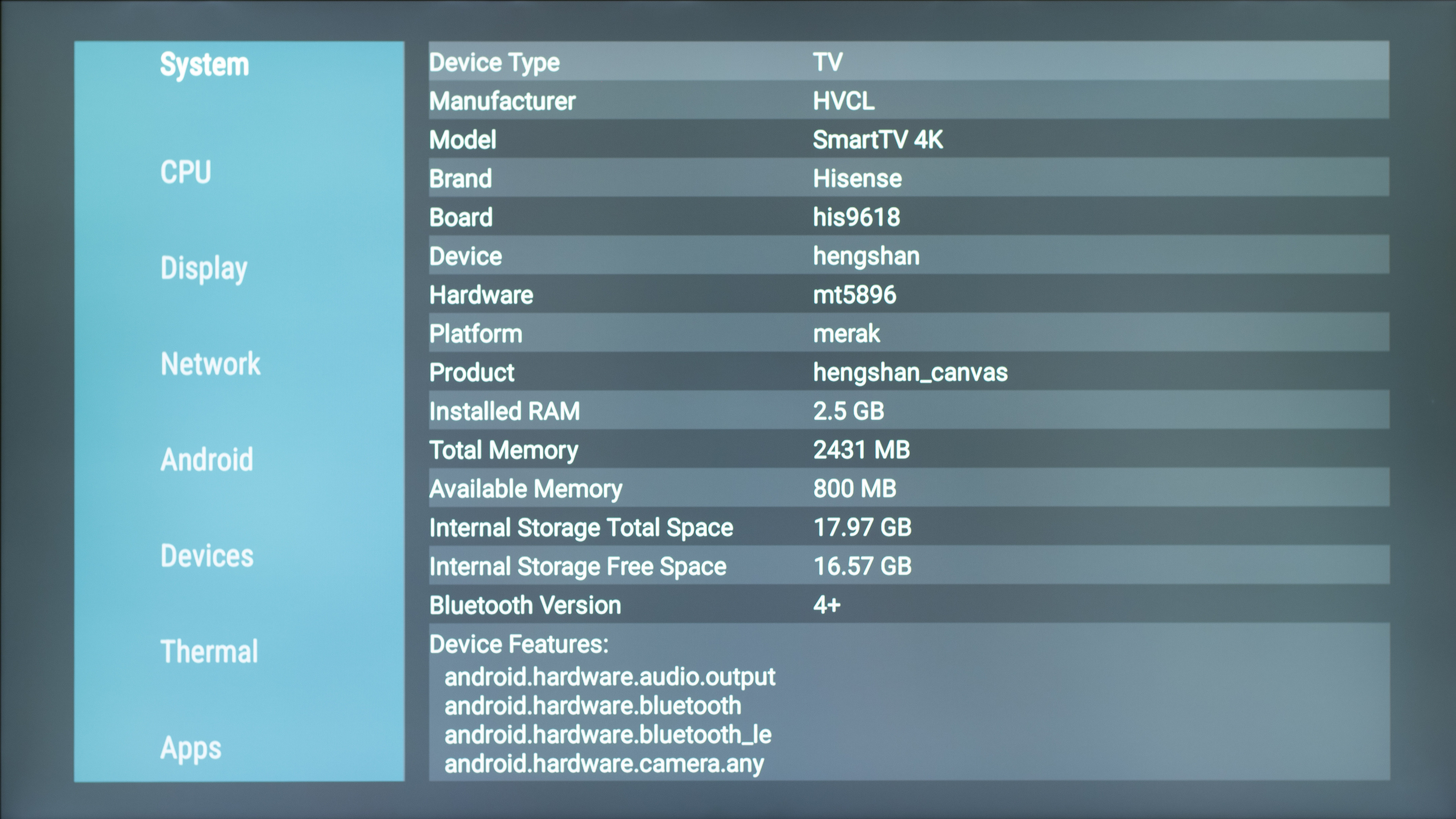
Running AIDA64 on the TV shows that it's powered by the MediaTek 700 processor, with 2.5GB of RAM and ~18GB of internal storage.
The art mode on this TV is fairly basic. There's no subscription service or marketplace for paid artwork, but it has a limited selection of free artwork instead. You can also upload your own photos via USB or a QR code on your phone to create custom slideshows. Like the Samsung The Frame 2026, it uses the TV's motion sensor to turn the art mode on and off to avoid wasting power when no one's in the room.
for pictures & test results

Like most TVs on the market, there are ads throughout the TV interface, and although you can turn off targeted ads, there's no option to turn them off entirely.
When you first start up the TV you can choose to run it in a Basic TV mode. This gives you an ad-free experience, but also disables most smart features.

for pictures & test results

- Manuals
- Remote
- Power cable
- Wall-mount equipment (brackets, screws, and anchors)
- Frame segments, with accessories
In its default 'Art Mode,' the TV consumes about 85 W of power. You can decrease or increase the model's brightness while in 'Art Mode,' which will impact its power consumption.
for pictures & test results

The frequency response on this TV is mediocre. There's very little bass, but most dialogue is clear and easy to understand. It gets very loud, but there's a lot of compression at max volume.