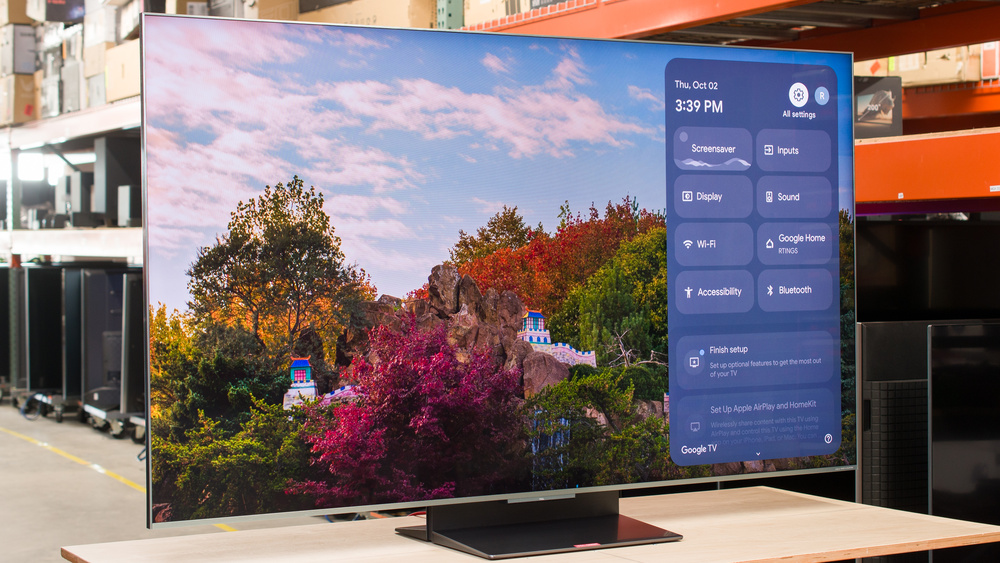
The TCL QM9K is a high-end model in TCL's 2025 North American lineup, sitting above the TCL QM8K. The QM9K features a similar WHVA panel to the TCL QM8K, but TCL advertises a higher peak brightness, up to 6,500 nits, and up to 6,000 dimming zones. It's a feature-packed TV with high refresh rate support up to 4k @ 144Hz or 1080p @ 288Hz, along with HDMI 2.1 bandwidth on two ports and an ATSC 3.0 tuner. It's the first TV on the market to come with built-in support for Google's Gemini AI assistant, which allows you to quickly search for information and get AI-summarized results right on the screen. We bought and tested the 65-inch model, but it's also available in a 75-inch, 85-inch, and 98-inch size.
Our Verdict
The TCL QM9K is a great TV overall. It gets incredibly bright, making it a fantastic choice for a bright living room, as it can easily overcome daytime glare. It looks just as stunning in the dark, thanks to its very effective Mini LED local dimming feature. Colors are bright and vibrant, but there are a few noticeable issues with color accuracy before calibration. It's a great gaming TV thanks to its wide selection of gaming features, like VRR support, low input lag, and support for very high refresh rates.
Incredibly high contrast.
Colors are bright and vibrant.
Bright enough to easily overcome glare even in extremely bright rooms.
Some noticeable color mapping issues out of the box.
Noticeable vignetting.
The TCL QM9K delivers an excellent home theater experience. It delivers incredibly deep, uniform blacks thanks to its Mini LED local dimming feature and high zone count. It gets incredibly bright, so even the brightest highlights in HDR stand out well. It doesn't track creative intent very well, though, and there are noticeable issues with both color mapping and brightness, resulting in a loss of fine shadow details and overblown highlights. It has fantastic format support, including DTS audio and Dolby Vision support. Unfortunately, the edges of characters and objects are blurrier than intended due to subpar pixel transitions when the action ramps up. There's also some visible stutter in shots with slower camera movements, but not everyone will be bothered by it
Incredibly high contrast.
Colors are bright and vibrant.
Specular highlights stand out incredibly well in HDR.
Very little haloing around bright highlights.
Excellent black uniformity.
Some noticeable color mapping issues out of the box.
Shadow details are crushed in HDR.
Noticeable stutter in slow panning shots.
Fast-paced scenes and sports have visible artifacts.
The TCL QM9K is an excellent choice for a bright room. It gets incredibly bright in both HDR and SDR, so it can easily overcome glare in a bright room. It has mediocre direct reflection handling, though, so you'll need to increase the brightness during the day. It has great colors, and bright ambient light has almost no noticeable impact on color saturation or contrast.
Bright enough to easily overcome glare even in extremely bright rooms.
Ambient light has very little impact on black levels or color saturation.
Glossy coating doesn't do much to reduce direct reflections.
The TCL QM9K is a great TV for watching sports. It gets incredibly bright, so you don't have to worry about glare if you're watching the big game during the day. It has an okay viewing angle, though, so the best seat is reserved for directly in front of the TV. It has a good response time, so most motion looks pretty good, but when the action really gets going, there's some noticeable blur around the edges of players and objects.
Bright enough to easily overcome glare even in extremely bright rooms.
Ambient light has very little impact on black levels or color saturation.
Smooths out low-quality content well, with just a slight loss of fine details.
Noticeable vignetting.
Image looks washed out from the sides.
Fast-paced scenes and sports have visible artifacts.
The TCL QM9K is a great gaming TV. It delivers a responsive gaming experience overall, mainly thanks to its low input lag, but motion is a bit blurry due to its slow response time. It has an impressive array of gaming features, though, including support for 4k @ 144Hz or 1080p @ 288Hz for PC gaming, and HDMI 2.1 bandwidth on two of its HDMI inputs. It also supports VRR with all sources to reduce screen tearing, but it's currently not working properly with NVIDIA GPUs when running at 60Hz. There's also no noticeable change in picture quality when you switch the TV to its dedicated Game Master mode.
Low input lag with all supported formats.
High refresh rate support, up to 4k @ 144Hz or 1080p @ 288Hz.
Switching to Game Master mode for the lowest input lag has no impact on picture quality.
Only two HDMI 2.1 bandwidth ports.
Sluggish response time at 60Hz and 120Hz.
The TCL QM9K has fantastic brightness. In SDR, it's bright enough to easily overcome glare, even in a really bright room. In HDR, it gets incredibly bright with all content, so small specular highlights stand out well in average scenes, but big, bright outdoor shots are also incredibly bright.
Bright enough to easily overcome glare even in extremely bright rooms.
Specular highlights stand out incredibly well in HDR.
The black levels on the TCL QM9K are excellent. Its Mini LED local dimming system delivers incredibly deep blacks. It has excellent black uniformity and very little haloing around bright highlights, but the zone controls aren't perfect, either, and there's some flicker as bright highlights move between zones.
Incredibly high contrast.
Very little haloing around bright highlights.
The TCL QM9K has very good colors. Colors are bright and vibrant, and the TV displays a wide range of colors. It has good accuracy out of the box in SDR, with just a few noticeable issues. HDR is a bit worse, with noticeable color mapping issues across the board.
Colors are bright and vibrant.
Fantastic color volume in HDR.
Some noticeable color mapping issues out of the box.
The TCL QM9K has good motion handling, especially when watching movies and shows. The vast majority of sources are free from judder and micro-judder, except for 25p content being sent via a 60p signal, so there are subtle hiccups in motion if you're watching European content from an older device. There's still some subtle stutter in all content, but it's mainly noticeable in slow panning shots. However, not everyone will be bothered by this. The TV does a good job avoiding color artifacts overall, but there's still some unintended intermediate colors in fast-paced scenes. Unfortunately, there's visible blur artifacts behind fast-moving objects and people, which affects motion clarity in fast-paced scenes and sports.
Removes judder from almost all sources.
No micro-judder from most sources.
Excellent lighting zone transitions.
Noticeable stutter in slow panning shots.
Fast-paced scenes and sports have visible artifacts.
The TCL QM9K has good responsiveness when gaming. It has incredibly low input lag, so your actions are always in sync with what you see on the screen. It also supports a wide range of high refresh rates, up to a maximum of 144Hz at 4k or 288Hz with 1080p/1440p signals. It has just decent motion handling, though, and there's noticeable blur.
Low input lag with all supported formats.
High refresh rate support, up to 4k @ 144Hz or 1080p @ 288Hz.
Sluggish response time at 60Hz and 120Hz.
Note: We're in the process of improving our tests related to image processing, but this score should give you a general idea of how a TV performs overall with its image processing capabilities.
The TCL QM9K has decent processing capabilities. It does a great job of smoothing out macro blocking and pixelization in low-quality content, but there's some loss of fine details. It upscales lower resolution content well, and there's very little banding in gradients. On the other hand, it has just okay PQ EOTF tracking, resulting in crushed blacks in shadow details and overblown highlights in the brightest scenes.
Smooths out low-quality content well, with just a slight loss of fine details.
Good upscaling.
Shadow details are crushed in HDR.
Performance Usages
Changelog
- Updated Sep 18, 2026: We converted this review to Test Bench 2.2.1, adding a new Dumb TV test for whether or not the TV can be used offline.
-
Updated Jun 19, 2026:
We mentioned the newly reviewed Samsung R95H in the Response Time section.
-
Updated Mar 25, 2026:
We bought and tested the TCL X11L, and added a comparison in the HDR Brightness section of the review.
-
Updated Mar 11, 2026:
We added text to our new Cinematic Motion Handling performance usage and our new Transition Artifacts and Stutter Reduction Via Interpolation test sections after converting the review to TV 2.2.
Check Price
Differences Between Sizes And Variants
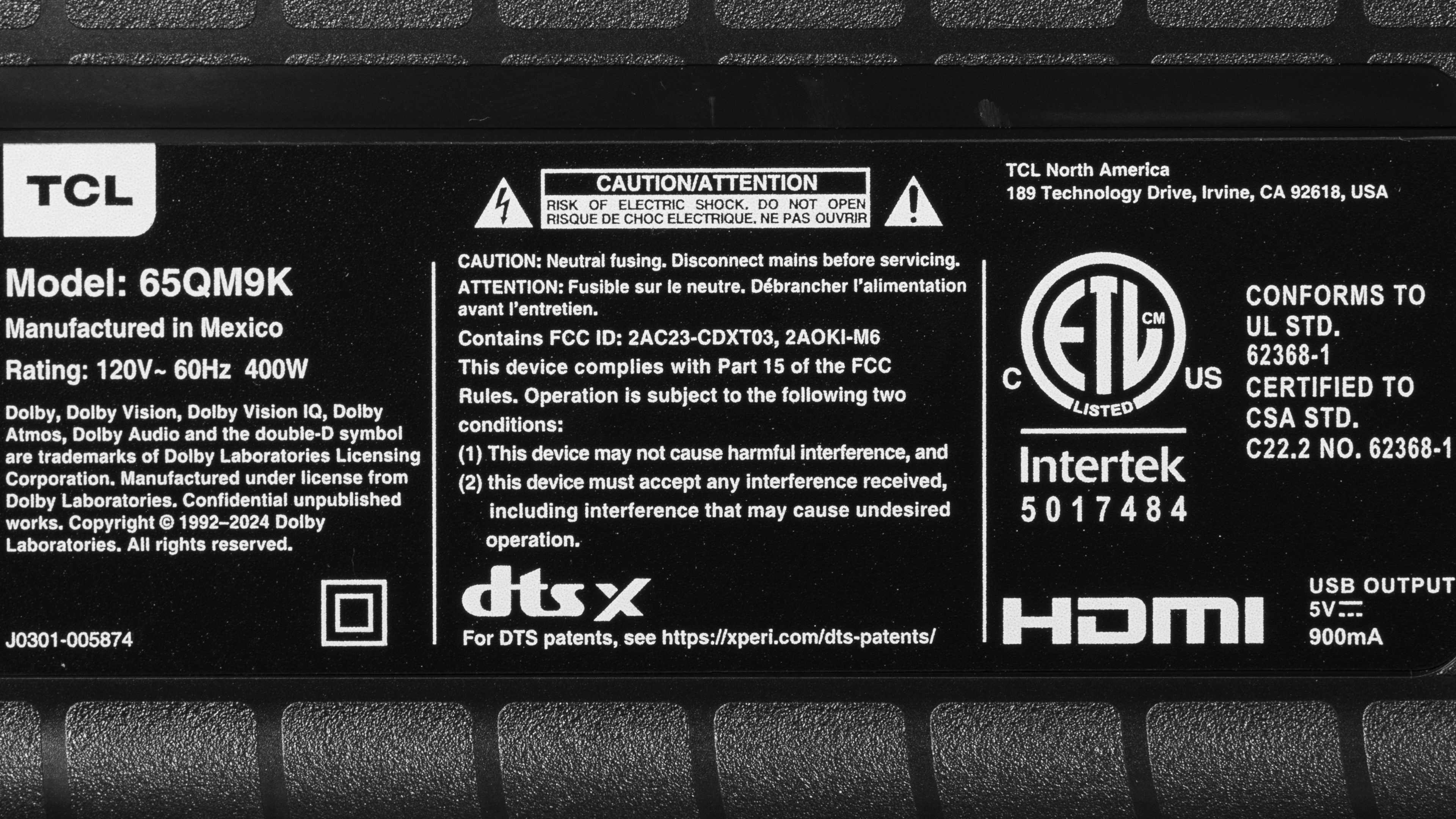
We bought and tested the 65-inch TCL QM9K, and these results are also valid for the 75, 85, and 98-inch models. The 98" model has two feet instead of a center stand, but otherwise performs about the same. The number of zones and the peak brightness increase slightly with each step up in size, but TCL hasn't provided the exact numbers for each size.
The closest European model is the TCL C9K, but owner reports have shown that it has different internal hardware, so these results don't apply to that model.
| Size | Model |
|---|---|
| 65" | TCL 65QM9K |
| 75" | TCL 75QM9K |
| 85" | TCL 85QM9K |
| 98" | TCL 98QM9K |
Our unit was made in China in June 2025.
Popular TV Comparisons
The TCL QM9K is an impressive TV overall, and it's one of the best performers all-around available in 2025. It's not quite the higher-end version of the TCL QM8K that most people were hoping for, though, and the increase in zone count doesn't quite translate to better dark room performance, so most people are better off sticking with the QM8K. The high-end Mini LED TV market is getting more and more crowded, but this one beats most of them overall, including the Sony BRAVIA 9 and the Samsung QN90F. It's not perfect, though, and its processing and image accuracy fall short of both of those competitors.
For more options, check out our recommendations for the best QLED TVs, the best gaming TVs, and the best TVs.
The TCL QM9K is slightly better than the TCL QM8K, at least in theory. The QM9K gets a bit brighter in both HDR and SDR, and it can sustain that brightness longer. This doesn't actually matter that much, though, as most HDR content won't hit highlights that bright or for that long, so in most real content, it looks about the same as the QM8K. The QM9K does have a more recent smart interface, though, as it runs the Google TV version 14 instead of 12 on the QM8K; it also supports Google's Gemini AI assistant.
The LG C5 OLED is better than the TCL QM9K in ideal viewing conditions, like a dark home theater. This is due to its superior black levels, accuracy, and processing. The LG also performs better for gamers due to its clearer motion and lower input lag. However, the TCL is significantly brighter, making it the better choice for bright rooms.
The TCL QM9K and the Sony BRAVIA 9 trade blows in a few different ways, and the best one really depends on what matters to you. The TCL gets brighter and can deliver more vibrant colors, but HDR content that actually takes advantage of that is rare. The BRAVIA 9 has much better processing and is far more accurate, so if you care about creative intent, it's the far better choice.
The TCL QM9K is better than the Samsung QN90F for most users. The TCL gets significantly brighter in HDR, and it has a better local dimming system with less haloing around bright highlights. On the other hand, if you're in a really bright room, the Samsung is slightly better, as its matte anti-reflective coating effectively eliminates distracting glare from direct reflections.

We buy and test dozens of TVs yearly, taking an objective, data-driven approach to deliver results you can trust. Our testing process is complex, with hundreds of individual tests that take over a week to complete. Most of our tests use specially designed test patterns that mimic real content, but we also use the same sources you have at home to ensure our results match the real-world experience. We use two main tools for our testing: a Colorimetry Research CR-100 colorimeter and a CR-250 spectroradiometer.
Test Results
for pictures & test results

for pictures & test results

for pictures & test results

The TCL QM9K is one of the brightest TVs on the market in 2025. Even the brightest HDR content stands out incredibly well with both small specular highlights and large bright areas. It doesn't sustain that brightness for very long, but this isn't an issue with most real content, as specular highlights aren't normally visible for more than a few seconds anyway.
It's nearly as bright as the higher-end TCL X11L with medium and high-APL scenes. Small specular highlight details over 5,000 nits can technically get brighter on the X11L, but content that's mastered at those levels is incredibly rare. In practice, there's no noticeable difference in brightness between the X11L and this TV with most real content.
The posted results are with Dynamic Tone Mapping (DTM) disabled. Here are additional measurements with it set to each of its three settings, all in the 'Movie' HDR Picture Mode:
Results with DTM set to Detail Priority:
- Hallway Lights: 875 cd/m²
- Yellow Skyscraper: 670 cd/m²
- Landscape Pool: 495 cd/m²
Results with DTM set to Balance:
- Hallway Lights: 790 cd/m²
- Yellow Skyscraper: 675 cd/m²
- Landscape Pool: 529 cd/m²
Results with DTM set to Brightness Priority:
- Hallway Lights: 972 cd/m²
- Yellow Skyscraper: 580 cd/m²
- Landscape Pool: 681 cd/m²
for pictures & test results

for pictures & test results

for pictures & test results

Overall, switching to Game Master doesn't change the peak brightness of the TV. There are a few minor differences, but it's not noticeable.
Here are measurements with Dynamic Tone Mapping (DTM) set to each of its three settings, all in Game Master:
Results with DTM set to Detail Priority:
- Hallway Lights: 1060 cd/m²
- Yellow Skyscraper: 749 cd/m²
- Landscape Pool: 525 cd/m²
Results with DTM set to Balance:
- Hallway Lights: 1112 cd/m²
- Yellow Skyscraper: 723 cd/m²
- Landscape Pool: 562 cd/m²
Results with DTM set to Brightness Priority:
- Hallway Lights: 1104 cd/m²
- Yellow Skyscraper: 720 cd/m²
- Landscape Pool: 600 cd/m²
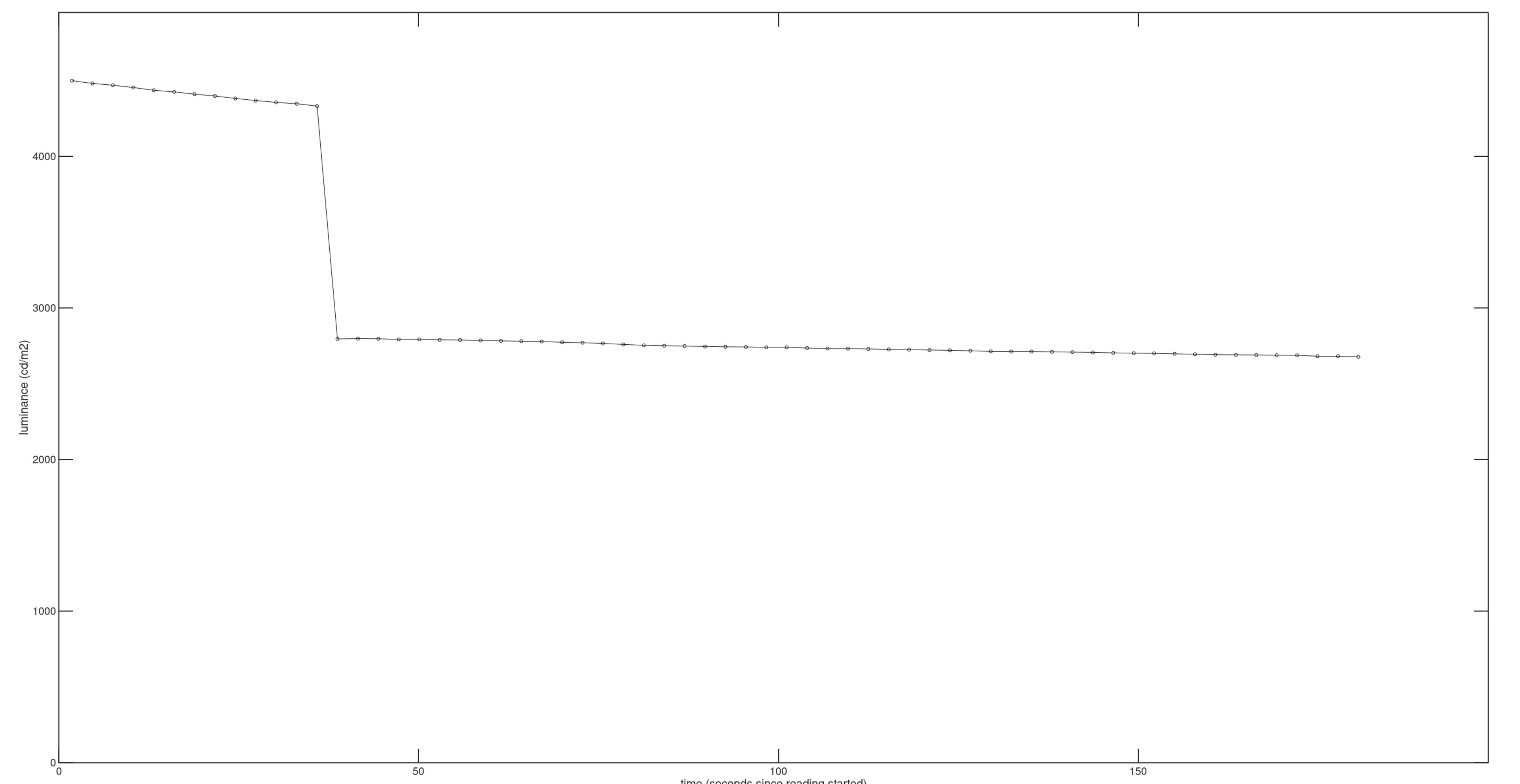
This TV is incredibly bright in SDR and easily overcomes glare in a bright room. There's a noticeable drop in peak brightness over time, but it maintains them for long enough that this won't be an issue with the vast majority of real content. As with most TVs, large bright scenes aren't quite as bright as more moderately lit ones, but they're still bright enough.
for pictures & test results

The contrast on this TV is superb. The Mini LED backlight delivers incredibly deep blacks, even in complex scenes with very bright highlight details.
for pictures & test results

The zone precision on the TCL QM9K is excellent. There's some noticeable haloing around really bright parts of otherwise dark scenes. With real content, it's especially distracting if you have subtitles turned on.
for videos & test results

Zone transitions are excellent on this TV. It does a good job keeping up with quick-moving highlights, so the brightness is even, with no trailing halo or dark leading edge. There's noticeable flicker as objects move between zones, though.



for pictures & test results

for pictures & test results

This TV has great color volume. It has nearly perfect coverage of the DCI-P3 color space, but it can't quite display the most saturated reds and greens. It also has decent coverage of the widest BT.2020 color space. There's a slight decrease in coverage in lighter scenes, but it's not significant.
| Volume ΔE³ | DCI-P3 Coverage |
BT.2020 Coverage |
|---|---|---|
| L10 | 94.79% | 72.93% |
| L20 | 95.25% | 73.61% |
| L30 | 94.79% | 73.51% |
| L40 | 94.20% | 74.96% |
| L50 | 93.57% | 74.97% |
| L60 | 92.78% | 73.79% |
| L70 | 92.58% | 67.64% |
| L80 | 92.23% | 65.61% |
| L90 | 91.98% | 65.10% |
| L100 | 90.90% | 67.19% |
| Total | 93.03% | 70.45% |
for pictures & test results

for pictures & test results

The TCL QM9K has fantastic color volume in HDR. Colors are incredibly bright and vibrant, and whites don't overpower bright, saturated colors. It also displays deep saturated colors well, thanks to its high contrast ratio.
for pictures & test results

for pictures & test results

for pictures & test results

The color accuracy out of the box is good. The most noticeable issue is the color temperature, which is warm out of the box, and the RGB balance is noticeably off across the board. Gamma tracking is mixed; dark scenes are crushed a bit, but bright highlights are overblown. Color dE is very low, with no noticeable mapping errors.
for pictures & test results

for pictures & test results

for pictures & test results

This TV is easy to calibrate, and it delivers an incredibly accurate image after calibration. The only remaining issue is with pure blue, and it's a low enough dE that it's not noticeable at all.
See our full calibration settings.
for pictures & test results

for pictures & test results

The TCL QM9K has just okay accuracy in HDR out of the box. There are noticeable color mapping errors, the white balance is way off, and the overall color temperature is a bit cool.
for pictures & test results

for pictures & test results

Calibrating this TV in HDR improves the overall accuracy a bit, but it's far from perfect. There are still noticeable mapping errors in both colors and the white balance. The color temperature is much better after calibration, though.
for pictures & test results

Unfortunately, the PQ EOTF tracking on this TV is just okay, and it's a bit all over the place. Shadow details are significantly crushed in all content. Midtones are a bit better overall, but they're still either slightly raised or a bit too dim. Bright highlights are significantly overblown, and the TV exceeds the mastering level for content mastered at 600 and 1,000 nits.
for pictures & test results

This TV has great low-quality content smoothing. It smooths out pixelization and macro blocking well, but there's a slight loss of fine details.
for pictures & test results

Lower-quality streams are upscaled properly, with no noticeable issues or excessive over-sharpening. Fine details are a bit hard to make out, but the image is clear.
for pictures & test results
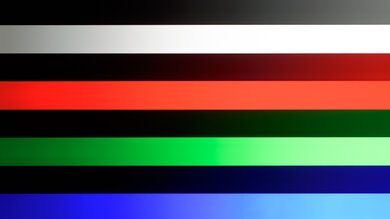
The gradient handling on this TV is great. There's some banding in shades of gray, both dark and light, but it's not too bad. Colors look much better, with no significant banding in any color.
The TCL QM9K has incredibly low input lag in Game Master mode, ensuring a responsive gaming experience with any supported resolution and refresh rate. Unlike older TCL TVs, it also supports low-latency motion interpolation, so you can improve the fluidity of motion without adding significant lag.
The TV supports all common resolutions up to 4k @ 144Hz on two of its four HDMI ports. It also supports up to 288Hz with 1080p and 1440p signals. All supported formats also support proper chroma 4:4:4, which is essential for clear text from a PC.
The TCL QM9K supports all three types of variable refresh rate (VRR) technology to reduce screen tearing. It works well with AMD sources, like an AMD GPU or any console across a wide refresh rate range, and it works with Low Framerate Compensation (LFC), ensuring your games remain nearly tear-free even when your frame rate drops very low.
It has the same issue with NVIDIA GPUS as the TCL QM8K, though. If you set your desktop to a locked 60Hz refresh rate, VRR doesn't work properly, and there's noticeable tearing at any frame rate. This is only an issue if you have an older GPU and can't handshake above 4k @ 60Hz; it works fine if you set your computer to 4k @ 120Hz or higher and let VRR do its thing.
for pictures & test results
for pictures & test results

The CAD at the max native resolution refresh rate of 144Hz is just okay. Transitions are slow across the board, but it's especially bad when going from very dark to very bright shades. Transitions that stay close to the same shade look a lot better, but there's still noticeable blur.
for pictures & test results

for pictures & test results

When you drop down to 120Hz, the CAD is slightly worse overall, but it's not much of a difference. Overall, it behaves almost identically to the 144Hz performance.


for pictures & test results

The TV is fully compatible with everything the PS5 offers, like 1440p @ 120Hz and 4k @ 120Hz, as well as HDMI Forum VRR. It also supports Auto Low Latency Mode, so you don't have to worry about manually switching to Game Master to get the lowest input lag.
for pictures & test results

The TV is fully compatible with everything the Xbox Series X|S offers, including 1440p @ 120Hz, 4k @ 120Hz, HDMI Forum VRR, and FreeSync Premium Pro. It also supports Auto Low Latency Mode, so you don't have to manually switch to Game Master to get the lowest input lag.
for videos & test results
for pictures & test results

for pictures & test results
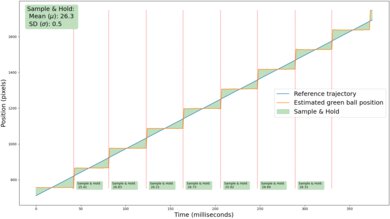
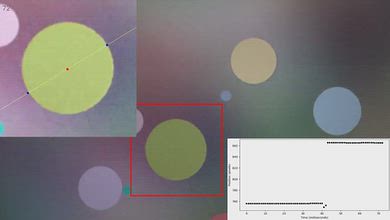
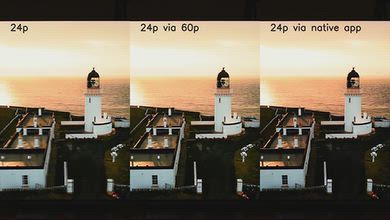
The TCL QM9K has a good cinematic response time, which results in some noticeable stutter when watching 24p and 25p content. It's not as bad as OLED TVs, but it's still noticeable in slow panning shots.
for videos & test results
for pictures & test results

for pictures & test results
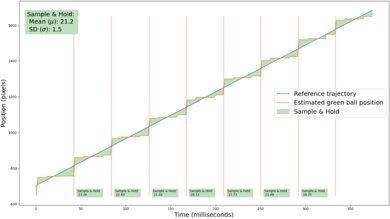
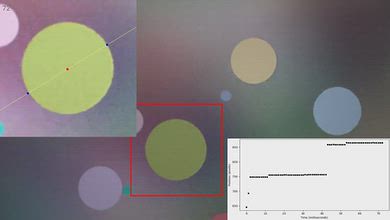
The TV's motion interpolation feature does a good job of mitigating stutter. Low frame rate content is smoothed out well when using the interpolation setting that's equivalent to 30fps, resulting in motion with good fluidity and consistency, even in slow panning shots.
for pictures & test results
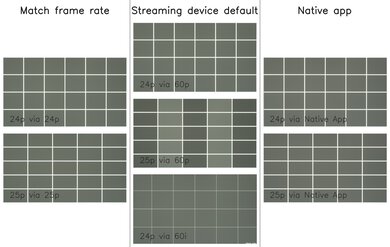
The TV removes judder from all sources when watching movies or shows that are in 24p. To remove 24p judder from 60p and 60i sources, like a cable box, Motion Clarity needs to be set to 'On' with sliders set to '0.' However, this setting only works with 24p content. The TV doesn't entirely remove judder from 25p content being sent via 60p, but frame times aren't too inconsistent, so motion is just a bit jittery. Fortunately, the TV removes 25p judder if you're using an external device like an Apple TV that has a 'Match Frame Rate' feature or when using the TV's native apps.
for videos & test results
for videos & test results
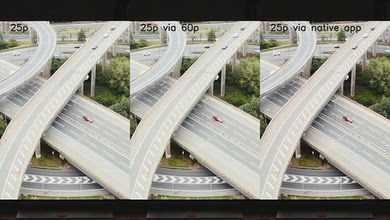
The TCL QM9K only has micro-judder present in scenes with complex motion when watching 25p content via a 60p signal, like when using an older streaming device that doesn't have a feature to match the outputted signal to the frame rate of the content. These micro-judders occur every 5-10 seconds, so they're pretty noticeable. Outside of that, there's no micro-judder in 24p and 25p content.
for pictures & test results

for pictures & test results

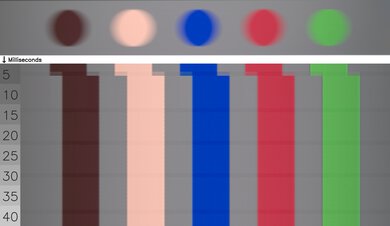
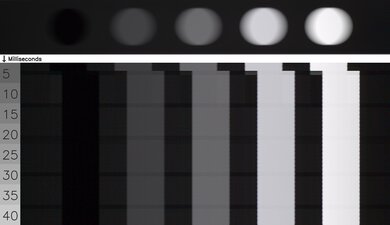
This TV has a good cinematic response time. Most transitions look good overall, with no noticeable overshoot. Transitions to very bright shades or out of near-blacks are extremely slow, though, taking almost one full 24p frame. Still, there's much less motion blur on this TV than there is on a similar model like the Samsung R95H.
for pictures & test results
for pictures & test results
The TCL QM9K has passable transitions when watching movies, shows, and sports. It does a good job of keeping colors pure during RGB transitions, but it's not perfect. For example, there's still some yellow around blues in fast-paced scenes and sports, which affects color consistency.
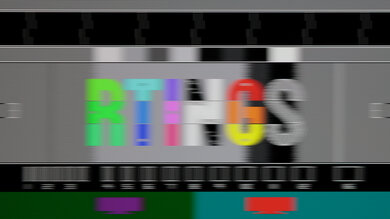
Unfortunately, the TV does a bad job keeping the edges of fast-moving objects consistent with the center, leading to visible blurriness in movies, shows, and sports with a lot of motion.
for pictures & test results

The TCL QM9K uses a mix of pulse width modulation and direct DC dimming to adjust the backlight output. It flickers at an extremely high frequency that most people won't notice, though.
for pictures & test results
for pictures & test results
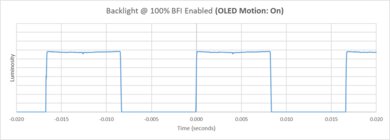
There's an optional backlight strobing feature, commonly known as black frame insertion. This feature is meant to reduce persistence blur and improve the appearance of motion. Unlike most TVs on the market in 2025, it works at both 60Hz and 120Hz.
for pictures & test results

for pictures & test results

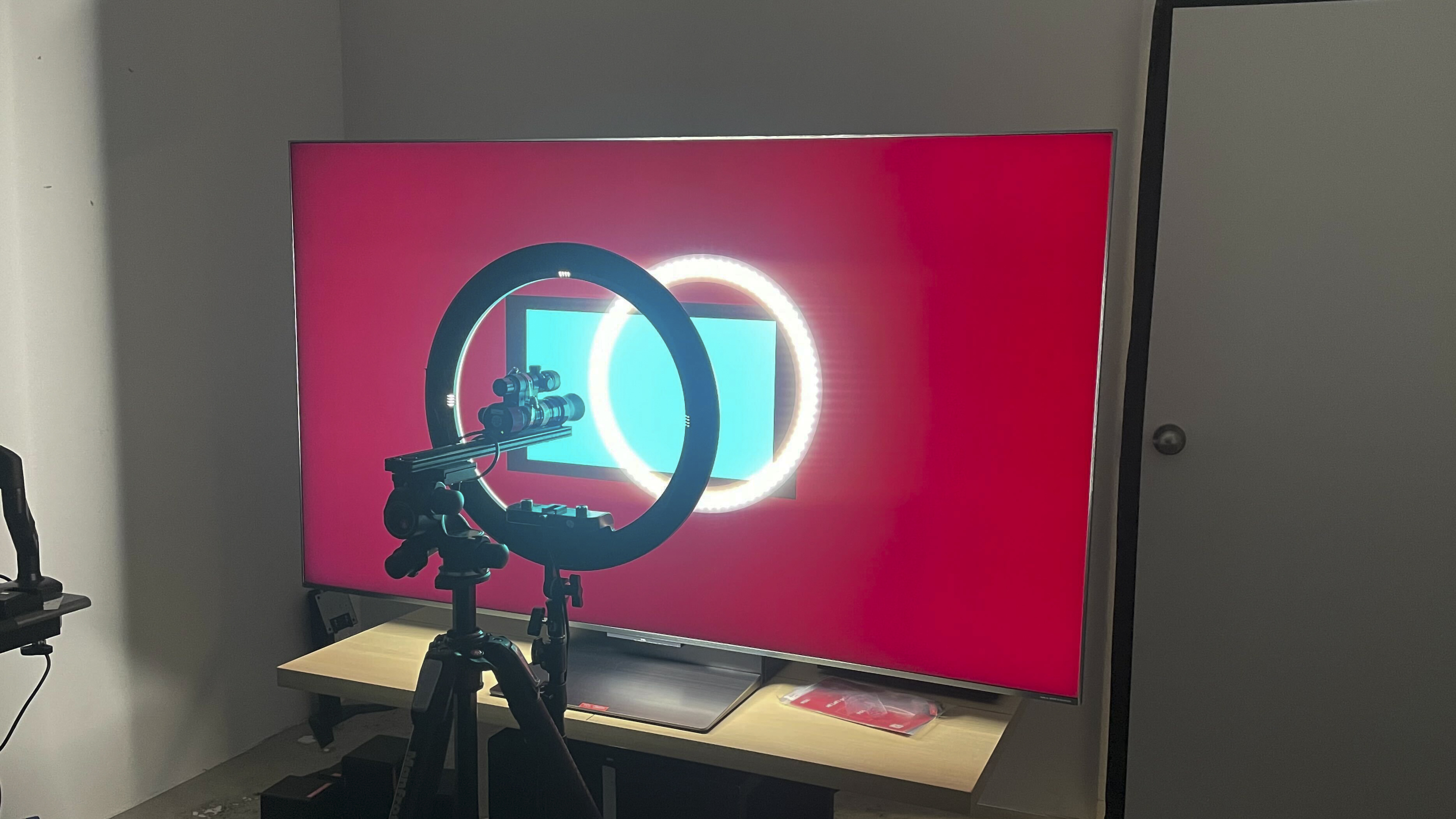
The glossy coating does a mediocre job of reducing the intensity of direct, mirror-like reflections. Bright lights and open windows opposite the TV can still be distracting, and you'll need to increase the brightness to overcome them.


for pictures & test results

for pictures & test results

The total reflected light is good. Mirror-like reflections are very noticeable when the TV is off, and there are diffraction artifacts like the rainbow smear around the light.
for pictures & test results

Ambient light has almost no noticeable impact on the color saturation of this TV.
for videos & test results
for pictures & test results

for pictures & test results

for pictures & test results

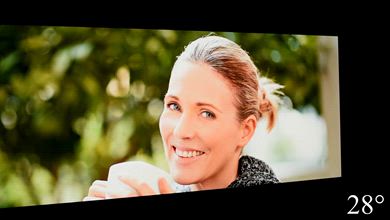
The viewing angle on this TV is okay. Colors wash out quickly as you move off-center, and there's a more noticeable color shift than there is on the TCL QM8K. It's not too bad, though, and this WHVA panel is better overall than most VA-type panels on the market, making it a better choice for a wide seating arrangement.
for pictures & test results

for pictures & test results

The gray uniformity on this TV is just decent. There's noticeable vignetting on the sides and some color issues near the center. There's relatively little dirty screen effect, though, so it's fine for watching sports.
for pictures & test results

for pictures & test results

Like the TCL QM8K, the TCL QM9K uses TCL CSOT's newest panel technology, known as WHVA. This new panel is designed to combine the strengths of VA and IPS, delivering wider viewing angles than traditional VA panels but with the same deep blacks. Unlike traditional VA panels, the subpixels are laid out in an R-G-B layout, which helps with text clarity when used with a PC.
The TV uses quantum dots for both red and green to achieve high color peaks with excellent separation between each primary color.
for pictures & test results

for pictures & test results

Only two of the inputs support HDMI 2.1 bandwidth. The eARC port is on one of the lower-bandwidth 2.0 ports. This has no impact on either the audio quality or the formats supported over eARC, but it leaves you with two high-bandwidth ports for recent game consoles or a PC.
The TV supports eARC, which lets you pass high-quality, uncompressed audio to a compatible receiver or soundbar through an HDMI cable. It supports all major audio formats, so you don't have to worry about compatibility with external sources.
for pictures & test results

The TCL QM9K has a very premium design, with thin, uniform bezels around the entire screen, and no noticeable dead gap between the bezels and pixels. The TCL badging along the bottom bezel is very discrete.
for pictures & test results

The TV comes with a compact, height-adjustable center-mounted stand. At its lowest position, the stand lifts the TV about 2.2 inches above the table and 3.4 inches at its highest, which is high enough for almost any soundbar.
Footprint of the 65-inch stand: 15.3" x 14.6".
for pictures & test results

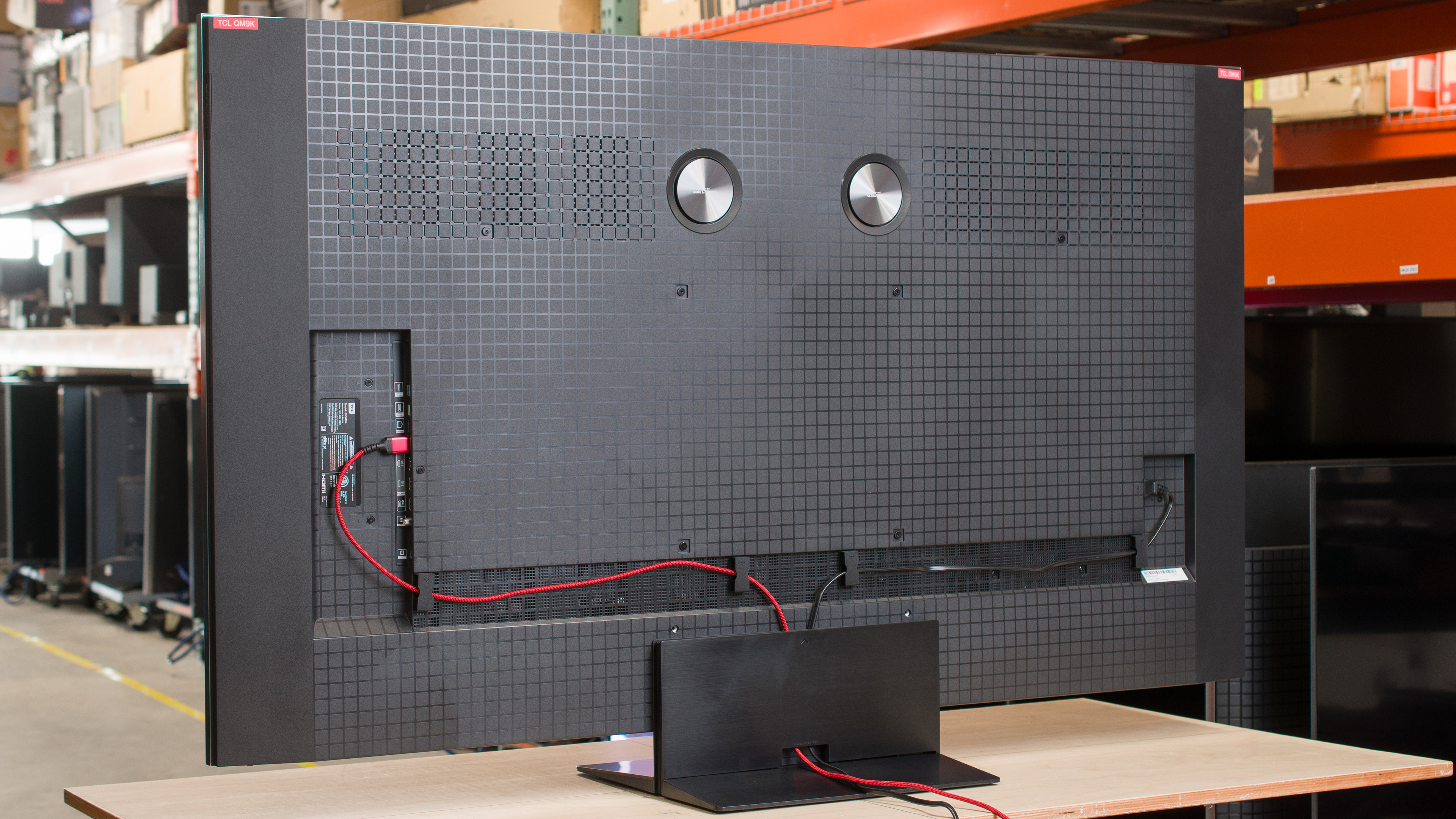
The back of the TV has a nice checkerboard pattern that gives it a premium look. The inputs face to the right when looking at the front of the TV, but they're inset into the back and can be difficult to access if the TV is mounted close to the wall. There are cutouts and clips to help with cable management through the stand.


for pictures & test results

This TV has excellent build quality. It's mostly made of a very high quality plastic. It feels sturdy and well-built, with no obvious issues at all.
for pictures & test results

The backlit remote has quick access buttons for the most popular streaming services, and it has a built-in microphone for voice commands. The TV also supports hands-free voice controls with the "Hey, Google" wake word.
for pictures & test results

The TCL QM9K ships with Google TV version 14, which features Google's Gemini AI assistant built in for the first time on any TV. This feature provides AI-summarized results with quick voice searches. It works well, providing relevant information quickly.
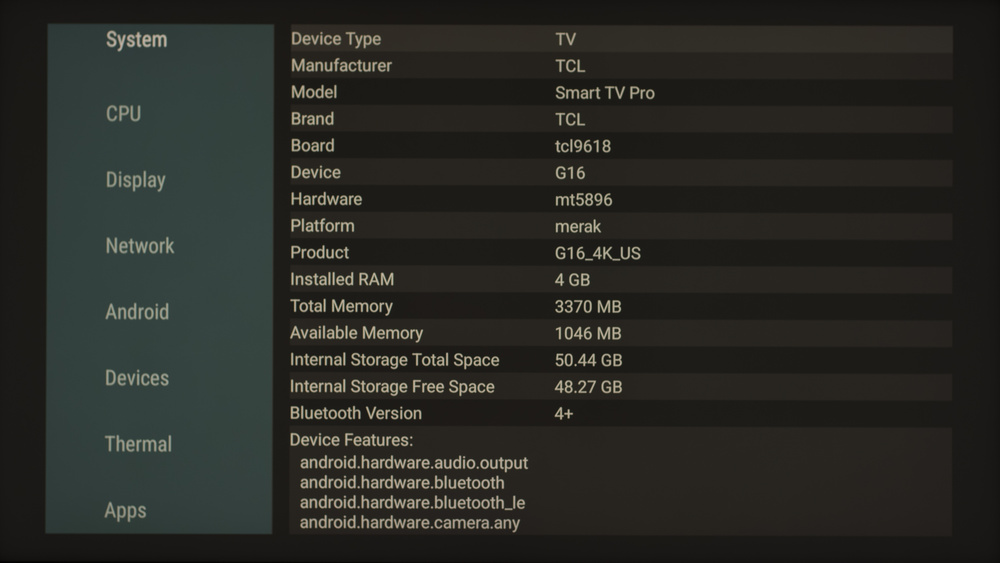
According to AIDA64 on the TV, it's powered by the MediaTek Pentonic 700 SoC, with 4GB of RAM and ~50GB of internal storage.
for pictures & test results

Unfortunately, like almost all TVs on the market, the smart interface contains ads, and you can't disable them.

for pictures & test results

- Setup guide
- Remote
- 2x AAA batteries
- Cable management clips
- Power cable
for pictures & test results

The TCL QM9K TV has an okay frequency response. Most audio is well balanced, but like any TV, there's very little low-bass response. Even a basic external soundbar will sound better.