We used the following calibration settings to test the 65-inch Panasonic W70B, but they're also valid for the 43, 50, 55, 70, 75, and 85-inch models. These settings apply to most types of content, except for gaming, which requires a few additional changes, listed below.
These settings are meant to provide a starting point; they're not meant to be copied 1:1. They provide the most accurate image in a moderately lit room, but you should adjust them to match your personal preferences and viewing conditions.
SDR Picture Settings
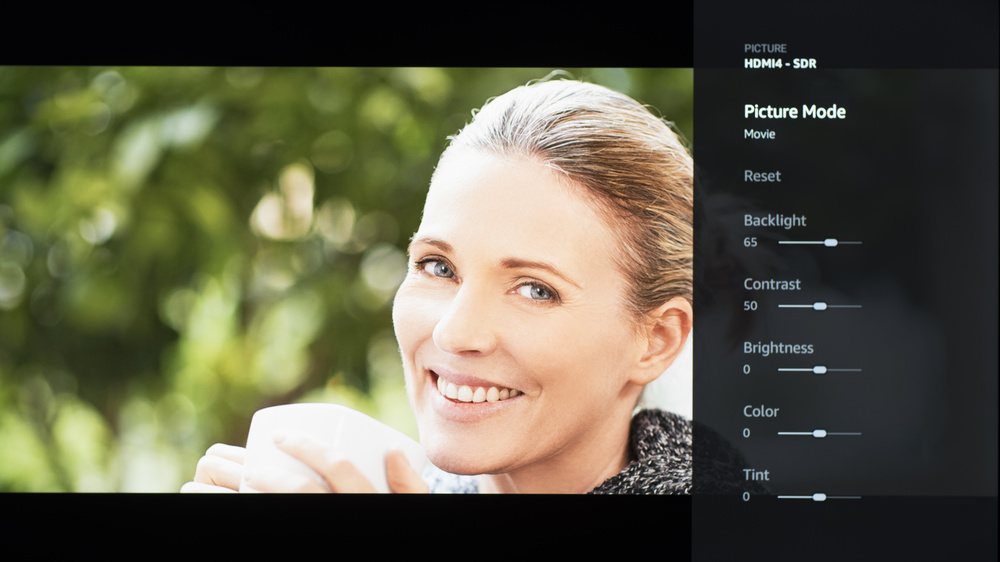
For SDR content, you can choose a few different preset picture modes. We used the 'Movie' Picture Mode because it's the most accurate out of the box and allows for the most customization. We set Backlight at '65' as it's closest to 200 nits on our unit, which is our target for a moderately lit room, but you should adjust this setting based on your viewing conditions. Below are the settings we used for SDR. All other settings were either disabled or left off.
- Picture Mode: Movie
- Backlight: 65
- Color Temperature: Warm2
- Contrast: 50
HDR10 and HDR10+
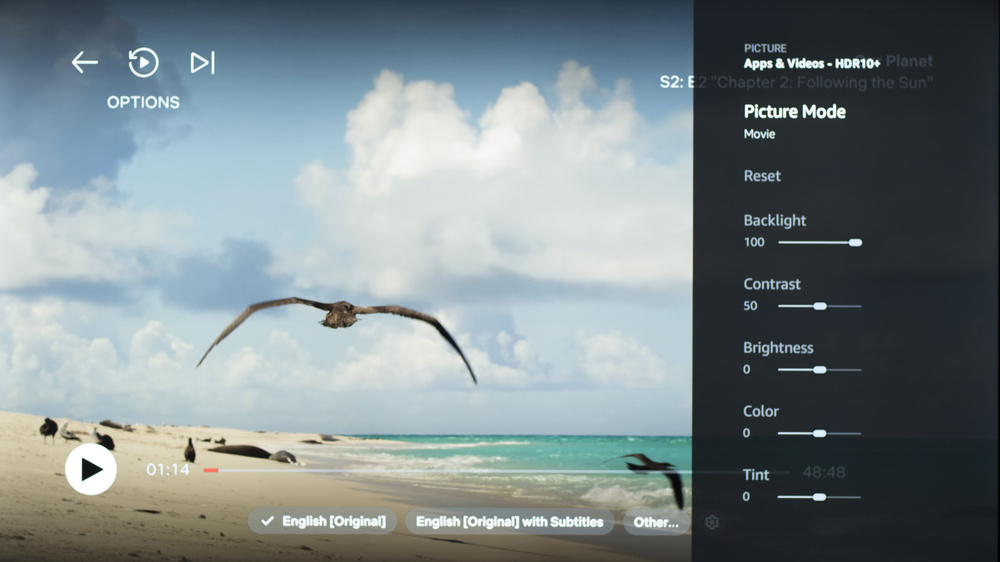
HDR is automatically enabled for native apps. When you start playing HDR content, a small HDR icon appears in the picture settings menu. Once you start playing HDR content, some of the settings change automatically. Below are the settings we used for HDR10. All other settings were either disabled or left off.
- HDR Picture Mode: Movie
- Backlight: 100
- Brightness: 0
- Contrast: 50
The TV supports HDR10+ from native apps and external devices. As with normal HDR content, when you start playing HDR10+ content, some settings change automatically. Since we don't specifically test HDR10+, we don't have exact settings for them, but they should be the same as our HDR10 settings. Note that this TV can only decode HDR10+; it doesn't use the dynamic metadata, so you won't see any difference between HDR10 and HDR10+.
HDR White Point
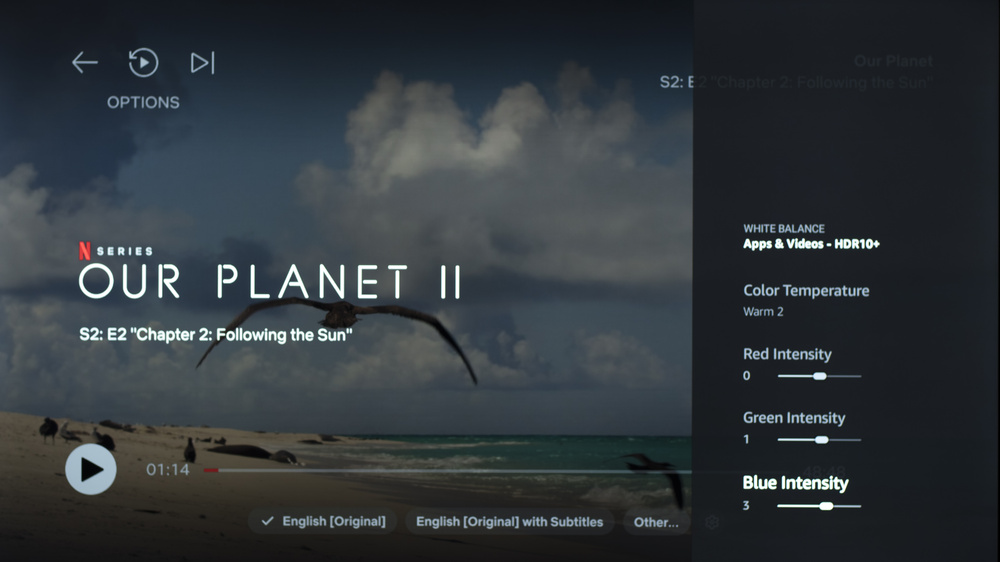
The following are the old results of calibrating the white balance of our unit to 6500K in HDR using the 2-point method. We don't publish the values we used for our new 20-point calibration.
They are provided for reference and shouldn't be copied as the calibration values vary per individual unit, even for the same model and size as the TV we reviewed, due to manufacturing tolerances. If you want to try them, you'll need to enter all values shown, as all of them are active at the same time. If you have worse picture quality, simply reset them to the default values.
Gaming Settings
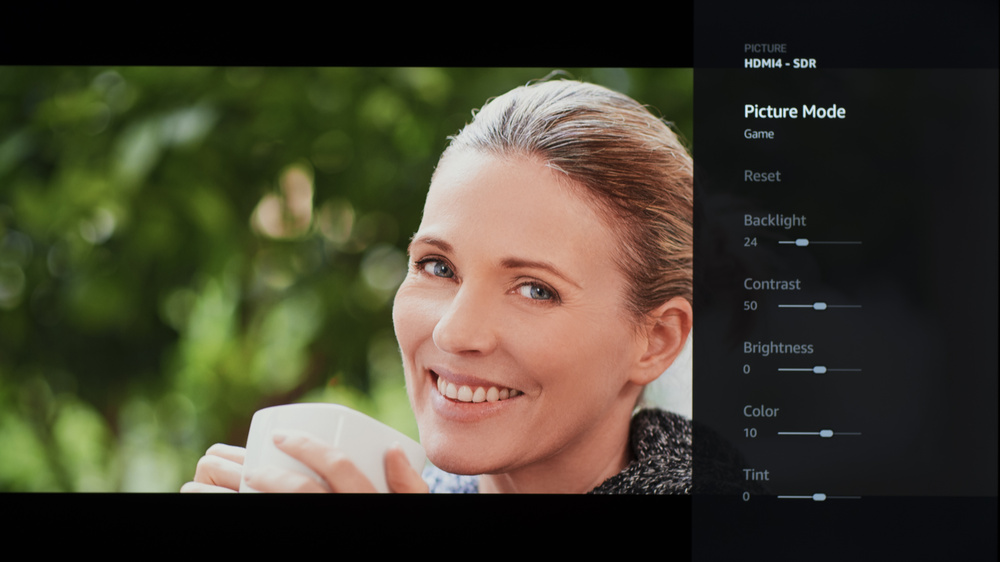
From the base SDR and HDR settings, very few changes are required for the best gaming experience. When you start gaming, it's best to switch to Game Mode to get the lowest input lag. The rest of our gaming settings are identical to our regular settings for SDR or HDR.
eARC/ARC
To make ARC work, Audio Output must be set to 'Auto' or 'ARC,' and Digital Audio Out should be set to 'Passthrough.' These settings are in the Display & Sound section.
Upscaling: Sharpness Processing
For our 480p upscaling test, we set Sharpness to '10,' with Super Resolution set to 'On.' Sharpness processing was calibrated with no over-sharpening for low-resolution content.
Judder
This TV lacks the Natural Cinema feature that normally enables the judder-removal feature on TVs powered by Fire TV.
Stutter Reduction Via Interpolation
Setting Motion Processing to 'Standard' outputs a framerate equivalent to 30fps.
Storage Space & Firmware
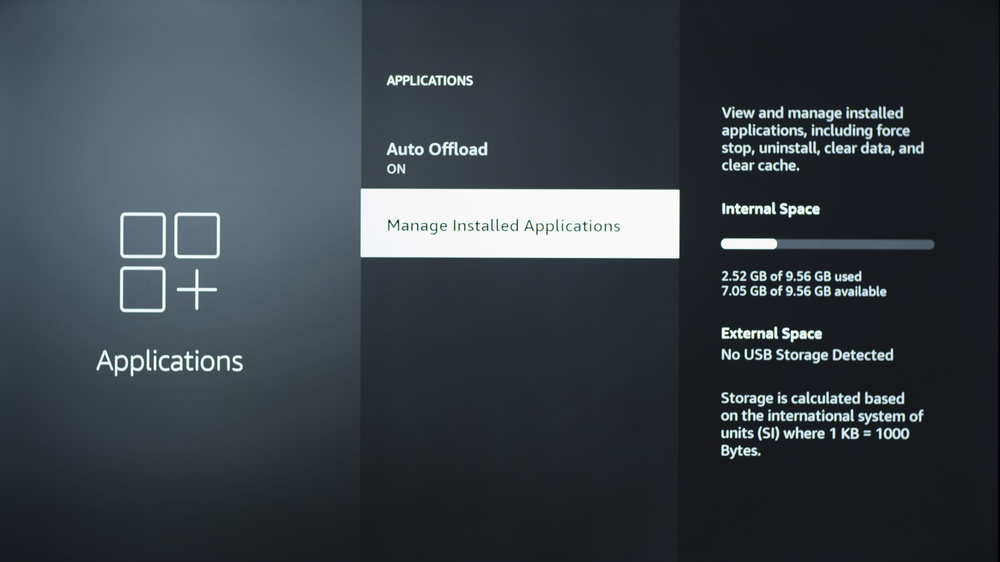
This TV has about 7GB of accessible internal storage with the included apps installed. These settings are valid for the unit we bought and tested, and it was calibrated on Fire OS 8.14.2 (RS8142/3011).
Other Settings
For information on any other settings or features that fall outside of the scope of our testing, please refer to the product's page.