
Thanks to platforms like YouTube and TikTok, it's easier than ever to start vlogging or streaming. While shooting videos on your smartphone is a good place to start, a dedicated camera can help take your videos to the next level. Whether it's a DSLR or mirrorless camera for sit-down vlogging or a compact point-and-shoot to easily take on the go, there's no single best camera when it comes to vlogging, just as there's no single way to make vlogs. A fully articulated screen helps, but the most important thing is to choose a model that fits your budget, shooting preferences, and the type of content you'd like to create. Lighting and audio will be just as, if not more, important than the camera you use, so don't forget to factor additional equipment into your budget.
We've bought and tested over 125 cameras, and below, you'll find the best vlogging cameras to buy in 2026. If you want something more lightweight for on-the-go vlogging, you can also check out our picks for the best compact cameras. Otherwise, if you're filming videos of sports or fast action, try the best video cameras for sports. Finally, if you're looking for something more advanced, you'll want the best video cameras we've tested overall.
We've independently purchased over 125 cameras and tested them using a standardized methodology. All the results are available to help you make the right purchasing decision for your needs, with objective, data-driven reviews. We keep every product in our lab inventory to ensure we can go back, retest models, and verify that all the information we provide is still accurate.
-
Best Vlogging Camera
 Vlogging7.4Studio Video9.5Action Video6.6Body Type:SLR-StyleMirrorless:YesSensor Size:4/3 (MFT)See all our test resultsScreen Articulation Type:Tilt and Fully-Articulated
The Panasonic LUMIX GH7 is the best vlogging camera we've tested. It's the latest model in Panasonic's GH series, which has been a popular choice among YouTubers for several iterations. While it doesn't have the same low-light advantage as full-frame alternatives, the Micro Four Thirds (MFT) format lends itself well to video work in controlled lighting conditions, with a very wide range of lens options to choose from. The GH7 is one of the most powerful MFT cameras we've tested so far, with a relatively high-res sensor that captures excellent video quality, with support for a very wide range of recording formats, including ProRes codecs and internal RAW video capture.
The camera is also built for demanding video work, with active cooling fans and heat vents to prevent overheating. It has a robust design, with a tilting/articulated screen, CFexpress card slot, and more. If you're just looking for something to capture your day-to-day to share with the good people on YouTube, this camera might be overkill. However, it's the best camera we've tested for vloggers who are serious about videography.
-
Best Mid-Range Vlogging Camera
Vlogging7.9Studio Video9.1Action Video7.8Body Type:SLR-StyleMirrorless:YesSensor Size:APS-CSee all our test resultsScreen Articulation Type:Fully-ArticulatedThe Sony α6700 may not be as advanced as the Panasonic LUMIX GH7, but it's chock-full of amazing video features for the price. Despite incurring a notable crop, it can record in 4k at up to 120 fps for slow-motion or action recording, and the camera uses an incredibly effective AF system that performs as well as the GH7's. You also get IBIS for smoother handheld recording and a fully articulated screen so you can monitor yourself. Plus, more advanced shooters can take advantage of internal 10-bit 4:2:2 recording to get more flexibility in post.
Overall, the α6700 is an excellent video camera for the price, with more than enough advanced video features to please enthusiasts. But don't overlook the Fujifilm X-S20 in this price range, either. Its AF isn't as reliable as the α6700's, and it maxes out at 4k 60 fps, but it's another excellent choice for video work, with a dedicated 'Vlog' mode that simplifies the vlogging process for content creators. It even includes more advanced features like open gate 6.2k recording to give you more flexibility with aspect ratios to post across different social media channels.
-
Best Lower Mid-Range Vlogging Camera
Vlogging8.5Studio Video9.3Action Video5.5Body Type:SLR-StyleMirrorless:YesSensor Size:APS-CSee all our test resultsScreen Articulation Type:Fully-ArticulatedIf the Sony α6700 is out of your price range, the Sony ZV-E10 II is a great choice at a lower price point. The biggest trade-off here is the lack of built-in stabilization, but you can compensate for that to an extent by using optically stabilized lenses and enabling e-stabilization. That aside, the camera has surprisingly advanced video features, including 4k 120 fps and internal 10-bit 4:2:2 support. Video quality is great overall, and the camera's autofocus performs remarkably well in video mode. Like the other ZV cameras we mentioned in this article, it lacks a viewfinder, but the camera's fully articulated touchscreen is ideal for vlogging. It has the usual Sony vlogging features, including a 'Background Defocus' button to quickly switch to a shallow depth of field and a 'Product Showcase' mode for product vloggers.
While it tops out at 60 fps and sacrifices ergonomics for its small size, the slightly cheaper Fujifilm X-M5 is another excellent entry-level choice for vlogging. Its small body and fully articulated screen make it easy to shoot on the go. Internal recording capability is still excellent, with 10-bit 4:2:2 capture, Log formats, and 6.2k open-gate recording. A dedicated 'Vlog' mode makes it easy to start filming even if you're a new videographer; film simulation profiles let you change the look of your videos in-camera; and a vertical recording mode gets your footage ready for social media without extra work.
-
Best Budget Vlogging Camera
Vlogging8.6Studio Video8.2Action Video4.2Body Type:SLR-StyleMirrorless:YesSensor Size:APS-CSee all our test resultsScreen Articulation Type:Fully-ArticulatedThe Sony ZV-E10 is the predecessor to the Sony ZV-E10 II above. This first version maxes out at 30 fps in 4k with a slight crop. However, it has a very reliable autofocus system, and it's notably cheaper, making it the best option for vloggers on a tight budget. What separates it from the Sony ZV-E10 II above comes down to recording options, since this first version maxes out at 30 fps in 4k with a slight crop and doesn't offer internal 10-bit 4:2:2 color. If you shoot straightforward talking-head or day-in-the-life content and don't plan on grading your footage, you won't run into either limit.
Other than that, you should expect a similar design and feature set compared to the other video-focused Sonys we've mentioned here: no viewfinder, a three-capsule vlogging mic, a fully articulated screen, and the usual vlogging modes, like 'Product Showcase.' Ultimately, if you can live without those high frame rate options in 4k or internal 10-bit 4:2:2 color, then this is a great budget choice to get you started.
-
Best Cheap Vlogging Camera
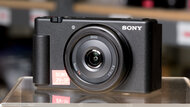
Vlogging8.2Studio Video8.1Action Video4.6Body Type:Point and ShootMirrorless:YesSensor Size:1-inchSee all our test resultsScreen Articulation Type:Fully-ArticulatedWhile interchangeable-lens models give content creators the most flexibility, the Sony ZV-1F is an extremely portable all-in-one vlogging tool that won't break the bank. It's the most affordable camera in Sony's ZV lineup and an easy way to start vlogging. Its fixed 20mm-equivalent lens is wide enough to fit you and your surroundings in the frame at arm's length, and the whole camera slips easily into a pocket. You get the same vlogging-friendly design as its pricier stablemates, including a fully articulated touchscreen, a three-capsule directional mic, and Sony's vlogging modes like 'Product Showcase' and 'Cinematic Vlog.' Video autofocus reliably tracks both faces and objects, and S-Log profiles give you room to color grade as your skills grow. 4k recording has essentially no time limit and rarely overheats, and USB-C power delivery lets you keep filming for long sessions.
It uses the same 1-inch sensor as the pricier Sony ZV-1 II, but it lacks optical stabilization and instead relies on digital stabilization. The lens has no optical zoom either, so your framing options are limited. Also, while you can plug in an external microphone, there's no headphone jack to monitor your audio. It's also less suitable as a photo camera than the models above, since it can't shoot RAW and lacks continuous autofocus for stills. If you can stretch your budget, the original Sony ZV-1 adds those features, plus optical stabilization and a zoom lens, for steadier walking shots and more flexible framing.
-
Best Full-Frame Vlogging Camera
Vlogging7.6Studio Video9.1Action Video8.0Body Type:SLR-StyleMirrorless:YesSensor Size:Full FrameSee all our test resultsScreen Articulation Type:Fully-ArticulatedIf you tend to shoot in uncontrolled environments, such as on the go in low light, a compact full-frame option like the Sony ZV-E1 is a sure bet. It's Sony's first full-frame vlogging cam, with a 12-megapixel full-frame sensor that's optimized for low light, making it one of the best cameras for YouTube vlogging in dimmer or less controlled lighting conditions. On top of that, it can record at up to 120 fps in 4k, with internal 10-bit 4:2:2 capture, and has a remarkably effective autofocus system. There's no viewfinder here, but the camera includes a built-in directional mic and a fully articulated screen that makes it easy to monitor yourself, along with in-body image stabilization (IBIS) to help reduce camera shake.
This is the ultimate vlog camera for the solo operator, with features designed to take the guesswork out of video production. Naturally, like our top pick, the Panasonic LUMIX GH7, it also comes at a premium price, so unless you're serious about making a career out of vlogging, it too will likely be overkill for your needs. There are more compact options out there, too, and the ZV-E1 overheats quickly during longer recording sessions, so keep reading if you're looking for a more affordable or compact option for on-the-go vlogging.




Notable Mentions
-
Nikon Z 50II:
The Nikon Z 50II is a great budget vlogging camera alternative to the Sony ZV-E10. It lacks some of that camera's dedicated vlogging features, like a vlogging mic and special focus modes, but still includes 10-bit N-Log support, very good autofocus, and a viewfinder for a more well-rounded camera for photography.
See our review -
DJI Osmo Pocket 4:
While we haven't tested it, the DJI Osmo Pocket 4 is one of the best all-in-one vlogging cameras you can get. It significantly improves upon the DJI Pocket 2 which we reviewed, with a larger sensor, bigger screen, better battery life, and 10-bit D-LOG recording. However, at around twice the cost, it's a harder sell for budget shooters. It's also not available in the US due to the current ban.
Untested - Join the discussion - Nikon Z 30: The Nikon Z 30 is a great budget vlogging camera with specs similar to the Sony ZV-E10. However, the Sony has a more reliable autofocus system and doesn't struggle as much with overheating. The Sony camera also has a wider selection of lenses to choose from. See our review
Recent Updates
Sep 29, 2026:
Our current picks are still accurate and available. We added the Fujifilm X-M5 as an alternative to the Sony ZV-E10II and updated our Notable Mentions to include the Sony ZV-1F, Nikon Z 50II, and the DJI Pocket 4.
Jan 10, 2025:
We reviewed the article for accuracy and clarity.
Nov 14, 2024:
We added the Panasonic LUMIX GH7 as the top pick due to its videography-oriented design and internal capabilities and then renamed the Sony ZV-E1 as the 'Best Full-Frame Vlogging Camera.' We also moved the Canon EOS R10 to the Notable Mentions and replaced it with the Sony ZV-E10 II because it's more suited to vlogging.
Sep 17, 2024: We renamed the Canon EOS R10 to 'Best Entry-Level Vlogging Camera' and the Sony α6700 to 'Best Mid-Range Vlogging Camera' to better represent their respective market positions and simplify the categories in the article.
Jul 19, 2024: We added mention of the DJI Pocket 3 in our overview of the DJI Pocket 2 to give users a fuller picture of the options currently available in the market.
All Reviews
Our recommendations above are what we think are currently the best cameras for YouTube vlogging for most people to buy, according to their needs. We factor in the price, feedback from our visitors, and availability (no cameras that are difficult to find or almost out of stock in the U.S.).
If you'd like to choose for yourself, here's the list of all our camera reviews. Be careful not to get caught up in the details. There is no single perfect camera. Personal taste, preference, and shooting habits will matter more in your selection.


