Color volume is a representation of the number of colors a projector can display across its luminance range. A projector may produce saturated colors at one luminance level but lose saturation at a different level, making some shades look washed out. Our SDR Color Volume test measures how much of the DCI-P3 and BT.2020 color gamuts the projector can reproduce in the CIELAB color space, and presents the results using the two-dimensional gamut rings intersection plot, making it easier to see how its color range changes from dark to light.
Test results
Test Methodology Coverage
The Color Volume tests were first added in Test Bench 1.0. They replace the previous Color Gamut test used on earlier test benches, so the results aren't directly comparable.
| 0.9 | 0.10 | 0.11 | 0.12 | 1.0 | |
|---|---|---|---|---|---|
| Color Volume | ❌ | ❌ | ❌ | ❌ | ✅ |
| Color Gamut | ✅ | ✅ | ✅ | ✅ | ❌ |
When It Matters
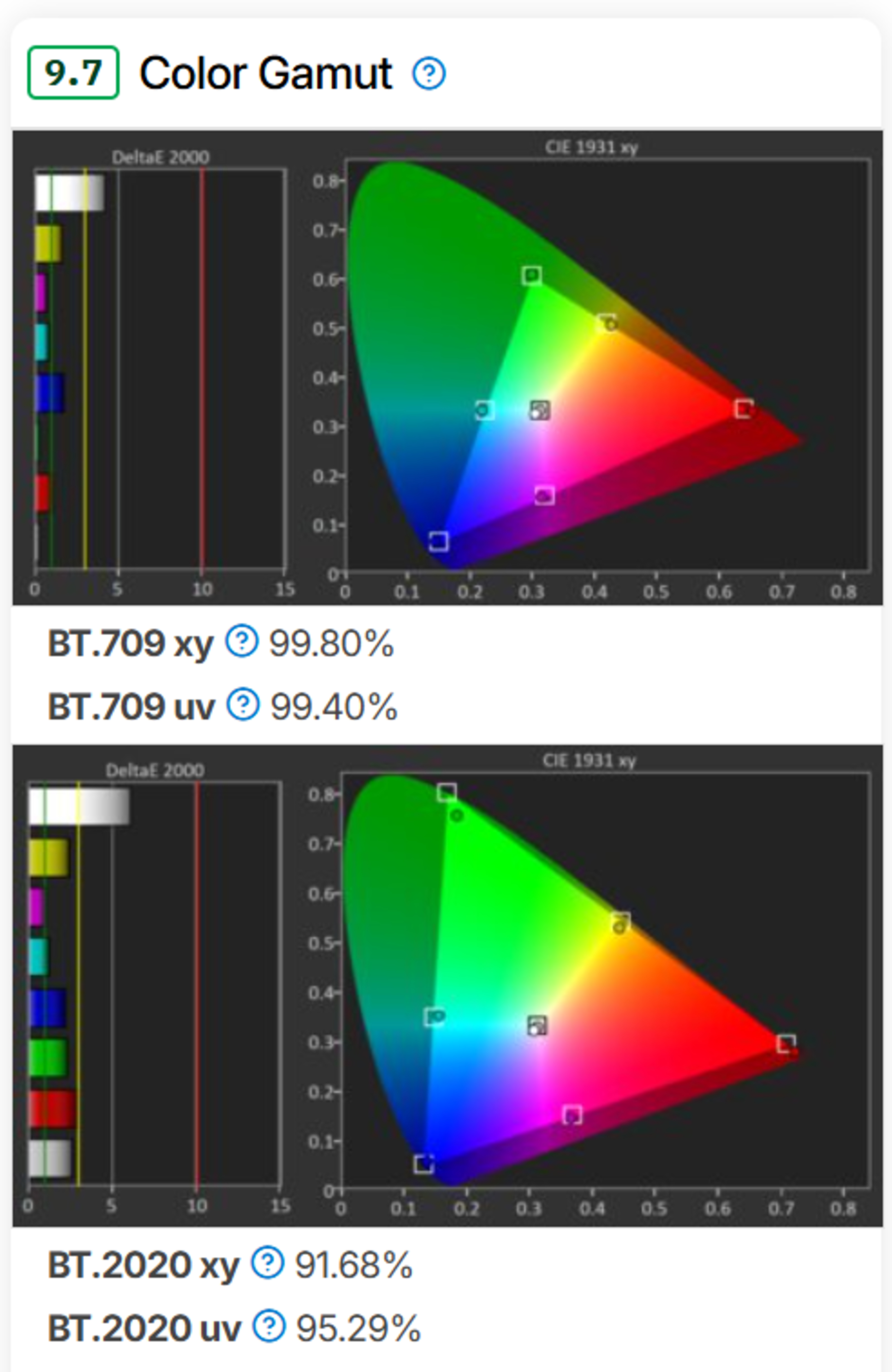
Color Volume replaces our previous Color Gamut test because it provides a more complete picture of the colors a projector can reproduce. A traditional color gamut measurement shows the outer boundary of the projector's colors on a flat, two-dimensional chart. It can show that a projector reaches a deeply saturated green, for example, but not whether it maintains that saturation as green becomes lighter or darker. CIELAB color volume adds lightness as a third dimension, so two projectors with similar color gamuts can still have noticeably different color volumes.
The examples below show how the two tests visualize the XGIMI HORIZON 20 Max. Their scores aren't directly comparable, but the previous Color Gamut test shows the outer boundaries of its color range on flat charts, while the Color Volume test uses a series of rings to show how that range changes across different lightness levels.
 |
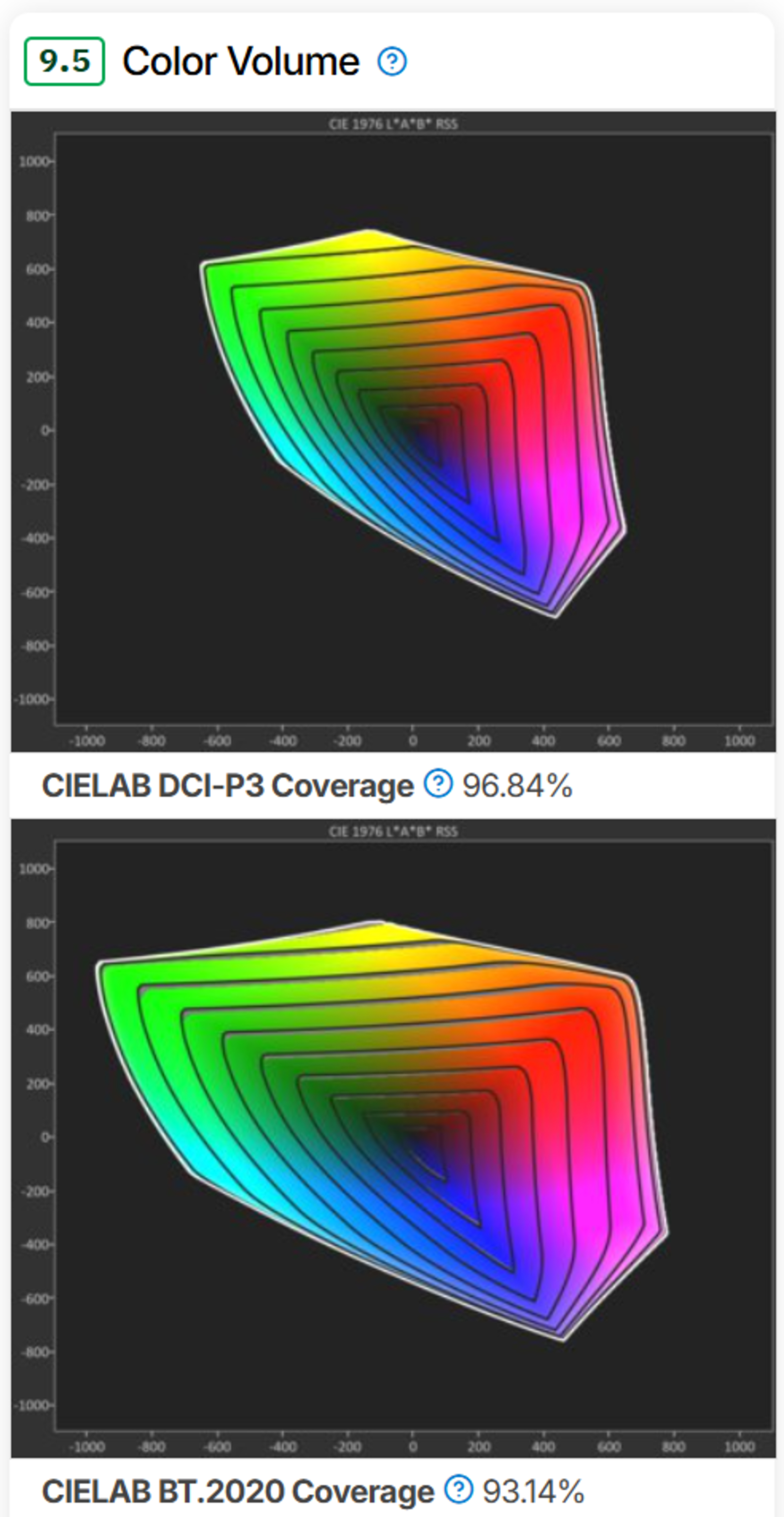 |
That difference can be visible in colorful scenes, as they can look richer on a projector that maintains a wider range of colors across different lightness levels. With more limited coverage, some colors may be pulled toward less saturated shades and look muted or washed out.
Most standard SDR movies and shows use the smaller Rec. 709 color space, so they don't normally require the wider DCI-P3 or BT.2020 ranges. Color Volume matters more when content uses colors beyond Rec. 709 or when you deliberately use a projector's wider color space setting for more saturated SDR playback. Many titles that use these wider color spaces are distributed in HDR, but our test remains entirely SDR: it measures the projector's available color range rather than how it processes an HDR signal. A large color volume also doesn't guarantee accurate color, so it's useful to consider this result alongside our Color Accuracy and Brightness tests.
Our Tests
We run the Color Volume test after calibrating the projector and selecting its widest available color-space setting. For lamp-based projectors, we warm the projector up for at least 15 minutes so its brightness and color output have time to stabilize. We use the same screen, dark room, measurement position, and 100-inch image size for every projector, so the results are comparable.
We use Calman software to display 602 SDR color samples covering many colors and lightness levels. A Colorimetry Research CR-100 colorimeter measures the reflected image from the screen. Before testing, we profile the colorimeter to the projector with a Colorimetry Research CR-250 spectroradiometer, which helps account for differences between projector light sources.
Once the measurements are complete, Calman compares the measured colors with the DCI-P3 D65 and BT.2020 reference volumes. It calculates the percentage of each target that the projector covers and generates a gamut ring intersection plot. Each ring represents the projector's color range at a different lightness level, allowing you to see where the projector maintains saturation and where its color range begins to narrow.
Only the portions of the measured volume that fall inside the reference target count toward the result. Producing colors outside the target doesn't compensate for colors missing elsewhere. Both coverage scores are calculated objectively from the measured data.
CIELAB DCI-P3 Coverage
This test determines how much of the DCI-P3 D65 color volume the projector can reproduce. DCI-P3 covers a considerably wider range of colors than the Rec. 709 gamut used by most standard SDR content.
We compare the projector's measurements with the DCI-P3 target and calculate the percentage of the target volume it covers. In the gamut rings intersection plot below, the gray areas around the edges of each colored ring show the portions of the target that the projector can't fully reproduce.
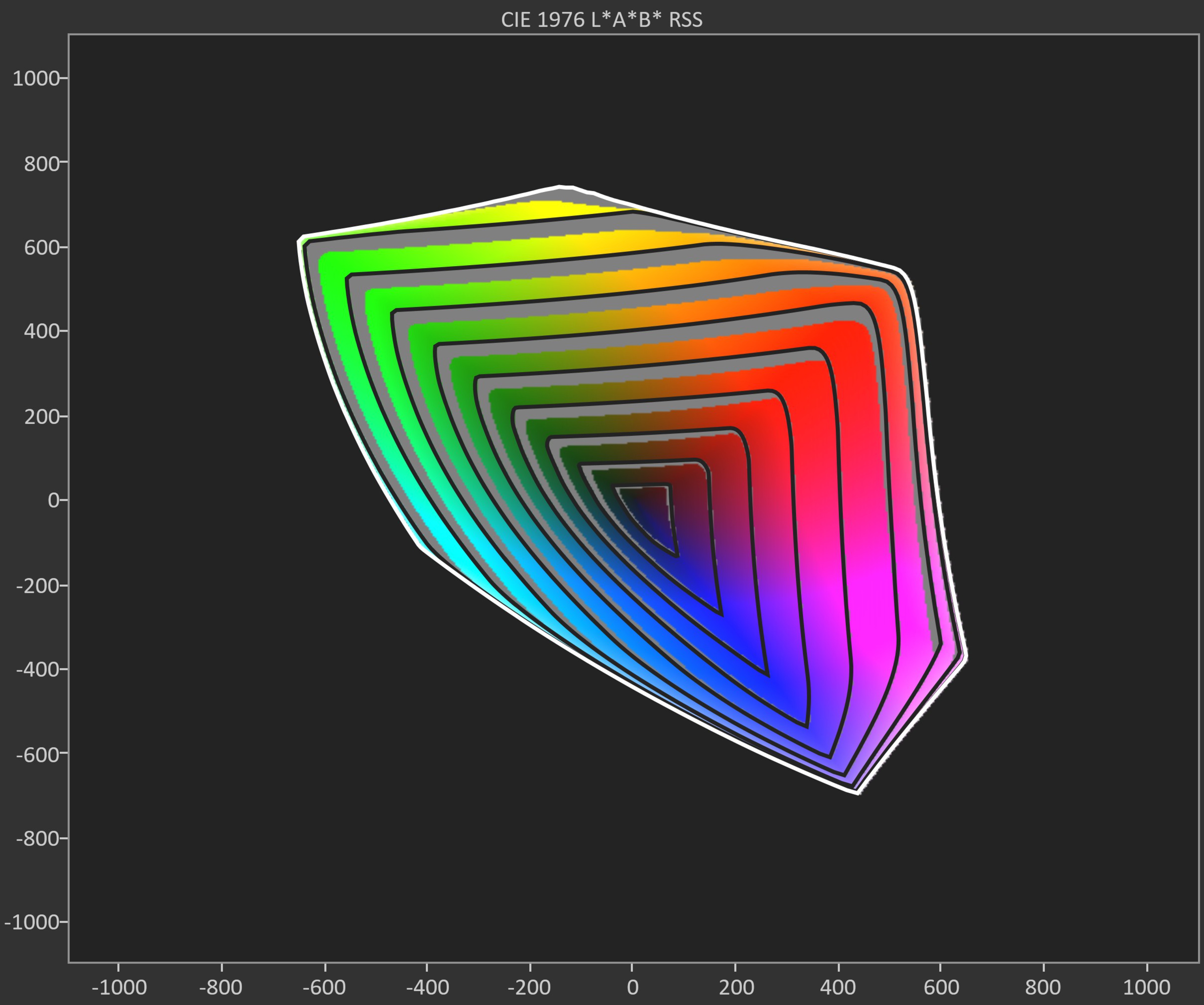
A projector with high DCI-P3 coverage maintains more of the target's colors across different lightness levels. With lower coverage, some saturated colors may look less vivid, or they may lose saturation as they become lighter or darker. DCI-P3 Coverage accounts for 75% of the overall Color Volume score because it's the more relevant of our two targets for most current wide-color-gamut content.
CIELAB BT.2020 Coverage
This test determines how much of the BT.2020 color volume the projector can reproduce. BT.2020 is substantially larger than DCI-P3 and includes highly saturated colors that are difficult for current projectors to cover completely.
We compare the same measurements with the larger BT.2020 target. Since that target extends considerably farther than DCI-P3, its coverage percentage is normally lower.
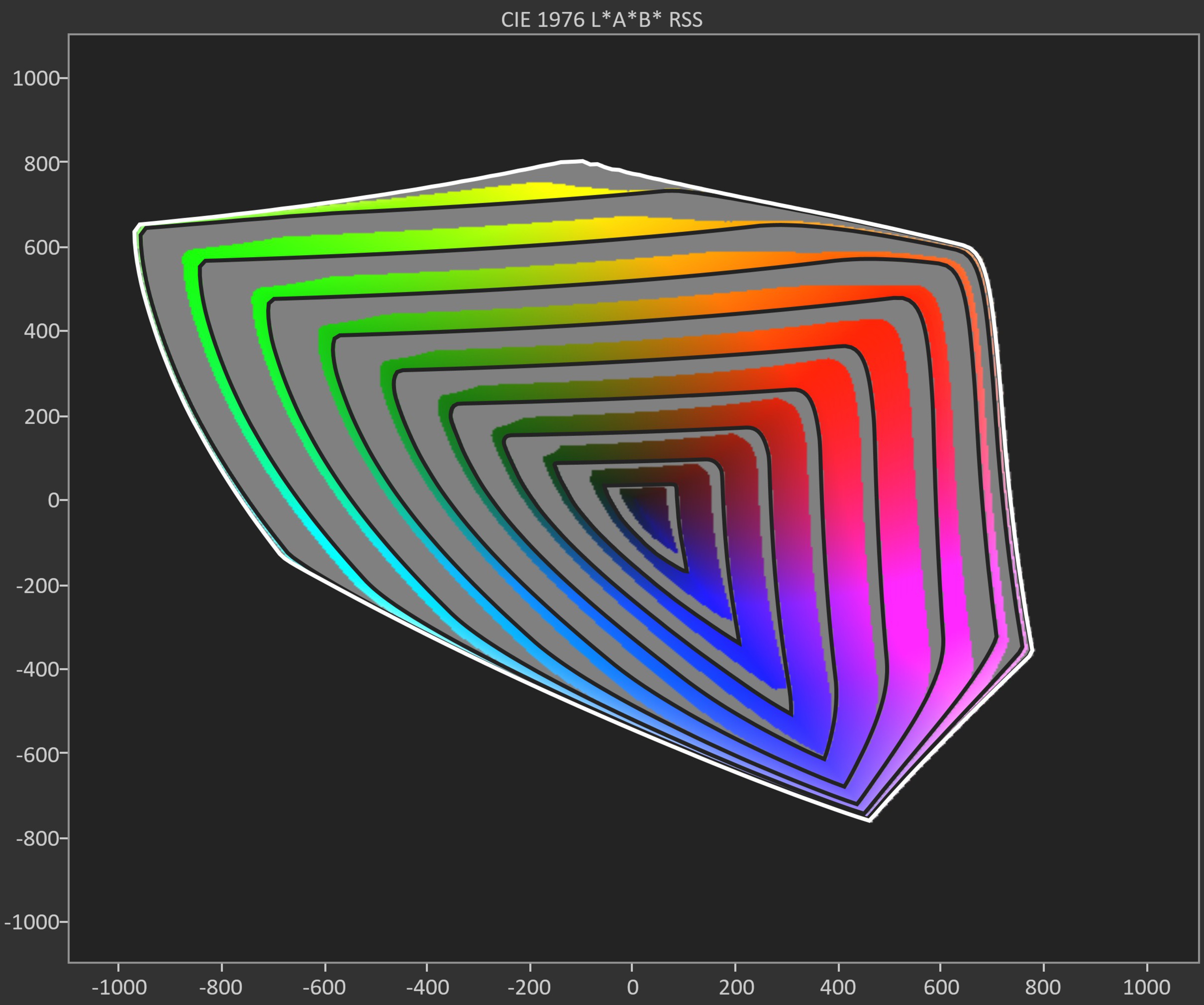
This result helps distinguish between a projector whose available color range remains close to DCI-P3 and one that can reproduce additional colors farther into the BT.2020 space. BT.2020 Coverage accounts for 25% of the overall Color Volume score because colors beyond DCI-P3 are used less frequently.
Additional Information
What This SDR Test Can Tell Us About HDR Content
Although we perform this test entirely in SDR, many movies, shows, and games that use DCI-P3 or BT.2020 colors are delivered in HDR. Projector owners commonly encounter this content when streaming HDR movies and shows, watching 4K Blu-rays, or playing HDR games on a console or PC. The SDR result can therefore provide some indication of the physical color range the projector has available for wide-gamut content.
However, it isn't a direct measurement of how those colors will look when the projector receives an HDR signal. A projector may use different picture modes, color processing, filters, or gamut mapping in HDR, so its handling of an HDR source may differ from what we measure with our standardized SDR workflow.
Our current projector methodology doesn't test HDR color volume, HDR tone mapping, PQ tracking, highlight handling, or HDR color accuracy. The Color Volume score, therefore, shouldn't be interpreted as an HDR-performance score. It only measures DCI-P3 and BT.2020 coverage using an SDR signal.
Using an SDR signal lets us isolate the projector's color-range capabilities without introducing HDR metadata or tone-mapping behavior. Every projector receives the same standardized measurement patterns, making the results easier to compare directly.
Why Projector Setup Affects Color Volume
A projector's image is measured after reflecting from a screen, so the screen is part of the complete imaging system. Its material, gain, tint, and viewing angle can all affect the measured image. We use the same screen, room, image size, and measurement position for each projector to ensure comparable results.
Image size affects how much light reaches a given area of the screen, while ambient light raises the visible black level and can make colors appear less saturated. A projector with wide measured color volume may therefore look less colorful in a bright room than it does under our controlled testing conditions.
Some projectors use a color filter or dedicated wide-gamut mode to produce more saturated colors. These modes can reduce light output or affect color accuracy, so the setting that produces the widest measured color volume may not always provide the best overall image for every room or screen size.
Conclusion
Our SDR Color Volume test shows how much of the DCI-P3 and BT.2020 color volumes a projector can reproduce across different lightness levels. The coverage scores and gamut rings intersection plots reveal where colors remain saturated and where they begin to wash out, making it easier to compare projectors' wide-color capabilities.
Acknowledgments
We'd like to acknowledge Dr. Kenichiro Masaoka of the NHK for his pioneering work in developing gamut rings. His contributions have significantly advanced our understanding of color gamut visualization, helping researchers and industry professionals analyze and compare color reproduction more effectively. We would also like to acknowledge Dr. Euan Smith for the development of the gamut rings intersection plots we use in this test.