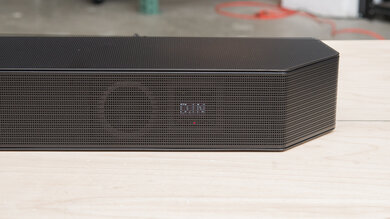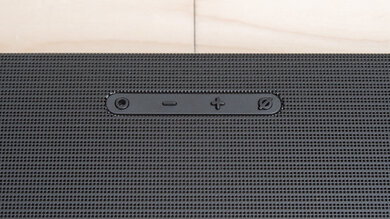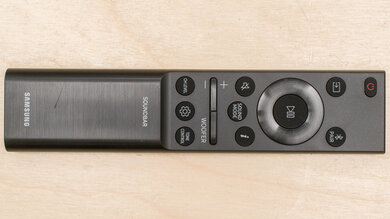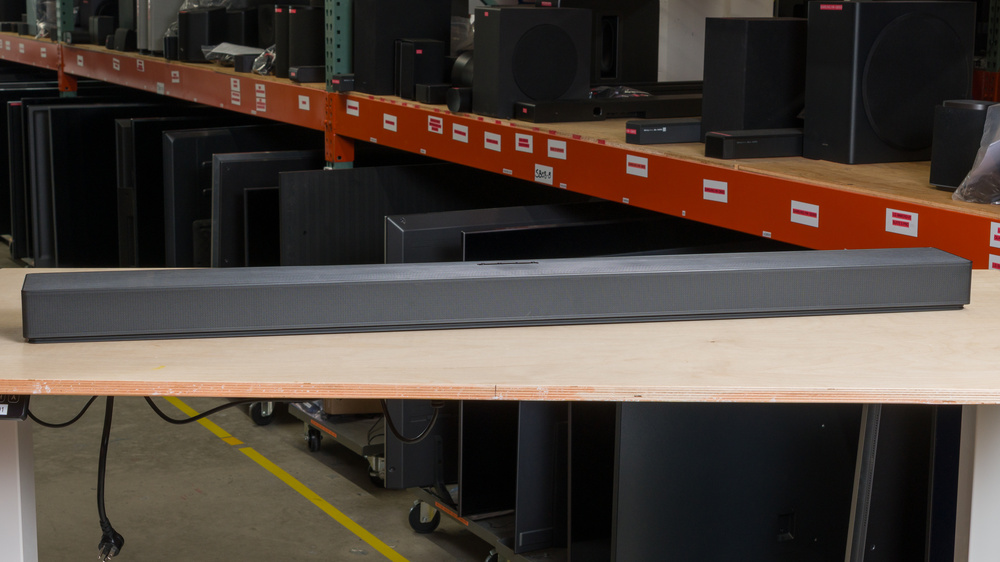
The Samsung HW-QS90H is a 2026, 7.1.2-channel, all-in-one soundbar from consumer home theater giant Samsung. It riffs on the concept of similar bar-plus-sub combos like the Samsung HW-Q900H, but trades the discrete subwoofer for four integrated woofers instead. While this design saves on space and can be perfect in apartment or shared-living situations, prospective buyers should consider whether the quad woofer design matches up to other all-in-one soundbar solutions from Sonos, Klipsch, and LG.
Our Verdict
The Samsung HW-QS90H is very good for mixed usage. The bar has a slew of customization options and enhancement features that make it a good option for dialogue-heavy content and nighttime listening. Despite the lack of a subwoofer, the bar has enough low-bass on tap that you're not without rumbly cinematic effects for your favorite action blockbusters. Audio latency is low across both HDMI connections, so the bar won't contribute to audio/visual desync when gaming. That said, you'll want to stick with the eARC connection since the soundbar can't passthrough 4k @ 120HZ video signals, which most consoles support.
Low audio latency via HDMI.
Extensive sound enhancement and customization.
Somewhat limited low-bass rumble.
The Samsung HW-QS90H is very good for dialogue-heavy content like TV shows. While the center channel doesn't get particularly loud relative to the other channels, the bar's default behavior with room correction enabled pushes voices and speech to the front of the mix and keeps dialogue intelligible even when whispered. That said, voices can sound digital or overprocessed to some, which you can avoid by disabling room correction. If you're on the other side of the spectrum and still find them hard to make out, the bar has two voice enhancement features you can use to make dialogue even clearer.
Low audio latency via HDMI.
Extensive sound enhancement and customization.
Voices can sound overly processed
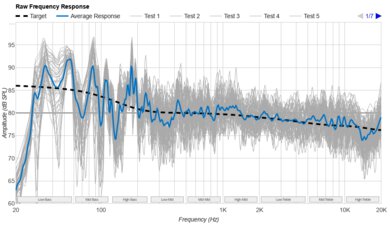
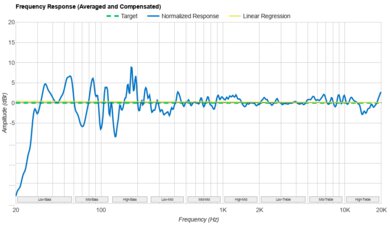
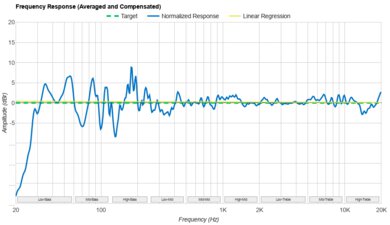
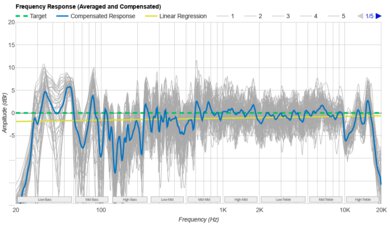
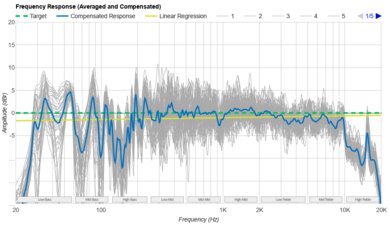
The Samsung HW-QS90H is good for music. Its stereo frequency response with room correction is warm, featuring an extra helping of mid- and high-bass energy for punchy kicks and boomy explosions. That said, the recessed treble range can reduce articulation in complex vocals and guitar riffs. The bar features a wide range of playback options via Wi-Fi and Bluetooth, and there's support for Tidal, Roon, and Spotify. You can also enable different sound modes to up-mix traditionally stereo content to the side-firing and up-firing drivers if that style of presentation suits your tastes. There's also a 7-band EQ if you want to take tuning decisions into your own hands.
Broad music streaming service support.
Extensive sound enhancement and customization.
Recessed treble muffles articulation.
The Samsung HW-QS90H is good for movies. While it doesn't have a discrete sub, the four integrated woofers take this all-in-one bar quite far. The bar doesn't output a chest-shaking amount of rumble, but there's enough to keep you immersed in the latest Sci-Fi releases. If you find the default tuning doesn't suit your tastes, or you'd like a bit more height or surround effects, you can always fine-tune the bar with the comprehensive 7-band EQ and channel-level adjustments via the app. There's also support for both DTS and Dolby family audio formats, making the bar a good pickup even if you have an older physical media collection.
Low audio latency via HDMI.
Extensive sound enhancement and customization.
Somewhat limited low-bass rumble.
Check Price
Differences Between Sizes And Variants
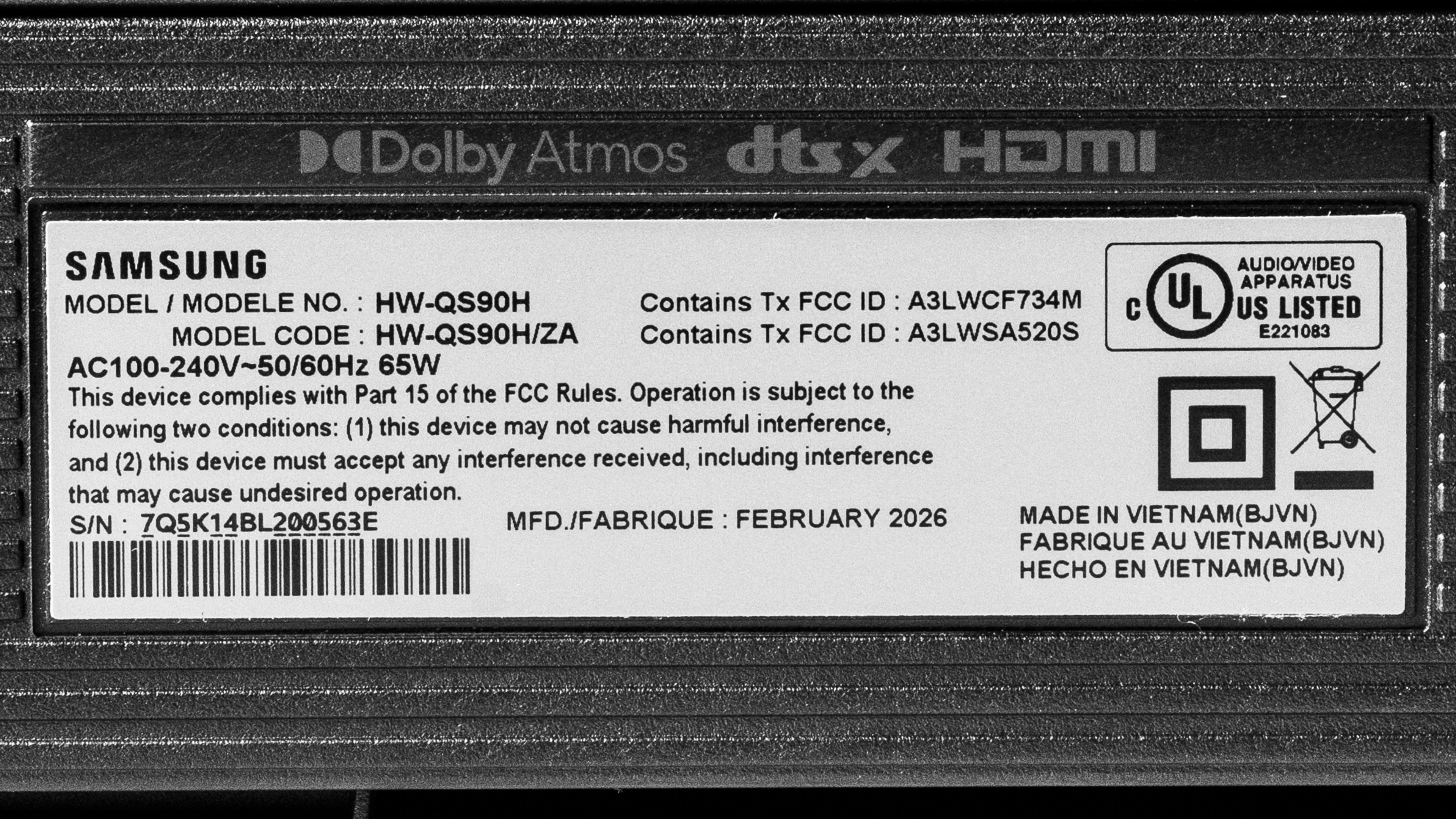
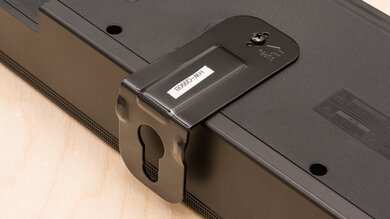
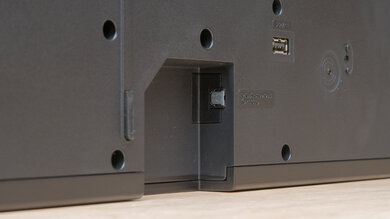
The Samsung HW-QS90H doesn't have any variants, but you can purchase satellite speakers to expand the setup from Samsung. We took a photo of our unit's label.
If you encounter another variant, please let us know in the comments, and we'll update the review.
Popular Soundbar Comparisons
The Samsung HW-QS90H is a premium all-in-one soundbar that competes directly with the likes of the Klipsch Flexus Core 300, Sonos Arc Ultra, and LG Sound Suite H7. While the Samsung is among the best for reproducing low-frequency rumble among these similarly positioned products, it offers the fewest viable expansion options and doesn't have the best connectivity flexibility on the list (though it's far from the worst). All three alternatives are expandable with a wireless sub and satellites, while the Samsung can only expand to include two wireless satellites. And while the Samsung offers HDMI In connectivity, unlike the Sonos and LG, it can't passthrough high refresh rate 4k signals like the Klipsch. If anything, the bar's claim to fame among these competitors is its ability to output height channel information slightly more convincingly than the other three, though it falls behind in other metrics like stereo soundstage.
If you need more options to check out, have a look at our recommendations for the best all-in-one soundbar, the best soundbars with subwoofer, and the best Dolby Atmos soundbars.
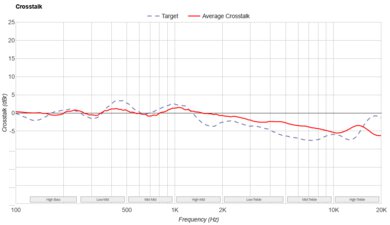
The Sonos Arc Ultra and Samsung HW-QS90H have different strengths. You can expand either system with satellites, though only the Sonos supports adding a discrete sub. It's also worth noting that you can pair the Sonos with home speakers like the Sonos Era 100 or Era 300 if you already own them, giving you more flexibility in how you use each component. That said, the Samsung is the only one that supports DTS audio formats and HDMI In video passthrough, making it the better option for older media collections or for passing through another source device. If you don't plan on expanding either soundbar with more components, the Samsung has deeper bass extension thanks to its four woofer design, but the Sonos has much better stereo tracking and a wider soundstage, alongside a more balanced default sound.
While the Samsung HW-Q800H and Samsung HW-QS90H are similar soundbars, the better of the two depends on your needs. The HW-Q800H comes with a discrete subwoofer, which leads to a better stereo frequency response thanks to its sub-bass output. While it sacrifices 'wide' side-firing drivers, this doesn't make a huge difference in immersion as it still has regular surround 'side' firing drivers. That said, the HW-Q800H has worse stereo tracking than the HW-QS90H (but neither bar is particularly good). Both have the same enhancement and connectivity options, though only the HW-QS90H supports DTS family audio formats. So if you don't have the space for a subwoofer or media you want to play requires DTS format support, the HW-QS90H is the better option for you.
The Klipsch Flexus Core 300 is better than the Samsung Hw-QS90H for most people. Both devices get similarly loud, output roughly the same amount of bass, and have comprehensive sound enhancement features. That said, the Klipsch has better connectivity as its one HDMI In port supports video passthrough with signals up to 4k @ 120Hz while the Samsung is limited to 60Hz. There's also a subwoofer line out on the Klipsch, so you can use a subwoofer you have lying around rather than purchase a new one. While the Samsung has louder up-firing drivers for height channel information, the Klipsch has smoother stereo tracking and a more balanced surround output.
The Samsung HW-Q990H is a better soundbar than the Samsung HW-QS90H, provided you have the space for satellites and a subwoofer. As you'd expect from a bar with additional components, the HW-Q990H outperforms the HW-QS90H in almost every sound metric we test, as its performance is bolstered by additional drivers and a dedicated subwoofer. It also has better connectivity, with two HDMI In ports that support 4k @ 120Hz passthrough compared to the HW-QS90H's single port capped at 4k @ 60Hz. Video passthrough doesn't matter to everyone, but it's beneficial if you have few ports on your TV and want to connect multiple consoles or a gaming PC. That said, if you're limited on space, the HW-QS90H is a no-brainer, especially since its four integrated woofers do a solid job outputting low-frequency rumble.
Test Results
for pictures & test results
for pictures & test results

for videos & test results

for videos & test results