Choosing the right mattress firmness can make all the difference between a restful night's sleep and hours of tossing and turning. A mattress that's too soft can feel like sinking into a hammock, while one that's too firm can feel like lying directly on the floor. In either case, you miss out on proper pressure relief and support, leaving you more likely to wake up on the wrong side of the bed. If you're shopping for a new mattress and wondering what really sets a medium-plush mattress apart from a medium-firm one, keep reading. We'll break down how we test mattress firmness and how to choose the right firmness level for your body type, sleeping position, and preferences.
Test results
Why Firmness Matters
A mattress has a couple of main jobs: to support your body by keeping your spine in a straight line, and to relieve pressure so you're comfortable throughout the night. It's also worth noting that firmness is subjective. While your sleeping position, body type, and factors like back pain or pressure sensitivity impact how firm a mattress feels to you, personal preference also plays a role. If you prefer a very firm mattress, for example, even a medium model might seem overly plush to you. That's why we test each mattress's firmness based on objective, measurable criteria. With the right information, you can compare firmness levels between brands and models, so you can find the one that's "just right" for you.
How We Objectively Test Firmness
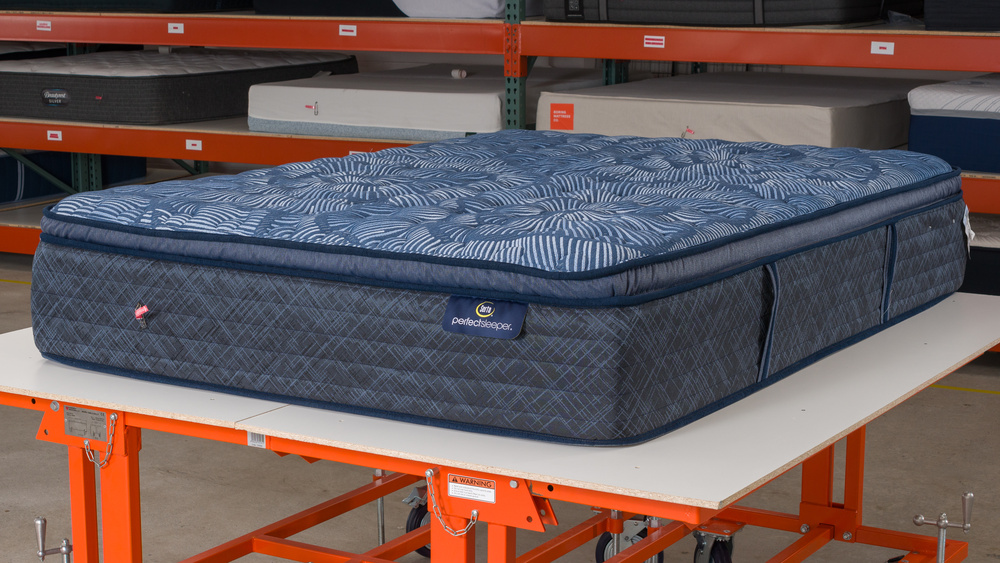
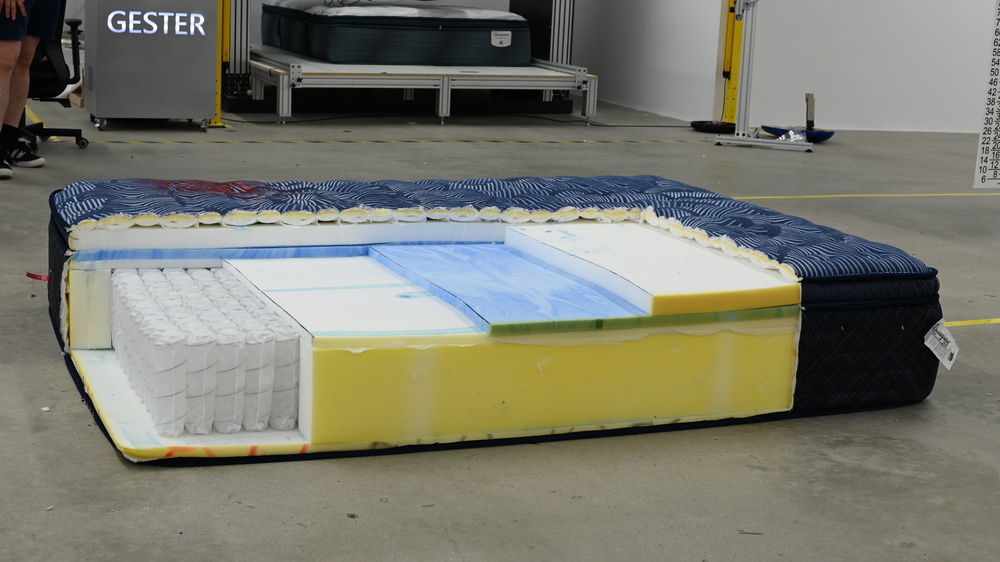
While we test each mattress for its overall firmness level, we also test each layer of foam and springs that make up a mattress for their individual firmness levels. Knowing the firmness level of each component can be handy since two mattresses with the same overall firmness level can feel very different. To show how we test each component and the mattress as a whole, we'll take a closer look at the Serta Perfect Sleeper Innerspring.
 |
 |
Mattress
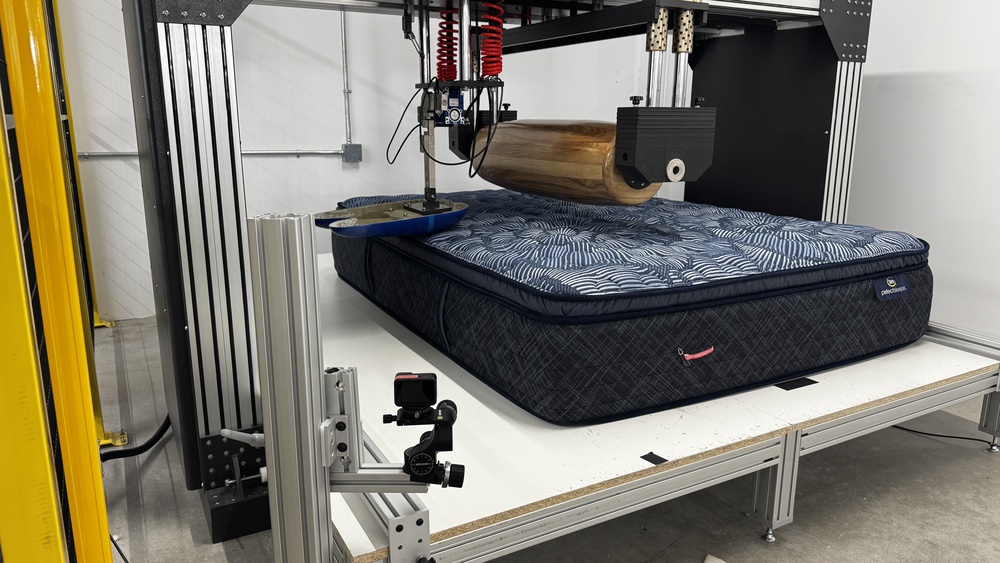
A mattress's firmness level can change a lot in the first month or so of use, so we need to break it in before we can begin testing. The first thing we do is unbox the mattress, lay it flat, and let it rest for at least a week. Once the mattress is ready, testers place it in the center of the mattress firmness testing machine so that a large wooden roller sits above the mattress's center. Then, the roller moves back and forth over the mattress 100 times, applying 1400 N of pressure each time, simulating a month of use.
When the mattress is ready for firmness testing, it goes back into the testing machine. A 355 mm diameter platen compresses the mattress, and we record the load-deflection curve. From this curve, we can see how much the springs resist pressure at three points: 1.5 kPa, 2.1 kPa, and 2.8 kPa. This gives us the normalized stiffness of the mattress. This is repeated at the lumbar and head/foot of the mattress, giving you an idea of the firmness level throughout the whole mattress. The result at the lumbar is then matched to the appropriate firmness level: plush, medium-plush, medium, medium-firm, or firm.
|
The Serta Perfect Sleeper Innerspring undergoing firmness testing. |
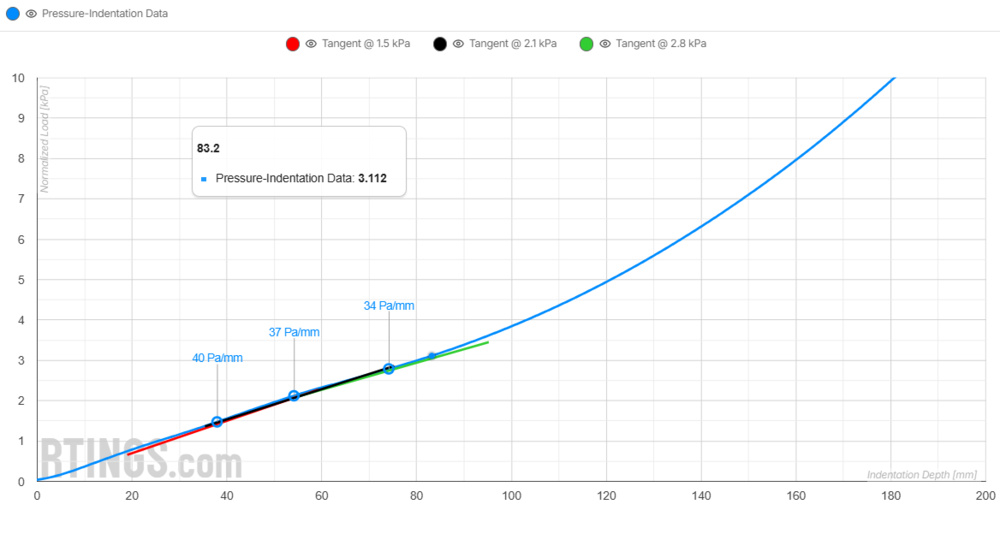
As you can see in the above graph, the mattress is quite soft at the head and foot of the bed, with a normalized stiffness of 37 Pa/mm.
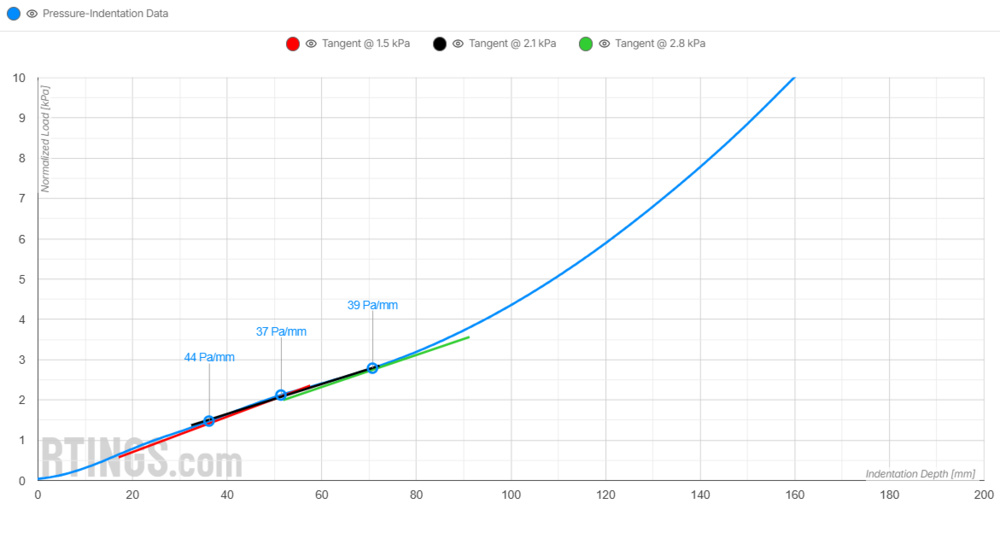
It's slightly firmer in the lumbar region, with a normalized stiffness of 40 Pa/mm. This could provide a bit of extra support for the hips or lumbar, but it won't be a very noticeable difference. Overall, the Serta Perfect Innerspring has a medium-plush firmness level, which we recommend for lighter and average side sleepers, since it allows the hips and shoulders to sink far enough into the mattress. It's also a good fit for lighter back and stomach sleepers who prefer a plush feel, since heavier and even average-sized sleepers will sink too far in to maintain spinal alignment.
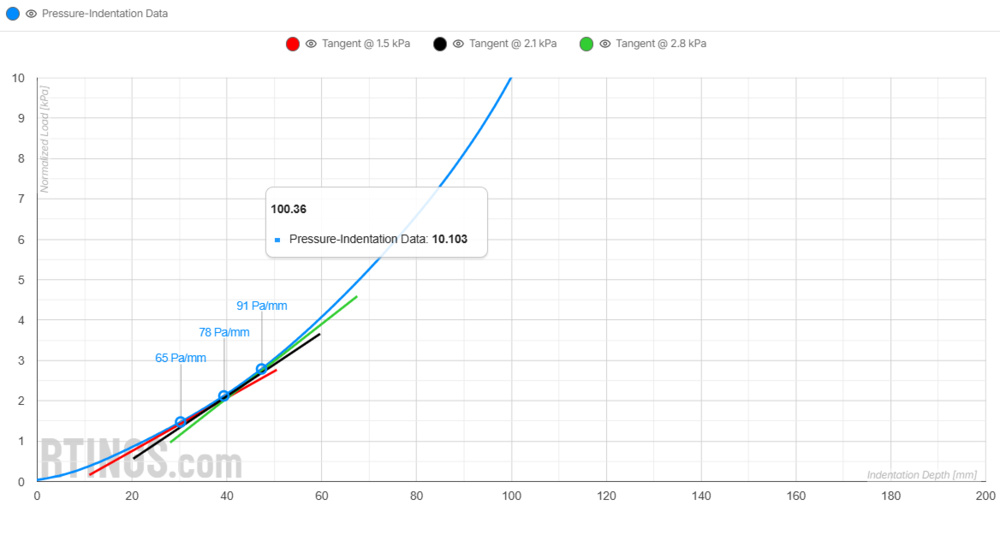
For contrast, here are the firmness graphs for a much firmer mattress, the Sleep On Latex Pure Green Organic.
 |
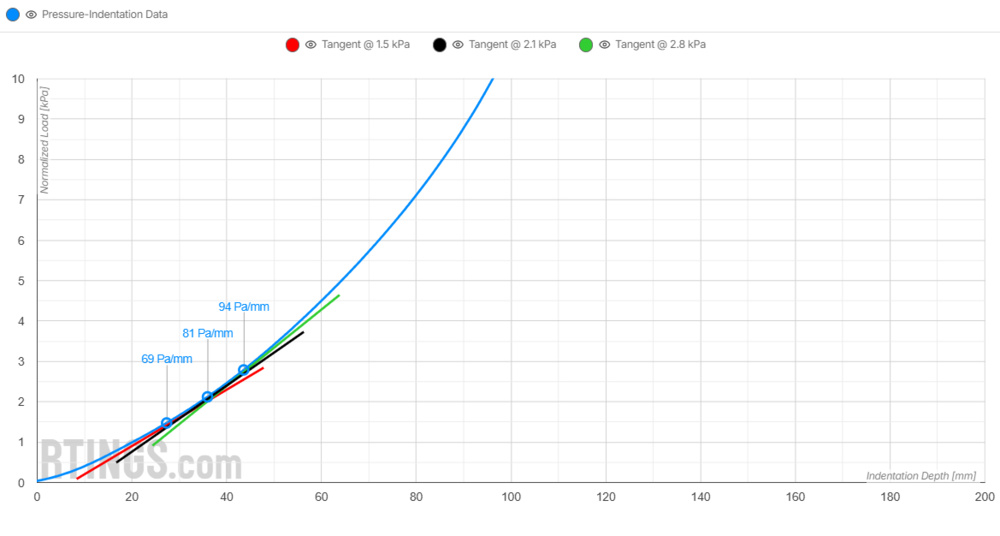 |
We recommend the Sleep On Latex Pure Green Organic only for average and heavier back and stomach sleepers, though it's so firm that even some people in that category will find it too firm. Lighter people and stomach sleepers require something much softer, as the firm surface creates pressure points for these sleepers.
Foam
To understand how firm an individual layer of foam is, we find the Indentation Pressure Deflection (IPD). Basically, this is a measure of how much pressure it takes to compress the foam by 25% and 65%. To get these results, we prepare a sample of foam 380 mm x 380 mm x 100 mm. Of course, mattress foam isn't usually 100 mm thick, so testers usually need to glue layers together to reach the right measurements. Once the sample is prepared, we use a foam firmness testing machine with a 200 mm diameter platen. During the test, the platen presses down on the foam and holds it in place for one minute. The pressure needed to compress the foam by 25% is then recorded as the IPD.
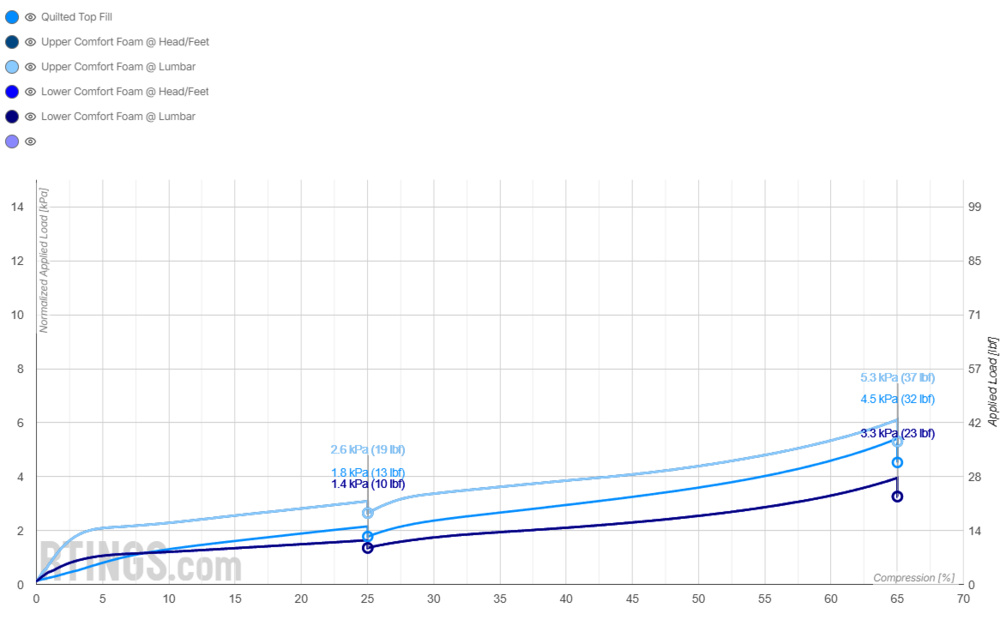
As the above graph shows, the Serta has three comfort layers of foam, two of which are measured at the head/foot and lumbar regions. The quilted top has a layer of polyfoam and fiber fill, and as we can see, the polyfoam is quite soft at 1.8kPa. This gives the mattress a plush feeling and makes it highly contouring, so it molds closely around your body and relieves pressure. The next layer down is polyfoam, and at 2.6kPa, it's considered medium-soft. While this isn't very firm, it's still the firmest comfort layer and makes the mattress a bit easier to move around on while maintaining the mattress's overall plushness. Finally, the lower comfort layer is memory foam, and with an IPD of 1.4kPa, it's very soft. This is expected of memory foam, which is typically soft and slow-moving. It adds even more softness and contouring.
This mattress has one more layer of foam, the transition layer. It's a polyfoam layer with an IPD result of 4.1kPa, making it medium-firm. As the name suggests, this layer provides a smooth transition between the soft comfort layers and the firmer support layer below. While the plush comfort layers allow you to sink into the mattress and contour your body, and the spring layer supports the heaviest parts of your body, like the hips or lumbar, the transition layer helps distribute weight evenly and prevents you from feeling the firmness of the support core too abruptly. In the case of this mattress, pocket springs make up the support layer, but for foam mattresses, support layer details would also be included in this graph.
In general, side sleepers tend to prefer both comfort and support foams with a lower IPD, while back, stomach, and heavier sleepers benefit from foams with a higher IPD. See what we recommend in the chart below.
| Side Sleepers | Back & Stomach Sleeper | |
| Comfort Foam | < 2 kPa IPD | > 2 kPa IPD |
| Support Foam | < 5 kPa IPD | > 5 kPa IPD |
Springs
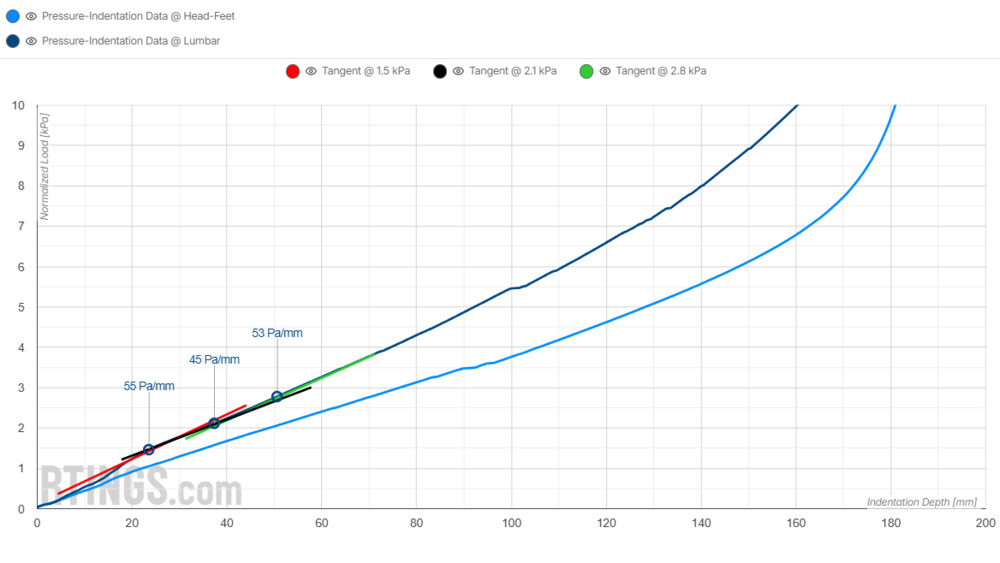
The process for finding the firmness of the spring layer is similar to finding the firmness of the mattress overall. After taking the mattress apart, testers place the spring layer into a mattress firmness testing machine. This time, a 355 mm diameter convex plate compresses the springs, and we record the load-deflection curve. From this curve, the Normalized Stiffness is calculated from three points: 1.5 kPa, 2.1 kPa, and 2.8 kPa. This is repeated at the lumbar and the head/foot of the bed, and for the comfort layer of springs, if there is one.
|
The spring layer of the Serta Perfect Sleeper Innerspring during the testing process. |
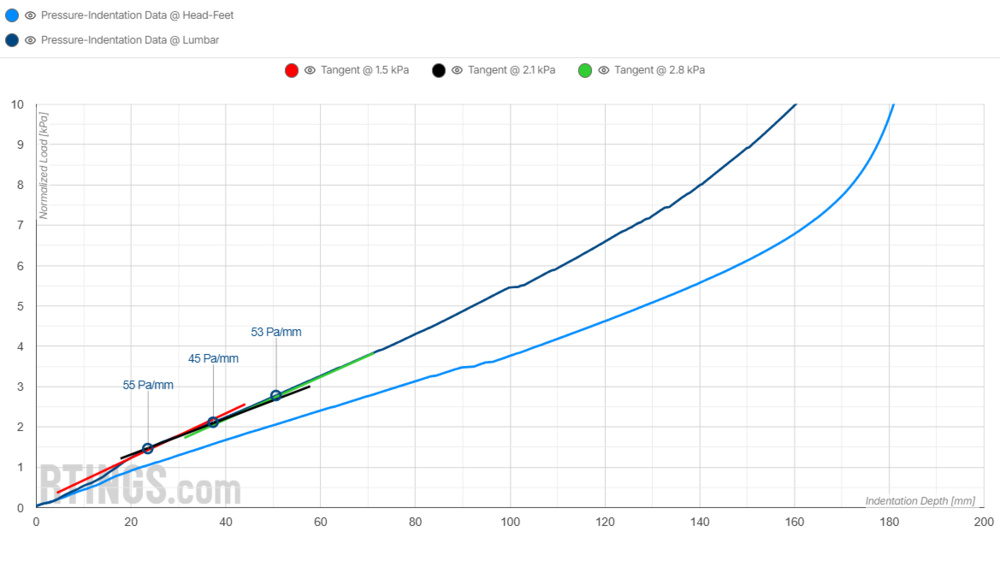
In this case, the graph shows that the Serta's spring layer is very soft, especially at the head and foot of the mattress. The normalized stiffness for the lumbar region is 51 Pa/mm, which is in line with other medium-soft mattresses. The normalized stiffness at the head/foot, on the other hand, is 37 Pa/mm, very soft even given the overall firmness rating. This configuration provides flexible support with extra stability for the hips if you sleep on your side.
While the springs in this mattress are a good choice for side sleepers, stomach and back sleepers benefit from firmer support, as shown below.
| Side Sleepers | Back & Stomach Sleepers | |
| Comfort & Support Springs | < 65 Pa/mm | > 65 Pa/mm |
How To Choose The Right Firmness Level
The most important considerations when choosing a mattress firmness are your sleeping position and size, though other factors like back or joint pain and, of course, personal preference are also worth considering.
When it comes to sleeping position, side sleepers benefit from a mattress on the softer end of the range. This allows the hips and shoulders to sink farther into the mattress, so there's not too much pressure on the shoulder, and the spine stays aligned. Back and stomach sleepers need something firmer with enough support to keep the lumbar from sinking too far, again, keeping the spine aligned.
As for body size, the more you compress a mattress, the softer it'll feel. So, lighter people perceive mattresses as firmer, while heavier people compress the materials further and perceive them as softer.
You can use the chart below to determine the ideal firmness level for you.
| Firmness Level | Normalized Stiffness | Side Sleepers | Back & Stomach Sleepers |
| Plush | < 37 Pa/mm | Lighter | Not Recommended |
| Medium-Plush | 37 - 42 Pa/mm | Lighter & Average | Lighter |
| Medium | 43 - 49 Pa/mm | Average to Heavier | Lighter to Average |
| Medium-Firm | 50 - 60 Pa/mm | Heavier | Lighter to Average |
| Firm | > 60 Pa/mm | Not Recommended | Average & Heavier |
While the overall firmness level is the most important factor to consider, after testing a few mattresses, you may also find that you prefer a specific firmness level in the components. For example, you might prefer a flexible spring or foam support layer over one that offers more structured support. Or you might discover that you like sleeping on a firmer upper layer rather than one that feels cushy and plush. You may also find you prefer a mattress with more or less support at the lumbar versus the head and foot of the mattress. Figuring out these details can help you find a mattress that's not only the right firmness overall but one that feels balanced, with just the right amount of support, exactly where you want it.
Conclusion
Now that you have the information you need to choose the right mattress firmness, you may want to learn about mattress types or read through our mattress buying guide to find out what else to look out for as you shop. If you're curious what we recommend, you can also jump straight to the best mattresses.