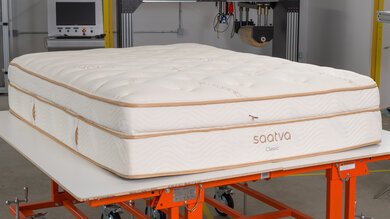
The Saatva Classic (Plush Soft) is a mid-range innerspring mattress. This softer variant of the Saatva Classic includes a thick quilted layer, polyfoam and memory foam comfort layers, comfort layer pocket coils, and Bonnell coils for support. The manufacturer advertises that its cover is made of organic cotton and that the foams in the mattress are CertiPUR-US certified.
Our Verdict
-
7.5Light Weight
-
8.7Average Weight
-
9.0Heavy Weight
The Saatva Classic (Plush Soft) is well-suited for most side sleepers. It offers good body conformity for people in the lighter weight category, so your shoulder will sink in enough for comfortable side sleeping. It offers a fantastic performance for average and heavier people, who will sink more into it and get even better pressure relief. Regardless of weight, your whole body will sink into its plush quilted layer, which also helps with pressure relief. However, if you're in the heavier weight category, you may find that a firmer mattress offers sufficient pressure relief and better support.
Good body conformity for lighter people.
Fantastic body conformity for average and heavier people.
Enveloping feel helps with pressure relief.
-
7.5Light Weight
-
7.0Average Weight
-
6.7Heavy Weight
The Saatva Classic (Plush Soft) is best suited for lighter back sleepers. It offers satisfactory support for people in that weight category, so your spine will stay mostly aligned when sleeping on your back. Its plush, somewhat contouring quilted layer allows you to sink in a little, which helps relieve pressure on your hips. However, it's not ideal for average and heavier back/stomach sleepers, as it's not supportive enough to keep your spine aligned.
Decent support for lighter people.
Enveloping feel helps with pressure relief.
Mediocre support for average and heavier people.
-
7.2Light Weight
-
6.5Average Weight
-
6.2Heavy Weight
The Saatva Classic (Plush Soft) is best suited for lighter stomach sleepers. If you're in the lighter weight category, it's supportive enough to keep your spine mostly aligned. Still, you might prefer a somewhat firmer mattress for stomach sleeping, when support is particularly important to keep your back from arching. It's not a good option for average and heavier stomach sleepers, as its mediocre support performance means your hips won't be properly supported.
Decent support for lighter people.
Mediocre support for average and heavier people.
Changelog
-
Updated Jul 30, 2026:
Compared its performance for side sleepers to the Helix Midnight Elite's in the Firmness box.
- Updated Mar 09, 2026: We converted this review to Test Bench 1.2. We've added sub-usages to the sleeping position usages in the Our Verdict section to clearly show the suitability of a mattress for your weight and sleeping position.
-
Updated Jan 19, 2026:
Compared its motion isolation to the Tuft and Needle Mint's.
- Updated Dec 12, 2025: Review published.
- Updated Nov 03, 2025: Our testers have started testing this product.
- Updated Oct 30, 2025: The product has arrived in our lab, and our testers will start evaluating it soon.
- Updated Sep 30, 2025: We've purchased the product and are waiting for it to arrive in our lab.
Test Results

Longevity
The Saatva Classic (Plush Soft) isn't a very durable mattress. Most of the foam in the mattress is lower-density, lower-quality foam that will start showing signs of wear sooner. You may notice permanent impressions sooner compared to mattresses that use good-quality foam. That said, the transition layer is made of good-quality polyfoam.
Uses mostly lower-quality foam that will show signs of wear sooner.
Like the Saatva Classic (Luxury Firm) and Saatva Rx, most of the foam in the mattress isn't dense enough to be considered good quality. The exception is the polyfoam between the comfort coils and support coils, which is good-quality foam that should resist showing signs of wear for longer. The polyfoam in the quilted layer, the memory foam in the lumbar area, and the polyfoam lower comfort layer are all low-density and are more likely to start forming permanent indentations sooner.
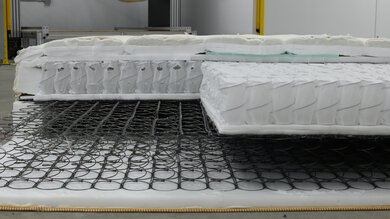
The quilted top includes polyfoam and fiber fill. Most of the other foam layers are made of resilient polyfoam, including the lower comfort and transition layers. While the strip of memory foam in the lumbar area is less bouncy and responsive, which is normal for memory foam, overall, the foam layers contribute to the mattress's very responsive feel.
Pressure Relief
The Saatva Classic (Plush Soft) offers a good pressure relief performance for most people. If you're in the lighter weight category, you'll compress it enough for comfortable side sleeping. It also offers fantastic body conformity for average and heavier people, so you won't feel a lot of pressure on your arm or shoulder when side sleeping. The mattress's thick quilted layer is very soft, and you'll sink into it easily, regardless of your weight, which also helps with pressure relief.
Good body conformity for lighter people.
Fantastic body conformity for average and heavier people.
Enveloping feel helps with pressure relief.
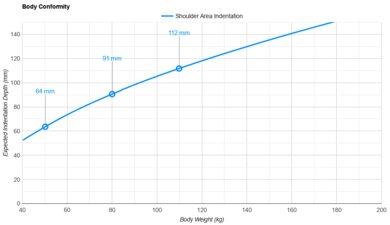
This mattress offers sufficient body conformity for most people. If you're in the lighter weight category, it has a good performance. Your shoulder will fully compress its quilted layer, and you can sleep on your side without feeling uncomfortable pressure. It offers even better conformity for people in the average weight category, who will compress the mattress even more. Its body conformity is also fantastic for heavier people, so it'll effectively relieve pressure when you're sleeping on your side. However, both your hips and shoulder will sink about 4.4"/11.2 cm into it, and if you don't like to sink very far into your mattress, it's worth noting that many firmer mattresses also offer good pressure relief for people in the heavier weight category.

Support
The Saatva Classic (Plush Soft) is most supportive for people in the lighter weight category. This medium-plush mattress does a decent job of preventing the heavier parts of your body from sinking in further than the rest, so your spine stays mostly aligned when sleeping on your back or stomach. However, it offers mediocre support for people in the average and heavier weight categories, who will probably prefer a firmer mattress for comfortable back or stomach sleeping.
Decent support for lighter people.
Mediocre support for average and heavier people.
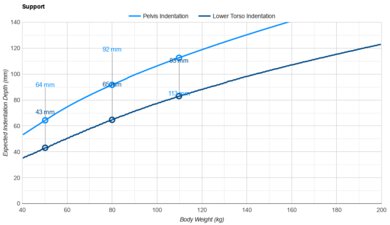
This mattress is most supportive for lighter people. It does a decent job of keeping lighter people's hips supported, making it suitable for back and stomach sleeping. However, it's much less supportive for people in the average and heavier weight categories, so your hips will sink in further than the rest of your body, making it less suitable for back sleepers and especially stomach sleepers.
Cooling
The Saatva Classic (Plush Soft) has a great cooling performance. It dissipates a decent amount of heat during the first hour of sleep, it but does an excellent job of moving heat away from you over an eight-hour night. It's cooling enough for hot sleepers, especially if you're more likely to feel overheated later on in the night.
Cooling enough for hot sleepers.
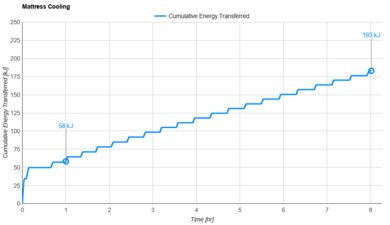
It has a great cooling performance. It dissipates a decent amount of heat in the first hour you're in bed, so it doesn't feel particularly cool or hot as you're falling asleep. However, it does an excellent job of dissipating heat overnight, making it a good option for hot sleepers, especially if you're mostly bothered by heat later in the night.
Motion Dissipation
The Saatva Classic (Plush Soft)'s motion dissipation performance is just okay. It doesn't do a good job of localizing movements, so if your partner rolls over, you'll feel it near the source, in the lumbar area, as well as at the head and foot of the mattress. Motion also dissipates slowly, so when your partner rolls over, you may feel the mattress wobble a bit afterwards. Overall, it's not the best option if you sleep with a partner and want a mattress that absorbs movement.
Motion dissipates slowly.
You'll feel movements all over the mattress.
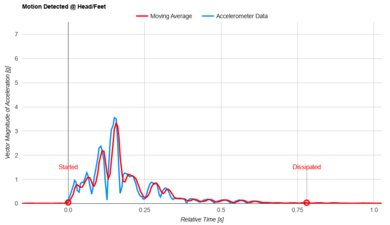
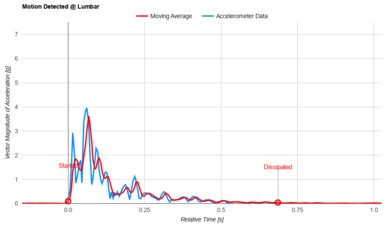
Its motion isolation performance is just okay, so it's not ideal if you sleep with a partner. You'll feel your movements near the source and across the mattress. Motion also takes a while to dissipate, so you may feel the mattress wobble or jiggle after someone moves, which makes motion more likely to wake you. If you're looking for a mattress for side sleep with better motion dissipation, you might prefer the Tuft and Needle Mint.
Responsiveness
The Saatva Classic (Plush Soft) is very responsive. Its upper comfort layers respond to your movements quickly, so you don't feel tightly hugged or constricted. It's also a very bouncy mattress, which adds to its springy feel and helps make it feel easier to change sleeping positions.
Bouncy feel makes it feel easy to change sleeping positions.
High responsiveness, so you don't feel stuck in place.
It's extremely responsive. It responds to your movements very fast, so you won't feel stuck in place.
The comfort springs are moderately bouncy, so they offer more push-back and create a springier feel compared with some other mattresses' comfort coils, such as the Stearns & Foster Lux Estate or the Saatva Rx. The support coils are extremely bouncy, which helps explain the mattress's very springy overall feel and helps make it feel easier to move around on.
It's a very bouncy mattress. It pushes back against your movements, giving it a springy feel that makes it feel easier to change sleeping positions and less likely to make you feel stuck in place.
The quilted layer is very resilient, or bouncy, which helps give the mattress its responsive feel. The memory foam in the lumbar area has much lower resilience, so it doesn't offer much 'push-back,' and you'll easily sink into it. The lower comfort and transition layers are also very resilient, which also helps explain the mattress's very responsive feel overall.

The Saatva Classic comes in 14.5" (36.8 cm) and 9.5" (24.1 cm) variants that have the same feel and performance, according to the manufacturer. Ours is a 14.5-inch unit, but measured a little more at 15.1"/38.3 cm. You may need to use deep-pocket fitted sheets.
Note: We photographed the mattress from the right side (from the foot of the bed) instead of the usual left side, because our unit arrived soiled from shipping.
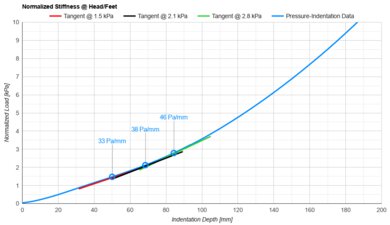
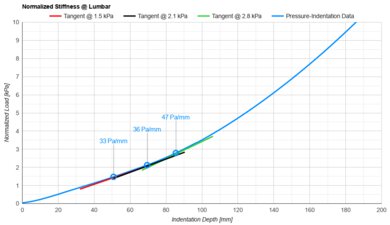
The Saatva Classic (Plush Soft) is medium-plush. It's softer than the 'Medium' Saatva Classic (Luxury Firm) and offers good enough pressure for most side sleepers. However, if you're in the lighter weight category, you might prefer an even plusher mattress such as the Helix Midnight Elite. Similarly, it's decently supportive for lighter people, but not supportive enough for back/stomach sleepers in the average or heavier weight categories.
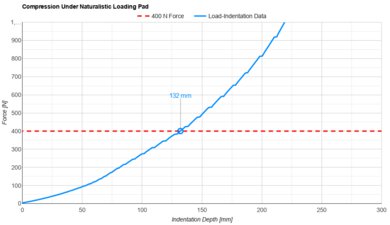
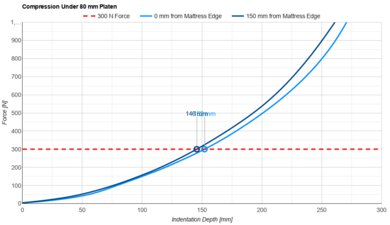
This mattress has fantastic edge support. The edges are reinforced with polyfoam and don't compress a lot if you sit or sleep on the side of the mattress. The edges form a slight slope outward when you sit on the side of the mattress, but overall, they provide a sturdy surface for getting in and out of bed and allow you to sleep near the edge without feeling at risk of sliding off.
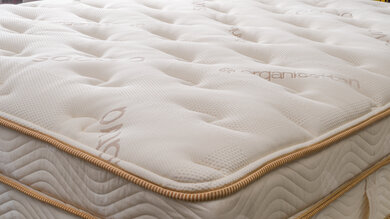
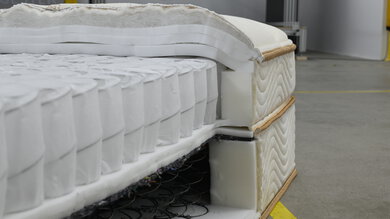
The sides of the mattress's coil layers are reinforced with polyfoam, which contributes to its fantastic edge support performance.

The quilted layer is quite thick at 2.6"/6.5 cm. The strip of memory foam in the lumbar area is very thin at 0.4"/1 cm, and while it doesn't measurably add firmness in that area, it may help fill in the area under your lower back if you sleep on your back, or add contouring around your hips, which helps with pressure relief. The lower comfort layer is 0.9"/2.2 cm thick and helps distribute your weight over the layer of comfort coils. Similarly, the 0.9"/2.2 cm transition layer helps distribute your weight over the support spring layer, which can help prevent the heavier parts of your body from sinking in more. This design is very similar to the advertised design of the Saatva Classic (Luxury Firm). The main difference is that the Plush Soft variant's quilted layer is nearly an inch thicker.
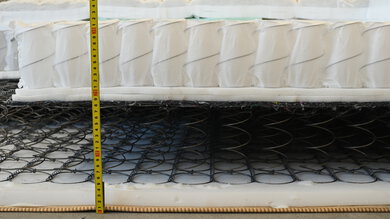
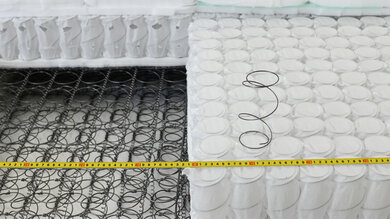
This mattress has a comfort layer of 15-gauge pocket coils, which corresponds with a softer spring feel. The support layer is made up of 13-gauge Bonnell coils. These springs are made of thicker wire and provide a firmer feel to help support the heavier parts of your body. The interconnected coils don't isolate motion as well as individually wrapped pocket coils, which helps explain the mattress's weaker motion isolation performance.
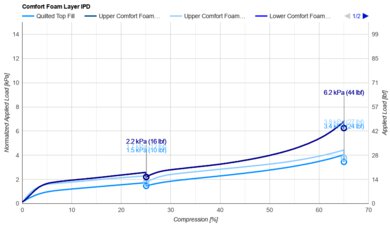
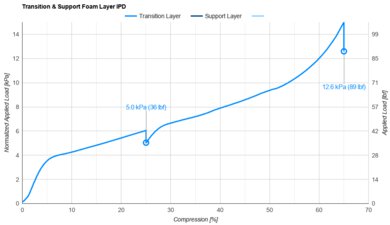
This mattress's thick quilted layer is very soft, which helps give the mattress its excellent overall pressure relief performance. The memory foam in the lumbar area is also soft, so your hips will sink into it. The polyfoam layer directly above the comfort coils is medium-firm. You won't feel like you're hitting a hard surface under the quilted layer, but its firmer feel helps prevent you from feeling the individual comfort coils. The transition layer is made of very firm polyfoam, and while you won't directly feel it, it helps distribute your weight over the support coils.
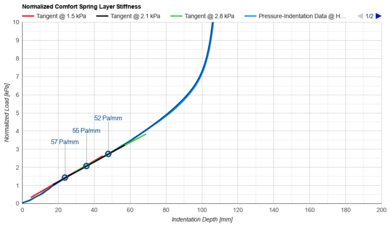
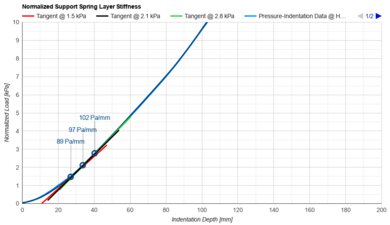
The comfort layer coils are very soft, as they're intended to add contouring and pressure relief, just like foam comfort layers. The support layer of Bonnell coils is on the opposite extreme, with a very firm feel, which is intended to add support for the heaviest parts of your body, though the mattress only offers sufficient support for lighter sleepers overall.
Popular Mattress Comparisons
The Saatva Classic (Plush Soft) has a similar design to the firmer variant, the Saatva Classic (Luxury Firm), but includes a thicker quilted layer that helps it offer good pressure relief for most people, making it a good option for side sleeping. However, average and heavier people might prefer a 'Medium' option like the Casper Snow that offers a balance of pressure relief and support. This mattress offers great cooling, so it's suitable for hot sleepers. However, just like the Luxury Firm variant, it doesn't have the best motion dissipation performance, so if you sleep with a partner who tosses and turns, you might prefer a medium-plush mattress with a better performance in that regard, such as the Sealy Posturepedic Hybrid.
If you're looking for a recommendation, check out the best mattresses for side sleepers, the best memory foam mattresses, and the best mattresses overall.
The Helix Midnight Luxe 2025 is better for most people than the Saatva Classic (Plush Soft). The Helix has a more durable design as well as significantly better cooling and motion dissipation. Its better support makes it suitable for a wider range of sleepers. However, the Saatva's better pressure relief makes it more suitable for lighter side sleepers. You might also prefer it if you want a very bouncy, very responsive mattress.
The Tuft and Needle Mint is better than the Saatva Classic (Plush Soft) for most people. Both mattresses are well-suited for side sleepers, offering enough pressure relief even for lighter side sleepers. The Tuft and Needle is more supportive, so it can work for a wider range of back and stomach sleepers. It also offers significantly better motion isolation. That said, it's not very bouncy, and you might prefer the Saatva's much springier feel, which makes it feel easier to move around in your sleep.
The Helix Midnight Elite is better than the Saatva Classic (Plush Soft) for most people. Both are best-suited for side sleepers, but the Helix offers better pressure relief for lighter people. It's also slightly more supportive for most people. It has better motion isolation, so it's much more suitable for couples, and it's made with higher-quality foam that makes it more durable.
The Puffy Monarch and Saatva Classic (Plush Soft) are both Medium-Plush hybrid mattresses that relieve pressure well for average and heavier side sleepers, letting you sink in enough for real cushioning at the shoulder and hip. Neither model is firm enough to be ideal for back or stomach sleeping. Where they differ is in the details that shape your day-to-day experience: the Monarch does a better job keeping a partner's movements from reaching your side of the bed, while the Saatva holds its shape better at the edges and moves more easily under you when you shift positions at night. Neither mattress is especially durable, since both rely on lower-density foam in their comfort layers that's likely to wear down over time.
Differences Between Sizes And Variants
The Saatva Classic comes in 9.5" and 14.5" variants, which the manufacturer says have the same feel and performance. It also comes in different firmness levels: Plush Soft, Luxury Firm, and Firm. These results are for the 14.5" Plush Soft variant. Here's a picture of our unit's label. We've also tested the 14.5" Saatva Classic (Luxury Firm).

If you have the Saatva Classic (Plush Soft) or another variant, we invite you to share your experience in the comments.