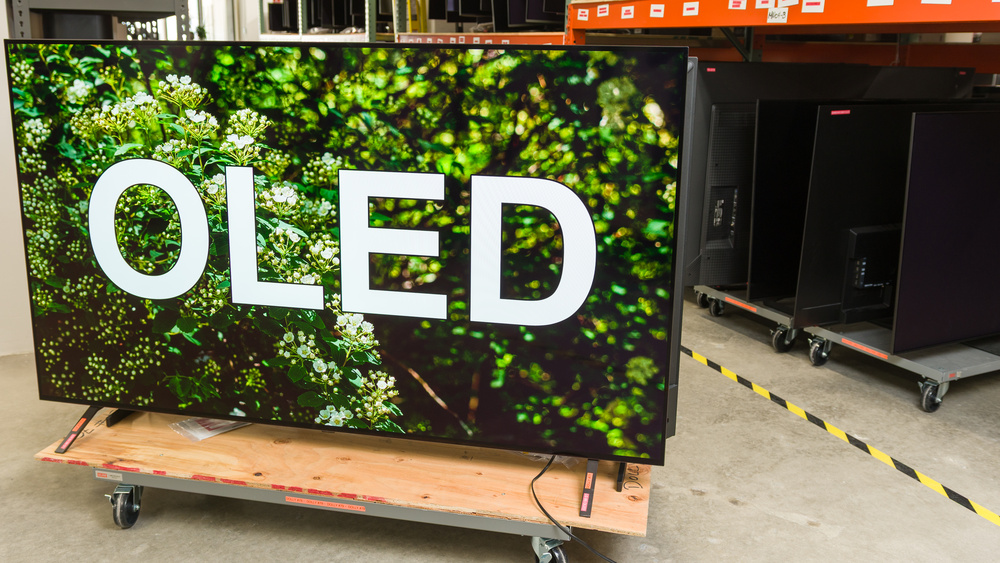
OLED TVs have become quite popular over the last few years, and they've dropped in price significantly. What truly separates OLED TVs from the pack is their ability to display perfect, inky blacks without any haloing around highlights and subtitles. OLEDs are also fantastic gaming TVs due to crystal clear motion, high refresh rates, and other modern gaming features. They've also gotten a lot brighter since they were first released, so many OLEDs are also suitable for brighter spaces. If you want to see how OLEDs stack up against the competition, take a look at our Mini LED vs. OLED article.
Many 2026 OLEDs are now available to purchase, but you may not see them in this article until the latter half of the year, since they're very expensive near release and most of them don't offer a big improvement over their 2025 predecessors. Right now is a great time to buy a 2025 OLED, since they're on sale for much cheaper than the newer versions.
We've bought over 75 OLED models and put them through our rigorous testing process to see which ones are worth buying. Below are our recommendations for the best OLED televisions you can buy in the US. You can also explore our picks for the best TVs, the best gaming TVs, and the best TV brands. Feel free to vote on which models you want us to buy and test. To learn about the newest OLEDs on the market, visit our 2026 TV lineup page.

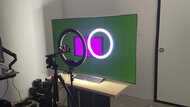
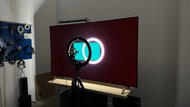
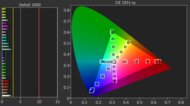
We buy and test dozens of TVs yearly, taking an objective, data-driven approach to deliver results you can trust. Our testing process is complex, with hundreds of individual tests that take over a week to complete. Most of our tests use specially designed test patterns that mimic real content, but we also use the same sources you have at home to ensure our results match the real-world experience. We use two main tools for our testing: a Colorimetry Research CR-100 colorimeter and a CR-250 spectroradiometer.
-
Best OLED TV
 Mixed UsageHome TheaterBright RoomSportsGamingBrightnessBlack LevelColorMotion HandlingGame Mode ResponsivenessProcessing (In Development)Resolution:4kNative Refresh Rate:165HzScreen Finish:MattePanel Type:OLEDSub-Type:QD-OLEDDolby Vision:NoSee all our test resultsSizes:55" 65" 77" 83"
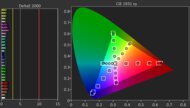
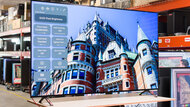
The Samsung S95H OLED is the best OLED TV we've tested in 2026. This TV delivers stellar performance, with incredibly high peak brightness, even when most of the screen is bright, ensuring a stunning movie-watching experience. Of course, like all OLEDs, it also has those true inky blacks that OLED TVs are known for. Colors are incredibly bright and vibrant, and it's extremely accurate out of the box, so you don't have to worry about getting it calibrated. While OLEDs have always been known to be best for dark room viewing, this one stands out even in a bright room thanks to its superb anti-reflective coating, which effectively eliminates glare from lamps or open windows.
When you're not watching the latest shows or movies, it's also a superb gaming TV, with barely any noticeable latency and a nearly instantaneous response time. It has a high refresh rate and four HDMI 2.1 bandwidth inputs, so you can take full advantage of the latest consoles or a gaming PC. The built-in Tizen smart interface has a wide selection of streaming apps, so you'll have no trouble finding content to watch. It's available in sizes ranging from 55 to 83 inches, but the largest size is a bit different and doesn't perform quite as well.
-
Best Mid-Range OLED TV
Exclusive member deal: RTINGS members save $250 on the LG C6 55" ($1,549.99), $200 on the 65" ($2,499.99), or $400 on the 77" ($3,299.99) at our partner retailer. Join now to unlock the deal.Mixed UsageHome TheaterBright RoomSportsGamingBrightnessBlack LevelColorMotion HandlingGame Mode ResponsivenessProcessing (In Development)Resolution:4kNative Refresh Rate:165HzScreen Finish:GlossyPanel Type:OLEDSub-Type:WOLEDDolby Vision:YesSee all our test resultsSizes:42" 48" 55" 65"If you want something a bit cheaper, you can step down to the LG C6 OLED 2026 instead. This incredible TV delivers nearly identical dark room performance, with deep, inky blacks that give the TV an almost 3D-look. It's not as bright, though, and it has a glossy coating, so glare is a bit more distracting during the day, and bright scenes aren't quite as impactful. As for colors, it's a bit more complicated. The 42-, 55-, and 65-inch versions of the C6 use an older panel type, and colors aren't as vivid as on the Samsung S95H OLED. The 48-inch C6, as well as the 77- and 83-inch LG C6H OLED, use a newer panel that delivers more vibrant colors, so the difference isn't as noticeable between the S90H and those sizes.
As for smart features, the C6 doesn't disappoint. While it uses a different smart platform than the S95H, known as webOS, it has an equally great selection of streaming apps. Like the S95H, it has a slew of extra gaming features, including a high refresh rate, VRR support, and HDMI 2.1 bandwidth on all four inputs. Really, there's not much of a difference between this and the S95H when it comes to gaming.
-
Best Budget OLED TV
Mixed UsageHome TheaterBright RoomSportsGamingBrightnessBlack LevelColorMotion HandlingGame Mode ResponsivenessProcessing (In Development)Resolution:4kNative Refresh Rate:120HzScreen Finish:GlossyPanel Type:OLEDSub-Type:WOLEDDolby Vision:YesSee all our test resultsSizes:48" 55" 65" 77" 83"The LG B5 OLED is the best budget OLED TV on the market. It's not cheap by any means, but it's a great TV with high-end features and is an excellent entry point into the OLED market. Colors aren't as bright as those on the LG C6 OLED, but they're still rich and vibrant enough for a pleasing viewing experience. It's noticeably dimmer than the C6 and only gets bright enough to handle glare in dimly lit rooms, but it's still bright enough for highlights to stand out in HDR movies, shows, and games. The TV delivers the same inky blacks that OLEDs are known for, and its viewing angle is about as wide as the C6, so it's suitable for large living rooms.
Although it doesn't support 144Hz as the C6 does, it still has four HDMI 2.1 ports capable of 4k @ 120Hz with VRR, so it's fully compatible with modern gaming consoles. Motion is incredibly clear thanks to its nearly instantaneous pixel transitions, and it also provides low input lag for a responsive feel. LG's webOS offers a huge catalog of features and streaming apps, so finding content is a breeze. It even has solid image processing, which is great when your content quality is suboptimal. It's been replaced in 2026 by the LG B6 OLED, but we haven't tested it yet.
Notable Mentions
-
LG G6 OLED:
The LG G6 OLED competes with the Samsung S95H OLED. While the LG offers better format support for physical media collectors, the Samsung provides more consistent performance and handles bright rooms better, making it the better option for most people.
See our review -
Sony BRAVIA 8 II OLED:
If you want a QD-OLED TV like the Samsung S95H OLED, but you're a movie buff who prioritizes Dolby Vision support and image processing, the Sony BRAVIA 8 II OLED is a great option. Still, the Samsung is a more well-rounded TV thanks to its superior bright-room and gaming performance, and it's cheaper, making it the better option for most people.
See our review -
Samsung S90H OLED:
The Samsung S90H OLED is a great competitor to the LG C6 OLED, with better reflection handling in a bright room. The C6 is a lot brighter, though, so it's the better choice for most people.
See our review
Recent Updates
Jun 19, 2026:
We replaced the Samsung S95F OLED and the LG C5 OLED with their 2026 counterparts, the Samsung S95H OLED and the LG C6 OLED, as the newer models offer some noticeable performance improvements.
May 28, 2026:
We replaced the Samsung S90F OLED with the LG C5 OLED in the 'Best Mid-Range' category to offer more variety in our picks. We also moved the S90F to the Notable Mentions, removed the Panasonic Z85A OLED from the Notable Mentions since it's no longer available, and revised text throughout the article for clarity.
Mar 31, 2026:
We revised the introduction to make it more concise and confirmed the availability of our current picks.
Jan 27, 2026:
We updated text throughout the article for accuracy, and swapped the Sony A95L OLED with the Sony BRAVIA 8 II OLED in the Notable Mentions.
Nov 12, 2025:
Replaced the LG B4 OLED with the LG B5 OLED in the 'Best Mid-Range' category.
All Reviews
Our recommendations above are what we think are currently the best OLED TVs for most people that are available to purchase in the United States. We factor in the price (a cheaper TV wins over a pricier one if the difference isn't worth it), feedback from our visitors, and availability (no TVs that are difficult to find or almost out of stock everywhere, and we only test those available in the U.S.).
If you would like to do the work of choosing yourself, here is a list of all our recent reviews of OLED TVs. Be careful not to get too caught up in the details. While no TV is perfect, most OLEDs are great enough to please almost everyone, and the differences are often not noticeable unless you really look for them. If you want to learn more about the technology, check out our What Is OLED? article.