Version 1.3.1 of our air purifier testing methodology expands our test coverage with a field stating whether an air purifier has a filter system that carries a HEPA rating.
Why Are We Making These Changes?
HEPA (High Efficiency Particulate Air) filtration is a term coined by the U.S. Department of Energy and has a strict definition: a filter meeting this standard should trap 99.97% of airborne particles 0.3 microns (µm) in size. Unfortunately, air purifier manufacturers have played fast and loose with this terminology, using marketing designations like 'HEPA-like' or 'HEPA-type', which aren't subject to the same level of regulatory scrutiny. Others simply don't disclose the results of any sort of independent lab testing that would ratify a HEPA rating.
All of this makes buying a new air purifier a bit of a minefield for the average consumer. The goal of this test bench was to cut through the marketing chaff and provide a clear answer as to whether a filter carries an official HEPA rating, or just the semblance of one.
 |
 |
Beyond units with filter systems that carry a Certified HEPA designation, we've also included units with filters that meet a recognized HEPA standard when tested by a third party, including IEST-RP-CC007, IEST-RP-CC001, and EN 1822.
- IEST-RP-CC007: A testing procedure used to ensure filters meet HEPA and ultra-low penetration air (ULPA) standards in factory conditions.
- IEST-RP-CC001: Covers testing for HEPA and ULPA filters that are intended for use in clean air devices and cleanrooms, which fall under the umbrella of ISO 14644.
- EN 1822: A European standard used to define filter testing to ensure they are, in fact, HEPA or ULPA-grade.
It's worth noting that we've extended this same rating to units that deviate slightly from these standards, such as the Shark BreatheClear HP162, which claims its H14 HEPA filter was tested according to 'IEST-RP-CC007.3, 0.1–0.2 microns'; however, this doesn't specify whether the testing was conducted by a third party or by the manufacturer itself. Based on the manufacturer's other air purifiers with similar filter designs, we've assumed this filter does, in fact, meet some sort of HEPA standard.
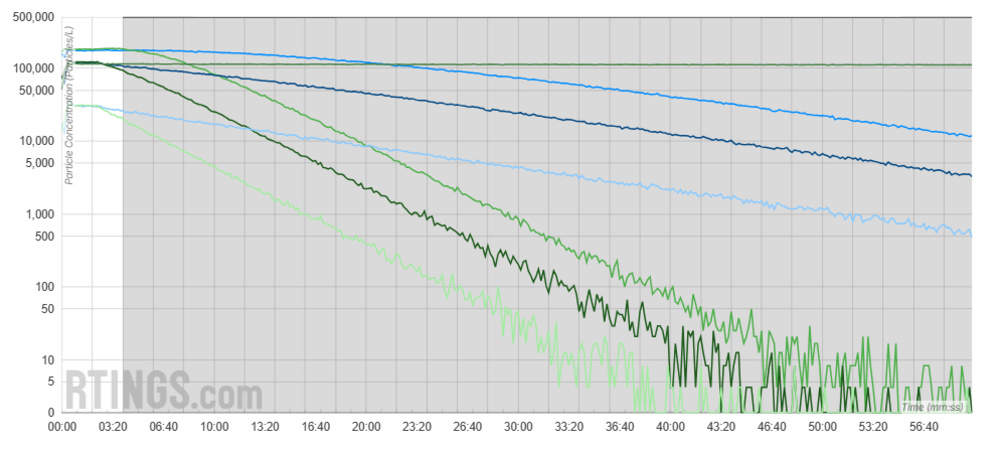
With all this being said, a HEPA-certified filter is just one part of the equation, and doesn't automatically mean an air purifier will do a good job. We found in our Particle Filtration Rate testing, which tracks particle concentration at 0.3, 0.5, and 1.0 μm, that airflow is just as important when it comes to determining performance.
Let Us Know What You Think
Your feedback is instrumental in helping us further improve our testing in every aspect. If you have comments, questions, criticisms, or suggestions about this update or any future updates, reach out to us in the comments or email us at feedback@rtings.com.
48 Air Purifiers Updated
We have retested popular models. The test results for the following models have been converted to the new testing methodology. However, the text might be inconsistent with the new results.
- Austin Air HealthMate Junior
- Blueair Blue Pure 211i Max
- Blueair Blue Pure 511i Max
- Blueair Blue Signature Large
- Blueair Blue Signature Small
- Corsi-Rosenthal Box
- Corsi-Rosenthal Box with Single Filter
- Coway Airmega 200M
- Coway Airmega 400
- Coway Airmega Mighty AP-1512HH
- Dyson Find+Follow Purifier Cool
- Dyson HEPA Big+Quiet Formaldehyde BP06
- Dyson HushJet
- Dyson Pure Cool TP01
- Dyson Pure Hot+Cool Link HP02
- Dyson Purifier Big+Quiet Formaldehyde BP04
- Dyson Purifier Cool PC1
- Dyson Purifier Cool TP07
- Dyson Purifier Hot+Cool Formaldehyde HP09
- Dyson Purifier Hot+Cool HP07
- Dyson Purifier Hot+Cool HP1
- Dyson Purifier Hot+Cool Purifying Heating Fan HP4B
- Honeywell HPA300
- Levoit Core 200S
- Levoit Core 300
- Levoit Core 300S
- Levoit Core 400S
- Levoit Core 600S
- Levoit Core Mini-P
- Levoit Vital 200S
- Levoit Vital Pet Pro
- Mila Air 3
- NuWave OxyPure
- PuroAir 240
- Rabbit Air A3
- Shark Air Purifier 4 HE402
- Shark Air Purifier HP102PET
- Shark Air Purifier MAX HP202
- Shark BreatheClear Compact Pro HP062
- Shark BreatheClear HP162
- Shark BreatheClear MAX HP365CO
- Shark NeverChange Air Purifier MAX HP302
- Shark NeverChange HP152
- Winix 5500-2
- Winix 5530
- Winix C545
- Winix C610
- Winix C909
