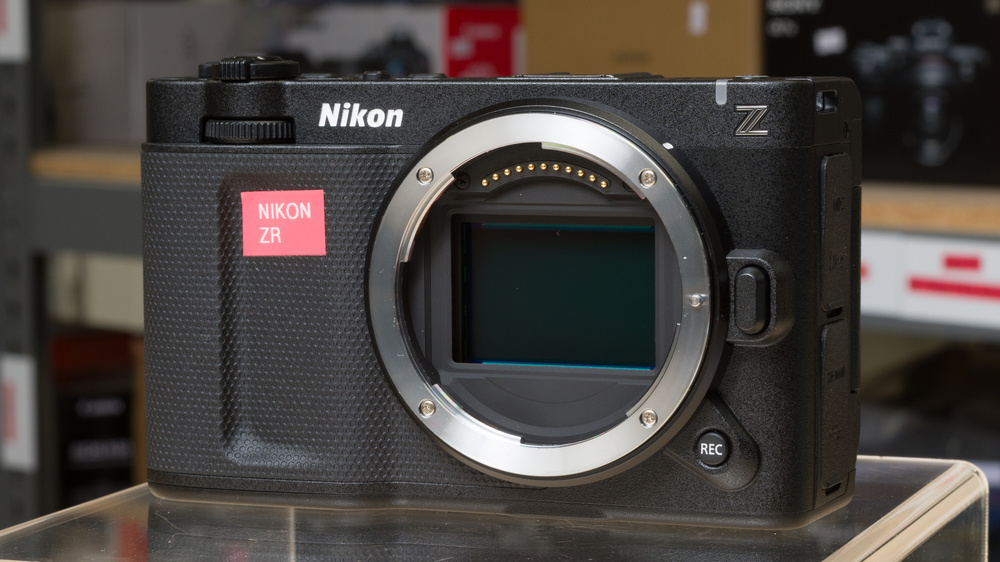
The Nikon ZR is a full-frame enthusiast video-focused camera. It's the first camera in Nikon's Z Cinema lineup, and the first one Nikon developed with RED, its cinema camera subsidiary, which it acquired in 2024. Inside its compact, boxy body, made for rigs and gimbals, sit the same 24.5-megapixel partially stacked sensor and EXPEED 7 processor as in the Nikon Z 6III. Its main addition is the multiple internal recording options. It records 6k RAW internally at up to 60 fps in R3D NE or N-RAW, or 30 fps in ProRes RAW HQ. To fit into RED workflows, it also supports RED's Log3G10 profile and color space, RED-style file naming, and shutter angle exposure settings. It also records 32-bit float audio, even from its built-in microphones, which is ideal for dealing with clipping in situations where sound isn't well controlled. While it doesn't include a viewfinder, it does have a large 4-inch touchscreen, making it easier to forgo an external monitor.
Our Verdict
The Nikon ZR is excellent for travel photography, even though it's designed with video in mind. Its body is compact and relatively light for a full-frame camera, and it's weather-sealed to handle the occasional rain on your trips. The sensor captures plenty of fine detail, and in-body stabilization keeps handheld shots steady when the light drops at night. Changing settings and framing shots on the large touchscreen is quick, too. However, there's no viewfinder, and the boxy body suits a rig better than handheld shooting. It's also quite large once you factor in the full-frame lenses that you'll have to use.
Large, bright 4-inch fully articulated touchscreen.
Lighter and more compact than most full-frame hybrid cameras.
Weather-sealed body.
Effective in-body image stabilization.
Excellent tracking autofocus in photos.
Detailed RAW photos with great dynamic range.
No viewfinder.
Boxy design with a shallow grip.
The Nikon ZR is excellent for landscape photography. Its sensor resolves plenty of fine detail and captures a wide range of highlights and shadows. The dust- and drip-resistant body holds up in light rain, and the fully articulated screen lets you compose low-angle or tripod shots comfortably. The display is bright enough to see outdoors, but the lack of a viewfinder can make framing shots in bright sunlight less comfortable.
Large, bright 4-inch fully articulated touchscreen.
Lighter and more compact than most full-frame hybrid cameras.
Weather-sealed body.
Effective in-body image stabilization.
Detailed RAW photos with great dynamic range.
No viewfinder.
Boxy design with a shallow grip.
The Nikon ZR is outstanding for sports and wildlife photography, even if it's not its intended use. It shoots uncropped RAW bursts at 20 fps, with excellent sustained shooting performance and a virtually unlimited buffer that lets you capture long sequences without slowing down. Its tracking autofocus keeps moving subjects in focus most of the time, too. A 120 fps JPEG mode is also available, but it adds an APS-C crop. On the downside, there's no viewfinder, and the shallow grip makes long telephoto lenses less comfortable to handle.
Weather-sealed body.
Fast 20 fps RAW bursts with a virtually unlimited buffer.
Excellent tracking autofocus in photos.
No viewfinder.
Electronic shutter only.
Second card slot only takes slower microSD UHS-I cards.
The Nikon ZR is excellent for vlogging. Its 4-inch screen is much larger than on most cameras, and you can turn it to face the front to check your framing while you talk. Face tracking keeps you sharp as you move, and in-body stabilization smooths out handheld footage. The built-in microphones record 32-bit float audio, which gives you more room to fix levels in editing. A second record button on the front and a tally light also help when you film yourself. However, it's bulkier and heavier than dedicated vlogging models, which usually have smaller sensors.
Internal 6k RAW video in R3D NE, N-RAW, and ProRes RAW HQ.
Large, bright 4-inch fully articulated touchscreen.
Records 32-bit float audio, even with the built-in microphones.
Lighter and more compact than most full-frame hybrid cameras.
Effective in-body image stabilization.
Outstanding autofocus in video.
Low rolling shutter in video.
No overheating, with clips of up to six hours.
Excellent video dynamic range.
Records 4k at up to 120 fps and 1080p at up to 240 fps.
Boxy design with a shallow grip.
Second card slot only takes slower microSD UHS-I cards.
6k recording limited to RAW formats, and 4k at 120 fps adds a crop.
The Nikon ZR is an outstanding studio video camera. Internally, it captures 12-bit RAW video in RED's R3D NE format, N-RAW, or ProRes RAW HQ, and it also supports ProRes 422 HQ and 10-bit H.265. Log recording with N-Log or RED's Log3G10 helps you get the most out of its excellent video dynamic range. It didn't overheat in testing, and clips can run for up to six hours. It records 32-bit float audio internally, so levels are easier to fix in post. You also get a headphone jack and USB-C power delivery. That said, it uses a smaller, less secure micro HDMI port, and 6k recording only works in RAW formats.
Internal 6k RAW video in R3D NE, N-RAW, and ProRes RAW HQ.
Large, bright 4-inch fully articulated touchscreen.
Records 32-bit float audio, even with the built-in microphones.
Outstanding autofocus in video.
Low rolling shutter in video.
No overheating, with clips of up to six hours.
Excellent video dynamic range.
Records 4k at up to 120 fps and 1080p at up to 240 fps.
Micro HDMI port instead of a full-size one.
Second card slot only takes slower microSD UHS-I cards.
6k recording limited to RAW formats, and 4k at 120 fps adds a crop.
The Nikon ZR is good for action video, but it's not really made for this use. It isn't waterproof or rugged like a dedicated action camera, and there's no practical way to attach it to a helmet or a bike. However, its compact body fits well on a gimbal, and its partially stacked sensor keeps rolling shutter relatively low, although quick pans can still produce slightly skewed vertical lines. For slow-motion clips, it can shoot 4k at 120 fps with a crop or 1080p at 240 fps. In-body stabilization also helps smooth out footage when you shoot on the move.
Lighter and more compact than most full-frame hybrid cameras.
Outstanding autofocus in video.
Low rolling shutter in video.
No overheating, with clips of up to six hours.
Records 4k at up to 120 fps and 1080p at up to 240 fps.
Not designed for action cam mounting.
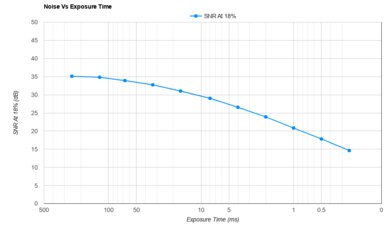
The Nikon ZR has great RAW image quality. Its 24.5-megapixel sensor resolves plenty of fine detail, so you can still crop your shots a bit in editing. It also captures a wide dynamic range, so high-contrast scenes keep detail in both bright and dark areas. Noise is also well controlled in dim light, though it becomes more apparent in particularly dark environments where a higher ISO is needed.
Detailed RAW photos with great dynamic range.
Performance Usages
Check Price
Differences Between Sizes And Variants
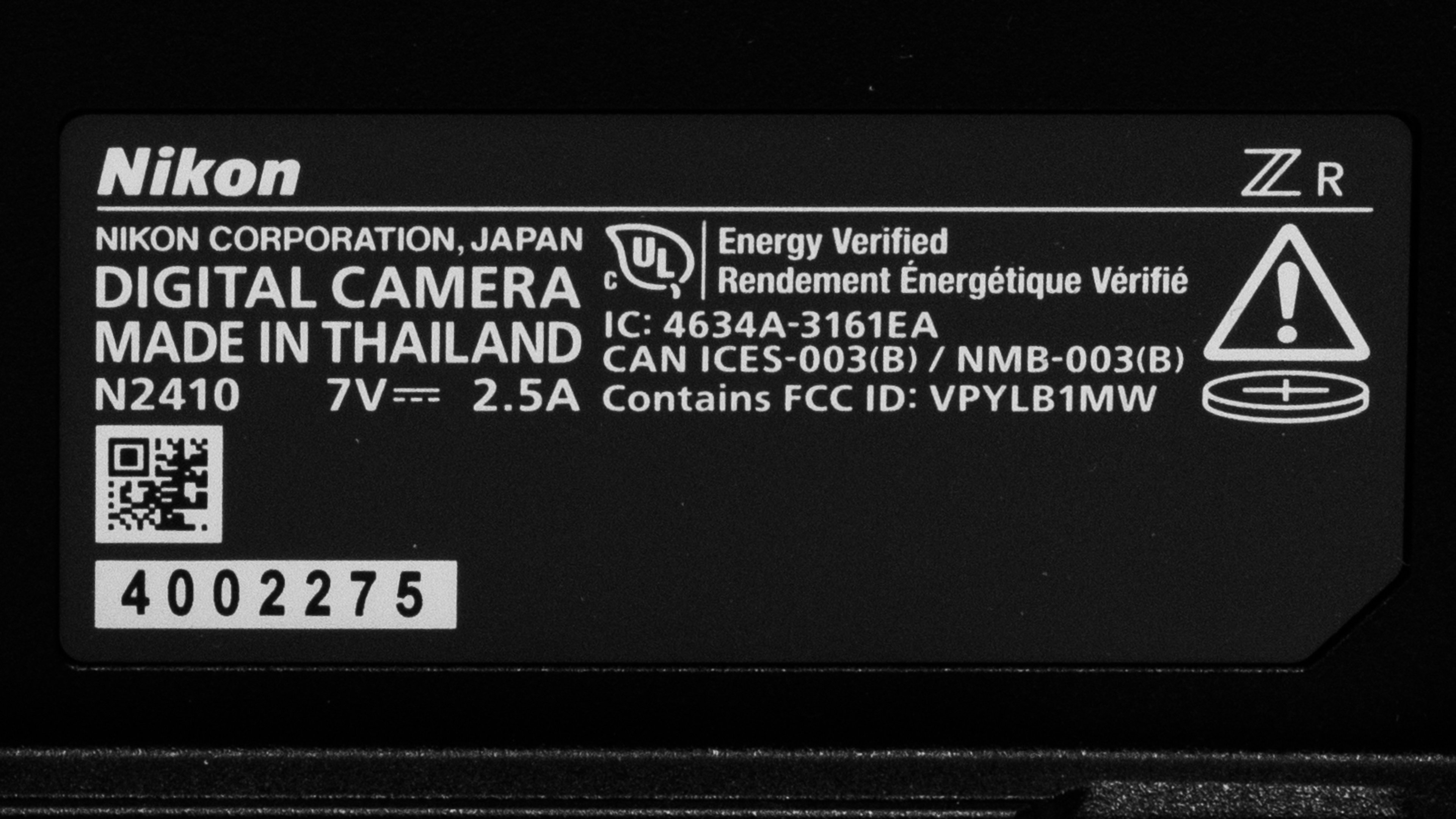
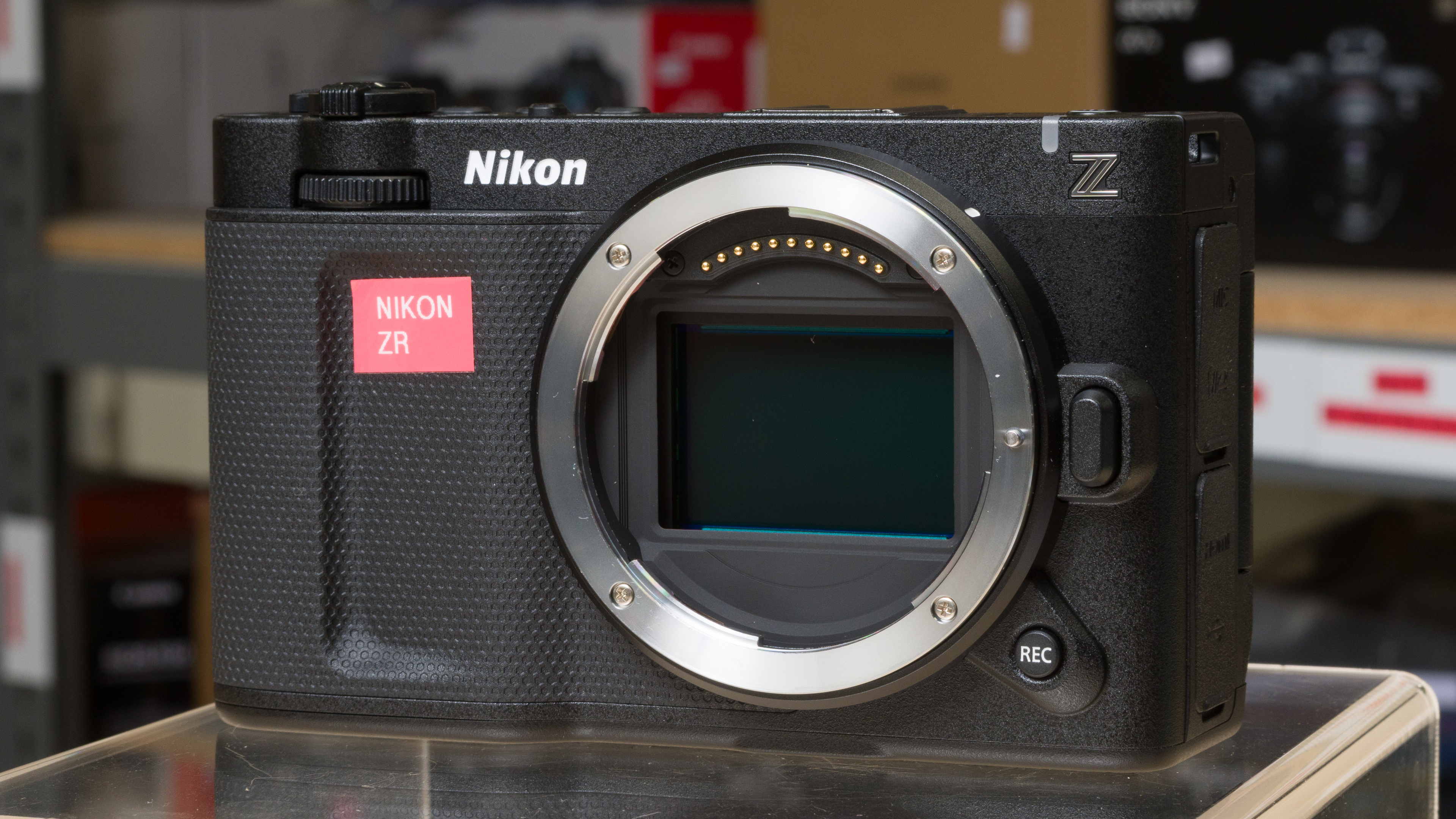
The Nikon ZR is only available in 'Black.' We tested the body-only version, and retailers also sell it in kits with the NIKKOR Z 24-50mm f/4-6.3, the NIKKOR Z 50mm f/1.8 S, or the NIKKOR Z 35mm f/1.4 lens. Here's a photo of our unit's label.
Popular Camera Comparisons
The Nikon ZR is a compact full-frame cinema camera for filmmakers and content creators who want RAW video and RED color science without a bulky rig or exorbitant price tag. It records 6k RAW internally in three formats, captures 32-bit float audio, and its 4-inch screen can replace an external monitor in many setups. It also takes great photos, with fast bursts and reliable tracking autofocus, though it lacks a viewfinder and a mechanical shutter.
Its closest rival is the Sony ZV-E1, another compact, video-first full-frame camera without a viewfinder. The Sony is lighter and keeps more highlight and shadow detail in photos, but the Nikon records RAW video internally and didn't overheat in our testing. For a mix of photos and video, hybrids like the Nikon Z 6III, the Panasonic LUMIX S5 II, and the Sony α7 V are larger but add a viewfinder and a deeper grip. Overall, if you mostly shoot video and want internal RAW recording without stepping up to a full-size cinema camera, the ZR is an excellent pick. While the RAW formats are extremely heavy, they do provide outstanding flexibility for post-production. This is a much more accessible entry point into RED color science, which remains among the best in the business.
For more options, check out our recommendations for the best video cameras, the best vlogging cameras, or the best Nikon cameras.
The Nikon ZR and the Nikon Z 6III share the same sensor and processor, and which one suits you best comes down to whether you lean toward video or photos. The Z 6III is the better photo camera thanks to its bright electronic viewfinder, mechanical shutter, and a deeper grip that feels more secure with larger lenses. It also has a full-size HDMI port and a second slot for faster UHS-II SD cards. On the other hand, the ZR weighs less and takes up less space, and its 4-inch screen is both larger and brighter. It adds RED's R3D NE format with Log3G10, 32-bit float audio, and a tally light, and it supports much longer clips, which makes it better for professional video work.
The Nikon ZR is better for video and fast action, while the Panasonic LUMIX S5 II suits hybrid shooters who want a traditional camera body. The Panasonic has an electronic viewfinder, a mechanical shutter, two UHS-II SD card slots, and a full-size HDMI port. Its sensor also captures a wider dynamic range and slightly more detail in photos, and it records 6k open gate video. However, the Nikon records RAW video internally, while the Panasonic needs a paid upgrade to output RAW over HDMI. The Nikon's tracking autofocus in photos is also far more reliable; it shoots much faster bursts, and it shows much less rolling shutter. It's also smaller and lighter.
The Panasonic LUMIX GH7 and the Nikon ZR both focus on video, but the Nikon's full-frame sensor is much larger than the GH7's Micro Four Thirds sensor. For photos, the Nikon resolves more detail, handles noise much better, and nails focus far more often when tracking subjects. For video, it keeps a more usable dynamic range. Recording in Log, both capture a similar total range, but the Nikon's shadows stay much cleaner, leaving more room to grade. Its 4k footage also shows less rolling shutter. The Nikon's body is also lighter and smaller, even if it comes with ergonomic sacrifices. However, full-frame lenses are larger than Micro Four Thirds lenses, so that advantage shrinks once you mount a lens for vlogging. On the other hand, the GH7 records 4k at 120 fps without a crop, has a built-in fan, and uses a full-size HDMI port. Its screen tilts and articulates, so it stays clear of cables plugged into the side. For photos, it adds an electronic viewfinder and a mechanical shutter.
Test Results
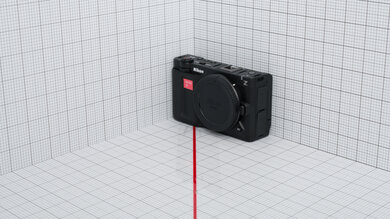
The Nikon ZR has okay portability. For a full-frame camera, it's compact and fairly light, and it's noticeably smaller than hybrids like the Nikon Z 6III. Still, it won't fit in a jacket pocket, and you need a camera bag once you add a lens.
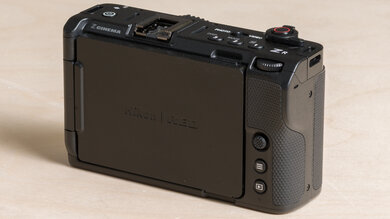
The Nikon ZR has excellent build quality. Its magnesium alloy body feels solid, and Nikon says it meets the same durability standards as the Nikon Z 6III, with sealing against dust and moisture. The battery and memory cards share a compartment behind a hinged door that locks, and the fully articulated screen moves on a sturdy hinge. Fixed strap lugs also keep the strap from rattling and adding noise to your recordings. The buttons and dials feel sturdy, though they're a bit mushy.
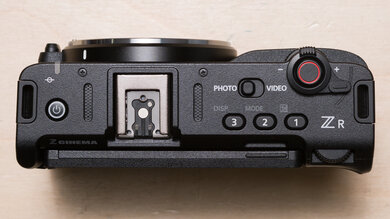
The Nikon ZR has a minimal, boxy layout with fewer physical controls than a typical hybrid. There's no mode dial, so you press a button on the top plate to choose your shooting mode from an on-screen menu. There's no exposure compensation dial either, but a nearby custom button handles it by default. A switch on top toggles between photo and video, and a second record button on the front makes it easy to start recording when you film yourself. Around the shutter button, a zoom lever lets you punch in to check focus or magnify photos during playback.
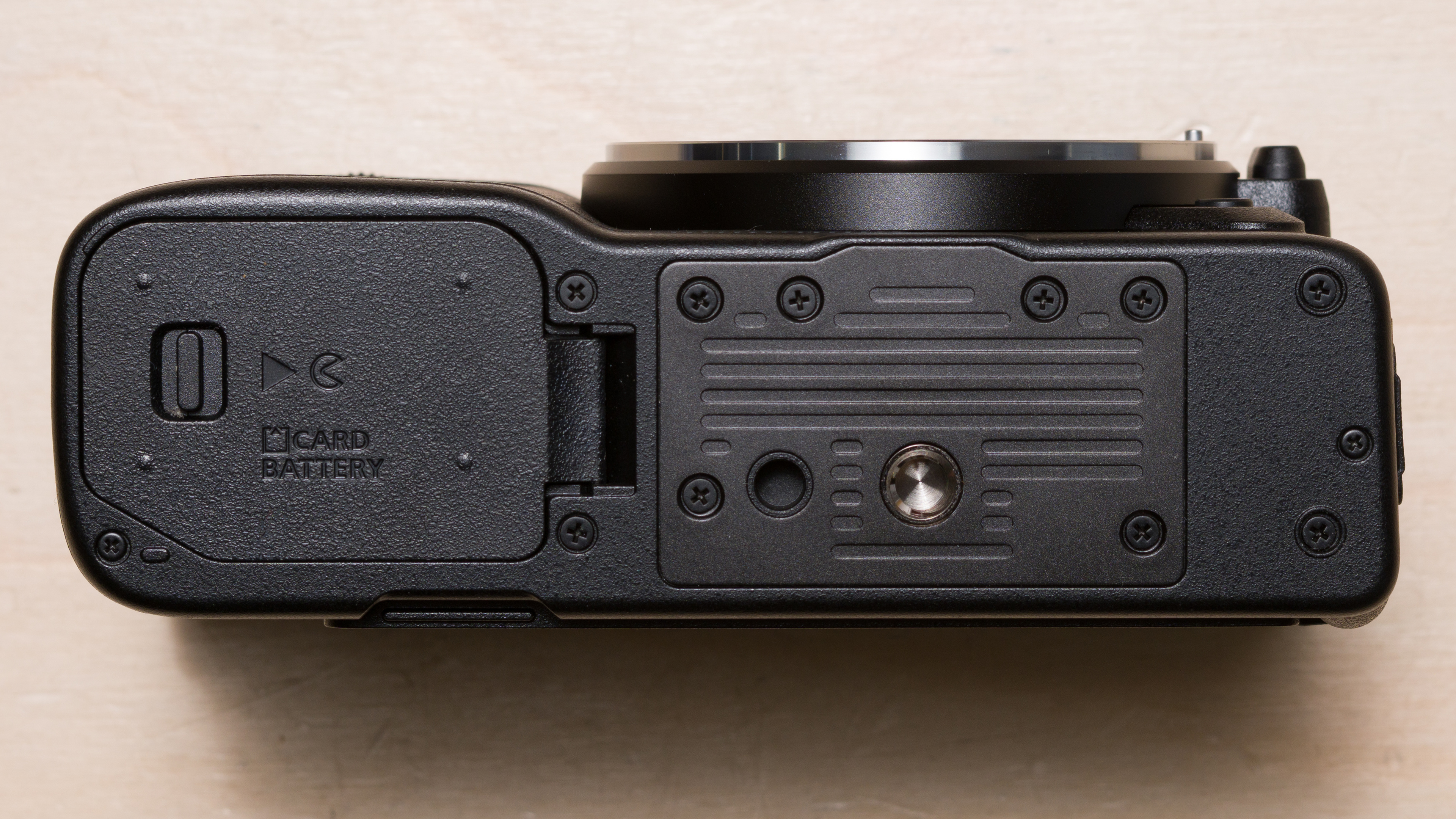
By default, the rear command dial controls shutter speed, while the front one sets the aperture. There's also a tally light, so you and your subjects can tell when the camera is recording. On top, there's a digital accessory shoe, and Nikon includes a cover for it. Note that this camera has no mechanical shutter, but the electronic shutter reaches speeds of up to 1/16,000s. You'll find the battery door on the underside of the camera.
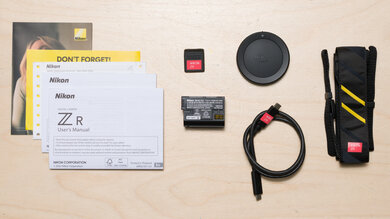
- 1x Nikon EN-EL15c battery
- USB-C cable
- Shoulder strap
- Hot shoe cover
- Sensor cap
- User manual
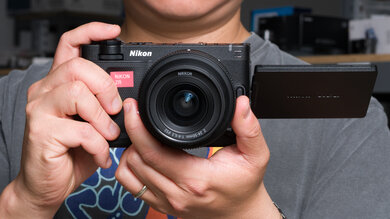
The Nikon ZR has excellent ergonomics if you plan to use it mostly for video. Its grip is shallow, but the tall body leaves room for every finger, so it's comfortable for all hand sizes. Textured rubber also covers the grip and thumb rest for a secure hold. Its boxy design is clearly made for rigs and gimbals, though, so it isn't as comfortable for handheld photography as a hybrid body such as the Nikon Z 6III.
The two command dials make it easy to change shutter speed and aperture, and a large joystick lets you move your focus point or scroll through menus. However, adjusting ISO takes a trip to the touchscreen unless you remap a button for it. A single button opens both the quick 'i' menu with a short press and the main menu with a long press. Some custom buttons also sit on the front of the body, out of reach of your thumb. On the upside, the screen is large, and its touch interface feels like an external monitor, which makes it easy to change nearly every setting from it.
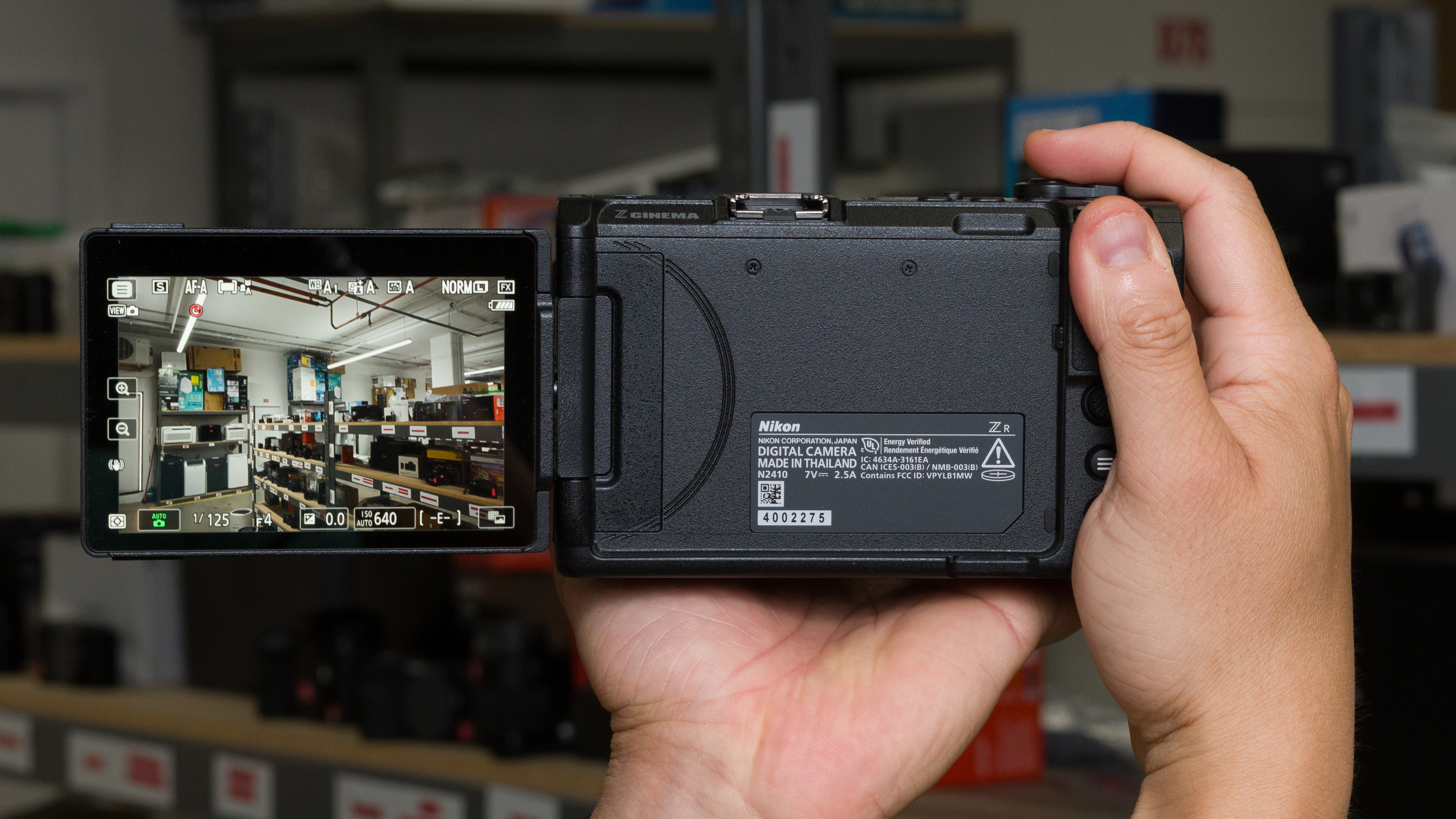
The Nikon ZR has no viewfinder, so you rely on the screen to frame every shot.
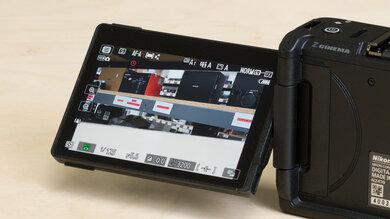
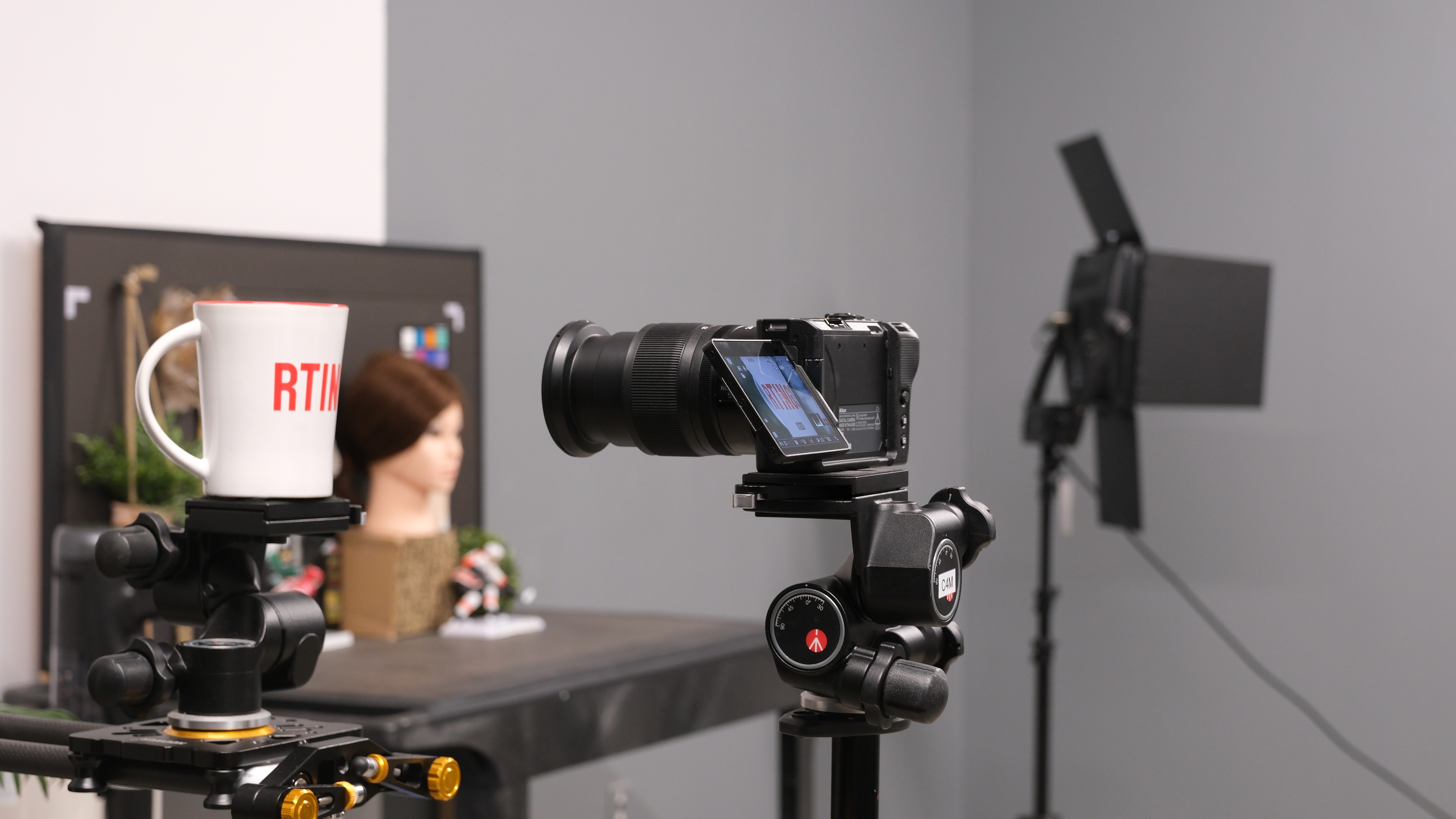
The screen on the Nikon ZR is outstanding. At 4 inches, it's much larger than the screens on most cameras, and Nikon advertises it as covering the full DCI-P3 color space. It's sharp and gets bright enough to stay easy to see outdoors. It's fully articulated, too, so you can flip it out to the side and face it forward for vlogging or shooting at high and low angles. The only issue is that it can get easily obstructed if you plug accessories into the side ports. You can control almost everything by touch, including setting your focus point, taking photos, changing settings, and swiping or zooming through your photos in playback.
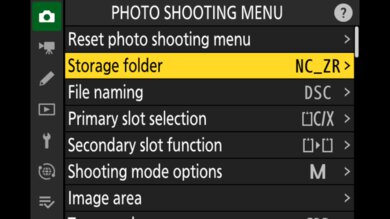
The menu system is excellent. Nikon uses the same layout as on the Nikon Z 6III, with clear categories that are easy to browse by touch. Reopening the menu brings you straight back to the last setting you changed, rather than the top of the page. A customizable 'i' menu gives you quick access to your most-used settings, and built-in help text describes what each option does.
However, there's only one menu for both photos and video. Most video settings are grouped into a single long list at the end of the custom settings menu. Finding options such as frame rate, resolution, or codec requires some scrolling.
The Nikon ZR uses a 24.5-megapixel full-frame, partially stacked CMOS sensor with Nikon's EXPEED 7 processor, the same combination as in the Nikon Z 6III. The partially stacked design reads the sensor out faster than a standard sensor, which helps reduce rolling shutter. Natively, it covers ISO 100 to 64000, with an extended setting down to ISO 50. In R3D NE, it switches to a dual-base ISO system: you pick a 'Low' base of ISO 800 or a 'High' base of ISO 6400, depending on the shooting conditions.
The Nikon ZR has great battery life. It runs on the EN-EL15c and it's rated for 350 photos per charge. That CIPA figure is only a rough guide, since your settings and shooting habits change how long a charge lasts. Video is where it shines: it recorded continuous 4k footage for over two hours in our test. A USB-C connection charges the battery and powers the camera while you record.
The Nikon ZR has outstanding shooting speeds. In its 'Continuous H (extended)' mode, it shoots RAW or JPEG photos at 20 fps without a crop. Even after 30 seconds of continuous RAW shooting, the camera didn't slow down, and it was ready to record video right away. For even faster action, the 'C120' mode shoots at 120 fps. However, it only saves JPEGs, adds an APS-C crop, and needs a shutter speed of 1/125s or faster. In that mode, the buffer fills after about six seconds and takes about 17 seconds to clear.
Note: The Nikon ZR doesn't have a mechanical shutter, so we measured its maximum high-speed continuous rate with the electronic shutter. We usually test this result with the mechanical shutter, so it isn't directly comparable with other cameras we've tested. In essence, the camera performs the same as the Nikon Z 6III in this metric.

Photo tracking autofocus is excellent. Even with a busy background, the camera stays locked on moving subjects, and the vast majority of our test shots were perfectly sharp. Nearly every shot was at least usable, so you rarely lose a moment to missed focus. It can also detect people, animals, and vehicles automatically.

With tracking turned off and a single focus point, autofocus is outstanding. Keep your subject under that point, and nearly every shot comes out perfectly sharp.
Image stabilization is excellent. The in-body system keeps handheld photos sharp down to a 1/6s shutter speed, even with an unstabilized lens. Results vary with your lens, focal length, and technique.
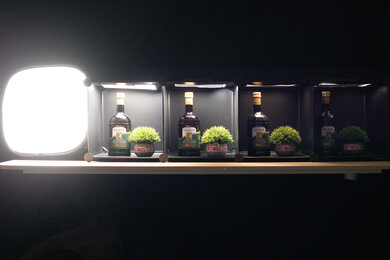
The Nikon ZR has great dynamic range. Shooting at base ISO, it holds onto detail in both bright and dark parts of the frame. A backlit subject retains its detail rather than becoming a silhouette against the sky. As you'd expect, its range only narrows gradually as shutter speeds get faster.
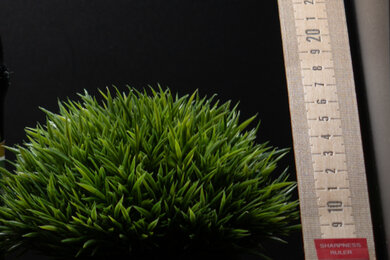
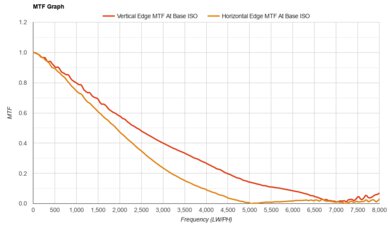

The Nikon ZR has a remarkable set of video features. It records 1080p, 4k, and 6k video, though 6k is only available in RAW formats, and standard H.265 recording tops out at 5.4k. For grading, you can shoot in N-Log or HLG, and the R3D NE format adds RED's Log3G10 profile with its REDWideGamutRGB color space. Nikon also offers nine RED-curated 'Imaging Recipes' through its Nikon Imaging Cloud service, plus a 'Cinematic video' mode with preset frame rate, shutter angle, and color settings.
Other filmmaking tools include shutter angle control, custom LUT previews, and a waveform monitor. Shutter angle sets your exposure time relative to the frame rate, like on cinema cameras, so motion blur looks the same when you switch frame rates.
Since firmware version 1.10, you can also sync timecode over a cable and import up to 50 LUTs. For external recorders, you get a clean 10-bit HDMI signal, and a tally light tells you when the camera is recording.
The Nikon ZR captures stereo sound, with audio level meters on the screen. It can record 32-bit float audio internally from both its built-in microphones and the 3.5mm jack. By comparison, cameras like the Panasonic LUMIX GH7 and the Sony α7 V need an XLR adapter for that. This format gives you much more room to raise quiet sounds or recover loud peaks in editing without clipping. It's currently only available when you record in the NEV, R3D, or MOV formats, though. The built-in microphones also include five pickup patterns, including a voice isolation mode and a 360-degree mode.
Nikon has announced firmware version 2.00, scheduled for release later in 2026. It brings Log3G10 and REDWideGamutRGB to H.265 recording, adds a 'High ISO NR' setting for H.265 Log footage, and enables focus peaking while recording in R3D NE. Nikon is also developing open gate recording and a de-squeeze display for anamorphic lenses, with a 2027 target. Our results are based on firmware version 1.11.
The Nikon ZR's 4k internal recording is outstanding. Its 12-bit RAW formats reach extremely high bit rates, and ProRes 422 HQ and H.265 capture 10-bit 4:2:2 footage, leaving plenty of color data for grading. Despite having no cooling fan, the camera never overheated in testing, even through more than two hours of continuous recording. Since firmware version 1.10, clips can also run for up to six hours in ProRes 422 HQ, H.265, and H.264 when you use external power.
For RAW video, you can choose between RED's R3D NE, Nikon's N-RAW, and ProRes RAW HQ, all in 12-bit. In 4k, there's a full-frame RAW mode at up to 60 fps and an APS-C crop mode at up to 120 fps, while 6k RAW also reaches 60 fps. R3D NE also gives you RED's Log3G10 profile and a dual base ISO system, with bases at ISO 800 and 6400. RAW recording requires the CFexpress Type B slot, since the microSD slot is too slow. The files are also extremely large. Nikon lists about 3,730 Mbps for 6k at 60 fps in R3D NE or high-quality N-RAW, which fills roughly 1.7 TB per hour of footage. Even full-frame 4k at 60 fps runs at about 1,660 Mbps, so you need large cards and plenty of storage. Focus peaking isn't available while you record in R3D NE, though.
Thankfully, as mentioned in the Video File Format and Compression section, Nikon is planning to beef up compressed H.265 recording options with its firmware 2.00 update.
In 4k, the autofocus is outstanding. Objects moving through the frame stay perfectly sharp from start to finish. When you film people, face and eye detection reliably sticks to them as they walk around.
Rolling shutter in 4k is decent. Thanks to the partially stacked sensor, vertical lines only lean slightly when you pan quickly or film fast-moving subjects. It's much less distracting than on full-frame cameras with standard sensors, like the Panasonic LUMIX S5 II.
Rolling shutter is excellent in 1080p. It's even lower than in 4k, and you only see very little skewing during quick pans.
Video dynamic range is excellent. In N-Log, the Nikon ZR records a broad span of tones from deep shadows to bright highlights, with noise kept well under control. Most of that range stays clean when judged against a strict noise threshold, giving you ample grading room in high-contrast scenes. Keep in mind that we tested N-Log, not the R3D NE format with Log3G10, which Nikon advertises with over 15 stops of dynamic range.
Tested settings:
• Resolution: 4k
• Frame Rate: 30 fps
• Format: MOV, H.265, 10-bit
• Log Format: N-Log
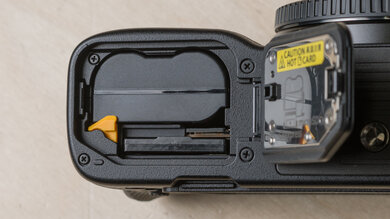
There are two card slots on the Nikon ZR: a CFexpress Type B slot and a microSD slot. The microSD slot only supports slower UHS-I cards. It works best for backups, overflow recording, or separating RAW and JPEG files, rather than for high-bit-rate video. Both slots sit next to the battery in the compartment on the bottom of the camera, behind a locking hinged door. A large tripod plate or cage can block that door, so you sometimes need to remove it to swap cards.
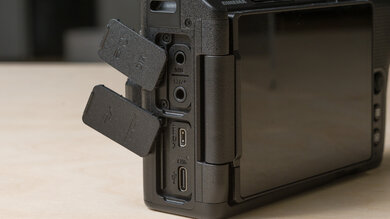
Inputs and outputs on the Nikon ZR are outstanding. Behind the flaps on the side, you get a 3.5mm microphone input with line-in support, a 3.5mm headphone jack, a USB-C port, and a micro HDMI port. Besides transferring files at SuperSpeed USB rates, the USB-C port also handles charging and keeps the camera running on external power. Since firmware version 1.10, the microphone jack also accepts timecode from an external generator. However, the micro HDMI port is more fragile than a full-size port, and the cable can come loose more easily on a rig.