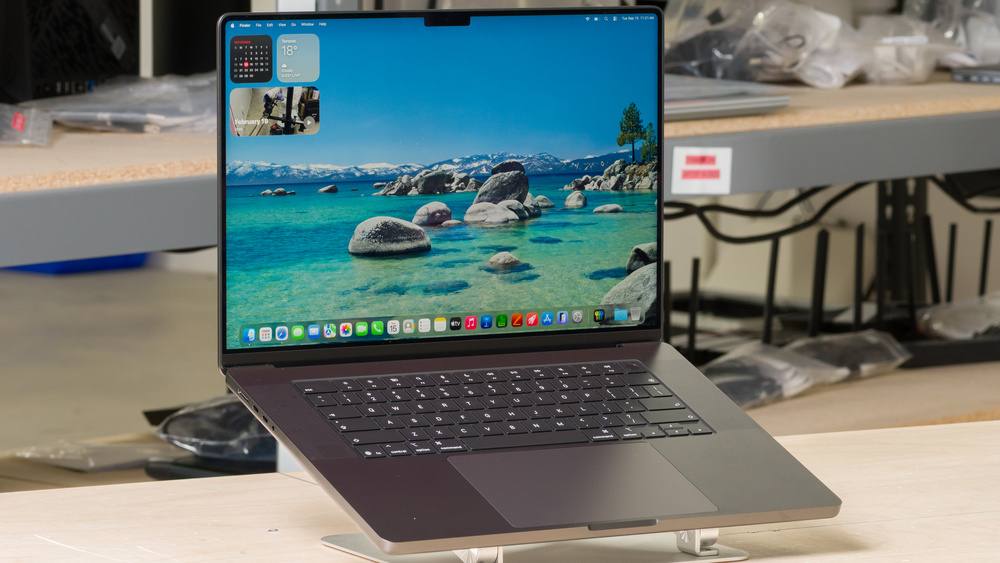
The Apple MacBook Pro 16 (M5, 2026) is a premium workstation laptop designed for creative and professional work. It replaces the Apple MacBook Pro 16 (M4, 2024) and is available with Apple's M5 Pro or M5 Max chip. Unlike the 14-inch model, it doesn't offer a base M5 configuration. Memory and storage max out at 128GB and 8TB, respectively, depending on the chip you select.
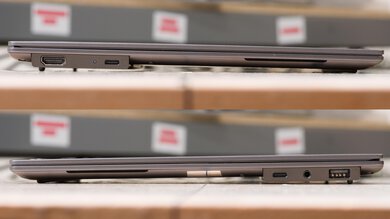
It has a 16-inch Liquid Retina XDR display with a 3456 x 2234 resolution and an adaptive refresh rate of up to 120Hz. You can choose between standard glossy and nano-texture finishes. Other features include Wi-Fi 7, Bluetooth 6.0, a fingerprint sensor, and a 1080p webcam. Ports comprise three USB-C/Thunderbolt 5s, an HDMI 2.1, a full-size SD card reader, a headphone jack, and a MagSafe charging port.
Our Verdict
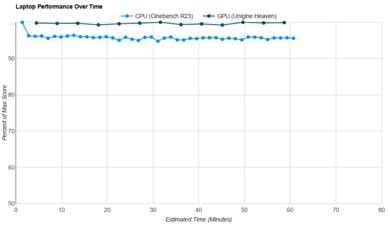
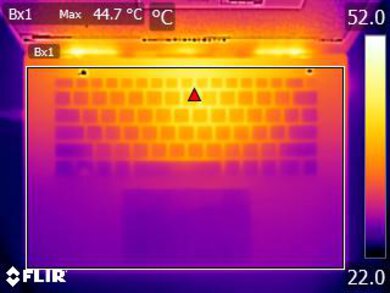
The Apple MacBook Pro 16 (M5, 2026) is good for gaming, though performance varies considerably between titles. Our M5 Max configuration delivers high frame rates in games like Resident Evil 4 and Civilization VII, but more demanding titles like Assassin's Creed Shadows struggle, particularly with higher ray tracing settings. Its 120Hz display lets you see more of those frames, and performance remains stable during extended sessions. However, the fans get loud, the keyboard gets hot, and macOS has a smaller game library than Windows, so check that your favorite games are supported before buying.
120Hz display with decent response time.
Minimal throttling under load.
Heavy typers may not like the keyboard's short travel.
Limited number of games with macOS support.
The Apple MacBook Pro 16 (M5, 2026) is great for school and work. Its large, sharp display gives you plenty of space for multitasking, and its battery lasts over 16 hours of web browsing, easily covering a typical day of classes or meetings. You get a good keyboard, an exceptionally large and accurate touchpad, and an outstanding webcam for video calls. The M5 Max configuration handles everyday tasks with ease and has ample processing power for demanding coursework. That said, the laptop and charger are heavy to carry together, and the keyboard's shallow key travel won't suit everyone. There are plenty of ports for displays and accessories, though older USB-A devices require an adapter.
Exceptional build quality
All-day battery life.
Amazing user experience with its bright display, tactile keyboard, and large haptic touchpad.
Outstanding 1080p webcam.
Heavy typers may not like the keyboard's short travel.
No touch input support.
Large and heavy, especially when carrying the charger.
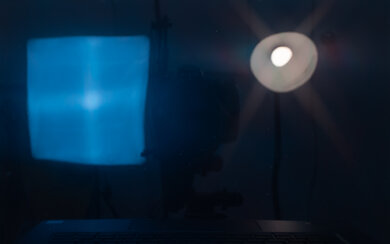
The Apple MacBook Pro 16 (M5, 2026) is great for media consumption. Its large Mini LED display produces sharp images, rich colors, and deep blacks, making movies look good in both bright and dark rooms. It also handles reflections well and gets very dim for nighttime viewing, though some blooming is visible around bright objects in dark scenes. The speakers get loud with little compression at maximum volume, while nearly 16 hours of local video playback gives you plenty of time to watch movies away from an outlet. Its size and weight make it less convenient for travel, especially if you need to carry the heavy charger with you.
Exceptional build quality
All-day battery life.
Sharp, colorful, Mini LED display.
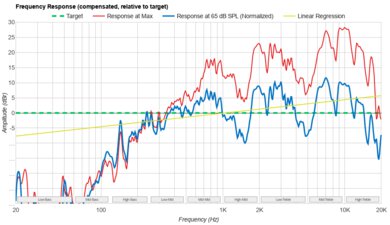
Loud speakers sound natural and clear, with a good amount of bass.
Some blooming around bright objects in dark scenes.
Large and heavy, especially when carrying the charger.
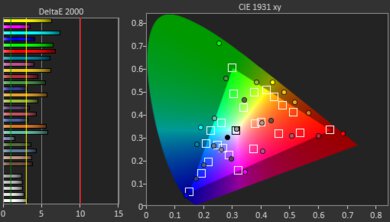
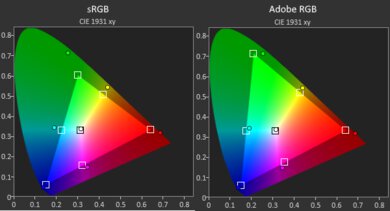
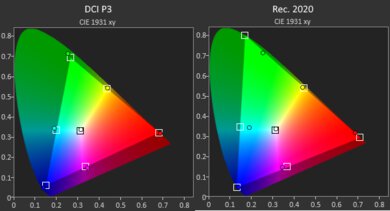
The Apple MacBook Pro 16 M5 is great for heavy workloads. Our M5 Max configuration delivers outstanding CPU performance and handles demanding tasks like code compilation and CPU rendering well. It also has enough graphics power for video editing and 3D work in compatible applications, although performance depends on the software and chip configuration. Its display offers nearly complete DCI-P3 coverage and outstanding factory calibration, making it well-suited for color-critical work. Performance stays consistent during prolonged workloads, but the laptop gets hot and loud. Also, you need to choose enough memory and storage at purchase, as neither is user-upgradeable.
Minimal throttling under load.
Wide port selection.
M5 Pro and Max SoCs can handle demanding tasks.
The Apple MacBook Pro 16 (M5, 2026) has exceptional battery life. Our M5 Max configuration lasts over 16 hours of web browsing and nearly 16 hours of local video playback, allowing you to leave the charger behind for a typical day of light use. Demanding workloads drain the battery much faster; gaming reduces the runtime to around two hours.
All-day battery life.
The Apple MacBook Pro 16 (M5, 2026) has outstanding build quality with premium materials and incredible fit and finish. Its stable hinge keeps the display firmly in position while allowing you to open the laptop with one finger.
Exceptional build quality
The Apple MacBook Pro 16 (M5, 2026) handles demanding graphics workloads like video editing and 3D rendering in compatible applications, with minimal performance loss during prolonged use. Performance depends on whether you choose the M5 Pro or one of the two M5 Max GPU configurations. Our tested M5 Max also delivers high frame rates in several games, although demanding ray tracing settings can require compromises in image quality or frame rate.
Minimal throttling under load.
M5 Pro and Max SoCs can handle demanding tasks.
The Apple MacBook Pro 16 (M5, 2026) delivers outstanding processing performance. Our 18-core M5 Max configuration performs exceptionally well in both single-core and multi-core benchmarks, providing plenty of power for demanding applications and tasks that can use many CPU cores. It also maintains nearly all of its performance during sustained workloads. The main trade-off is heat and fan noise when pushing the processor hard.
Minimal throttling under load.
M5 Pro and Max SoCs can handle demanding tasks.
Performance Usages
Check Price
Differences Between Sizes And Variants
We tested the Apple MacBook Pro 16 (M5, 2026) with a standard glossy display, an M5 Max chip with an 18-core CPU, 36GB of RAM, and a 2TB SSD. The display finish, chip, memory, storage, and color are configurable.
Apple lists the following options. Memory and storage availability depend on the chip configuration.
| Component | Options |
|---|---|
| Display | Standard glossy or nano-texture Liquid Retina XDR display; 3456 x 2234 resolution, up to 120Hz |
| Chip | M5 Pro: 18-core CPU, 20-core GPU; M5 Max: 18-core CPU, 32-core or 40-core GPU |
| M5 Pro memory | 24GB, 48GB, or 64GB |
| M5 Max memory | 36GB with the 32-core GPU; 48GB, 64GB, or 128GB with the 40-core GPU |
| M5 Pro storage | 1TB, 2TB, or 4TB |
| M5 Max storage | 2TB, 4TB, or 8TB |
| Color | Silver or Space Black |
Our performance and battery results apply to the tested M5 Max configuration. Other chip and memory configurations can perform differently, and our reflection results apply to the standard glossy display.
Popular Laptop Comparisons
The Apple MacBook Pro 16 M5 is Apple's larger mobile workstation, offering more screen space than the 14-inch MacBook Pro and more processing power and connectivity than the MacBook Air. Its strengths are its sustained CPU performance, long battery life in light use, color-accurate display, and large touchpad. The main compromises are its weight, limited upgradeability, and heat and fan noise under demanding workloads.
Among Windows alternatives, creator laptops like the ASUS ProArt P16 H7606 (2024) offer features the MacBook lacks, including touch and pen input and NVIDIA GPU options. The MacBook is a stronger fit if you want long battery life and work in macOS applications; a Windows model is preferable if your workflow requires Windows software or NVIDIA graphics.
For more options, see our recommendations for the best workstation laptops, the best laptops for video editing, and the best laptops for battery life.
The Apple MacBook Pro 16 (M5, 2026) and the Apple MacBook Air 13 (M5, 2026) are laptops with different uses in mind. The MacBook Pro is better suited to demanding creative work, with more powerful chip options, active cooling for sustained workloads, and support for more memory. Its larger 120Hz Mini LED display provides more workspace, smoother scrolling, and deeper blacks than the Air's 60Hz IPS screen. It also has more ports, including HDMI and an SD card reader. The MacBook Air is much easier to carry, and its fanless design keeps it silent, making it a better fit for everyday productivity and frequent travel.
The Apple MacBook Pro 16 (M5, 2026) is a refresh of the Apple MacBook Pro 16 (M4, 2024). Both offer a high-resolution 120Hz display, Thunderbolt 5 connectivity, and configurations intended for demanding professional work. The M5 model introduces newer chip options, Wi-Fi 7, Bluetooth 6.0, and higher starting storage capacities. Those changes matter more for demanding work and large projects than everyday browsing or document editing. Also, our tested configurations differ: the M4 model has a 40-core GPU and 48GB of memory, while our M5 unit has 36GB, so the results aren't a comparison between equivalent configurations.
The Apple MacBook Pro 16 (M5, 2026) and the ASUS ProArt P16 H7606 (2024) are large laptops designed for creative work. The MacBook offers much longer battery life and a higher-refresh display, making it more convenient for working away from an outlet. The ASUS provides an OLED touchscreen with pen support, USB-A ports, and NVIDIA GeForce RTX GPU options. Choose based on your applications and input needs: the ASUS is more suitable if you need Windows or want to draw directly on the screen, while the MacBook suits macOS workflows and long periods of light use away from a charger.
The Apple MacBook Pro 16 (M5, 2026) and the Apple MacBook Air 15 (M4, 2025) target different workloads. The Pro is better suited to prolonged demanding tasks, with active cooling, more powerful chip options, and a wider port selection. Its 120Hz display also offers deeper blacks than the Air's 60Hz IPS panel. The Air is a better fit for everyday productivity if you prioritize portability and silence, as its fanless design produces no fan noise. However, that design also limits its sustained performance during demanding work.
Test Results
for pictures & test results
for pictures & test results
for pictures & test results


for pictures & test results

for pictures & test results
for pictures & test results
for pictures & test results