HP OMEN MAX 16 (2025)  Laptop Review

Reviewed Jun 04, 2025 at 10:45am
Tested using Methodology v0.9 
HP OMEN MAX 16 (2025)
6.7
General Productivity 
7.4
Multimedia 
8.4
Gaming 
8.4
Workstation 
 5
  1. Recommended in:
  2. Gaming

The HP OMEN MAX 16 (2025) is a premium gaming laptop. It's available with an Intel Core Ultra 7 255HX or Core Ultra 9 275HX CPU and various discrete NVIDIA GeForce RTX 50-series GPUs, from an RTX 5060 to an RTX 5090. Memory and storage max out at 64GB and 2TB, respectively. Display options include a 165Hz FHD+, a 240Hz QHD+ IPS, and a 240Hz QHD+ OLED panel—all three support G-SYNC variable refresh rate. This laptop has a 1080p webcam with facial recognition, a Wi-Fi 6E or Wi-Fi 7 wireless adapter, and RGB keyboard backlighting. Ports comprise two 10Gbps USB-As, two USB-C/Thunderbolt 4s, an HDMI 2.1, a 1Gbps Ethernet, and a headphone jack.

See our unit's specifications and the available configuration options in the Differences Between Variants section.

Our Verdict

6.7
General Productivity 

The HP OMEN MAX 16 is alright for general productivity. Its Intel CPU and discrete GPU can easily handle productivity tasks like web browsing, text formatting, and spreadsheets. However, the user experience is so-so; it has a large 16-inch display that's well suited for multitasking, but the keyboard feels mushy and might take some time to get used to it. The webcam is pretty good, though, and you also get tons of ports for peripherals and external displays. Unfortunately, this is a rather bulky laptop, and its battery lasts only seven to eight hours in light uses, so you'll need to keep the charger nearby.

Pros
  • Sturdy build.

  • Large screen for multitasking.

  • Responsive touchpad.

  • Good 1080p webcam.

Cons
  • Bulky and heavy.

  • Battery lasts less than eight hours in light uses.

  • Keyboard requires some adaptation.

7.4
Multimedia 

The HP OMEN MAX 16 is decent for media consumption. It has a large 16-inch screen, and there are multiple display options, including a QHD+ OLED panel that'll deliver an amazing dark room and HDR viewing experience. The speakers get reasonably loud with minimal compression artifacts at higher volume levels. They sound okay—clear but slightly boxy, with only a small amount of bass. Unfortunately, this is a rather bulky laptop that's hard to carry. Its battery life isn't bad, though, lasting around six hours of local video playback.

Pros
  • Large screen.

  • Available with OLED panel for better dark room and HDR viewing experience.

  • Battery lasts around six hours of local video playback.

Cons
  • Bulky and heavy.

  • Speakers lack bass.

8.4
Gaming 

The HP OMEN MAX 16 is a great gaming laptop. Available with Intel Arrow Lake CPUs and NVIDIA 50-series GPUs, this 16-inch laptop can deliver smooth gameplay in demanding AAA titles. There are multiple display options, including a 165Hz FHD+ and two 240Hz QHD+ (IPS and OLED) panels, all with G-SYNC support to reduce screen tearing. You can choose between a Wi-Fi 6E or Wi-Fi 7 wireless adapter, and if that isn't good enough, there's also a gigabit Ethernet port to ensure you get the best internet connection when gaming online. RAM and storage are user-upgradeable, so you can upgrade or add more later. Thermal throttling is very minimal, but the fans are extremely loud.

Pros
  • Delivers high, consistent frame rates in demanding games.

  • High-refresh display with decent response time.

  • VRR support.

  • Minimal thermal throttling.

  • User-replaceable RAM and storage.

Cons
  • Loud fans under load.

8.4
Workstation 

Although the HP OMEN MAX 16 isn't designed for use as a workstation, it can be a great option, as it has plenty of processing power to handle demanding tasks. The downside is that you can only get this laptop with NVIDIA's more mainstream GeForce GPUs, which aren't optimal for some professional workloads. This system can handle content creation, though it's best to get a model with the QHD+ 100% DCI-P3 OLED panel, as the other displays only have full sRGB coverage. You get plenty of ports for peripherals and external displays, including two Thunderbolt 4s and a gigabit Ethernet. RAM configuration maxes out at 64GB; however, the memory is user-replaceable, and so is the storage drive. There's very little thermal throttling under load, but the fans get extremely loud.

Pros
  • CPU and discrete GPU can handle demanding workloads.

  • Minimal thermal throttling.

  • User-replaceable RAM and storage.

Cons
  • Loud fans under load.

  • No professional discrete GPU option.

  • 6.7
    General Productivity
  • 7.4
    Multimedia
  • 8.4
    Gaming
  • 8.4
    Workstation
  • Changelog

    1.  Updated Nov 18, 2025: 

      Added mention of the Dell Alienware 18 Area-51 (2025) as an alternative with a larger display in the Screen Specs section.

    2.  Updated Oct 30, 2025: 

      We've updated text throughout the review after converting to Test Bench 0.9.

    3.  Updated Oct 30, 2025: We've updated the review to Test Bench 0.9, which adds several test boxes in the performance section, including CPU/RAM Performance, Low Tier Graphics, High Tier Graphics, Professional 3D (GPU accelerated), CPU-Intensive Game Performance, GPU-Intensive Game Performance, and Ray Tracing Performance. See the 0.9 changelog here.
    4.  Updated Jun 04, 2025: Review published.

    Differences Between Sizes And Variants

    We tested the HP OMEN MAX 16 (model 16-ah0070ca) with a 240Hz QHD+ IPS screen, an Intel Core Ultra 9 275HX CPU, an NVIDIA GeForce RTX 5080 Laptop GPU, 32GB of RAM, and 1TB of storage. The screen, CPU, GPU, memory, and storage are configurable; the available options are below.

    SCREEN

    • 16" IPS 1920 x 1200 165Hz (matte, 400 cd/m², 100% sRGB)
    • 16" IPS 2560 x 1600 240Hz (matte, 500 cd/m², 100% sRGB)
    • 16" OLED 2560 x 1600 240Hz (glossy, 400 cd/m² SDR/500 cd/m² HDR, 100% DCI-P3)

    CPU

    • Intel Core Ultra 7 255HX (20 cores/20 threads, up to 5.2GHz, 30MB L3 cache)
    • Intel Core Ultra 9 275HX (24 cores/24 threads, up to 5.4GHz, 36MB L3 cache)

    GPU

    • NVIDIA GeForce RTX 5060 Laptop GPU 8GB GDDR7 (unknown TGP)
    • NVIDIA GeForce RTX 5070 Laptop GPU 8GB GDDR7 (unknown TGP)
    • NVIDIA GeForce RTX 5070 Ti Laptop GPU 12GB GDDR7 (unknown TGP)
    • NVIDIA GeForce RTX 5080 Laptop GPU 16GB GDDR7 (175W TGP)
    • NVIDIA GeForce RTX 5090 Laptop GPU 24GB GDDR7 (175W TGP, Core Ultra 9 only)

    MEMORY

    • 16GB DDR5 5600MHz (1x 16GB)
    • 16GB DDR5 5600MHz (2x 8GB)
    • 24GB DDR5 5600MHz (2x 12GB)
    • 32GB DDR5 5600MHz (2x 16GB)
    • 32GB DDR5 6400MHz (2x 16GB)
    • 64GB DDR 5600MHz (2x 32GB)
    • 64GB DDR5 6400MHz (2x 32GB)

    STORAGE

    • 512GB M.2 2280 PCIe Gen 4 NVMe SSD
    • 1TB M.2 2280 PCIe Gen 4 NVMe SSD
    • 1TB M.2 2280 PCIe Gen 4 NVMe Performance SSD
    • 1TB M.2 2280 PCIe Gen 5 NVMe Performance SSD
    • 2TB M.2 2280 PCIe Gen 4 NVMe Performance SSD
    • Dual storage option: 2x 512GB M.2 2280 PCIe Gen 4 NVMe SSD

    COLOR

    • Shadow Black
    • Ceramic White

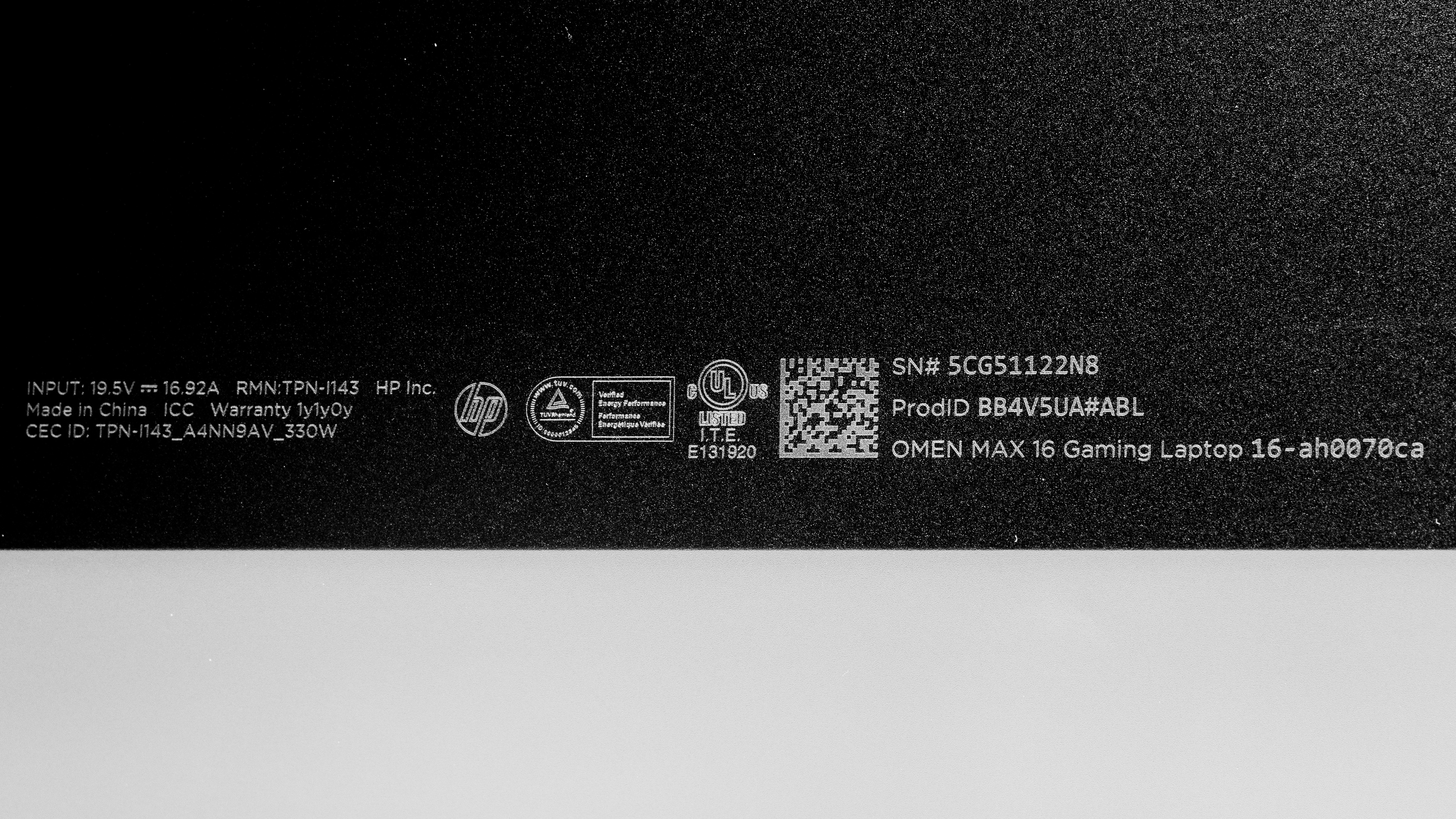
    See our unit's label.

    Popular Laptop Comparisons

    The HP OMEN MAX 16 is an excellent gaming laptop that delivers smooth gameplay in demanding titles. That said, the NVIDIA 50-series GPUs are only a minor upgrade over the 40-series, so it might not be worth upgrading if you already have a laptop with a 40-series GPU, and if you're upgrading from an earlier generation, you can likely find a discounted 40-series model that'll deliver a similar gaming experience, like the ASUS ROG Strix 16 (2024). Unfortunately, this is one of the loudest laptops when it comes to fan noise. Some may not like its zero-lattice keyboard, as the lack of space between the keys may lead to more typos in regular typing.

    For more options, check out our recommendations for the best gaming laptops, the best budget and cheap gaming laptops, and the best laptops for video editing.

    ASUS ROG Strix G16 (2024)

    The HP OMEN MAX 16 (2025) is better than the ASUS ROG Strix G16 (2024) for gaming. While the OMEN's NVIDIA 50-series GPUs are only a minor upgrade over the Strix G16's 40-series GPUs, you can get the OMEN with an RTX 5090, whereas the Strix G16 tops out at an RTX 4080. The OMEN MAX 16's Intel Arrow Lake CPU also performs much better in multi-threaded workloads than the Strix G16's Intel 14th Gen processors. The OMEN MAX has an additional OLED display option, which will deliver a better visual experience, especially when gaming in the dark.

    ASUS ROG Zephyrus G16 (2024) GU605

    The HP OMEN MAX 16 (2025) and the ASUS ROG Zephyrus G16 (2024) GU605 are both excellent 16-inch gaming laptops. If you're only looking to play games and want the best performance possible, the OMEN MAX 16 is the one to get, as it can deliver smoother gameplay in demanding games. The Zephyrus G16 is more of a hybrid device, meaning it has a more compact design that makes it more suitable for other uses, like video editing and general productivity. Its slimmer design comes at the cost of some performance, though, as its NVIDIA 40-series GPUs can only run up to 115W. The OMEN MAX 16 is also a better choice if you want to upgrade the RAM yourself, since the Zephyrus G16 uses soldered memory.

    Dell Alienware m16 R2 (2024)

    The HP OMEN MAX 16 (2024) is better than the Dell Alienware m16 R2 (2024) for most uses. The OMEN MAX 16 is available with faster Intel Arrow Lake CPUs and newer NVIDIA 50-series GPUs. Plus, you can get the OMEN MAX 16 with up to an RTX 5090, whereas the Alienware m16 R2 tops out at an RTX 4070. The OMEN MAX 16 also has an OLED display option that'll provide a better visual experience, especially when gaming in a dark room.

    Razer Blade 18 (2024)

    The HP OMEN MAX 16 (2025) and the Razer Blade 18 (2024) are both high-end gaming laptops. The Blade 18 feels more premium and generally provides a better user experience overall. It's a larger device intended more as a desktop replacement, though the OMEN MAX 16 isn't really well suited for on-the-go use either, as it's rather bulky and heavy. Performance-wise, while the OMEN MAX 16 comes out slightly ahead, it isn't by much, as its NVIDIA 50-series GPUs are only a minor upgrade over the Blade 18's 40-series GPUs. 

    Show more 

    Test Results

    perceptual testing image
    Sort:
    RATINGS
    Category:
    All
    Design
    Style
    Form Factor
    Traditional (Clamshell)

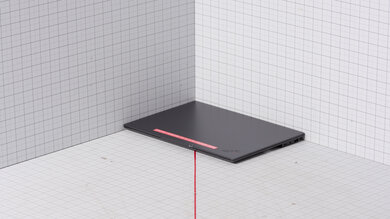
    The HP OMEN MAX 16 is available in a Shadow Black or Ceramic White colorway. See the bottom of the laptop.

    8.5
    Build Quality

    The HP OMEN MAX 16's build quality is excellent. Its full-aluminum chassis feels very sturdy, exhibiting only a small amount of flex. The screen has a slight outward curve; however, it isn't noticeable unless you look from the side, and it's unlikely to be an issue in terms of durability. The finish doesn't scratch easily. Fingerprints and smudges don't show too much from occasional manipulation, but they accumulate over time and are quite visible. The Ceramic White model likely won't show smudges as much. The feet feel solid and stick firmly to the bottom.

    9.1
    Hinge
    Range
    140°
    Stability
    Good
    One Finger Lift
    Yes

    The hinges feel smooth and solid. They move a little bit when manipulating the screen near the top corners, but that shouldn't be a major concern. There's very little screen wobble when typing heavily.

    4.6
    Portability
    Size
    16"
    Thickness
    1.3" (3.3 cm)
    Width
    14.0" (35.6 cm)
    Depth
    10.6" (26.9 cm)
    Volume
    192.8 in³ (3,160.2 cm³)
    Weight
    6.0 lbs (2.7 kg)
    Charger Size
    33.3 in³ (546.5 cm³)
    Charger Weight
    1.8 lbs (0.8 kg)
    8.1
    Serviceability
    Ease Of Access
    7.0
    RAM Slots
    2
    Storage Slots
    2
    Replaceable Battery
    Yes
    Replaceable Wireless Adapter
    Yes

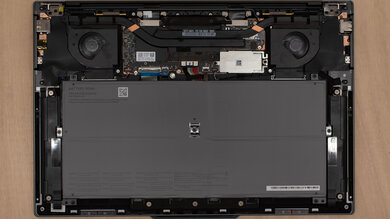
    Accessing the HP OMEN MAX's internals is relatively straightforward; you need to remove six screws and use a prying tool to release the bottom panel's clips. One screw (at the top of the panel) is captive, meaning it remains attached to the panel. The other screws are of two different sizes, so it's best to keep them organized to facilitate the reassembly. There are protective covers on top of the memory modules, wireless adapter, and SSD. The memory's protective cover comes off easily with no tool required; however, you need to remove additional screws to get to the wireless adapter and SSD. The storage slots support M.2 2280 PCIe Gen 4 and Gen 5 NVMe SSDs.

    See the maintenance and service guide here.

    In The Box

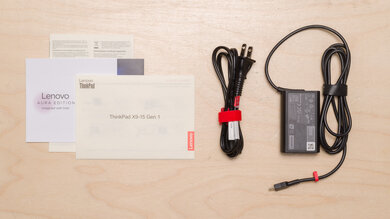
    • 330W power adapter
    • Documentation

    Note: Models with an NVIDIA GeForce RTX 5060 or 5070 come with a 280W power adapter.

    Display
    Screen Specs
    Resolution
    2560 x 1600
    Aspect Ratio
    16:10
    Pixel Density
    188 PPI
    Panel Type
    IPS
    Touch Screen
    No
    Screen-To-Body Ratio
    82%

    The HP OMEN MAX 16 is available with the following displays:

    • 16" IPS 1920 x 1200 165Hz (matte, 100% sRGB)
    • 16" IPS 2560 x 1600 240Hz (matte, 100% sRGB)
    • 16" OLED 2560 x 1600 240Hz (glossy, 100% DCI-P3)

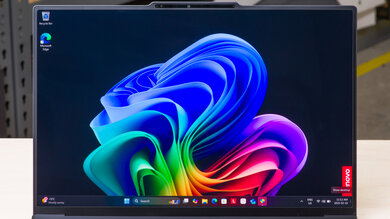
    The QHD+ resolution looks very sharp on a 16-inch screen. You can see individual pixels a few inches away from the screen, but even then, you'd have to look intensely to really see them. With a pixel density of 142 PPI, the FHD+ panel will show individual pixels more, making it less ideal for text-heavy productivity tasks. However, the lower resolution is easier to drive, allowing for higher frame rates when gaming. Regarding the OLED panel, OLEDs are susceptible to permanent burn-in, but it isn't really an issue for gaming. Consider the Dell Alienware 18 Area-51 (2025) if you're looking for a similar laptop with an even larger screen.

    9.6
    Refresh Rate
    Refresh Rate
    240 Hz
    Variable Refresh Rate
    G-SYNC

    You can get this laptop with a 165Hz IPS, a 240Hz IPS, or a 240Hz OLED panel. The 240Hz QHD+ IPS display we tested has a decent response time, showing only a small amount of ghosting behind fast-moving objects. The 165Hz FHD+ IPS panel has the same advertised response time of 3ms, while the 240Hz QHD+ OLED panel has a faster advertised response time of 0.2ms. All three displays support G-SYNC.

    7.3
    Contrast
    Native Contrast
    1,329 : 1

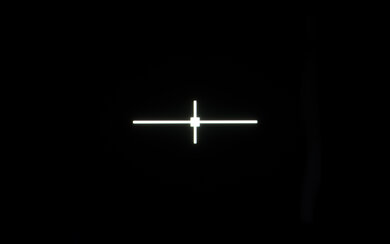
    The 240Hz QHD+ IPS display's contrast ratio is decent and within the typical range of most IPS panels; however, it's still low compared to other display technologies. This contrast level makes blacks look gray in dim settings. The 165Hz FHD+ IPS panel likely has the same contrast ratio. The OLED panel's contrast ratio is effectively infinite since OLEDs can turn off individual pixels to produce perfect blacks.

    8.8
    Brightness
    Maximum Brightness
    536 cd/m²
    Minimum Brightness
    20 cd/m²

    The 240Hz QHD+ IPS display gets bright enough for use in most indoor settings. You can even use it outdoors in broad daylight, though you may have trouble seeing some content under direct sunlight. It also gets pretty dim at the lowest brightness setting, which helps reduce eye strain when viewing content in the dark. The 165Hz IPS and the 240Hz OLED panel have a lower advertised brightness of 400 cd/m² in SDR.

    7.5
    Reflections
    Screen Finish
    Matte
    Total Reflections
    5.03%
    Indirect Reflections
    3.99%
    Calculated Direct Reflections
    1.04%

    The display's coating is technically matte, but in practice, it's somewhere between a true matte and a semi-glossy finish, as you can make out the outline of some reflections. This coating handles reflections well—you'll only have trouble with reflections when viewing dark-color content. The OLED panel has a glossy finish and will struggle more with direct, mirror-like reflections.

    6.7
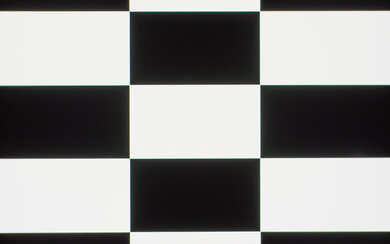
    Black Uniformity
    Uniformity (Std. Dev.)
    1.520%

    The QHD+ OLED panel's black uniformity is perfect since OLEDs can turn off individual pixels to produce pure blacks.

    6.9
    Out-Of-The-Box Color Accuracy
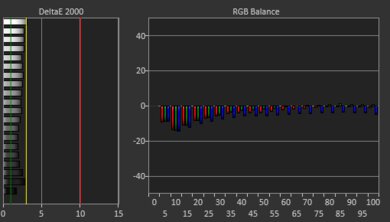
    Avg. White Balance dE
    4.25
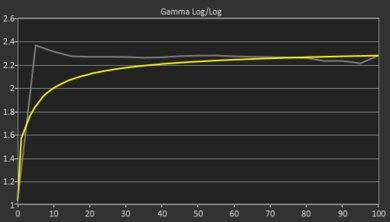
    Avg. Gamma
    2.2
    Avg. Color dE
    2.8
    Avg. Color Temperature
    6,358 K

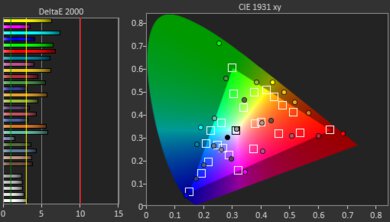
    The 240Hz QHD+ IPS display's out-of-the-box accuracy is okay. Most color inaccuracies are minor, but the white balance is visibly inaccurate, especially at higher brightness levels. Except for some over-darkening in dark scenes, the gamma is pretty good, following closely the target curve.

    8.6
    Color Gamut
    sRGB xy
    99.43%
    sRGB uv
    97.92%
    Adobe RGB xy
    79.75%
    Adobe RGB uv
    89.21%
    DCI-P3 xy
    80.86%
    DCI-P3 uv
    84.73%
    Rec. 2020 xy
    58.26%
    Rec. 2020 uv
    62.61%

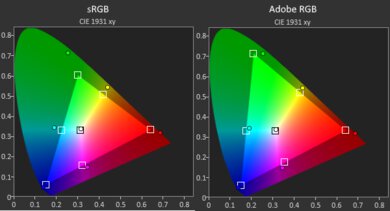
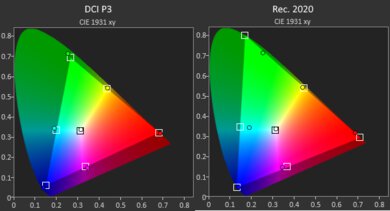
    The 240Hz QHD+ IPS display is essentially an sRGB panel, meaning it only has full coverage of the sRGB color space used in most content. The 165Hz FHD+ IPS panel has the same advertised color gamut, while the 240Hz QHD+ OLED panel has full coverage of the wider DCI-P3 color space.

    10
    Flicker
    Flicker-Free
    Yes
    Flicker Frequency
    No Flicker
    Flicker Active Below
    0%

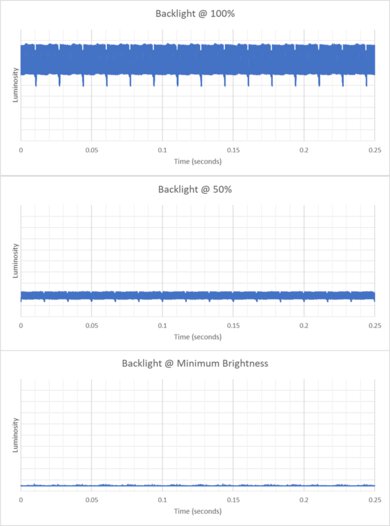
    Our unit's 240Hz QHD+ IPS panel is entirely flicker-free. The 165Hz FHD+ IPS panel is likely flicker-free as well. The OLED panel flickers; other reviewers have reported that it flickers at 960Hz, though we can't confirm it since we haven't tested it.

    Interface
    7.7
    Keyboard
    Typing Quality
    7.0
    Numpad
    Yes
    Backlighting
    Per-Key RGB
    See details on graph tool
    Operating Force
    68 gf
    Actuation Force
    32 gf
    Pre-Travel
    1.11 mm
    Total Travel
    1.61 mm

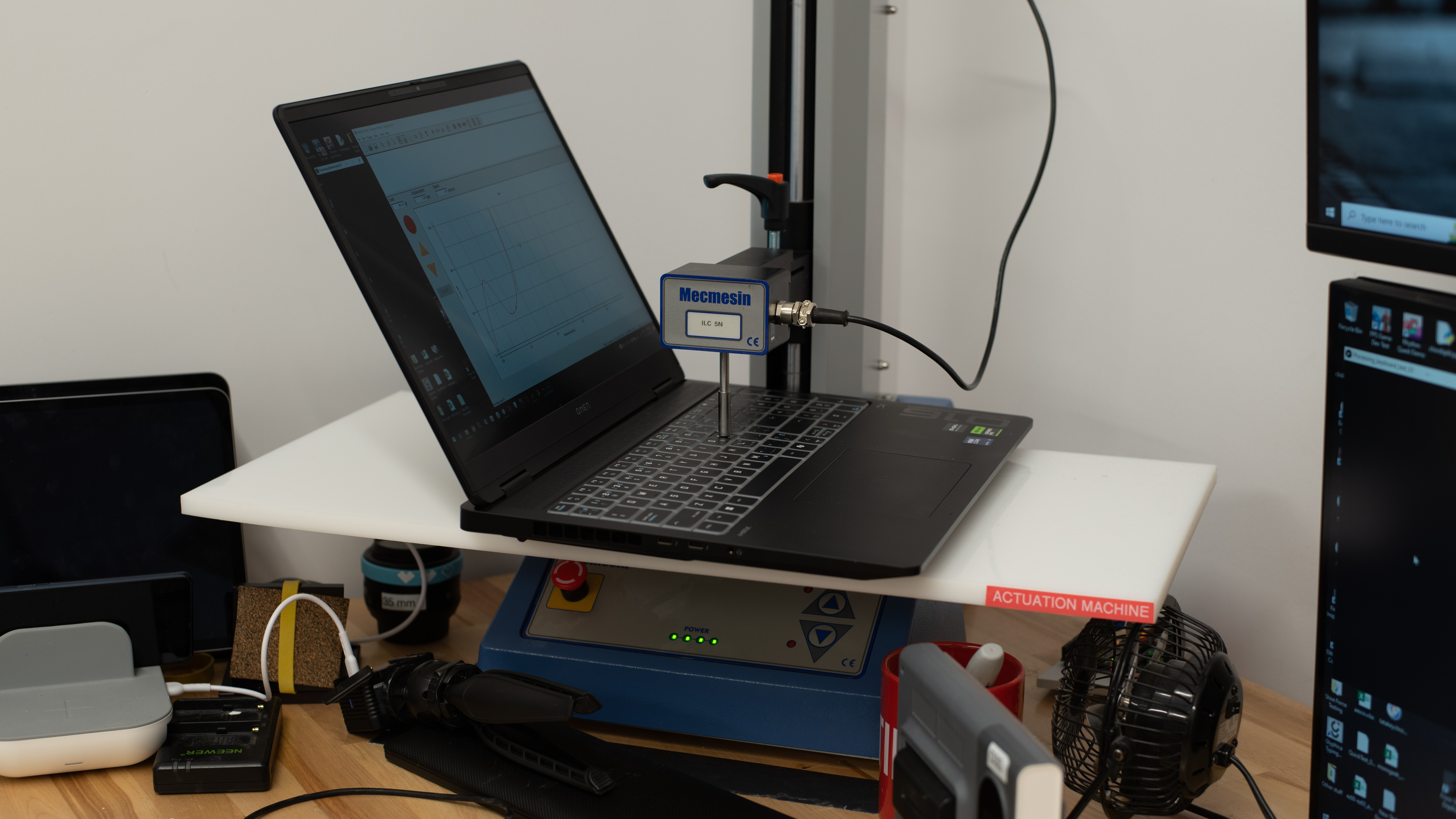
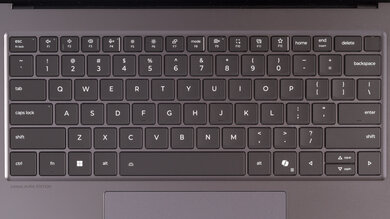
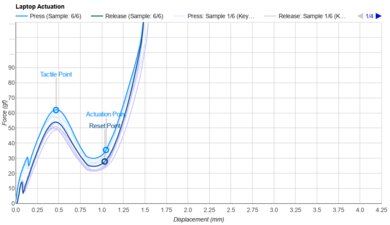
    The HP OMEN MAX has a good keyboard. There isn't anything particularly weird about the layout itself, though it might take some time to get used to the location and size (especially Up and Down) of the arrow keys below the right-Shift. The zero-lattice design (meaning there's no space between the keys) might also require some adaptation. While some keys feel a little wobbly, most of them are very stable. As for the typing experience, the keys have decent travel and are easy to actuate, but they're a bit mushy, providing only a moderate amount of tactile feedback. You can customize the per-key RGB backlighting via the OMEN Gaming Hub app; the backlight shines well through the legends and around the pudding keycaps. This laptop is also available with a 4-zone RGB keyboard backlighting.

    8.0
    Touchpad
    Tracking Quality
    8.0
    Size
    15.5 in² (100.0 cm²)
    Material
    Plastic
    Dedicated Buttons
    No

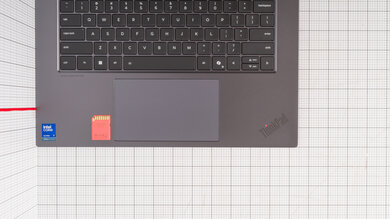
    The HP OMEN MAX 16 has a great touchpad. Although it's on the smaller side for a 16-inch laptop, it works well for most uses. The size is only an issue when performing actions like dragging and dropping over a long distance. It tracks all movements and gestures well, even near the edges, and palm rejection works as intended. This is a diving board touchpad; you can perform clicks pretty far up (almost three quarters of the way up), but it doesn't work consistently. The actuation feels satisfyingly tactile.

    7.7
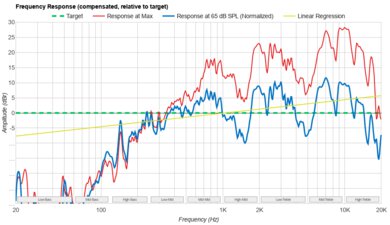
    Speakers
    See details on graph tool
    Max Volume
    74 dB SPL
    Standard Error @ Normal Vol. (65 dB)
    5.3 dB
    Slope @ Normal Vol. (65 dB)
    -0.1
    Bass Extension (Low-Frequency Ext.)
    236 Hz
    Treble Extension (High-Frequency Ext.)
    18 kHz
    Dynamic Range Compression @ Max Vol.
    0.6 dB

    The HP OMEN MAX's speakers are at the bottom of the laptop, near the front (the grills above the keyboard are air vents). The speakers get reasonably loud with minimal artifacts at higher volume levels. They sound okay—clear and relatively natural, but slightly boxy, with only a small amount of bass.

    7.9
    Webcam & Microphone
    Video Quality
    7.5
    Resolution
    1080p
    Position
    Top Center
    Privacy Cover
    Yes
    Face Unlock
    Yes

    The HP OMEN Max 16 has a good webcam. The image looks fairly detailed but a tad noisy, and the colors look slightly unnatural. There's also some haloing throughout, softening the whole image. Voices sound loud and clear over the microphone with little to no background noise. Activating the physical privacy cover also disables the camera at the software level.

    Connectivity
    9.5
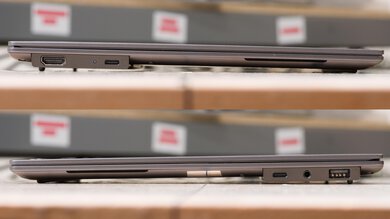
    Ports
    USB-A Ports
    2
    USB-C Ports
    2
    Thunderbolt
    Thunderbolt 4
    USB-C Charging
    Yes
    USB-C Display Out
    Yes
    HDMI
    2.1
    DisplayPort
    No
    3.5mm Jack
    Combo mic/headphone
    Card Reader
    No
    Ethernet
    Yes
    Proprietary Port
    HP AC Adapter Port
    Security Lock
    No

    The HP OMEN MAX 16 has an outstanding port selection. Both USB-As support USB 3.2 Gen 2 data transfer speed (up to 10Gbps). The USB-Cs support Thunderbolt 4 data transfer speed (up to 40Gbps), Power Delivery, DisplayPort 2.1, and HP Sleep and Charge. The latter lets you charge a mobile device connected to the port even when the laptop is in sleep mode. You can charge the laptop via USB-C, but the USB-C ports can only take up to 100W, meaning the battery will drain if you perform intensive tasks at the same time. The Ethernet port has a maximum speed of 1Gbps.

    Wireless Communication
    Wi-Fi
    Wi-Fi 7 (802.11be)
    Bluetooth
    5.4

    The HP OMEN MAX 16's wireless adapter is an Intel Wi-Fi 7 BE200. You can also configure this laptop with an Intel Wi-Fi 6E AX211 adapter. Wi-Fi 6E and Wi-Fi 7 have faster speeds, lower latency, and less signal interference than previous Wi-Fi standards. However, you need a Wi-Fi 6E or Wi-Fi 7 router to benefit from these features. Check out our best router recommendations if you want to upgrade your home wireless network.

    Configuration
    CPU
    Brand
    Intel
    Model
    Core Ultra 9 275HX
    Core Count
    24
    Thread Count
    24

    The HP OMEN MAX 16 is available with the following CPUs:

    • Intel Core Ultra 7 255HX (20 cores/20 threads, up to 5.2GHz, 30MB L3 cache)
    • Intel Core Ultra 9 275HX (24 cores/24 threads, up to 5.4GHz, 36MB L3 cache)

    Based on Intel's Arrow Lake architecture, these are high-performance mobile CPUs used in gaming and workstation laptops. They can handle nearly every type of workload, from general productivity tasks to intensive simulations and 3D graphics. Regarding core composition, the Ultra 7 255HX has 8 performance and 12 efficiency cores, while the Core Ultra 9 275HX has 8 performance and 16 efficiency cores. Unlike previous generation Intel CPUs, neither supports Hyper-Threading. Both have an NPU with a rated performance of 13 TOPS (Trillions of Operations Per Second) to handle AI tasks like image generation in photo editing apps and background blurring during video calls.

    See Intel's Quick Reference Guide for more information about these Arrow Lake CPUs.

    GPU
    Brand
    NVIDIA
    Model
    GeForce RTX 5080 Laptop GPU
    Dedicated/Integrated
    Dedicated
    VRAM Size
    16 GB
    GPU Total Graphics Power (TGP)
    175W

    The HP OMEN MAX 16 is available with the following discrete GPUs:

    • NVIDIA GeForce RTX 5060 Laptop GPU 8GB GDDR7 (unknown TGP)
    • NVIDIA GeForce RTX 5070 Laptop GPU 8GB GDDR7 (unknown TGP)
    • NVIDIA GeForce RTX 5070 Ti Laptop GPU 12GB GDDR7 (unknown TGP)
    • NVIDIA GeForce RTX 5080 Laptop GPU 16GB GDDR7 (175W TGP)
    • NVIDIA GeForce RTX 5090 Laptop GPU 24GB GDDR7 (175W TGP, Core Ultra 9 only)

    The NVIDIA GeForce RTX 50-series Laptop GPUs are largely an incremental upgrade to the 40-series GPUs, providing only a minor increase in raw performance. Other than quality improvements to existing features like Super Resolution (upscaling) and Ray Reconstruction, the only new feature exclusive to the 50-series is Multi-Frame Generation (MFG). MFG allows the GPU to generate up to three frames per rendered frame (up from one on the 40-series GPUs), resulting in higher frame rates and smoother gameplay in supported games. That said, at the time of writing, MFG is still in its early days. It often causes visual artifacts, especially in challenging scenes with heavy, more unpredictable movements, and it can cause noticeably higher latency.

    As for the performance difference between the available GPUs, the RTX 5060 and 5070 are primarily for 1080p gaming. They can handle some games at 1440p, but with only 8GB of VRAM, you'll likely experience stutters in demanding games. The RTX 5070 Ti, 5080, and 5090 are all suitable for gaming at the QHD+ resolution; the choice ultimately comes down to what kind of performance you expect and your budget.

    HP doesn't specify the TGP of the RTX 5060, 5070, and 5070 Ti, but based on the capability of the cooling system, they likely run at their maximum wattage, which means the RTX 5060 and 5070 would run at 115W, while the RTX 5070 Ti would run at 140W.

    See NVIDIA's specifications page for more information about the NVIDIA 50-series Laptop GPUs.

    RAM
    Capacity
    32 GB
    Modules
    2
    Type
    DDR5
    Speed
    5,600 MHz

    You can configure this laptop with 16GB, 32GB, or 64GB of RAM. The 32GB and 64GB configurations are available with 5600MHz or 6400MHz modules. The memory is user-replaceable.

    Storage
    Advertised Capacity
    1,000 GB
    Usable Capacity
    939 GB
    Drive 1
    SK Hynix PCB01 HFS001TFM9X187N
    Drive 1 TypeSSD
    Drive 2
    No 2nd Drive
    Drive 2 TypeNo 2nd Drive

    You can configure this laptop with 512GB, 1TB, or 2TB of storage. These storage options use a single SSD. There's also a dual storage option with two 512GB SSDs. The storage is user-replaceable; both slots support M.2 2280 PCIe Gen 4 and Gen 5 NVMe SSDs.

    Performance
    8.5
    CPU/RAM Performance
    Cinebench 2024 - Single Core
    131 points
    Cinebench 2024 - Multi Core
    1,867 points
    Geekbench 6 - Single Core
    3,008
    Geekbench 6 - Multi Core
    19,235
    Blender - CPU (Avg)
    150 samples/min
    PassMark PT - CPU Mark
    59,700
    PassMark PT - Memory Mark
    3,441
    PassMark PT - Memory Mark (Android)
    N/A
    Mozilla Kraken
    281 ms
    8.6
    Low Tier Graphics
    Geekbench 6 - GPU Compute
    180,116
    Basemark Web 3.0
    2,308
    PassMark PT - 2D Mark
    1,328
    PassMark PT - 2D Mark (Android)
    N/A
    PassMark PT - 3D Mark
    24,470
    PassMark PT - 3D Mark (Android)
    N/A
    Novabench 5 - GPU
    1,917.0
    mprep - Stress My GPU
    165,010
    8.8
    High Tier Graphics
    3DMark - Steel Nomad (DX12)
    5,362
    3DMark - Steel Nomad (Vulkan/Metal)
    5,508
    Basemark GPU (DX12)
    236,540
    Basemark GPU (Vulkan/Metal)
    224,680
    GFXBench - High Level Test (Vulkan/Metal)
    16,602 Frames
    7.2
    Professional 3D (GPU Accelerated)
    Blender - GPU (Avg)
    2,296 samples/min
    Cinebench 2024 - GPU
    N/A

    The NVIDIA GeForce RTX 5080 is not currently supported by Cinebench 2024.

    8.6
    CPU-Intensive Game Performance
    Civilization VII - AI
    14.8 s/turn
    Civilization VII - Graphics (Avg)
    314.3 fps
    Civilization VII - Graphics (1% Low)
    130.2 fps
    Total War: Warhammer III (Avg)
    140.3 fps
    Baldur's Gate 3 (Avg)
    81.1 fps
    Baldur's Gate 3 (1% Low)
    58.6 fps
    Previous Methodology Score
    9.2
    Previous Methodology Score Converted
    8.7
    8.3
    GPU-Intensive Game Performance
    Cyberpunk 2077 (Avg)
    114.9 fps
    Cyberpunk 2077 (Min)
    98.7 fps
    Assassin's Creed Shadows (Avg)
    70 fps
    Assassin's Creed Shadows (1% Low)
    59 fps
    GTA V (Avg)
    175.8 fps
    GTA V (1% Low)
    65.0 fps
    Black Myth: Wukong (Avg)
    53 fps
    Black Myth: Wukong (5% Low)
    47 fps
    Resident Evil 4 (Avg)
    139.8 fps
    Resident Evil 4 (1% Low)
    110.3 fps
    Previous Methodology Score
    9.4
    Previous Methodology Score Converted
    8.0
    6.5
    Ray Tracing Performance
    Cyberpunk 2077 (Avg)
    77.1 fps
    Cyberpunk 2077 (Min)
    70.0 fps
    Assassin's Creed Shadows (Avg)
    46 fps
    Assassin's Creed Shadows (1% Low)
    40 fps
    Black Myth: Wukong (Avg)
    28 fps
    Black Myth: Wukong (5% Low)
    24 fps
    9.7
    Storage Drive Performance
    Sequential Write Speed
    2,126.0 MB/s
    Sequential Read Speed
    6,041.6 MB/s
    Random Write Speed
    90.8 MB/s
    Random Read Speed
    76.7 MB/s
    6.6
    Battery
    Capacity
    83 Wh
    Battery Life (Web Browsing)
    7.6 hrs
    Battery Life (Video Playback)
    6.2 hrs
    Battery Life (Gaming)
    2.1 hrs
    Charge Time
    2.2 hrs

    Battery life depends on the configuration. Models with the 165Hz FHD+ display and/or a lower-end GPU will likely have a longer battery life.

    6.8
    Thermals And Noise
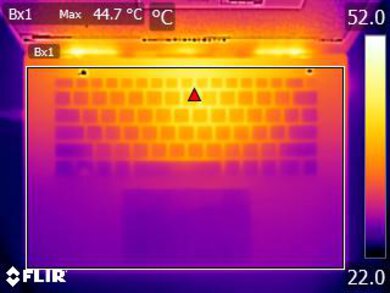
    Keyboard Temp While Idle
    31 °C (88 °F)
    Keyboard Temp Under Load
    37 °C (98 °F)
    Fan Noise While Idle
    27.5 dBA
    Fan Noise Under Load
    59.0 dBA
    Power & Fan Control App
    Yes

    The keyboard deck remains relatively cool despite the CPU reaching a boiling 100 °C (212 °F). Unfortunately, the fans are extremely loud. You can change the power mode and fan speed in the OMEN Gaming Hub app. See video for a quick tour of the OMEN Gaming Hub app. The Automatic Fan Cleaning feature in the app helps keep the fans clean by spinning backward, reducing the need for maintenance.

    The posted results are measurements taken in the Unleashed power mode. Here are the measurements in the Performance and Balanced modes:

    Performance

    • Keyboard Temp Under Load: 35.5 °C (95.9 °F)
    • Fan Noise Under Load: 52 dBA

    Balanced

    • Keyboard Temp Under Load: 34.9 °C (94.82 °F)
    • Fan Noise Under Load: 48 dBA
    9.0
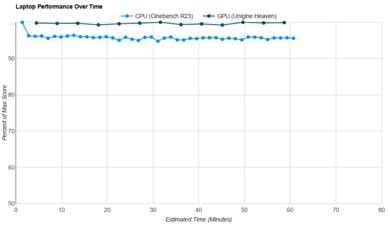
    Performance Over Time
    See details on graph tool
    CPU Temp (Cinebench)
    100 °C
    CPU Perf. Loss (Cinebench)
    6% loss
    GPU Temp (Heaven)
    62 °C
    GPU Perf. Loss (Heaven)
    0% loss
    Additional Features And Software
    Software
    Operating System
    Windows 11
    Additional Software
    Yes

    The HP OMEN MAX 16 has many pre-installed applications; see this video for the full list.

    Extra Features
    Biometrics
    Face Recognition
    RGB Illumination
    Yes
    Touch Pen Support
    No Stylus Support
    Secondary Display
    No

    The HP OMEN MAX 16 has a Windows Hello facial recognition camera. You can use it to log in quickly, authorize purchases in the Windows Store, and auto-fill saved passwords on supported websites.

    In addition to RGB keyboard backlighting, there's also a 4-zone RGB light bar at the front of the laptop. You can customize this light bar in the OMEN Gaming Hub app.