See the previous 0.8.3 changelog.
What's Changed?
Laptop Test Bench 0.9 has a few changes:
- Updated Performance Benchmarks to better display average gaming performance, as well as include newer titles
- Updated and added Synthetic Benchmarks tools
You can learn more about how we test these aspects in detail by reading our test articles on Graphics And Professional 3D, CPU/RAM Performance, and Gaming And Ray Tracing.
Performance Benchmarks
 |
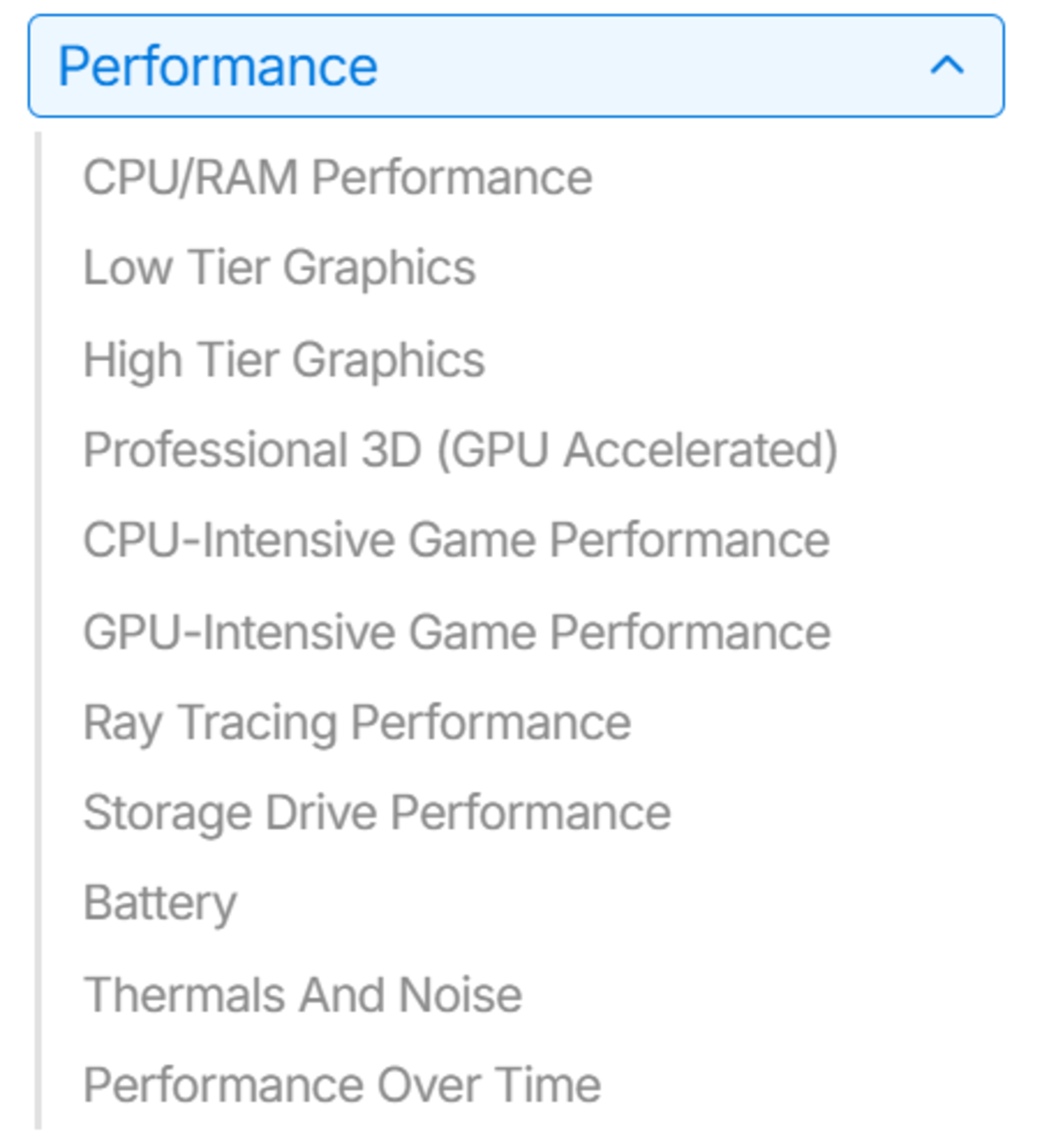 |
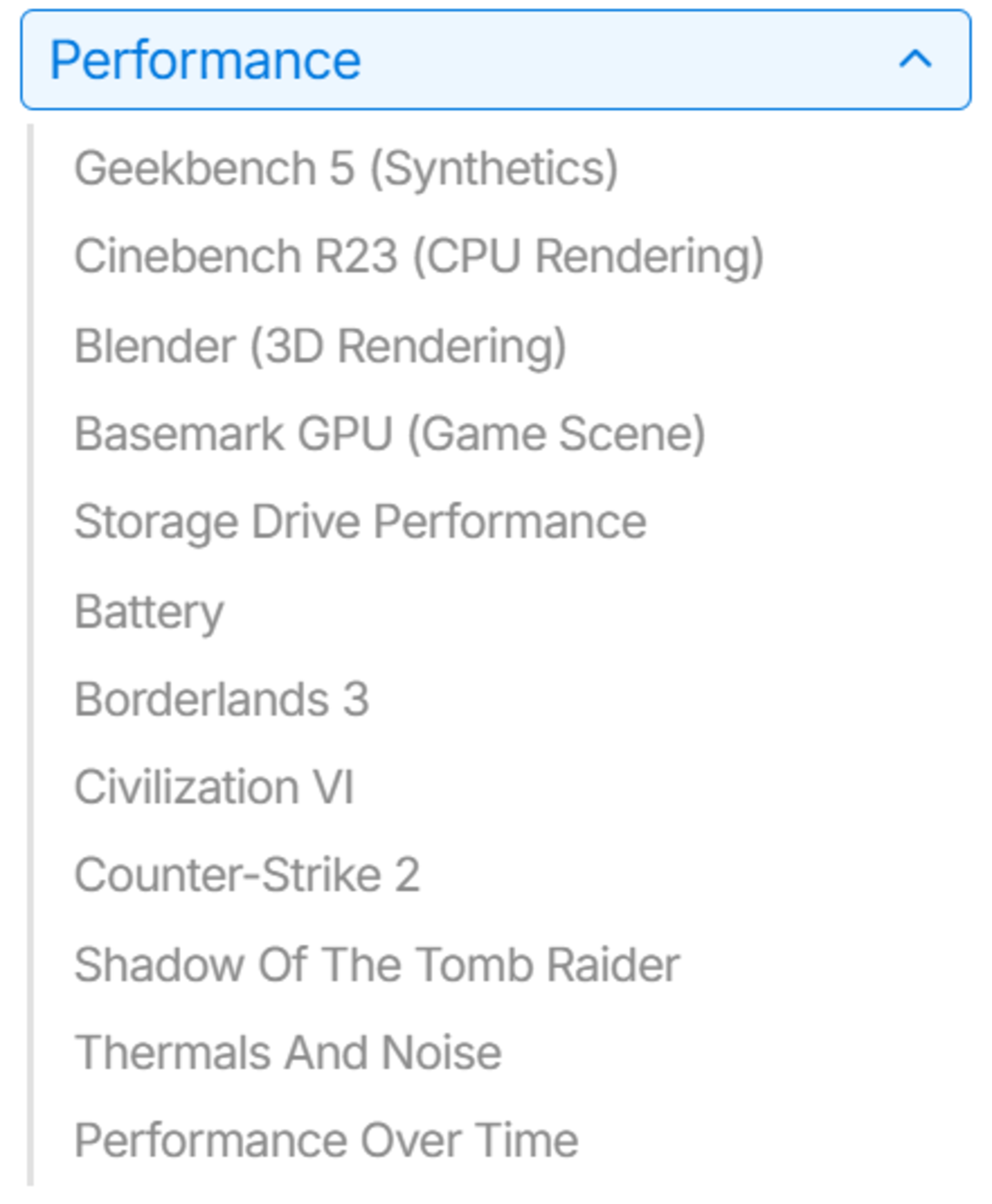
| 'Performance' section on Test Bench 0.8.3 | 'Performance' section on Test Bench 0.9 |
We've updated the Performance benchmarks to include more modern and recent games, and they're easier to read. Instead of each game being its own separate test box, they're now presented as test results within specific tests, with that overall test box giving an average score of all tested games.
For example, here you can see the results for the GPU-Intensive Game Performance test box on the HP OMEN MAX 16 (2025):
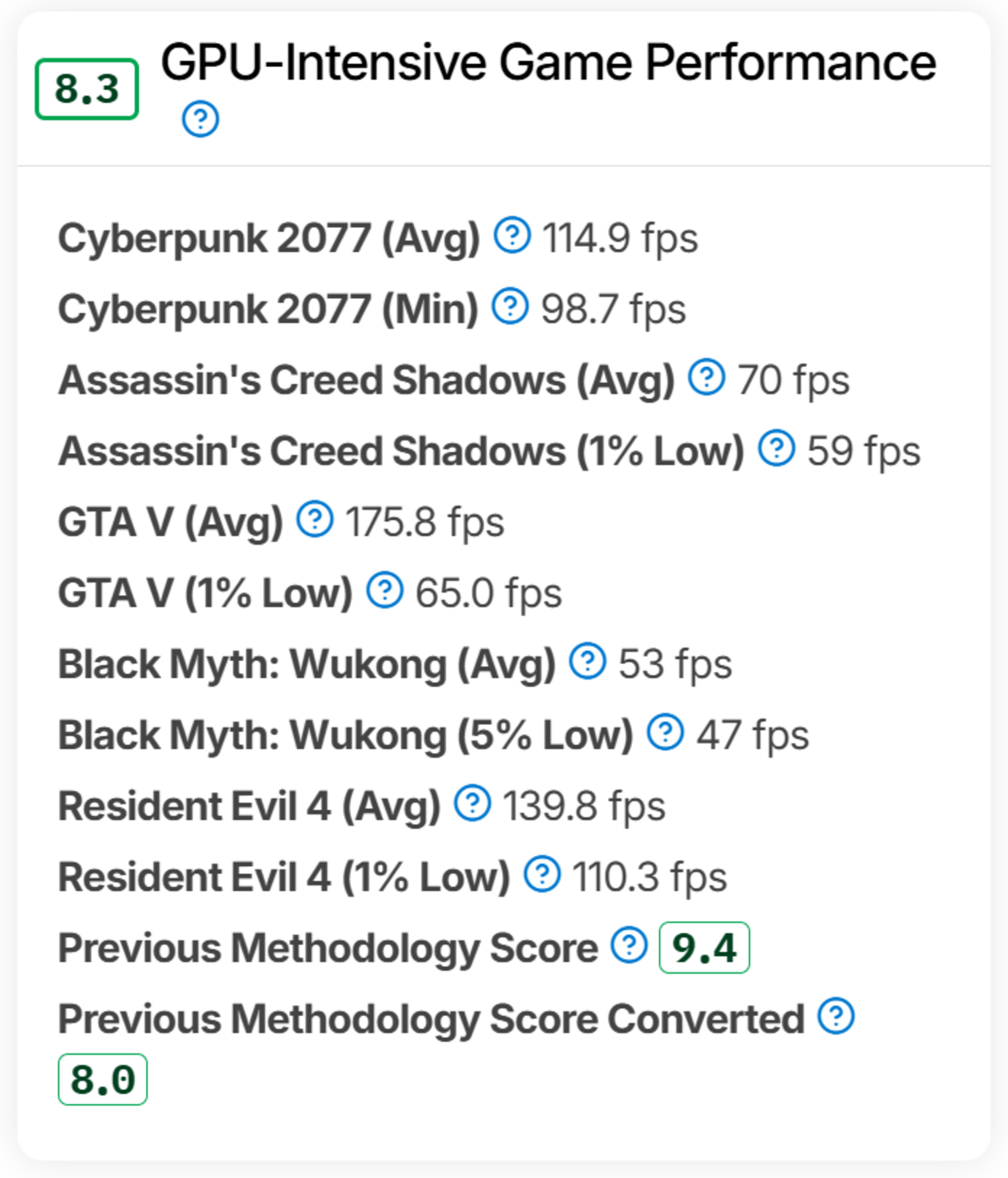
Because all tested games are in one test box, the overall score of the box (8.3) represents an average of several games. The other tests in this section are also laid out similarly, so it's easier to get an overall sense of average gaming performance, while also being able to see the specific results for each test.
"Previous Methodology Score" shows you what this same laptop would have scored using the combined score of the previous games that we used to test GPU performance with (Borderlands 3 and Shadow Of The Tomb Raider).
"Previous Methodology Score Converted" takes the 'Previous Methodology Score', but converts it to our current benchmarks to give an up-to-date estimated score. For example, while a laptop may score high at launch with the benchmarks at the time, over time, apps become more demanding, and what used to score high may no longer be considered good. This result will help you compare older laptops against newer laptops on our test bench.
In contrast, here's an example of two game test boxes on the previous Test Bench 0.8.3:

Not only are the games much older and less relevant to test the performance of recent high-end gaming laptops, but they're also presented in a way that makes it more difficult to see the average performance across multiple games.
Synthetic Benchmark Changes
Aside from in-game benchmarks, we also updated, removed, and added many synthetic benchmarks in Test Bench 0.9. For any benchmark in Test Bench 0.8.3 that we still test in Test Bench 0.9, we now test on the most recent and up-to-date version. This means that while in 0.8.3 we used Blender 2.83, Geekbench 5, and Cinebench R23, in 0.9 we now use Blender 4.4.x, Geekbench 6, and Cinebench 2024.
We also added PassMark PT, Basemark Web 3.0, 3DMark, GFXBench, Novabench 5, mprep, and Mozilla Kraken benchmarks.
Let Us Know What You Think!
Your feedback is instrumental in improving our testing. If you have comments, questions, or suggestions about this or any future updates, reach out to us in the comments or at feedback@rtings.com.
29 Laptops Updated
We have retested popular models. The test results for the following models have been converted to the new testing methodology. However, the text might be inconsistent with the new results.
- Acer Aspire 15 (2024)
- Acer Chromebook Plus Spin 714 (2024)
- Acer Nitro V 16 (2024)
- Acer Swift Go 14 (2024)
- Apple MacBook Air 13 (M4, 2025)
- Apple MacBook Pro 14 (M4, 2024)
- Apple MacBook Pro 16 (M4, 2024)
- ASUS ProArt P16 H7606 (2024)
- ASUS ROG Flow Z13 (2025) GZ302
- ASUS ROG Strix G16 (2024)
- ASUS ROG Zephyrus G14 (2024)
- ASUS Zenbook A14 UX3407 (2025)
- Dell Alienware m18 R2 (2024)
- Dell Pro Max 16 (2025)
- Dell XPS 13 (2024)
- Framework Laptop 12 (2025)
- Framework Laptop 13 (2025)
- Gigabyte AORUS MASTER 16 (2025)
- HP OMEN MAX 16 (2025)
- HP Victus 16 (2024)
- Lenovo IdeaPad Slim 3i 15 (2023)
- Lenovo IdeaPad Slim 3i Chromebook 14 (2023)
- Lenovo Legion Pro 5 Gen 8 16 (2023)
- Lenovo ThinkPad P1 Gen 7 (2024)
- Lenovo Yoga Pro 9i 16 (2024)
- LG gram 16 (2024)
- Microsoft Surface Laptop 7th Edition 15 (2024)
- MSI Katana A15 AI (2024)
- Razer Blade 18 (2024)