Razer Blade 18 (2024)  Laptop Review

Reviewed Oct 18, 2024 at 08:19am
Writing modified Oct 08, 2025 at 12:31pm
Tested using Methodology v0.9 
Razer Blade 18 (2024)
6.4
General Productivity 
6.6
Multimedia 
8.2
Gaming 
8.1
Workstation 
 10
  1. Recommended in:
  2. Laptops

The Razer Blade 18 (2024) is an 18-inch premium gaming laptop. It replaces the Blade 18 from 2023 (Intel 13th Gen). This 2024 model has an Intel Core i9-14900HX CPU paired with an NVIDIA GeForce RTX 4070, 4080, or 4090 Laptop GPU. RAM and storage max out at 64GB and 4TB, respectively. Display options include a 300Hz QHD+ (2560 x 1600) Mini LED and a 200Hz 4k+ (3840 x 2400) IPS panel; both support G-SYNC variable refresh rate. It has per-key RGB keyboard backlighting, a 1440p webcam with a privacy cover, an IR facial recognition camera, and Wi-Fi 7 wireless connectivity. Ports comprise three USB-As, two USB-Cs (one with Thunderbolt 4/5 support, depending on configuration), an HDMI 2.1, an SD card reader, and a 2.5Gbps Ethernet port.

See our unit's specifications and the available configuration options in the Differences Between Variants section.

Our Verdict

6.4
General Productivity 

The Razer Blade 18 is mediocre for general productivity. This premium model feels incredibly well-built and provides a great user experience with its large display, tactile keyboard, and responsive touchpad. But unfortunately, it's hard to carry around since this is more of a desktop replacement than a portable device for on-the-go use, and its battery life is very short at around five hours of light use. It has plenty of processing power to tackle general productivity tasks like web browsing, text formatting, and spreadsheets, as well as more demanding workloads like photo and video editing. It has an excellent 1440p webcam for video calls and a wide port selection to connect multiple peripherals and external displays.

Pros
  • Large, sharp, bright display.

  • Tactile keyboard, large and responsive touchpad.

  • Wide port selection.

  • Excellent 1440p webcam.

Cons
  • Bulky and heavy.

  • Short battery life.

6.6
Multimedia 

The Razer Blade 18 is only okay for media consumption. This 18-inch model is available with a QHD+ Mini LED or 4k+ IPS display; both look bright and colorful. While not as sharp as the 4k+ panel, the QHD+ panel is better suited for dark room viewing, as it can produce much deeper blacks. Depending on your taste, you might want to calibrate the display, as the factory calibration oversaturates some colors to give a more vibrant, albeit less accurate, look. The speakers get very loud with minimal compression artifacts, and they sound clear and full, with a decent amount of bass. Unfortunately, this laptop is quite large, making it hard to carry around, and its battery life is very short at four hours of video playback.

Pros
  • Sharp, bright display with full DCI-P3 coverage.

  • Mini LED display option for dark room viewing.

  • Loud speakers sound clear and full, with a decent amount of bass.

Cons
  • Bulky and heavy.

  • Short battery life.

  • sRGB content looks oversaturated.

8.2
Gaming 

The Razer Blade 18 is an impressive gaming laptop. It has a fast Intel Core i9-14900HX CPU, which you can pair with an NVIDIA GeForce RTX 4070, 4080, or 4090 Laptop GPU, giving you plenty of processing power to deliver smooth gameplay in demanding AAA games. You can choose between a 300Hz QHD+ Mini LED or a 200Hz 4k+ display; both provide incredible responsiveness and smooth motion with almost no ghosting in fast-paced titles. They also support G-SYNC variable refresh rate to reduce screen tearing. There are plenty of ports, including a 2.5Gbps Ethernet port, to ensure a reliable internet connection when gaming online. Thermal throttling is minimal, but unfortunately, the fans are extremely loud at full speed.

Pros
  • CPU and GPU can handle demanding workloads.

  • High-refresh displays with fast response times and VRR support.

  • Wide port selection.

  • User-replaceable RAM and storage.

  • Wi-Fi 7 and 2.5Gbps Ethernet port.

Cons
  • Performance drops significantly in 'Balanced' mode.

  • Loud fans.

8.1
Workstation 

The Razer Blade 18 isn't designed specifically for use as a workstation, though it's great at it overall. It's a great option for content creators, as it has more than enough processing power to handle tasks like photo and video editing, and it's available with 100% DCI-P3 displays. However, there are no professional GPU options which are better optimized for tasks like 3D modeling and simulations. The system can support up to 96GB of RAM, but you'll have to upgrade it yourself, as Razer only offers up to 64GB. Its outstanding port selection includes Thunderbolt 5 and HDMI 2.1 support, so you can easily connect multiple displays and transfer files quickly. Thermal throttling is minimal; however, the fans get extremely loud at full speed.

Pros
  • CPU and GPU can handle demanding workloads.

  • Displays are suitable for color-critical work.

  • Wide port selection.

  • Thunderbolt 5 and HDMI 2.1.

  • User-replaceable RAM and storage.

Cons
  • No professional GPU options.

  • Performance drops significantly in 'Balanced' mode.

  • Loud fans.

  • 6.4
    General Productivity
  • 6.6
    Multimedia
  • 8.2
    Gaming
  • 8.1
    Workstation
  • Changelog

    1.  Updated Oct 30, 2025: 

      We've updated text throughout the review after converting to Test Bench 0.9.

    2.  Updated Oct 30, 2025: We've updated the review to Test Bench 0.9, which adds several test boxes in the performance section, including CPU/RAM Performance, Low Tier Graphics, High Tier Graphics, Professional 3D (GPU accelerated), CPU-Intensive Game Performance, GPU-Intensive Game Performance, and Ray Tracing Performance. See the 0.9 changelog here.
    3.  Updated May 07, 2025: We've updated this review to Test Bench 0.8.3, which removes the viewing angle tests and adds a GPU Total Graphics Power comparison in the GPU section. The Pen Input test in the Extra Features section has also changed, as it now shows whether the laptop supports pen input rather than the inclusion of a stylus in the box. See the changelog for more details.
    4.  Updated Oct 18, 2024: Review published.

    Differences Between Sizes And Variants

    We tested the Razer Blade 18 (model RZ09-0509) with a 200Hz 4k+ IPS display, an Intel Core i9-14900HX CPU, an NVIDIA GeForce RTX 4090 Laptop GPU, 32GB of RAM, and 2TB of storage. The display, GPU, memory, and storage are configurable; see below for all the configuration options.

    SCREEN

    • 18" Mini LED 2560 x 1600 300Hz (matte, 100% DCI-P3, G-SYNC)
    • 18" IPS 3840 x 2400 200Hz (matte, 100% DCI-P3, G-SYNC)

    CPU

    • Intel Core i9-14900HX (24 cores/32 threads, up to 5.5GHz, 24MB cache)

    GPU

    • NVIDIA GeForce RTX 4070 Laptop GPU 8GB GDDR6 (140W TGP /w Dynamic Boost)
    • NVIDIA GeForce RTX 4080 Laptop GPU 12GB GDDR6 (175W TGP /w Dynamic Boost)
    • NVIDIA GeForce RTX 4090 Laptop GPU 16GB GDDR6 (175W TGP /w Dynamic Boost)

    MEMORY

    • 32GB DDR5 5600MHz
    • 64GB DDR5 5600MHz

    STORAGE

    • 1TB M.2 PCIe Gen 4 NVMe SSD
    • 2TB M.2 PCIe Gen 4 NVMe SSD
    • 4TB M.2 PCIe Gen 4 NVMe SSD

    COLOR

    • Mercury White
    • Black

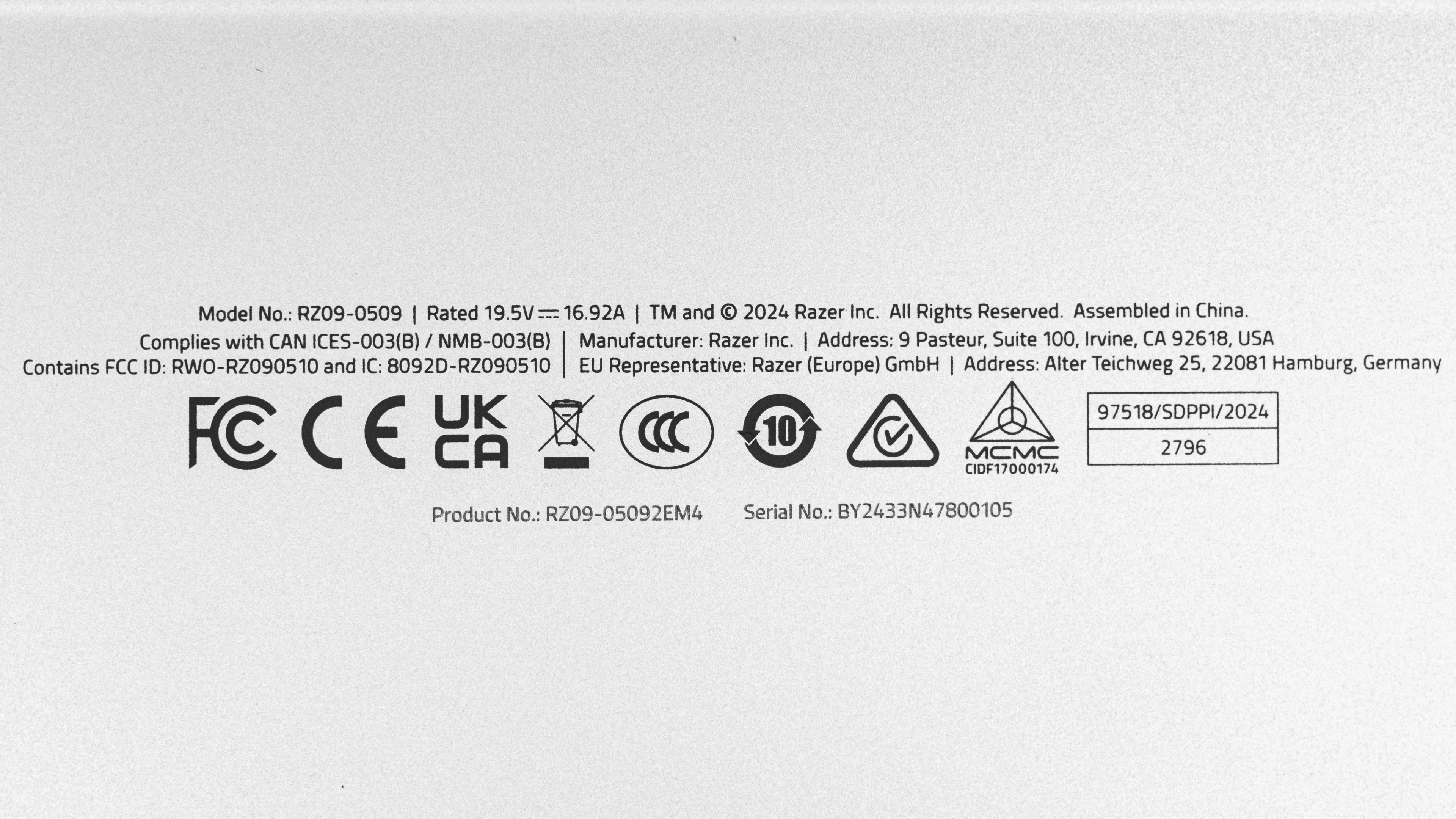
    See our unit's label.

    Popular Laptop Comparisons

    The Razer Blade 18 is an excellent gaming laptop. It has plenty of processing power to deliver smooth gameplay in demanding AAA games and is available with fast, VRR-enabled displays. Its build quality is outstanding and among the best you can find on the market, and it provides a superior user experience than most laptops, including productivity models. That said, you can get similar performance on significantly cheaper laptops. Also, its sheer size and short battery life make it more of a desktop replacement rather than a portable model for on-the-go use.

    For more options, check out our recommendations for the best gaming laptops, the best budget and cheap gaming laptops, and the best laptops for video editing.

    Dell Alienware 18 Area-51 (2025)

    Although the Razer Blade 18 (2024) and the Dell Alienware 18 Area-51 (2025) are both high-end 18-inch gaming laptops, they're of different generations. The former uses Intel 14th Gen CPUs and NVIDIA 40-Series GPUs, while the latter uses Intel Core Ultra Series 2 HX CPUs and NVIDIA 50-Series GPUs. Both perform as they should for their respective hardware, so the differences between them primarily reside in build quality and user experience. The Razer feels sturdier and more premium, sporting an Apple MacBook-like all-aluminum chassis and a simpler, cleaner design. It also provides a slightly better user experience overall, including a larger touchpad, better-sounding speakers, and a higher-quality webcam.

    ASUS ROG Zephyrus G16 (2024) GU605

    The Razer Blade 18 (2024) and the ASUS ROG Zephyrus G16 (2024) GU605 are both high-end gaming laptops that provide a great user experience. The Blade 18 is more of a desktop replacement due to its large size, while the Zephyrus G16 is more compact and better suited for on-the-go use. Performance-wise, you can get more processing power on the Blade 18, as it has a faster Intel 14th Gen HX CPU, and its NVIDIA GPUs run at higher wattages. Also, it doesn't suffer from the performance inconsistencies encountered on the G16. On the other hand, the G16 has more configuration options, so it's easier to find a model that fits your budget. If RAM upgradeability is important to you, know that only the Blade 18's memory is user-replaceable.

    ASUS ROG Zephyrus G14 (2024)

    Though both are gaming laptops, the Razer Blade 18 (2024) and the ASUS ROG Zephyrus G14 (2024) are quite different, as the Blade 18 is a large 18-inch model designed to be a desktop replacement, while the G14 is a much more portable model for on-the-go use. The Blade 18 will give you more processing power, as it's available with a faster Intel 14th Gen HX CPU and higher-end NVIDIA GPUs, including an RTX 4080 and 4090 Laptop GPU. It also has higher-refresh display options, a better webcam, a wider port selection, and user-replaceable RAM. On the other hand, the G14's battery life is much better in light uses, making it a better option as a general productivity device.

    Dell Alienware m18 R2 (2024)

    The Razer Blade 18 (2024) and the Dell Alienware m18 R2 (2024) are both 18-inch gaming laptops configurable with Intel 14th Gen HX CPUs and NVIDIA 40-series GPUs. Generally speaking, the Blade 18 has a more premium feel and better features, like a higher-resolution 4k+ and a Mini LED display option, a larger touchpad, Thunderbolt 5 support, better-sounding speakers, and a higher-quality webcam. However, the Alienware m18 has more configuration options, making it easier to get a model that fits your budget, and its top-end models have more storage slots. Performance is pretty similar between these two laptops, though the Alienware gets much hotter under load.

    Show more 

    Test Results

    perceptual testing image
    Sort:
    RATINGS
    Category:
    All
    Design
    Style
    Form Factor
    Traditional (Clamshell)

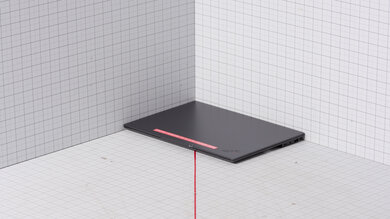
    The Razer Blade 18 2024 is available in a Mercury White or Black colorway. See the bottom of the laptop.

    9.5
    Build Quality

    The Razer Blade 18's build quality is outstanding. The whole device feels well-assembled, with no obvious gaps in the construction. Its full-aluminum chassis feels sturdy; there's only a little bit of flex on the lid, but only if you apply intentional force. The keyboard deck is rock solid, and the display doesn't twist when manipulating it. The finish is fairly scratch-resistant; fingerprints and smudges aren't a problem on the Mercury White model, though it's likely worse on the Black model. The feet feel sturdy and stick firmly to the bottom.

    9.1
    Hinge
    Range
    135°
    Stability
    Good
    One Finger Lift
    Yes

    The Razer Blade 18 has an outstanding hinge. It feels smooth when opening and closing the lid, and it's very stable, exhibiting little to no wobble when moving the laptop or typing heavily.

    4.1
    Portability
    Size
    18"
    Thickness
    1.1" (2.7 cm)
    Width
    15.8" (40.1 cm)
    Depth
    10.9" (27.8 cm)
    Volume
    183.7 in³ (3,009.9 cm³)
    Weight
    6.9 lbs (3.1 kg)
    Charger Size
    22.2 in³ (364.3 cm³)
    Charger Weight
    2.6 lbs (1.2 kg)
    8.4
    Serviceability
    Ease Of Access
    7.5
    RAM Slots
    2
    Storage Slots
    2
    Replaceable Battery
    Yes
    Replaceable Wireless Adapter
    Yes

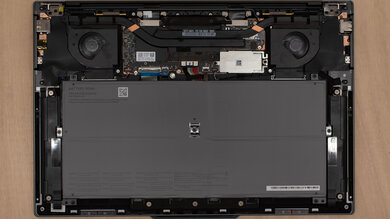
    Serviceability is good. To access the internals, you only need to remove 10 T5 screws and pull off the bottom panel. While a prying tool isn't necessary, it does take some effort to remove the panel. All the screws are of the same size, so you don't have to worry about keeping them organized. You can upgrade the memory up to a maximum of 96GB. Both storage slots support M.2 2280 PCIe Gen 4 NVMe SSDs.

    Razer doesn't provide a service manual.

    In The Box

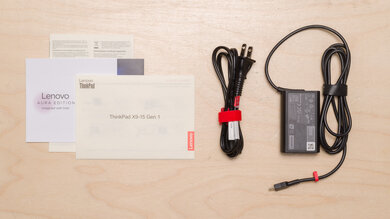
    • 330W power adapter and cord
    • Documentation
    • Microfiber cloth

    Note: Models with an NVIDIA GeForce RTX 4070 Laptop GPU come with a 280W power adapter.

    Display
    Screen Specs
    Resolution
    3840 x 2400
    Aspect Ratio
    16:10
    Pixel Density
    251 PPI
    Panel Type
    IPS
    Touch Screen
    No
    Screen-To-Body Ratio
    89%

    The Razer Blade 18 is available with the following displays:

    • 18" Mini LED 2560 x 1600 300Hz (matte, 100% DCI-P3)
    • 18" IPS 3840 x 2400 200Hz (matte, 100% DCI-P3)

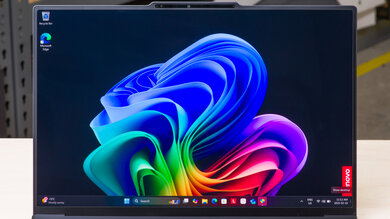
    The 4k+ display looks very sharp, with a pixel density in the same ballpark as the Apple MacBook Pro 16 (M3, 2023)'s Mini LED screen. The QHD+ isn't as sharp (168 PPI), though the difference might not be immediately noticeable when playing fast-moving games in which you don't have the time to appreciate the graphics. Both panels have a 16:10 aspect ratio, which doesn't affect gaming much but is great for productivity, as it gives you more vertical space than a standard 16:9 screen, allowing you to see more information when reading a document without having to scroll. The downside is that you'll almost always have black bars at the top and bottom when watching standard 16:9 videos.

    9.4
    Refresh Rate
    Refresh Rate
    200 Hz
    Variable Refresh Rate
    G-SYNC

    The 200Hz 4k+ display has a fast response time, resulting in a clear image with minimal ghosting in fast-moving scenes. The 300Hz QHD+ display will give you even smoother motion and better responsiveness. Both displays support G-SYNC to reduce screen tearing.

    When running on battery, the system limits the refresh rate to 120Hz in light workloads that only engage the integrated GPU. You must force the system to use the dedicated GPU if you want the display to run at 200Hz.

    6.9
    Contrast
    Native Contrast
    1,065 : 1

    The 4k+ IPS panel has an okay contrast ratio that's within the typical range of most IPS panels. However, it's still pretty low compared to other display technologies like VA and OLED. This contrast level makes blacks look gray in dim settings. The QHD+ Mini LED display has a much higher contrast ratio since it has local dimming. This means it can produce deep blacks, but there might be some blooming around bright objects in dark scenes, similar to the Apple MacBook Pro 16 (M3, 2023)'s display.

    8.4
    Brightness
    Maximum Brightness
    464 cd/m²
    Minimum Brightness
    24 cd/m²

    The 4k+ IPS panel gets bright enough for use in most indoor environments. Outdoor use is possible during the day, but you may have trouble seeing dark-color content. It gets very dim at the lowest brightness setting, which helps reduce eye strain when viewing content in the dark. Razer doesn't advertise the QHD+ Mini LED display's brightness.

    7.5
    Reflections
    Screen Finish
    Matte
    Total Reflections
    4.99%
    Indirect Reflections
    3.87%
    Calculated Direct Reflections
    1.12%

    The screen technically has a matte finish, but it looks and behaves like a cross between a glossy and matte display. It's better at handling direct, mirror-like reflections than a true glossy finish, but it doesn't suffer as much from the halo-like effects around bright objects often seen on matte finishes. For the most part, you'll only have trouble seeing dark color content if there's bright light shining directly on the screen. The QHD+ Mini LED display has the same anti-reflective coating.

    7.5
    Black Uniformity
    Uniformity (Std. Dev.)
    1.000%

    The QHD+ Mini LED display's black uniformity is likely much better since it has local dimming.

    6.6
    Out-Of-The-Box Color Accuracy
    Avg. White Balance dE
    3.43
    Avg. Gamma
    2.24
    Avg. Color dE
    4.02
    Avg. Color Temperature
    6,287 K

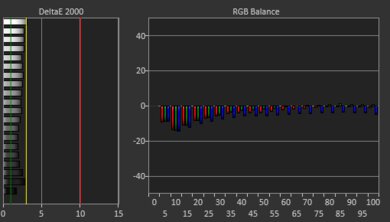
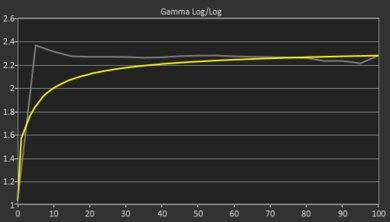
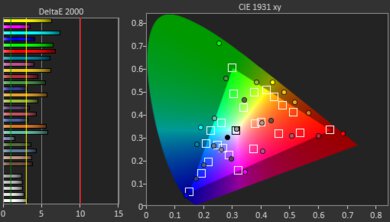
    The 200Hz 4k+ display's accuracy is okay out of the box. The panel uses the DCI-P3 color space when there isn't a set color profile, resulting in some oversaturation. Some people may prefer this oversaturated look; just know that it isn't accurate. The white balance inaccuracies are relatively minor, and the color temperature is only slightly cooler than the standard 6500K target, which isn't enough to make a huge difference visually. The gamma follows the curve fairly well; most scenes are a tad too dark, while bright scenes are slightly too bright.

    Razer Synapse has several preset color profiles, including DCI-P3, Adobe RGB, Rec. 709, and sRGB. However, selecting a color profile doesn't seem to have any effect. This may be a software bug; let us know in the comments if you've experienced the same issue.

    9.5
    Color Gamut
    sRGB xy
    138.87%
    sRGB uv
    131.41%
    Adobe RGB xy
    88.57%
    Adobe RGB uv
    94.57%
    DCI-P3 xy
    99.74%
    DCI-P3 uv
    99.91%
    Rec. 2020 xy
    73.44%
    Rec. 2020 uv
    76.25%

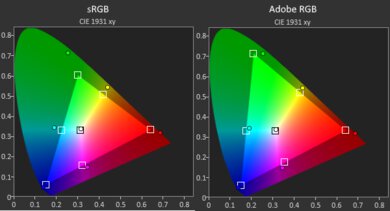
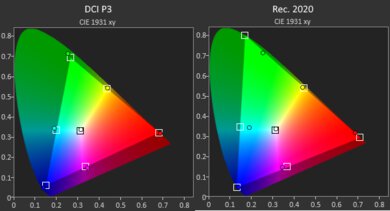
    The Razer Blade 18's 4k+ IPS display has an outstanding color gamut. It has full coverage of the sRGB and DCI-P3 color spaces, making it suitable for viewing and producing SDR and HDR content. Its Adobe RGB coverage is excellent, but likely not enough for professional print photography and art prints, as it can't reproduce the highly saturated greens that define Adobe RGB. The QHD+ Mini LED display has the same advertised color gamut.

    9.0
    Flicker
    Flicker-Free
    No
    Flicker Frequency
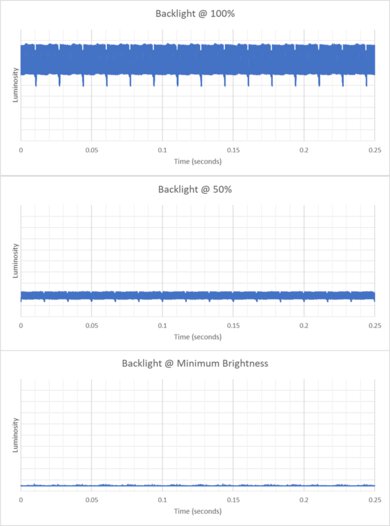
    > 1000Hz
    Flicker Active Below
    100%

    The QHD+ Mini LED display is likely similar.

    Interface
    9.1
    Keyboard
    Typing Quality
    9.0
    Numpad
    No
    Backlighting
    Per-Key RGB
    See details on graph tool
    Operating Force
    66 gf
    Actuation Force
    38 gf
    Pre-Travel
    1.05 mm
    Total Travel
    1.24 mm

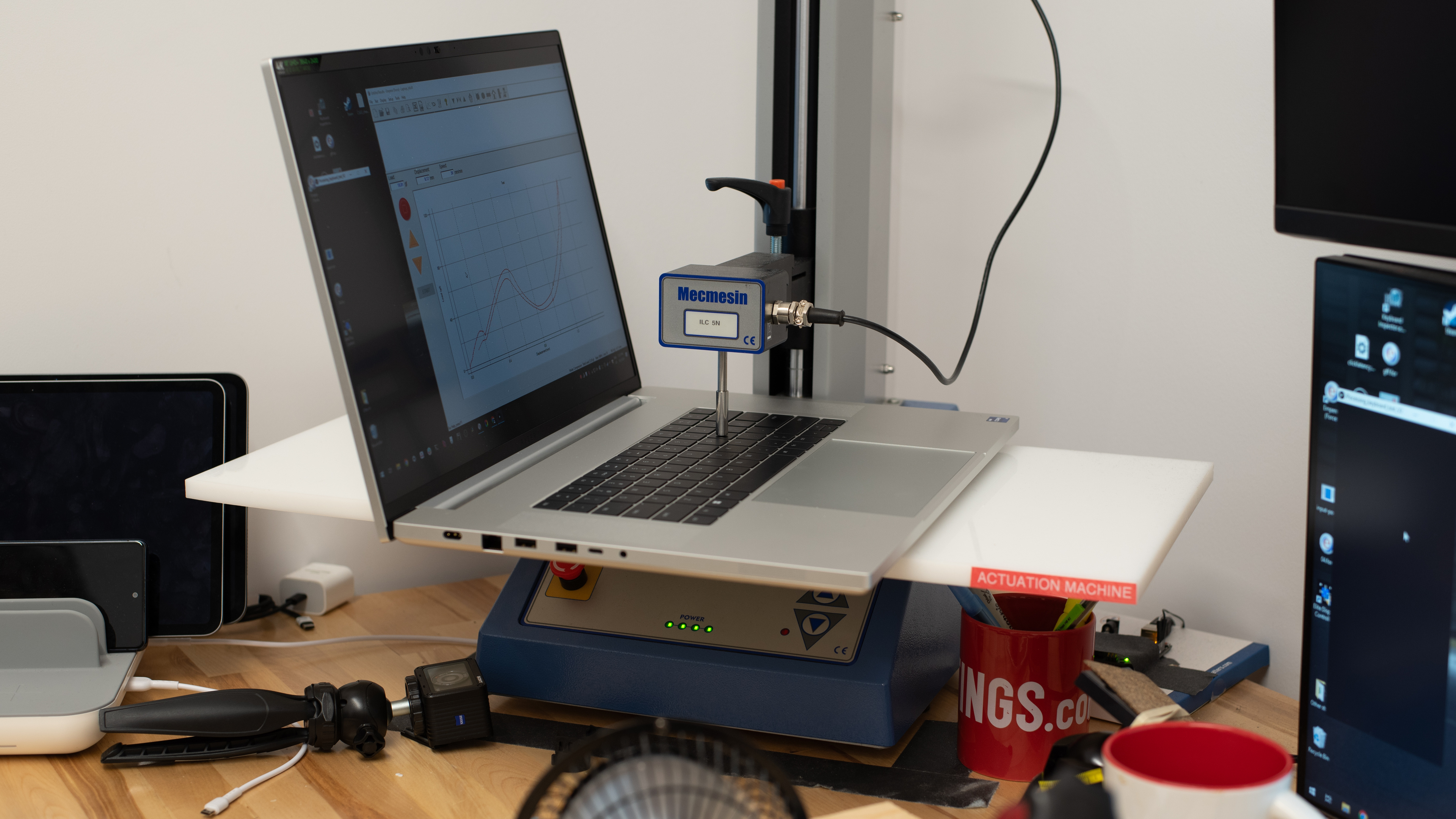
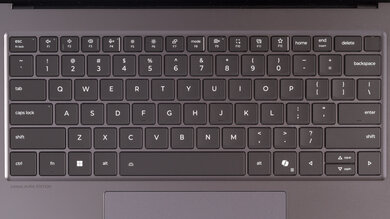
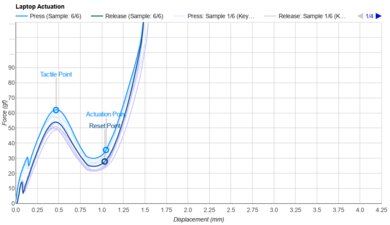
    The Razer Blade 18 2024 has an outstanding keyboard. The keys have a good amount of travel, require little force to actuate, and provide clear, satisfying tactile feedback. However, keycap stability is a tad inconsistent, as some keys feel more wobbly than others. While there isn't anything weird about the layout, the keyboard's large size can take some time to get used to, and it may cause fatigue over time, too, as you'd have to move your hands more to reach certain keys if you have small hands. You can customize the per-key RGB backlighting via the Razer Synapse application. The backlight's uniformity is good but not great, as it looks dimmer on some keys, particularly the bottom row.

    8.6
    Touchpad
    Tracking Quality
    8.0
    Size
    25.6 in² (164.9 cm²)
    Material
    Glass
    Dedicated Buttons
    No

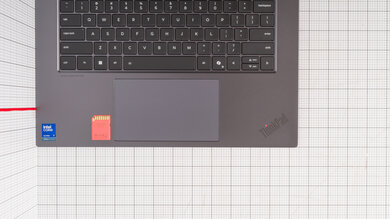
    The Razer Blade 18 2024 has an excellent touchpad. It's large and responsive to all movements and gestures. There are no issues when performing actions like dragging and dropping or zooming in and out of images. However, palm detection doesn't always work, resulting in occasional triggers when typing. This is a diving board touchpad with mechanical buttons, so you can't click in the top quarter portion of the touchpad. The buttons work well but feel a bit mushy.

    8.8
    Speakers
    See details on graph tool
    Max Volume
    85 dB SPL
    Standard Error @ Normal Vol. (65 dB)
    5.5 dB
    Slope @ Normal Vol. (65 dB)
    0.9
    Bass Extension (Low-Frequency Ext.)
    236 Hz
    Treble Extension (High-Frequency Ext.)
    15 kHz
    Dynamic Range Compression @ Max Vol.
    1.8 dB

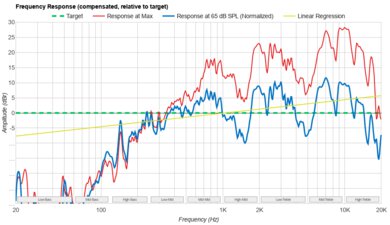
    The speakers get very loud with minimal compression artifacts at high volume levels. They sound clear, relatively natural, and full, with a decent amount of bass. However, the treble sounds a tad tinny, and there isn't much soundstage.

    9.2
    Webcam & Microphone
    Video Quality
    9.0
    Resolution
    1440p
    Position
    Top Center
    Privacy Cover
    Yes
    Face Unlock
    Yes

    The Razer Blade 18's webcam is outstanding. The image looks clear and detailed, with only a little bit of noise. However, the exposure is too low, and the color temperature is a tad too warm. Voices come across loud and clear over the microphone, with little to no background noise. The privacy cover is a physical barrier that also disables the camera and microphone at the software level.

    Connectivity
    9.0
    Ports
    USB-A Ports
    3
    USB-C Ports
    2
    Thunderbolt
    Thunderbolt 5
    USB-C Charging
    Yes
    USB-C Display Out
    Yes
    HDMI
    2.1
    DisplayPort
    No
    3.5mm Jack
    Combo mic/headphone
    Card Reader
    SD UHS 2
    Ethernet
    Yes
    Proprietary Port
    Razer Power Port
    Security Lock
    Yes

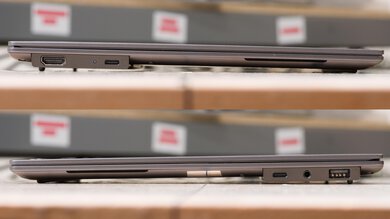
    The Razer Blade 18 has an outstanding port selection. All three USB-As support USB 3.2 Gen 2 data transfer speed of up to 10Gbps. The two USB-Cs are slightly different; the right one supports Thunderbolt 5 (Thunderbolt 4 on models with an RTX 4070), while the left one supports USB 3.2 Gen 2. Both USB-Cs support DisplayPort 1.4 and have a direct connection to the dGPU. They also support Power Delivery for fast charging; however, they can only take up to 100W of power, meaning the battery will discharge if you perform intensive tasks while charging. The Ethernet port has a maximum speed of 2.5Gbps.

    Wireless Communication
    Wi-Fi
    Wi-Fi 7 (802.11be)
    Bluetooth
    5.4

    The Razer Blade 18's wireless adapter is an Intel Wi-Fi 7 BE200 320Hz. Like Wi-Fi 6E, Wi-Fi 7 gives you access to the 6GHz band but with even faster speeds and lower latency. However, to benefit from these features, you need a router that supports Wi-Fi 7. If you want to upgrade your router, check out our recommendations for the best Wi-Fi routers.

    Configuration
    CPU
    Brand
    Intel
    Model
    Core i9-14900HX
    Core Count
    24
    Thread Count
    32

    The Razer Blade 18 2024 is only available with an Intel Core i9-14900HX, a high-performance processor typically found in gaming and workstation laptops. This 24-core CPU (eight performance and sixteen efficiency cores), a refresh of Intel's Raptor Lake chips, is among the fastest of its generation. It can handle general productivity tasks like web browsing and video playback, as well as highly intensive tasks like gaming, simulations, and 3D modeling. See more information about the Core i9-14900HX on Intel's product specifications page.

    GPU
    Brand
    NVIDIA
    Model
    Geforce RTX 4090 Laptop GPU
    Dedicated/Integrated
    Dedicated
    VRAM Size
    16 GB
    GPU Total Graphics Power (TGP)
    175W

    The Razer Blade 18 is available with the following GPUs:

    • NVIDIA GeForce RTX 4070 Laptop GPU 8GB GDDR6 (140W TGP /w Dynamic Boost)
    • NVIDIA GeForce RTX 4080 Laptop GPU 12GB GDDR6 (175W TGP /w Dynamic Boost)
    • NVIDIA GeForce RTX 4090 Laptop GPU 16GB GDDR6 (175W TGP /w Dynamic Boost)

    The available GPUs range from the upper mid-range RTX 4070 to the top-end RTX 4090 in NVIDIA's 40-series lineup. All three GPUs support the same features, so you aren't losing any features if you get a model with a 4070 or 4080. As for the intended gaming resolution, the RTX 4070 is mainly for 1440p gaming, while the RTX 4090 is mainly for 4k gaming. The RTX 4080, which sits between the RTX 4070 and 4090, can handle most titles at 4k, but you'll have to tweak the graphical settings and rely on features like DLSS and/or Frame Generation to get playable frame rates. It's worth noting that even though the RTX 4070 can deliver a relatively good gaming experience at 1440p, its 8GB of VRAM is quite limiting and may cause stutters in memory-intensive games. This will only get worse as games become more demanding in the future. All three GPUs are well-suited for content creation; however, if you plan on doing more specialized work like 3D modeling and simulations, you're better off getting a laptop with a professional GPU, like the Lenovo ThinkPad P1 Gen 7 (2024). See more details about the 40-series laptop GPUs on NVIDIA's product specifications page.

    RAM
    Capacity
    32 GB
    Modules
    2
    Type
    DDR5
    Speed
    5,600 MHz

    You can configure the Razer Blade 18 with 32GB or 64GB of RAM. The memory is user-upgradeable up to 96GB.

    Storage
    Advertised Capacity
    2,000 GB
    Usable Capacity
    1,879 GB
    Drive 1
    Samsung MZVL22T0HBLB-00B00
    Drive 1 TypeSSD
    Drive 2
    No 2nd Drive
    Drive 2 TypeNo 2nd Drive

    You can configure the Razer Blade 18 2024 with 1TB, 2TB, or 4TB of storage. The SSD is user-replaceable. There are two storage slots; both support M.2 2280 PCIe Gen 4 NVMe SSDs.

    Performance
    8.3
    CPU/RAM Performance
    Cinebench 2024 - Single Core
    126 points
    Cinebench 2024 - Multi Core
    1,635 points
    Geekbench 6 - Single Core
    2,872
    Geekbench 6 - Multi Core
    17,777
    Blender - CPU (Avg)
    136 samples/min
    PassMark PT - CPU Mark
    51,012
    PassMark PT - Memory Mark
    3,546
    PassMark PT - Memory Mark (Android)
    N/A
    Mozilla Kraken
    310 ms
    8.5
    Low Tier Graphics
    Geekbench 6 - GPU Compute
    182,283
    Basemark Web 3.0
    1,465
    PassMark PT - 2D Mark
    926
    PassMark PT - 2D Mark (Android)
    N/A
    PassMark PT - 3D Mark
    31,824
    PassMark PT - 3D Mark (Android)
    N/A
    Novabench 5 - GPU
    2,029.0
    mprep - Stress My GPU
    173,499
    8.8
    High Tier Graphics
    3DMark - Steel Nomad (DX12)
    5,151
    3DMark - Steel Nomad (Vulkan/Metal)
    5,294
    Basemark GPU (DX12)
    218,406
    Basemark GPU (Vulkan/Metal)
    210,488
    GFXBench - High Level Test (Vulkan/Metal)
    16,923 Frames
    7.3
    Professional 3D (GPU Accelerated)
    Blender - GPU (Avg)
    2,467 samples/min
    Cinebench 2024 - GPU
    22,435 points
    8.6
    CPU-Intensive Game Performance
    Civilization VII - AI
    14.2 s/turn
    Civilization VII - Graphics (Avg)
    302.4 fps
    Civilization VII - Graphics (1% Low)
    146.5 fps
    Total War: Warhammer III (Avg)
    121.8 fps
    Baldur's Gate 3 (Avg)
    91.9 fps
    Baldur's Gate 3 (1% Low)
    51.1 fps
    Previous Methodology Score
    8.9
    Previous Methodology Score Converted
    8.4
    8.1
    GPU-Intensive Game Performance
    Cyberpunk 2077 (Avg)
    99.6 fps
    Cyberpunk 2077 (Min)
    83.7 fps
    Assassin's Creed Shadows (Avg)
    63 fps
    Assassin's Creed Shadows (1% Low)
    52 fps
    GTA V (Avg)
    170.2 fps
    GTA V (1% Low)
    65.5 fps
    Black Myth: Wukong (Avg)
    52 fps
    Black Myth: Wukong (5% Low)
    46 fps
    Resident Evil 4 (Avg)
    150.5 fps
    Resident Evil 4 (1% Low)
    97.5 fps
    Previous Methodology Score
    9.0
    Previous Methodology Score Converted
    7.6
    6.5
    Ray Tracing Performance
    Cyberpunk 2077 (Avg)
    78.2 fps
    Cyberpunk 2077 (Min)
    66.3 fps
    Assassin's Creed Shadows (Avg)
    52 fps
    Assassin's Creed Shadows (1% Low)
    42 fps
    Black Myth: Wukong (Avg)
    27 fps
    Black Myth: Wukong (5% Low)
    23 fps
    9.6
    Storage Drive Performance
    Sequential Write Speed
    2,011.5 MB/s
    Sequential Read Speed
    4,588.4 MB/s
    Random Write Speed
    108.4 MB/s
    Random Read Speed
    69.0 MB/s
    4.7
    Battery
    Capacity
    92 Wh
    Battery Life (Web Browsing)
    5.2 hrs
    Battery Life (Video Playback)
    4.1 hrs
    Battery Life (Gaming)
    1.2 hrs
    Charge Time
    2.2 hrs

    Note: When running on battery, the system limits the display's refresh rate to 120Hz in lighter workloads that only engage the integrated GPU but keeps it at 200Hz in demanding workloads that require the dedicated GPU. As such, we've conducted the battery life for web browsing and video playback tests with the display at 120Hz and the gaming test with the display at 200Hz.

    6.8
    Thermals And Noise
    Keyboard Temp While Idle
    33 °C (92 °F)
    Keyboard Temp Under Load
    39 °C (103 °F)
    Fan Noise While Idle
    25.0 dBA
    Fan Noise Under Load
    57.0 dBA
    Power & Fan Control App
    Yes

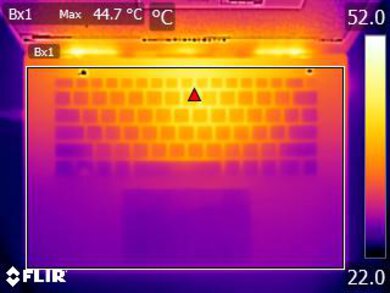
    Except for the Fan Noise While Idle measurement, the posted results are temperatures and fan noise levels obtained using the Turbo mode with the Max Fan setting on. The Max Fan setting makes the fans run at full speed, even in an idle state. Though away from where most people rest their hands, it's worth noting that the back of the deck (where the vents are) can get as hot as 50.2 °C (122.36 °F) in the Balanced mode and 54 °C (129.2 °F) in the Turbo mode. The bottom of the laptop reaches 45.4 °C (113.72 °F) in the Balanced mode and 57.8 °C (136.04 °F) in the Turbo mode.

    7.8
    Performance Over Time
    See details on graph tool
    CPU Temp (Cinebench)
    80 °C
    CPU Perf. Loss (Cinebench)
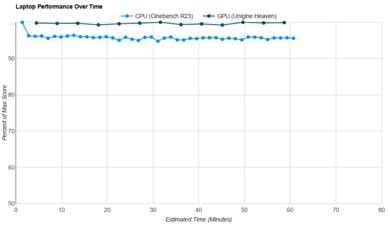
    0% loss
    GPU Temp (Heaven)
    63 °C
    GPU Perf. Loss (Heaven)
    14% loss

    We've conducted this test using the laptop's best performance (Turbo) mode with the fan speed at max instead of the default Balanced mode we've used in previous laptop reviews.

    Additional Features And Software
    Software
    Operating System
    Windows 11
    Additional Software
    Yes

    The Razer Blade 18 has a few pre-installed applications, including:

    • Razer Synapse: Lets you change or make a custom power/performance profile, change the fan speed, and change the display's color profile. You can also use it to customize the keyboard's RGB backlighting and other Razer peripherals. See our recommendations for the best Razer mice and best Razer keyboards.
    • THX Spatial Audio: Adds support for 7.1 surround sound.
    Extra Features
    Biometrics
    Face Recognition
    RGB Illumination
    Yes
    Touch Pen Support
    No Stylus Support
    Secondary Display
    No

    The Razer Blade 18 2024 has a facial recognition IR camera. You can use it to log in quickly, authorize purchases in the Windows Store, and auto-fill saved passwords on supported websites. The keyboard has per-key RGB backlighting; you can customize it via the Razer Synapse application.