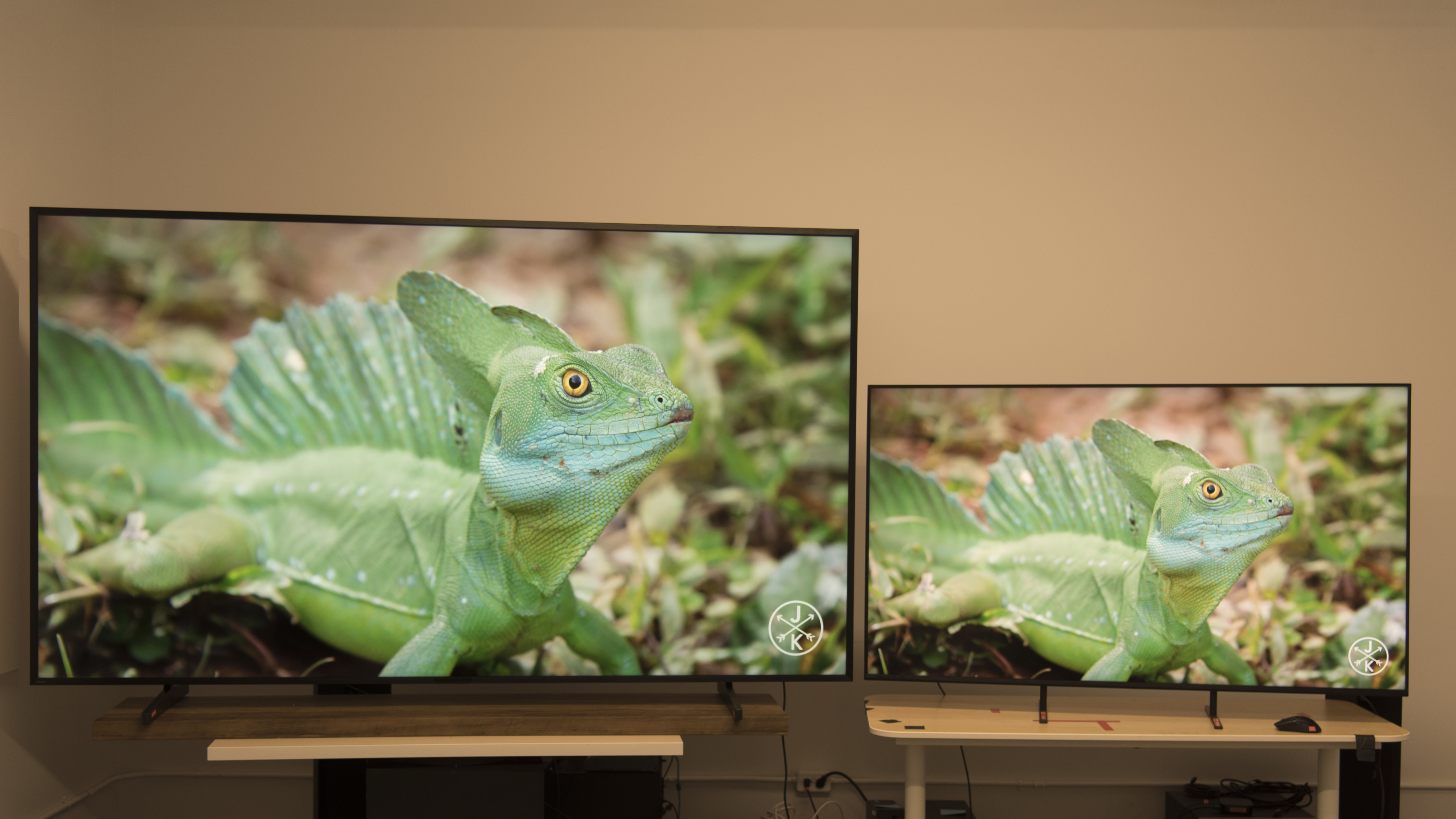
It's the battle of two TVs! Well, kind of, anyway... With massive TVs becoming increasingly available, we thought it was time to purchase some of these large TVs to compare them with their smaller counterparts. You might expect that the size of a TV doesn't affect its performance or image quality, but we heard rumblings that the 98-inch Sony BRAVIA 5 (K-98XR50) actually performed better than the 65-inch model (K-65XR50) we initially reviewed. So, is that the case? The short answer is yes, but the 98-inch model isn't better across the board. Instead of going through every test we conduct on a TV to see how they stack up against each other, this article is focused on the different aspects of image quality and performance between the two TVs, and you can still compare all of the results side by side.
Both sizes of the TV offer the same features, have the same image processing capabilities, are very similar in out-of-the-box color accuracy, and have almost identical handling of reflections. This article examines four key advantages of the 98-inch model: Brightness, Black Levels, Color Volume, and Pixel Response Times. This means you get superior image quality and performance from the larger size, making it noticeably better than the 65-inch model. However, not only is the 98-inch size more expensive up front, but it also consumes a lot more power, so you will also be paying more for it in the long run.
Both sizes were set up with nearly identical picture settings, so the differences between the two sizes have nothing to do with that. This data could change with future firmware updates, so check the reviews of the 65-inch and 98-inch models to get the most up-to-date information.
Black Levels
Black levels are a key component of a TV's image quality. When determining how good a TVs black levels are, we look at contrast, black uniformity, lighting zone precision, and lighting zone transitions. We're going to go over three of those tests in this article and leave black uniformity to the side, since both TVs have such similar uniformity that you'd be hard-pressed to notice any difference between them when it comes to the evenness of blacks across the screen.
CONTRAST
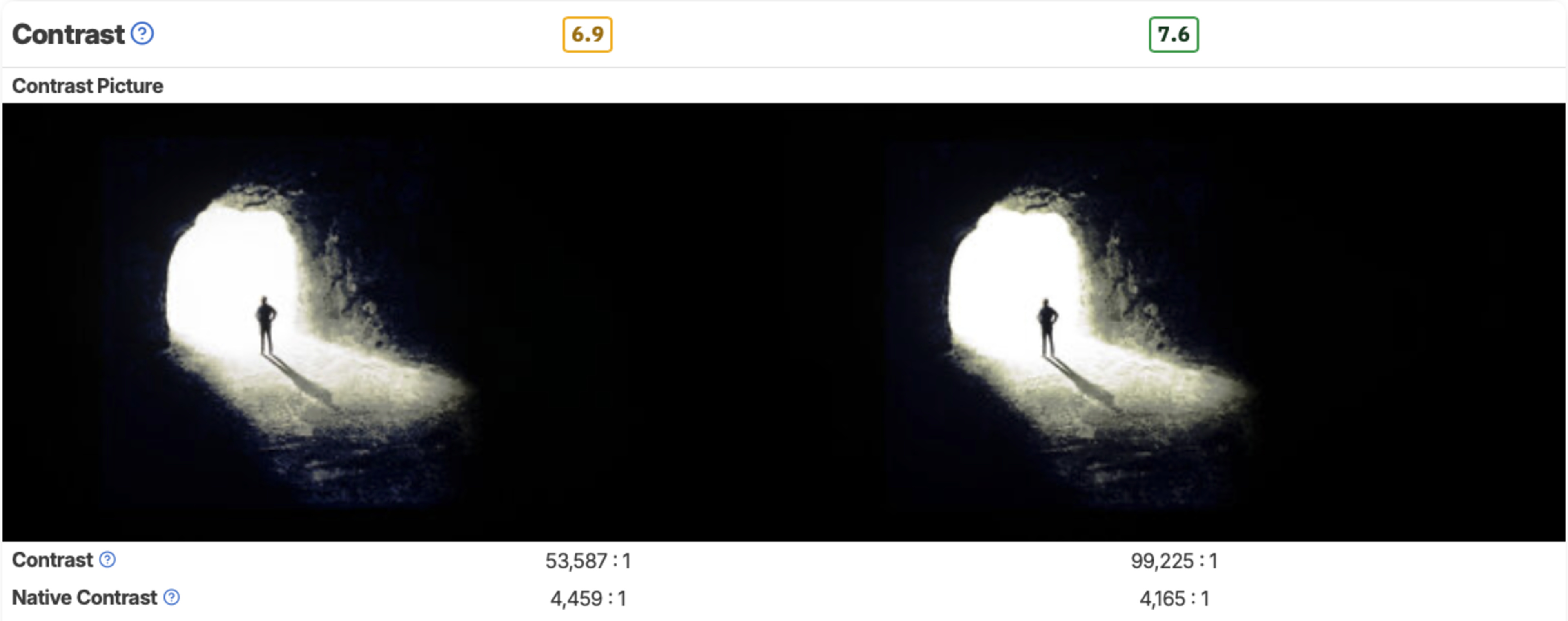
A display's contrast ratio shows the ratio between the darkest black a display can produce and the luminance of the brightest white. The higher the contrast ratio, the deeper the blacks appear while simultaneously highlighting bright elements. Our contrast test is conducted with the center of the cave set as close to 200 nits as possible, which gives us the white luminance measurement for our calculation. The lowest black reading we obtain is based on an average of four measurements. If you want to learn more about the specific way we measure contrast, check out our in-depth article. Let's examine the numbers we measured for each size.
| TV Size | White Level (nits) | Lowest Average Black Level (nits) | Contrast Ratio |
|---|---|---|---|
| 65" | 200.95 | 0.00375 | 53,587 : 1 |
| 98" | 198.45 | 0.002 | 99,225 : 1 |
The 2.5 nits difference between the whites is completely unnoticeable, since it's harder for us to perceive the difference in brightness at higher luminance levels. However, the opposite is true when it comes to blacks, where even one decimal point is visible. The 0.00175 nits difference here means blacks are roughly 47% deeper on the 98-inch size, which is very noticeable in a dark room. You might have noticed that both sizes of TV have very similar native contrast ratios, with the 65-inch model edging out the 98-inch model. So, why does the 98-inch model display deeper blacks? We don't know 100% for sure, but we do have a pretty solid theory.
Since the larger model has fewer local dimming zones per square inch (more on this later), each zone covers more of the screen. Sony's conservative dimming averages brightness across a zone, so when a zone fully dims, it turns off a larger portion of the screen at once, which can result in deeper blacks. Again, this is just a theory, and it may simply be due to the way the dimming algorithm is tuned for larger sizes. Ultimately, the most significant aspect to note is that the 98-inch size displays noticeably deeper blacks.
LIGHTING ZONE PRECISION & LIGHTING ZONE TRANSITIONS
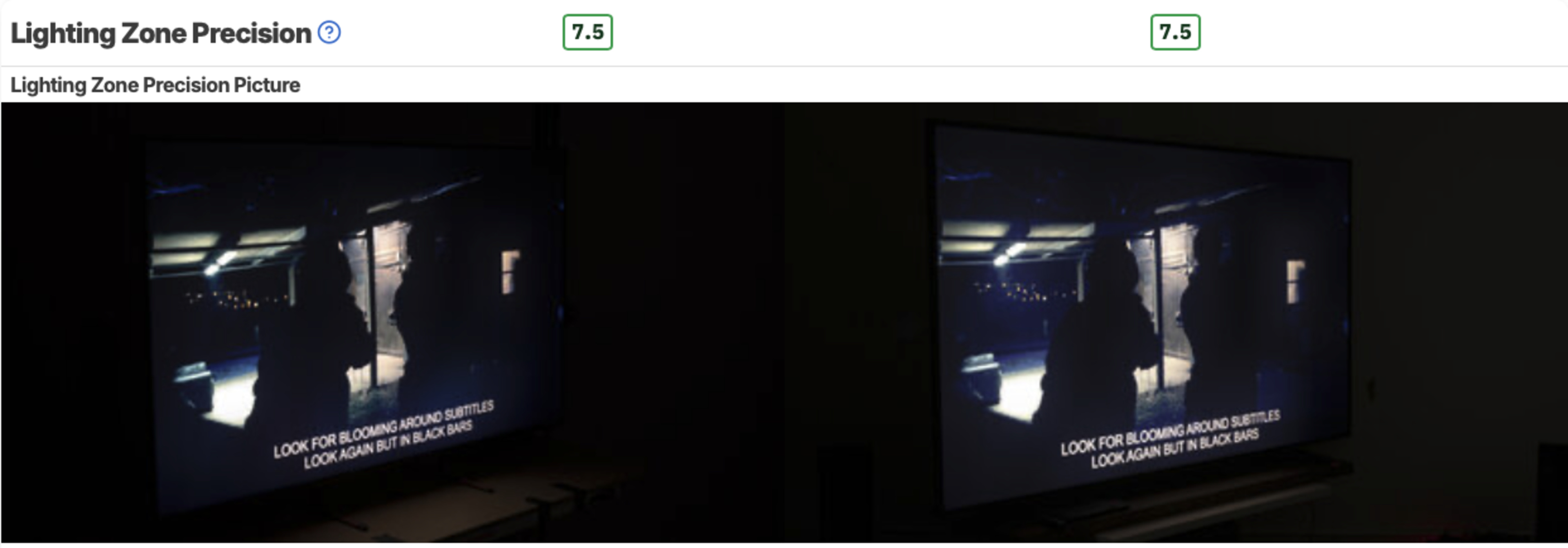
Contrast isn't the only thing that impacts a TV's overall black levels. Our lighting zone precision test examines how precisely a TV can dim the dark areas of an image surrounding highlights. If a TV performs poorly in this regard, the highlights will bleed into the dark areas, which can be distracting and affect the depth of blacks surrounding the highlights. The precision of zones is mostly determined by two things: the local dimming algorithm and the number of dimming zones a TV has. Let's break down the number of dimming zones and other key measurements for each TV size.
| TV Size | Zones | Pixels per Zone | Zone Size (in²) | Pixels per in² per Zone | Required Zones to Match 65" Zone Size |
|---|---|---|---|---|---|
| 65" | 384 | 21,600 | 4.7 | 4,596 | — |
| 98" | 720 | 11,520 | 5.7 | 2,021 | 872 |
If you were to take a quick glance at the table above, you might think that the 98-inch has tighter zone precision, since there are fewer pixels per zone, but that doesn't take into account the difference in sizes between the two TVs. Although the 98-inch model has more local dimming zones in total and fewer pixels per zone, its zones are physically larger (5.7 in² vs. 4.7 in² on the 65-inch) due to the bigger screen size. Because local dimming operates per zone rather than per pixel, physical zone size is the primary factor in precision. Smaller zones can adjust brightness more accurately over smaller portions of the screen, which can reduce haloing and better deepen blacks around highlights.
Since the 65-inch has smaller zones, in theory, it should achieve tighter local dimming control, while the 98-inch model's larger zones should result in less precise control. However, a TV's local dimming algorithm plays a crucial role in how well a TV controls haloing, and we didn't encounter any more haloing on the 98-inch model than on the 65-inch model.
The reason for this is the conservative approach the BRAVIA 5 takes in controlling haloing. There's a large averaging of zones, so neither size is very precise with small highlights. This means that both sizes often fall back to their native contrast ratio, especially during more challenging scenes. If you're looking at a scene of a starfield, the stars aren't crushed like they can be on some TVs, but the black areas between stars aren't very deep. This is because it doesn't dim its zones for scenes like this, so you don't see any haloing; however, the whole image appears a bit washed out.
There may be a rare instance where the 65-inch model is able to more finely dim around certain highlights, but we didn't encounter this during testing. The amount of haloing between the two sizes is more or less the same in most real-world scenes. In addition to precision, we didn't encounter any difference between the two sizes when it comes to zone transitions, so both sizes perform the same when highlights are moving across the screen. We have an article that covers Local Dimming on TVs if you want to learn more about the topic.
Brightness
Not only does the 98-inch model have better black levels, but it also offers a nice brightness advantage over the 65-inch model. Let's take a look at both sizes' HDR and SDR brightness to see just how much brighter the 98-inch model is. If you want to learn more about how we measure a TV's luminance, take a look at our articles on HDR Brightness and SDR Brightness.
HDR BRIGHTNESS

The table below lays out the exact brightness difference between the two sizes in HDR.
| Test | 65" | 98" | Difference In Nits | % Difference |
|---|---|---|---|---|
| Hallway Lights (~1950) | 408 | 539 | +131 | +32.1% |
| Yellow Skyscraper (~700) | 269 | 345 | +76 | +28.3% |
| Landscape Pool (~300) | 204 | 185 | -19 | -9.3% |
| Peak 2% Window | 617 | 921 | +304 | +49.3% |
| Peak 10% Window | 769 | 1,147 | +378 | +49.2% |
| Peak 25% Window | 816 | 1,250 | +434 | +53.2% |
| Peak 50% Window | 600 | 943 | +343 | +57.2% |
| Peak 100% Window | 485 | 686 | +201 | +41.4% |
| Sustained 2% Window | 611 | 919 | +308 | +50.4% |
| Sustained 10% Window | 759 | 1,136 | +377 | +49.7% |
| Sustained 25% Window | 806 | 1,238 | +432 | +53.6% |
| Sustained 50% Window | 599 | 942 | +343 | +57.3% |
| Sustained 100% Window | 485 | 685 | +200 | +41.2% |
As you can see from the table, the 98-inch model is up to 434 nits brighter, depending on the window size. The biggest difference percentage-wise is with 50% windows, which are just over 57% brighter on the 98-inch model. This extra brightness allows highlights to pop out more in HDR content, and entirely bright scenes look punchier. The 65-inch model peaks at 816 nits, so it relies on tone mapping for any HDR content mastered with a peak brightness of 1000 nits. The 98-inch peaks at 1,250 nits and hovers just under 1,000 nits with most window sizes, so it can display the majority of highlights in HDR content mastered at either 600 nits or 1,000 nits. Both sizes rely on tone mapping for the rare HDR content mastered at 4000 nits, but the 98-inch model will provide an image that looks closer to the content creator's intent for most HDR movies and shows.
SDR BRIGHTNESS

The 98-inch model also offers a brightness advantage in SDR, and is 189 nits brighter with our real scene test, which is the most indicative test for real-world usage. This extra luminance helps the larger size overcome more glare in bright rooms. The 65-inch is already bright enough for most well-lit environments, but if your space is very bright, those extra nits could be the difference between seeing reflections on your screen and not seeing any at all.
WHY IS THE 98-INCH BRIGHTER?
The difference in brightness is largely due to pixel pitch, which is the distance between the centers of two adjacent pixels, usually measured in millimeters. At the same resolution (4k in this case), a smaller pixel pitch means the pixels are physically smaller, while a larger pixel pitch indicates larger pixels. On the 98-inch model, each pixel is physically bigger, and this extra surface area allows more light from the backlight to pass through to each individual pixel, which results in higher brightness.
HDR Color Volume And SPD
In addition to an increase in contrast and brightness, the 98-inch model also offers a wider range of colors when displaying HDR games, movies, and shows. If you want to know more about how we perform our HDR color volume test and how to properly read the associated charts, check out our article on HDR Color Volume.
HDR COLOR VOLUME
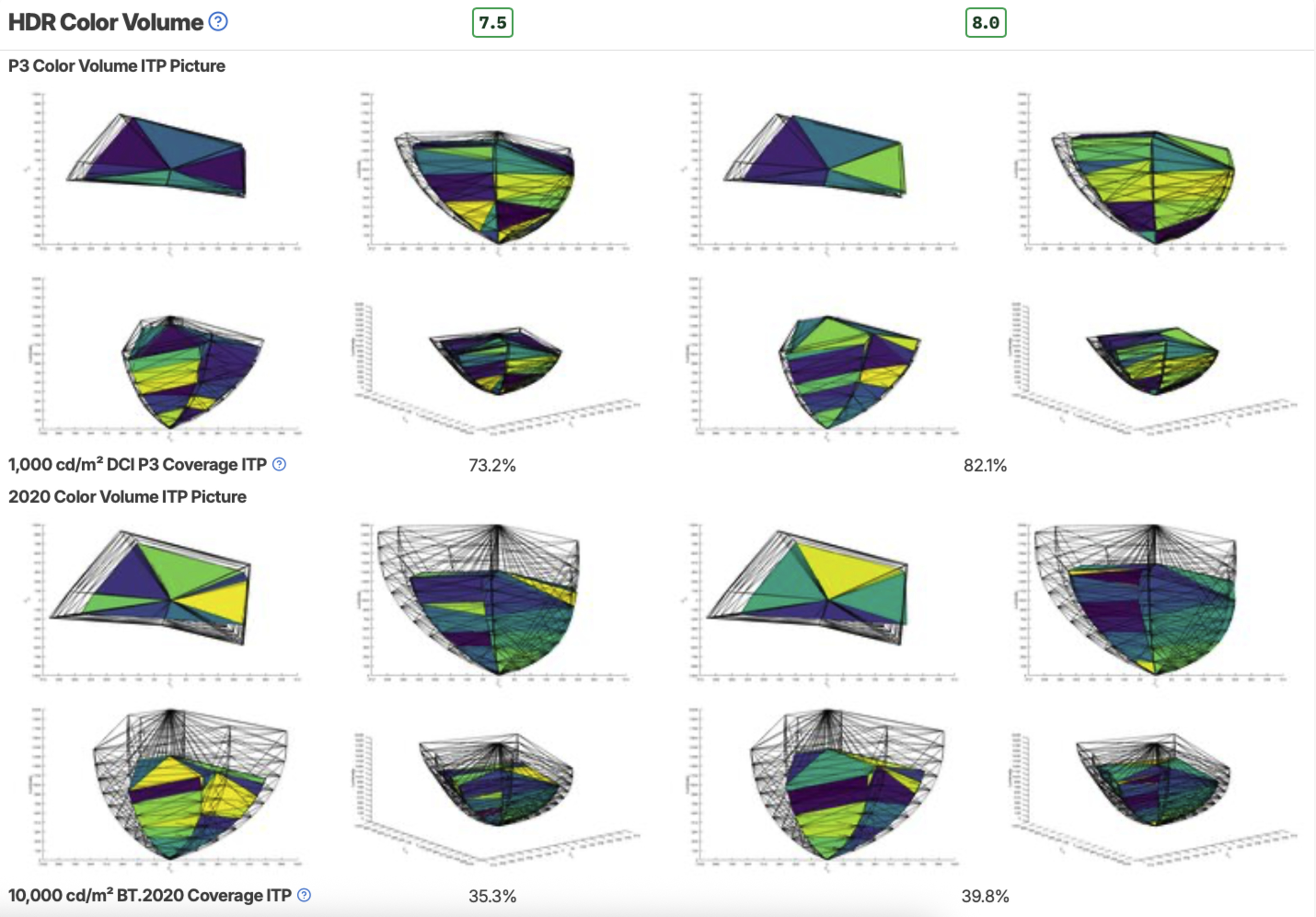

If you look at the results above, you can see a pretty clear increase in 1,000 cd/m² DCI P3 Coverage ITP on the 98-inch, which is the most commonly used color space for HDR content. The 98-inch covers 8.9% more of the DCI-P3 color space, and although the larger size does a slightly better job covering some dark colors, the main difference lies in bright colors. If you examine the graphs, you can see that the 98-inch fills more of the top end of the 3D bubble, indicating it can push its colors to higher luminance levels. You can also see that the 98-inch has brighter primary and secondary color luminance across the board, which makes it clear that the 98-inch can display brighter colors.
SPECTRAL POWER DISTRIBUTION
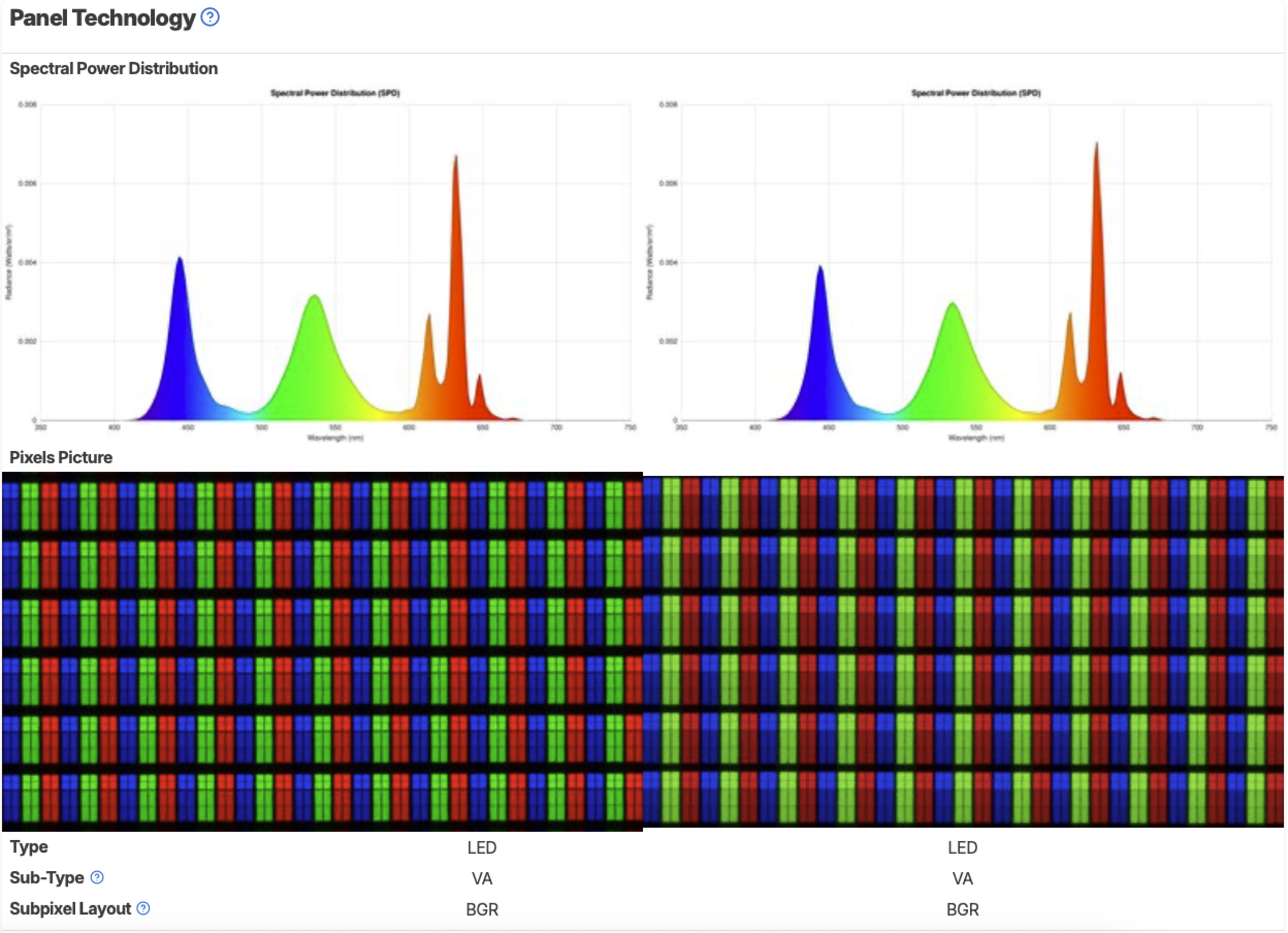
By examining the spectral power distribution of each size, we can see that each size utilizes the same type of BGR VA panel. Both sizes utilize a KSF phosphor coating to produce red light and color converters to achieve fairly high peaks in reds and blues. As you can see, primary colors don't bleed into each other much at all, which means that colors have good purity on each size. There are slightly higher peaks in reds for the 98-inch, while the 65-inch has slightly higher peaks on the blues. However, these differences are very minor and mean very little in the end. The key takeaway here is that, despite both sizes utilizing the same panel technology and having approximately the same color purity, the 98-inch model provides a better overall HDR color volume.
Cumulative Absolute Deviation (CAD)
The biggest surprise when we tested the 98-inch model is how much quicker pixel response times are compared to the 65-inch model. This leads to clearer motion on the larger size, which is most noticeable when playing fast-paced video games. Most of Sony's LED models have very slow response times, which really holds back their gaming performance. However, the 98-inch model's response times are the quickest out of any non-OLED Sony TV we've reviewed up until the date of this article. Check out our article on Cumulative Absolute Deviation to learn more.
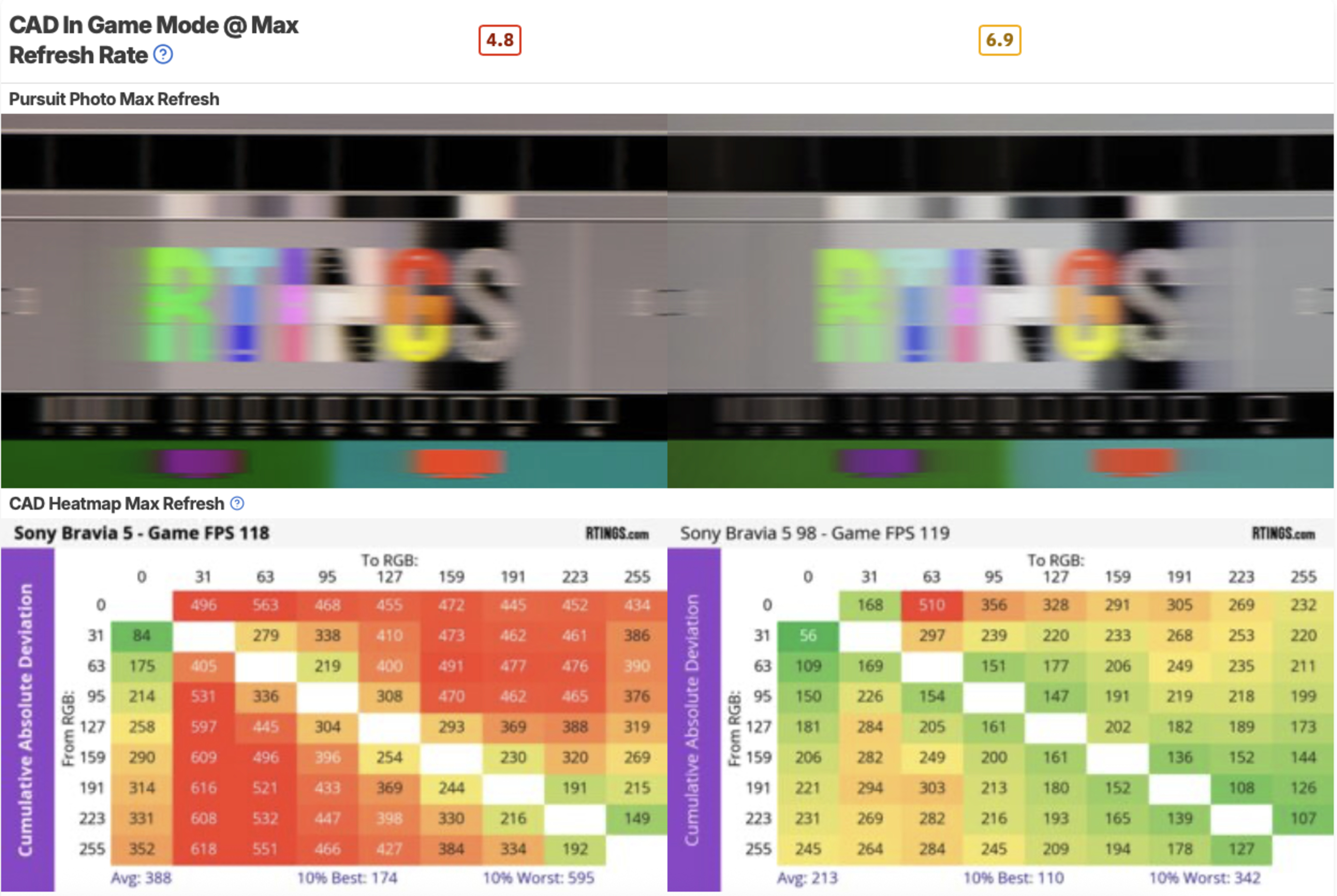
If you examine the detailed 120Hz CAD table, which measures pixel transitions from one RGB value to another, you can see that the difference in speed between the two sizes is quite significant. It's not just a few different transitions; the 98-inch is much faster across the board, which leads to visibly clearer motion. Although the 98-inch is still at its slowest overall when exiting a dark state, every transition from 0 to another RGB value is noticeably faster, resulting in less visible black smearing. The 98-inch model is also over twice as fast when transitioning from any RGB value to near-black, so motion is significantly clearer during these types of transitions.
However, the 98-inch model is very prone to overshoot, whereas the 65-inch model barely overshoots any transitions. This means that there's more inverse ghosting on the 98-inch model. Still, even with overshooting, the 98-inch model achieves its target RGB value much faster, so motion still appears sharper, as there's noticeably less motion blur overall. It's not just faster at 120Hz; you also see the same response time advantage with the 98-inch model at 60Hz.
Power Consumption
The 98-inch model has roughly 2.27 times the screen area of the 65-inch model, which is impressive for immersion, but not so impressive for the amount in your bank account. Simply put, the 98-inch model uses a lot more power. Even when streaming content on Netflix, the TV hovers around 430-450W, so expect to pay more for your energy bill with this size.

Conclusion
After comparing the key differences between the 65-inch and 98-inch BRAVIA 5s, it's pretty clear that the 98-inch model has a nice advantage in overall image quality. It offers better brightness, contrast, colors, and motion, so the difference between the two TVs is actually noticeable with real content. The 98-inch model is expensive and consumes a significant amount of power, so not only will it cost you more money upfront, but you will also incur higher costs in the long run. It's essential to note that, although the 98-inch is superior to the 65-inch, it still doesn't deliver top-tier image quality. However, it still looks quite good and is undoubtedly a standout size for a home theater, large living room, or other spacious areas.