
Mirrorless cameras have effectively become the industry standard. As a result, DSLR prices keep falling, which can make them tempting, and you certainly don't need cutting-edge gear to take great photos or enjoy the hobby. DSLRs can even be some of the best cameras for beginners. Still, if you want access to the latest camera technology, both now and in the years ahead, a mirrorless model is the smarter buy.
Mirrorless cameras also have a few practical advantages. They're usually smaller and lighter than DSLRs, their autofocus systems are faster and more precise, and their electronic viewfinders show you exactly how your exposure will look before you press the shutter. The category has grown quickly, too, so you'll find options for nearly every budget and skill level.
When choosing one, start with the lens mount, since you'll likely keep buying into that system for years. Then think about sensor size. Full-frame models like our top two picks have an edge in low light, while APS-C and Micro Four Thirds cameras keep both bodies and lenses more compact and affordable.
We've bought and tested over 130 cameras, and below, you'll find the best mirrorless camera to buy. If you want a full-frame body specifically, see our best full-frame mirrorless cameras picks. First-time buyers may find a better fit in our best mirrorless cameras for beginners or best budget mirrorless cameras articles. For a broader look that includes DSLRs and fixed-lens models, check out our best digital cameras.
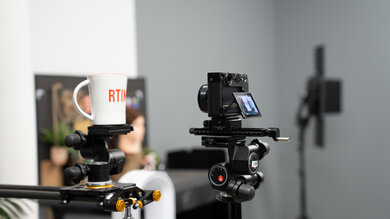
We've independently purchased over 125 cameras and tested them using a standardized methodology. All the results are available to help you make the right purchasing decision for your needs, with objective, data-driven reviews. We keep every product in our lab inventory to ensure we can go back, retest models, and verify that all the information we provide is still accurate.
-
Best Mirrorless Camera
 Travel Photography8.2Landscape Photography8.4Sports & Wildlife Photography8.6Vlogging7.8Studio Video9.5Action Video5.5Raw Photo8.7Body Type:SLR-StyleMirrorless:YesSee all our test resultsSensor Size:Full Frame
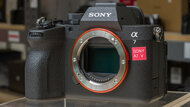
The Sony α7 V is the best mirrorless camera we've tested. Its sensor delivers fast, blackout-free RAW bursts and excellent image quality, backed by Sony's extensive E-mount lens lineup. Its 33-megapixel resolution carries over from the previous generation, the Sony α7 IV, but the sensor behind it is now partially stacked. This gives it much faster readouts, which, with the electronic shutter, enables it to capture full 14-bit RAW files at up to 30 fps without viewfinder blackout, and rolling shutter distortion drops noticeably. Pre-capture kicks in as soon as you half-press the shutter button, saving the second of action before you fully press it. Its autofocus tracks people, animals, and vehicles during those bursts, even if it can sometimes lose its target. In our tests, it delivered excellent RAW image quality, with crisp detail, exceptional dynamic range, and clean results in low light.
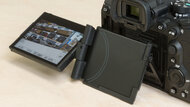
Handling holds up just as well; the handgrip is deep and large enough to comfortably fit all your fingers, and there's a rear rest that should suit most hand sizes, making the camera comfortable to use for long periods and balanced, even with larger lenses. The body is weather-sealed, the battery outlasts most of the competition, and the screen can tilt for low angles or flip to the side to face you. On the video side, it captures oversampled 4k with internal 10-bit 4:2:2 color and S-Log3, and it doesn't overheat, though you won't find RAW or 6k recording. Sony's E-mount also gives it a lasting edge. No other system has as many native and third-party lenses across every budget, which matters more over the life of a camera than any single spec. If you need those missing video features, the Canon EOS R6 Mark III is a just-as-capable hybrid that records 7K RAW and open-gate video internally, shoots uncropped 4k at 120 fps, and bursts at 40 fps, which is faster than the Sony. However, its battery drains quickly when recording video, and Canon's RF mount has fewer lenses, particularly at the lower end.
-
Best Upper Mid-Range Mirrorless Camera
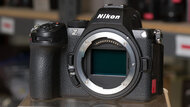
Travel Photography7.9Landscape Photography8.5Sports & Wildlife Photography8.8Vlogging7.2Studio Video9.2Action Video4.8Raw Photo8.8Body Type:SLR-StyleMirrorless:YesSee all our test resultsSensor Size:Full FrameThe Nikon Z 5II is the best upper mid-range mirrorless camera and the most sensible first step into full-frame for anyone who can do without the speed of the Sony α7 V. It sits near the bottom of Nikon's full-frame lineup, but it doesn't feel like a budget camera. It borrows the EXPEED 7 processor from the brand's higher-end bodies and comes with in-body image stabilization (IBIS), weather sealing, and a sturdy, comfortable build. It also performed excellently in our image quality tests, producing remarkably sharp photos, outstanding dynamic range in high-contrast scenes, and clean low-light shots. Autofocus is another strength. It identifies people, animals, and vehicles, grabs focus fast, and holds it. The electronic shutter reaches 11 fps in RAW or 30 fps in JPEG, while pre-capture keeps as many as a second of shots from right before you fully press the shutter, helping you catch fleeting moments like a bird's takeoff or an athlete mid-jump.
It's well-equipped for video, too, with internal 12-bit RAW and N-Log recording that gives you lots of flexibility when color grading, plus a fully articulated screen for filming yourself. However, 4k is limited to 60 fps and cropped by 1.5x, which rules out 4k slow motion. The battery also struggles to keep up during heavy photo sessions, so keep a spare battery or a power bank handy. If you mostly shoot slower subjects and want to save money, the original Nikon Z 5 still produces excellent images, though its burst shooting, autofocus, and video features are noticeably worse.
-
Best Mid-Range Mirrorless Camera
Travel Photography8.3Landscape Photography8.2Sports & Wildlife Photography8.3Vlogging7.9Studio Video9.1Action Video7.8Raw Photo7.9Body Type:SLR-StyleMirrorless:YesSee all our test resultsSensor Size:APS-CThe Sony α6700 is the best mid-range model we've tested. It's an impressive upgrade from Sony's older APS-C cameras like the Sony α6600, with a new sensor and processor, including a new AI-powered chipset that gives the α6700 one of the most effective autofocus systems on the market. The camera is also relatively portable, has IBIS, and includes some fairly advanced video features, including 4k at 120 fps (albeit with a significant crop) and internal 10-bit 4:2:2 recording.
Another great choice in this price range is the Fujifilm X-S20. Its autofocus system isn't quite as reliable as the Sony's, and it can't record 4k video at 120 fps. However, it's still a very impressive hybrid camera, with 4k 60 fps recording. Unlike the α6700, it even supports open gate 6.2k video capability and RAW video output to an external recorder. Those who prefer a more hands-off approach to editing will also love Fuji's JPEG colors and film simulation profiles, but Sony's extensive lens options and ultra-reliable AF make the α6700 a better overall pick.
-
Best Lower Mid-Range Mirrorless Camera
Travel Photography7.9Landscape Photography7.8Sports & Wildlife Photography8.4Vlogging7.4Studio Video8.2Action Video4.2Raw Photo7.5Body Type:SLR-StyleMirrorless:YesSee all our test resultsSensor Size:APS-CThe Canon EOS R10 is one of the best lower mid-range mirrorless cameras you can buy. If you're looking for a well-rounded model that's accessible enough for newcomers but still offers more advanced features, the R10 nails that balance. It has great ergonomics, an intuitive user interface, and highly effective autofocus, plus quick burst shooting and excellent image quality for its class. Vloggers and video shooters can take advantage of 4k recording at up to 60 fps (with a crop), as well as a dedicated high-frame-rate mode for slow-motion recording at up to 120 fps in 1080p.
This price range is packed with entry-level bodies from every major brand, and the R10 earns its spot by getting the fundamentals right. It has Canon's excellent autofocus and an intuitive interface that's easy to learn, its APS-C sensor captures good image quality, and its video specs are solid for the class. Its main weakness is lens selection, since Canon's RF mount still offers relatively few options. The Nikon Z 50II matches it in many areas, with excellent image quality, comfortable handling, and intuitive controls. It falls behind with less reliable autofocus, slower burst rates, and shorter battery life, but it's the better pick for video shooters thanks to its internal 10-bit Log, which preserves more dynamic range.
-
Best Budget Mirrorless Camera
Travel Photography7.9Landscape Photography7.5Sports & Wildlife Photography8.0Vlogging7.6Studio Video8.0Action Video4.2Raw Photo7.4Body Type:SLR-StyleMirrorless:YesSee all our test resultsSensor Size:APS-CIf you're on a tighter budget, the Canon EOS R50 is one of the best bang-for-your-buck mirrorless cameras you can get brand new. Sitting below the Canon EOS R10, this is a great entryway into "serious" photography for those who've never used a camera before. It has a highly portable body that makes it easy to grab and go, along with simple controls and easy-to-use auto modes for beginners. Plus, its APS-C sensor captures excellent image quality, and this camera has a great autofocus system and video specs for the price.
Lens options for Canon's RF mount are still limited, but on the upside, the camera is compatible with both APS-C and full-frame RF lenses, which makes it easier to upgrade to a full-frame body down the line if you want to. If you'd like a more compact camera kit with more lens options, the Olympus OM-D E-M10 Mark IV is a great alternative with a Micro Four Thirds sensor. However, its autofocus system isn't as reliable, and its ergonomics are somewhat lacking.
-
Best Cheap Mirrorless Camera
Travel Photography7.7Landscape Photography7.6Sports & Wildlife Photography6.9Vlogging5.1Studio Video7.4Action Video3.1Raw Photo7.3Body Type:SLR-StyleMirrorless:YesSee all our test resultsSensor Size:APS-CFirst-time buyers on a strict budget should look at the Canon EOS R100, the best cheap mirrorless camera we've tested. No other new Canon mirrorless body costs less. Canon had to cut a lot of corners to get there, so if you have a little more to spend, the Canon EOS R50 is worth it, since its autofocus and video are much better. If price is your top concern, though, the R100 still covers the basics well.
Its 24.1-megapixel APS-C sensor, borrowed from the Canon EOS Rebel SL3, produces plenty of detail and good dynamic range, and its autofocus is more effective than that of Canon's older entry-level DSLRs. Beginners will also appreciate how approachable it is, with menus you can learn quickly, sensible controls, and auto modes that handle settings for you. The RF lens selection is smaller than Canon's EF lineup, but the kit lens is fine for everyday photos, and RF lenses you buy now will carry over to a higher-end Canon body later. You can also adapt older EF lenses bought secondhand.
The compromises show up quickly once you start shooting. The screen is fixed, lacks touch support, and is difficult to view in bright sunlight. Burst shooting is slow, at 6 fps or just 3 fps with continuous autofocus, so it isn't suited to action. Video is very limited, too. 4k recording tops out at 24 fps with a heavy crop and slower contrast-detect autofocus, so you're better off filming in 1080p. You also can't top up the battery over USB, which makes a spare a must for long trips.
-
Best APS-C Mirrorless Camera
Travel Photography8.2Landscape Photography8.1Sports & Wildlife Photography8.3Vlogging7.6Studio Video9.2Action Video6.6Raw Photo8.1Body Type:SLR-StyleMirrorless:YesSee all our test resultsSensor Size:APS-CThe Fujifilm X-T5 is the best APS-C camera for photographers who want high-end image quality in a smaller kit than a full-frame setup, and that size advantage extends to lenses, which are generally lighter and more compact than full-frame equivalents. Its 40.2-megapixel sensor, the highest-resolution APS-C sensor on the market, captures impressive detail with plenty of room to crop and amazing dynamic range. Dedicated exposure dials, a three-way tilting screen, IBIS, some weather sealing, and excellent battery life round out a very well-rounded camera. It isn't perfect, though. Its small grip isn't very comfortable, the buffer fills quickly during bursts, noise handling is only decent in low light, and the screen can't flip around for vlogging.
If you want to save money and space, the Fujifilm X-T50 packs the same 40.2-megapixel resolution into an even smaller body, and pairing it with a pancake lens like the Fujifilm XF 27mm f/2.8 R WR makes for a remarkably compact kit. It keeps IBIS and adds a dedicated film-simulation dial, but its battery life is much worse, it isn't weather-sealed, and its grip can feel cramped.
-
Best Mirrorless Camera For Video
Travel Photography7.6Landscape Photography8.0Sports & Wildlife Photography7.9Vlogging7.4Studio Video9.5Action Video6.6Raw Photo7.8Body Type:SLR-StyleMirrorless:YesSee all our test resultsSensor Size:4/3 (MFT)Most people don't need a camera like the Panasonic LUMIX GH7, but for filmmakers and advanced videographers, it's the best mirrorless camera for video we've tested. Panasonic designed this Micro Four Thirds body around production work, starting with a built-in fan that limits overheating during long takes. A CFexpress slot, a full-size HDMI port, and a generous selection of other connections support demanding setups, and you can even record straight to an external SSD. The screen also tilts and fully articulates, so you can frame shots from awkward angles.
Its recording options are just as impressive. It captures ProRes formats internally, including ProRes RAW, and records 5.8k open-gate footage or 4k at up to 120 fps. Class-leading IBIS keeps handheld shots steady, and 32-bit float audio protects your recordings from clipped sound, though you need an adapter for that.
If you mostly film yourself or create social content, the Sony ZV-E10 II costs far less. It has no IBIS or viewfinder, so you'll need lenses with optical stabilization, along with e-stabilization, to keep handheld footage smooth. Otherwise, it's very capable. Video quality is great, its autofocus stays remarkably accurate while recording, and it shoots 120 fps 4k with 10-bit 4:2:2 color recorded internally. A fully articulated touchscreen helps you frame yourself, and Sony adds vlogging tools like a 'Background Defocus' button for blurring what's behind you and a 'Product Showcase' mode that shifts focus to items you hold up.




Notable Mentions
- Fujifilm X-H2: The Fujifilm X-H2 is an incredible APS-C camera with the same high-resolution sensor as the Fujifilm X-T5. It offers more advanced video capabilities, including 8k recording, but it's pricier and less portable. See our review
-
Nikon Z f:
The Nikon Z f is a full-frame camera with a vintage-inspired design, with very similar performance to the Nikon Z 5II. It captures excellent image quality and has a very reliable autofocus system. However, its ergonomics can take some getting used to, and it's more expensive.
See our review -
OM SYSTEM OM-1 Mark II:
The OM SYSTEM OM-1 Mark II is one of the best Micro Four Thirds cameras we've tested. It's a great choice if you need something more portable than the Nikon Z 5II. However, it isn't as well-rounded for video work, and its smaller sensor is more limited in lower light.
See our review -
Nikon Z 6III:
The Nikon Z 6III held our top spot before the Sony α7 V arrived, and it's still one of the best hybrid cameras we've tested, at a slightly lower price. Its autofocus is very dependable, it fires off bursts at blistering speeds, and video shooters get internal RAW recording, which the Sony lacks. Low light is where it falls behind Sony's offering, and its lens lineup isn't as well-rounded.
See our review -
Fujifilm X-M5:
Social media creators who'd rather not go with the Canon EOS R10 should consider the slightly cheaper Fujifilm X-M5. While its autofocus isn't as solid and its tiny body isn't as comfortable to hold, it records 6.2k open-gate and internal 10-bit 4:2:2 Log footage. Its 'Vlog' mode, vertical recording, and film simulations also make filming for social media simple.
See our review -
Sony α7C II:
If portability matters more than handling, the Sony α7C II is a great alternative to the Sony α7 V. It packs a full-frame sensor into a compact body, so it still captures excellent image quality. It isn't as comfortable to use as larger cameras like the α7 V, though.
See our review
Recent Updates
Oct 09, 2026:
We rewrote the article and refreshed our picks. We replaced the Nikon Z 6III with the Sony α7 V as the 'Best Mirrorless Camera'. We also replaced the Panasonic LUMIX S5 II with the Panasonic LUMIX GH7 as the 'Best Mirrorless Camera For Video,' added the Nikon Z 5II as the 'Best Upper Mid-Range Mirrorless Camera,' and the Canon EOS R100 as the 'Best Cheap Mirrorless Camera. Finally, we added the Fujifilm X-M5, Nikon Z 6III, and Sony α7C II to the Notable Mentions.
Jan 16, 2025:
We reviewed the picks and information in the article to ensure they're up to date, and the recommendations have remained the same.
Oct 21, 2024:
We updated the text for the Panasonic LUMIX S5 II, adding a comparison to the recently-reviewed Panasonic LUMIX GH7.
Aug 21, 2024: We've moved the Canon EOS R6 Mark II to the Notable Mentions and replaced it with the Nikon Z 6III as our top pick because it offers advantages in areas like readout speed, internal video capabilities, and lens selection.
Jul 24, 2024: We removed the Nikon Z 6II from Notable Mentions, as it's since been replaced by the Nikon Z 6III.
All Reviews
Our recommendations above are what we think are currently the best mirrorless interchangeable-lens cameras for most people to buy, according to their needs. We factor in the price, feedback from our visitors, and availability (no cameras that are difficult to find or almost out of stock in the US).
If you would like to choose for yourself, here's the list of all our reviews for interchangeable-lens mirrorless cameras. Be careful not to get caught up in the details. There is no single perfect camera. Personal taste, preference, and shooting habits will matter more in your selection.