
If you're just getting into making YouTube videos, your smartphone camera is probably the best, most cost-effective place to start. Using what you already own also leaves more room in your budget to invest in a good microphone and lighting setup, which is key to creating videos that will stand out in the sea of content on YouTube. That said, there are some things a smartphone can't do. Going with an interchangeable-lens camera gives you more control over the look of your videos. For instance, you can use different lenses to suit different video styles, like creating a shallower depth of field for talking head videos or using a fisheye lens for sports and action videos. Consumer cameras are becoming increasingly powerful video tools, offering more advanced recording formats, higher bit rates, and greater bit depth with Log profiles to give you more editing flexibility. If you tend to record yourself in vlogs or other content, you'll also want to make sure your camera has a fully articulated screen. Thankfully, if you want to step up your YouTube game, you'll have no shortage of camera options at different prices.
We've bought and tested over 130 cameras, and below, you'll find our recommendations for the best YouTube cameras to buy. If you're looking for something even more advanced, you can check out our picks for the best 4k cameras or the best video cameras we've tested more broadly. If shooting sports is more your thing, you can also look at the best video cameras for sports, and if you still run a blog, check out our best blogging cameras.
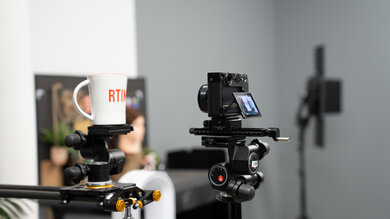
We've independently purchased over 125 cameras and tested them using a standardized methodology. All the results are available to help you make the right purchasing decision for your needs, with objective, data-driven reviews. We keep every product in our lab inventory to ensure we can go back, retest models, and verify that all the information we provide is still accurate.
-
Best YouTube Camera
 Vlogging7.4Studio Video9.5Action Video6.6Body Type:SLR-StyleMirrorless:YesSee all our test resultsSensor Size:4/3 (MFT)
If you're looking for the best camera for YouTube videos, the Panasonic LUMIX GH7 earns our top spot. It's one of the few cameras we've tested that can record uncropped 4k video at up to 120 fps. Beyond that, the camera supports a dizzying array of recording formats and codec options, including internal Apple ProRes codecs and internal RAW recording. The video quality from its Micro Four Thirds sensor is also excellent, and it uses Panasonic's phase detection autofocus system, which is remarkably effective in video mode.
The camera's design also reflects its video-centric focus, with design touches like a built-in fan for active cooling to prolong recording times, a tilting and fully articulated screen, dual card slots with CFexpress card support, multiple tally lights, and more. You even have the option to record 32-bit float audio when paired with Panasonic's XLR adapter. All in all, it's the best video camera for YouTube for more advanced videographers and filmmakers. If all of the above sounds like overkill, keep reading for some more options that are a bit easier to operate and a bit easier on the wallet. If you often shoot in low light, you should also prioritize our full-frame pick at the end of the article.
-
Best Mid-Range YouTube Camera
Vlogging7.9Studio Video9.1Action Video7.8Body Type:SLR-StyleMirrorless:YesSee all our test resultsSensor Size:APS-CIf you don't need more advanced features like internal RAW recording (spoiler: in most cases, you probably don't), you'll be all set with the Sony α6700, which is one of the best mid-range hybrid options you can get and the best choice for most people. With internal 10-bit 4:2:2 recording, you can capture very high-quality video with more leeway to edit and color-grade your footage. It's also one of the few cameras of its class that can record at up to 120 fps in 4k, although, unlike the Panasonic LUMIX GH7, there's a significant crop at 120 fps.
Beyond that, it features in-body image stabilization (IBIS) for smoother handheld recording, no recording time limits, and the same exceptional AI-driven autofocus found on higher-end Sonys like the Sony ZV-E1 (more on that below). While the α6700 is the best camera for YouTube videos at this price point, don't overlook the Fujifilm X-S20. Unlike the α6700, it can record 6.2k video from the full resolution of its sensor and supports RAW video output to a compatible external recorder. That said, it can't shoot at 4k video 120 fps, and its autofocus isn't as reliable.
-
Best Lower Mid-Range YouTube Camera
Vlogging8.5Studio Video9.3Action Video5.5Body Type:SLR-StyleMirrorless:YesSee all our test resultsSensor Size:APS-CIf you're just starting out on YouTube, the Sony ZV-E10 II is one of the best cameras for YouTube videos at a lower mid-range price. It lacks certain features you'll find on a higher-end hybrid camera like the Sony α6700, including a viewfinder and in-body stabilization, but it has a vlog-centric design that's well-suited for video recording and has surprisingly advanced internal recording abilities for its price.
The camera can capture 4k video at up to 60 fps, with a dedicated slow-motion mode that records 120 fps footage with a slight crop. It also supports Log recording, with internal 10-bit 4:2:2 color, which is great at this price point. On top of that, it has a highly effective autofocus system that rarely misses focus in video mode, and it doesn't overheat often. The biggest trade-off here, for those who shoot handheld, is the lack of IBIS. The sensor's readout speed isn't the best either, so you may get some wobbling effect with pans and camera movement, though it's a step up from its predecessor, the Sony ZV-E10, in that respect. Overall, this is a great value option for beginner YouTubers.
-
Best Budget YouTube Camera
Vlogging8.6Studio Video8.2Action Video4.2Body Type:SLR-StyleMirrorless:YesSee all our test resultsSensor Size:APS-CThe Sony ZV-E10 is one of the best cameras for YouTube beginners on a budget. Like its successor above, it lacks a viewfinder and has many of the same vlog-centric features, including a specialized 'Product Showcase' mode that automatically switches focus to any object held up in the frame, making it a great choice for product and beauty vloggers. While its internal capabilities are more limited than the Sony ZV-E10 II, with no 10-bit capture and more limited frame rate options, the camera is notably cheaper and still plenty capable for simpler vlogs and videos, with an excellent autofocus system and good overall video quality. However, it lacks IBIS and has some pretty noticeable rolling shutter distortion.
If you're looking for better stabilization, the similarly priced and more compact Olympus OM-D E-M10 Mark IV comes with five-axis IBIS, making it a great alternative if stabilization and portability are priorities. However, it has a much less reliable autofocus system and uses a smaller Four Thirds sensor with worse low-light noise performance. It also lacks a mic jack. Ultimately, the ZV-E10 is still the best budget option for aspiring YouTubers, thanks to its larger sensor, class-leading autofocus, and microphone input.
-
Best Cheap YouTube Camera
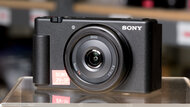
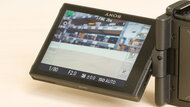
Vlogging8.2Studio Video8.1Action Video4.6Body Type:Point and ShootMirrorless:YesSee all our test resultsSensor Size:1-inchThe Sony ZV-1F is the best cheap YouTube camera we tested. It covers most of what a new YouTube channel needs in a body small enough to fit in your pocket. Its fixed 20mm-equivalent lens takes in a wide view, so you can hold the camera at arm's length and still fit yourself and your background in the shot. Sony carried over the features that make it easy to film with, including a fully articulated touchscreen for framing yourself, a three-capsule directional mic that focuses on your voice, and shooting modes like 'Product Showcase' for reviews and 'Cinematic Vlog' for a more polished look. Autofocus is also reliable enough as long as you don't need to track fast-moving subjects. It keeps both faces and objects sharp throughout a take. Long recordings won't slow you down either, since 4k has essentially no time limit, overheating is rare, and you can power the camera over USB-C while you film. S-Log profiles are also available for when you're ready to start color grading. You give up the flexibility of an interchangeable-lens camera, but you also skip the cost of buying lenses and get an extremely portable camera in exchange.
Its 1-inch sensor matches the one in the more expensive Sony ZV-1 II, but the stabilization is digital-only, so footage gets shaky once you start walking too briskly. There's also no optical zoom, which leaves you with a single field of view. You can connect an external mic, though without a headphone jack, you can't monitor your audio while recording. Photography also takes a back seat compared to the other picks above, as the camera can't shoot RAW or track moving subjects for stills. The original Sony ZV-1 costs more but fixes most of that, with optical stabilization for smoother walking shots, a zoom lens for more framing options, and better photo features.
-
Best Compact Full-Frame YouTube Camera
Vlogging7.6Studio Video9.1Action Video8.0Body Type:SLR-StyleMirrorless:YesSee all our test resultsSensor Size:Full FrameThe Sony ZV-E1 is Sony's first full-frame vlogging camera. Like other models in the ZV lineup, it has a fully articulated screen that's great for self-recording, as well as a built-in vlogging mic, making it one of the best YouTube cameras for vlogging. It doesn't have a viewfinder, but it's one of the most compact full-frame cameras on the market, and its sensor captures fantastic video quality, with excellent low-light performance that outpaces our top pick, the Panasonic LUMIX GH7, which uses a much smaller Micro Four Thirds sensor. Its low-resolution sensor is optimized for low light, making this a good choice for creators who tend to shoot on the go in uncontrolled lighting conditions. The full-frame sensor is also ideal if you want to maximize subject separation in your shots.
On top of that, features like auto framing or modes like 'Intelligent Auto' and 'Cinematic Vlog' do the heavy lifting to get the right look for your videos. However, the camera also supports internal 10-bit 4:2:2 Log recording, with 4k at up to 120 fps, making it a good fit for advanced shooters who want more flexibility over the production process, from shooting to uploading the final product. That being said, it's prone to overheating during longer or more demanding recording sessions, so keep that in mind if you tend to shoot longer-form content.





Notable Mentions
- Canon EOS R50: The Canon EOS R50 is another one of the best cameras for YouTube beginners. It's even more affordable than the Sony ZV-E10, but it lacks some of the ZV-E10's dedicated vlogging features, like a vlogging mic and specialized focus modes, so the ZV-E10 is a better overall choice. See our review
-
Fujifilm X-M5:
The Fujifilm X-M5 is an excellent option for video that slots somewhere in between the Sony ZV-E10 and ZV-E10 II. It supports 6k open gate and 10-bit 4:2:2 Log recording in 4k. However, the Sony models have more consistent autofocus performance, and the ZV-E10 II can record up to 4k at 120 fps, giving it a leg up on the Fuji for most vloggers and video creators.
See our review - Nikon Z 30: The Nikon Z 30 is a solid budget vlogging camera. Unlike the Sony ZV-E10, it records 4k 30 fps video without a crop, but it struggles with overheating and doesn't have as many lens options as the Sony. See our review
-
OM SYSTEM OM-5:
The OM SYSTEM OM-5 is a Micro Four Thirds mirrorless camera. Its small size, relatively sturdy build, and five-axis image stabilization make it an excellent choice for outdoor and on-the-go vlogging. However, its internal recording capability and autofocus aren't as good as those of the Sony ZV-E10 II.
See our review
Recent Updates
Oct 08, 2026:
The Sony ZV-1F replaces the discontinued DJI Pocket 2 as our 'Best Cheap YouTube Camera', and we've removed the 'Best Point-And-Shoot' category, with the Sony ZV-1 now mentioned as an alternative to the ZV-1F. We've also renamed 'Best Entry-Level' to 'Best Lower Mid-Range'. The rest of our picks remain unchanged.
Feb 03, 2025:
We added the Fujifilm X-M5 as a Notable Mention because of its portability and excellent-value video features.
Nov 06, 2024:
We renamed the Sony ZV-E1 as the 'Best Compact Full-Frame YouTube Camera' and replaced it with the Panasonic LUMIX GH7 in the best overall spot. We also replaced the Canon EOS R10 with the Sony ZV-E10 II and renamed it as the 'Best Entry-Level YouTube Camera,' and consequently renamed the Sony α6700 as the 'Best Mid-Range YouTube Camera.'
Aug 09, 2024: We checked that our picks are still the most relevant and brushed up some text for clarity.
May 15, 2024: We replaced the Fujifilm X-S10 with the Canon EOS R10 as the mid-range pick, because it has better availability and a better autofocus system. We also removed the Insta360 GO 2 from the Notable Mentions since we're not currently testing action cameras.
All Reviews
Our recommendations above are what we think are currently the best video cameras for YouTube for most people to buy, according to their needs. We factor in the price, feedback from our visitors, and availability (no cameras that are difficult to find or almost out of stock in the U.S.).
If you would like to choose for yourself, here's the list of all our reviews for cameras. Be careful not to get caught up in the details. There is no single perfect camera. Personal taste, preference, and shooting habits will matter more in your selection.