
Smartphones have made it easy to get quick snapshots of wildlife while you're out and about, but for those who are serious about wildlife photography, a dedicated camera with a telephoto lens will take your wildlife photos to the next level. There are a few factors to consider when choosing a camera for nature photography. Size and reach, which are intrinsically linked, are important factors. That makes sensor size your first decision. Cameras with Micro Four Thirds and APS-C sensors are usually smaller and apply a crop factor, so a shorter, smaller telephoto lens gets you more reach, which matters when you're hiking for hours. Full-frame cameras capture cleaner images in dim light but need longer, heavier lenses to match that reach. Fast, continuous shooting speeds allow you to capture clear stills of moving animals, while large image buffers let you shoot for longer without interruption. Silent shooting might also be important if you tend to shoot more skittish, easily frightened animals, while quicker animals like small birds require more responsive, accurate autofocus systems. Pre-capture, which saves frames from just before you fully press the shutter, also helps catch moments you can't predict.
Thankfully, we've done some of the work of narrowing down your options. We've bought and tested over 130 cameras in our lab, and below, you'll find our recommendations for the best cameras for wildlife photography. If you're an avid backpacker, check out our recommendations for the best cameras for hiking and backpacking. Alternatively, if you're after a simpler point-and-shoot camera with a lot of zoom range for far-off animals, try our list of the best zoom cameras. Otherwise, you can also see our overall picks for the best cameras on the market or our best cameras for general photography.
We've independently purchased over 125 cameras and tested them using a standardized methodology. All the results are available to help you make the right purchasing decision for your needs, with objective, data-driven reviews. We keep every product in our lab inventory to ensure we can go back, retest models, and verify that all the information we provide is still accurate.
-
Best Camera For Wildlife Photography
 Sports & Wildlife Photography7.5Body Type:SLR-StyleMirrorless:YesSee all our test resultsSensor Size:4/3 (MFT)
The OM SYSTEM OM-1 Mark II is the best camera for wildlife photography that we've tested. The Mark II offers a few improvements over its predecessor, including a deeper buffer and improved autofocus. As a Micro Four Thirds (MFT) camera, it's relatively portable and rugged, with a weather-sealed body and excellent ergonomics. Compared to full-frame models like the Sony α7 V below, equivalent lenses are also significantly smaller, reducing the overall size of your kit even when using telephoto lenses to capture far-off wildlife like birds.
Another benefit of the smaller sensor is that it allows for better in-body image stabilization (IBIS), with a five-axis IBIS system that works incredibly well to get steady shots at longer focal lengths. The camera also has a quick burst rate, including a pre-burst 'Pro Capture' mode that ensures you won't miss a critical moment. The biggest downside of the OM-1 is that its AF-C tracking isn't as reliable with very fast-moving subjects as the top autofocus systems from Sony or Canon, but it's still effective for most scenarios. If you're looking to save some money, the OM SYSTEM OM-1 or the even older Olympus OM-D E-M1 Mark III are both still great options, despite lacking the latest processing power and autofocus.
-
Best Mid-Range Camera For Wildlife Photography
Sports & Wildlife Photography8.7Body Type:SLR-StyleMirrorless:YesSee all our test resultsSensor Size:APS-CWhile the OM SYSTEM OM-1 Mark II is the best camera for nature photography if you need something rugged and compact, an APS-C option like the Canon EOS R7 has its own advantages and comes at a lower price point. With a remarkably quick 15 fps mechanical burst rate and a highly sophisticated autofocus system, the R7 is tailor-made for wildlife shooters. It has a very solid battery life and feels great in the hand, with excellent ergonomics and intuitive controls. It also has a fantastic IBIS system for steadier handheld shots.
Telephoto lenses for the R7 are generally less portable than Micro Four Thirds options. However, they're still typically smaller than full-frame alternatives with equivalent fields of view, allowing you to shoot far-off subjects without too much bulk. Ultimately, if you don't need the portability of a Micro Four Thirds kit, this is one of the best cameras for birding and wildlife at its price point. The Sony α6700 is another fantastic mid-range choice, with one of the best autofocus systems on the market and a very wide range of native and third-party lens options. However, it has worse ergonomics, a smaller viewfinder, and a slower max burst rate.
-
Best Budget Camera For Wildlife Photography
Sports & Wildlife Photography7.4Body Type:SLR-StyleMirrorless:YesSee all our test resultsSensor Size:4/3 (MFT)Shooting wildlife on a budget can be tricky, considering how quickly the cost of zoom and telephoto lenses can add up, but the Olympus OM-D E-M10 Mark IV is one of the best cameras for nature photography if you're on a tight budget. Like the OM SYSTEM OM-1 Mark II, it's an MFT camera, so there's a well-established stable of lenses to choose from, and they're typically smaller and cheaper than larger-format equivalents, making it easier to take longer telephoto lenses on the go for far-off animals like birds.
Beyond that, the camera is lightweight and portable, and it's one of the few cameras at this price point to feature five-axis IBIS. It can also shoot at up to 15 fps in its e-shutter in silent mode, so you can fire off extended bursts without scaring away more skittish animals. Add in a solid battery life and a decent autofocus system, and this little camera is hard to beat for beginners or wildlife photographers on a budget.
If you photograph more animals in motion, the Canon EOS R50 is the better budget choice. Its subject detection recognizes animals, and its tracking held up fairly well in our tests. It matches the Olympus at 15 fps and gets more shots per charge. However, it has no IBIS, and Canon's RF-S lineup has few affordable telephoto lenses, though it also accepts full-frame RF lenses when you're ready to upgrade. -
Best Full-Frame Camera For Wildlife Photography
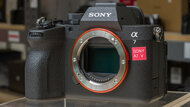
Sports & Wildlife Photography8.6Body Type:SLR-StyleMirrorless:YesSee all our test resultsSensor Size:Full FrameIf your best chances come in low light, like deer at the forest edge just after sunrise, the Sony α7 V is the best full-frame camera for wildlife photography we've tested. Its 33-megapixel sensor keeps noise low as the light fades and captures exceptional dynamic range, so you hold detail in both bright skies and shaded fur. You pay for that in size. The body is heavy, and full-frame telephoto lenses get big and expensive fast.
Sony's E-mount eases that cost, since it's one of the largest lens ecosystems available, with plenty of third-party telephotos at lower prices. The remarkably well-built, weather-sealed body and outstanding battery life also make it easy to rely on during long outings. For action, it shoots 14-bit RAW at up to 30 fps with the electronic shutter, and pre-capture keeps the second before you fully press the shutter. It detects animals, and its tracking performed very well overall, but it occasionally jumped to the background before finding the subject again.
If speed matters more than battery life, the Nikon Z 6III is a cheaper alternative that reaches 120 fps, though only in a cropped mode at that speed. Its battery doesn't last as long, and its dynamic range isn't as wide.
-
Best Bridge Camera For Wildlife Photography
Sports & Wildlife Photography7.4Body Type:BridgeMirrorless:YesSee all our test resultsSensor Size:1-inchIf you prefer the convenience of an all-in-one camera, the Sony RX10 V is one of the best bridge cameras on the market. Naturally, you won't get the same image quality or dynamic range as you would with one of the interchangeable lens options above. However, it does have a stacked 1-inch type sensor that puts it above your average bridge camera. The sensor is bigger than most bridge cam sensors, resulting in better-than-average image quality, and its stacked design also means a faster readout speed, allowing for burst shooting at up to 24 fps and reduced rolling shutter distortion.
Its built-in lens is also quite versatile, with a max full-frame equivalent focal length of 600mm, giving you plenty of range for far-off wildlife. On top of that, it has a good autofocus system to track moving wildlife, and its well-constructed, weather-sealed body gives you some peace of mind in adverse weather conditions. While interchangeable lens cameras are the way to go if image quality is your top priority, the convenience of having such a long zoom lens in an all-in-one package makes this a great option for birding and hiking enthusiasts.


Notable Mentions
-
Fujifilm X-H2S:
The Fujifilm X-H2S is a great alternative to the OM SYSTEM OM-1 Mark II if you need better autofocus and higher resolution files, and it's well-suited to wildlife photography thanks to its stacked sensor. However, it's less portable and more expensive.
See our review -
Nikon COOLPIX P1000:
The Nikon COOLPIX P1000 is a bridge camera with an astonishing 24mm to 3,000mm focal length range, far out-zooming the Sony RX10 V. That said, beyond the range of its zoom lens, it leaves much to be desired in terms of comfort, portability, and autofocus performance.
See our review -
Nikon D850:
The Nikon D850 is a fantastic DSLR option and a good alternative to the Sony α7 V. It's an especially good choice if you do other kinds of photography outside of wildlife. With a high 45 MP resolution, you can shoot in crop mode at faster burst rates and still get high-res images. That said, the camera is significantly less portable and has a less sophisticated autofocus system.
See our review -
Panasonic LUMIX G9 II:
If you want to stay with Micro Four Thirds for less money, the Panasonic LUMIX G9 II is a strong alternative to the OM SYSTEM OM-1 Mark II. It's also weather-sealed with IBIS, and its tracking performed slightly better in our tests. That said, it isn't as fast, and its body is a bit bulkier.
See our review -
Nikon Z 5II:
The Nikon Z 5II is a cheaper way into full-frame than the Sony α7 V. It has IBIS, weather-sealing, and pre-capture, and it produces very detailed files. However, it only reaches 30 fps when saving JPEGs, its battery drains faster, and Nikon's Z mount has fewer third-party lenses.
See our review
Recent Updates
Jan 31, 2025:
We've added the Nikon D850 as a Notable Mention due its high-resolution sensor, versatility, and wide lens selection.
Nov 05, 2024:
We replaced the OM SYSTEM OM-1 with the OM SYSTEM OM-1 Mark II in the top spot and added the Fujifilm X-H2S as a Notable Mention because of its stacked sensor and autofocus performance.
Aug 08, 2024: Because of its speed and sensor advantages, we replaced the Canon EOS R6 Mark II with the Nikon Z 6III and renamed it the 'Best Full-Frame Camera For Wildlife Photography.'
May 09, 2024: We added some additional info about the OM SYSTEM OM-1 Mark II since we've now tested it. We also removed the Canon EOS R6 from Notable Mentions, as it's less relevant for wildlife photography than the R6 Mark II and other options noted in the article and is now harder to find new.
Mar 12, 2024: We've added mention of the OM SYSTEM OM-1 Mark II to better represent the latest models on the market.
All Reviews
Our recommendations above are what we think are currently the best nature photography cameras for most people to buy, according to their needs. We factor in the price, feedback from our visitors, and availability (no cameras that are difficult to find or almost out of stock in the U.S.).
If you would like to choose for yourself, here's the list of all our camera reviews, ranked by their suitability for sports and wildlife photography. Be careful not to get caught up in the details. There is no single perfect camera. Personal taste, preference, and shooting habits will matter more in your final selection.